
This article is the full text of Chapter 1 of The Declaration of the Age of Physical Medicine (Yoon Jong-won). It is an academic exposition presenting the author's hypothesis of physical medicine, and you must not discontinue any currently prescribed medication on your own. The body text, figures, and citations follow the original manuscript.
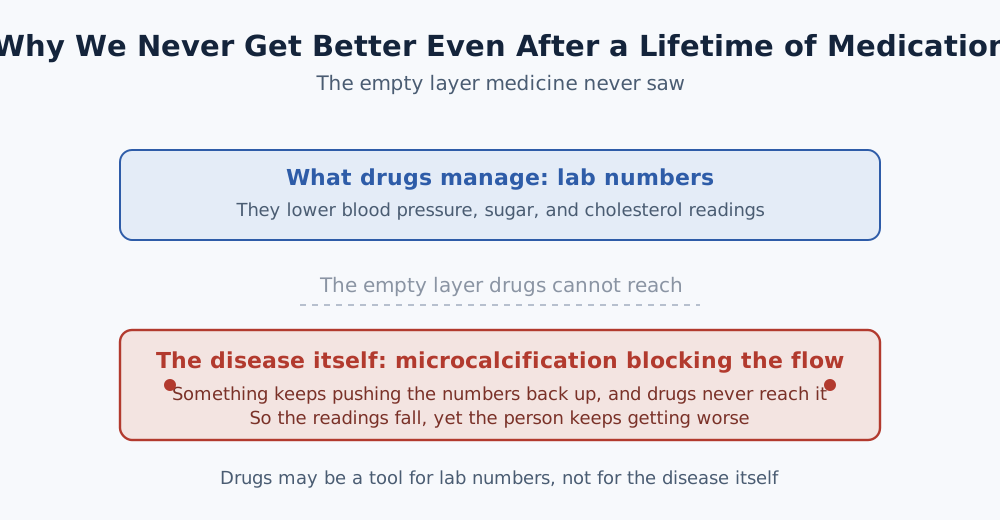
Let us picture one person. A mother in her late sixties. Twelve years ago she was first diagnosed with high blood pressure, and from that day on she has taken one pill of the same tablet at the same time every morning. For the past eight years that tablet became two, five years ago a cholesterol pill was added, and since last year one diabetes pill has been added on top. Every morning, in the small pill case on the table, five tablets are lined up neatly, and the mother does not skip a single one. The doctor praises her. You are taking your medication well. But the mother's blood pressure is still high, her cholesterol rose again at last year's test, and her HbA1c has crossed 7.
Leaving the clinic, the child who had come along asked the mother. They said the medication is working better, do you feel any better? The mother is silent for a moment, then answers. Well. All I know is that when I get up in the morning I feel heavier, I get more out of breath climbing stairs, and my hands and feet are colder. The child asks once more. Then why on earth are you taking the medication? After a long while the mother answers. Because the doctor told me to. Because they said it would get worse if I stopped.
There is one strange fact here. Even though she takes five pills every day, the mother is getting steadily worse. The doctor praises her for taking her medication well, and the numbers in the lab do look better than before she took the drugs, yet the mother's body is getting steadily heavier and steadily weaker. Twelve years ago one pill a day was enough, and now it has grown to five, and five more years from now it may become seven. And the mother's children sense somewhere that she can never stop taking those drugs for the rest of her life.
Why does such a thing happen? The answer is simple. It is because the drugs the mother takes every day are, in fact, not drugs that heal the mother's disease but drugs that only lower the numbers in the lab. The blood pressure drug does not restore the vessel itself; it only lowers the number called blood pressure. The cholesterol drug does not stop the damage to the vessel wall; it only lowers the number called blood cholesterol. The diabetes drug does not restore the cells' insensitivity to insulin; it only lowers the number called blood sugar. That the numbers rise again when the drug is stopped is because those drugs never touched the underlying reality. The underlying reality has been slowly progressing all along, and that is why more and more drugs are needed to keep the same numbers.
Then what is the underlying reality? What is that something that keeps driving the mother's blood pressure up, that something that keeps making the mother's cholesterol pile up again, that something that keeps the mother's insulin from getting through? The moment one poses this question, one meets a strange silence in medicine. Specialty medicine does not have the answer. To be precise, specialty medicine has only the answer of its own specialty, and those answers never gather in one place. Cardiology speaks of changes inside the vessel, endocrinology speaks of changes in the insulin signaling pathway, and nephrology speaks of changes in the glomerulus, but nowhere is there an integrated answer for how these changes occur together at the same time within the body of one and the same person.
Let me pose one decisive question. If, within the body of one person, at the same time, the vessels and the insulin and the glomeruli and the joints and the nerves and the heart and the brain are all slowly collapsing at once, should there not be a single common event that creates that simultaneity? If the manifestations of aging and chronic disease that specialty medicine diagnoses separately are in fact the surfacing, in different places, of one and the same event, then what is the underlying reality of that event? To answer this question, we must look into a layer that medicine has not seen all this while. The name of that layer is physics.
The natural sciences have a hierarchy. Physics is at the very bottom, chemistry is above it, and biology is above that. The physical laws come first, chemical reactions occur only within the range those physical laws allow, and living phenomena become possible on top of those chemical reactions. This hierarchy cannot be denied. And yet modern medicine has stopped at the upper two layers of this hierarchy, namely biology and chemistry. It knows, as precisely as it knows anything, which molecule binds to which molecule to turn on which signal, which enzyme catalyzes which reaction, and which gene makes which protein, but the answer is empty as to how the pathway through which those molecules and enzymes and proteins flow narrows and becomes blocked, and what physical event first turns that signal on and off.
This book is an attempt to fill that empty layer. It stacks one more layer on top of chemistry and biology, but names that layer physics. And it calls the medicine seen anew on top of that new layer physical medicine. Physical medicine does not deny existing medicine. It embraces, as they are, all the discoveries of the molecules and signals and pathways that specialty medicine has precisely revealed, and merely adds one higher layer where those discoveries gather in one place. The moment that one layer is added, the manifestations of aging and chronic disease that looked separate in specialty medicine begin to look like the surfacing, in different places, of one and the same event, and the reason the mother gets steadily worse even while taking five pills a day finally becomes clear.
This chapter is the place where we draw the outline of that empty layer. First we examine what the blood pressure drug, the cholesterol drug, and the diabetes drug have done and have not done over 30 years. Next we unravel why specialty medicine could not cross that limit, and why one layer came to be empty. Then we pinpoint the exact location of that empty layer in the hierarchy of the natural sciences, and finally we make clear what this book seeks to fill that place with. When this chapter ends, the reason the mother gets steadily worse even while taking five pills a day is no longer a mystery. From there, the real story of this book begins.
The 30-Year Limit of Blood Pressure, Cholesterol, and Diabetes Drugs
One of the greatest assets of modern medicine is the chronic-disease drug. The blood pressure drugs, cholesterol drugs, and diabetes drugs developed over the past half-century have greatly contributed to extending humanity's average lifespan. Many patients who once suddenly collapsed from myocardial infarction have crossed the crisis thanks to drugs, and many patients who once lay bedridden from stroke maintain their daily lives thanks to drugs. This fact is clear. Without these drugs, many of the parents of us who are reading this now would not be here with us.
But alongside those same drugs there is one clear fact. Now, 30 years on, these drugs cannot touch the underlying reality of chronic disease. The blood pressure of patients who take the drug every day is within the normal range, yet their microvasculature grows steadily narrower with time. The cholesterol number is kept normal, yet their arterial walls grow steadily stiffer with time. The HbA1c is well managed, yet their kidneys and retinas and nerves grow steadily more damaged with time. The drug held the numbers down, but the underlying reality progressed slowly all the while.
[Figure 1] The Relationship Between the Site of Action of Chronic-Disease Drugs and the Underlying Reality
| Drug | Site of action | What it holds down | What it cannot hold down |
|---|---|---|---|
| Blood pressure drug | Vessel contraction/relaxation signal | The blood pressure number | The progression of microcalcification in the microvascular wall |
| Cholesterol drug | Cholesterol synthesis in the liver | Blood cholesterol | The deposition of microcalcification in the arterial wall |
| Diabetes drug | Insulin secretion/action signal | The blood sugar number | The accumulation of microvascular microcalcification |
| Common | The signal dimension | The lab numbers | The progression of microcalcification dual blockade |
What the figure shows is simple. All three kinds of drugs operate in the signal dimension and hold down only the lab numbers. Operation in the signal dimension is maintained only while the drug is being taken. When the drug is stopped, the numbers soon rise again. And even while the drug is being taken, apart from the holding-down in the signal dimension, the underlying reality in the microvascular dimension progresses slowly. This is the reason the number of drugs increases with time even though the patient takes the drug every day, and the reason the same patient eventually reaches the events we call complications.
Let us recall one analogy. The water in a bathtub is overflowing. Someone comes and diligently wipes the water off the floor. The floor dries for a moment, but above the tub the water keeps flowing down. The moment the wiping hand stops, the floor is wet again, and with time, no matter how much one wipes, the water fills up faster and faster. The underlying reality is that the faucet above the tub is not turned off. The chronic-disease drugs of modern medicine are very skilled at wiping the floor. But they cannot reach the work of turning off the faucet. That the pills in the mother's pill case keep increasing is because more and more hands become necessary to wipe the floor faster.
Multinational clinical studies show this fact clearly. A large-scale, multi-year follow-up study sponsored by the U.S. National Heart, Lung, and Blood Institute reported that among more than 40,000 hypertension patients receiving standard blood pressure drug treatment, a considerable number newly experienced heart failure, stroke, and coronary events during the follow-up period despite well-managed blood pressure numbers. It means the drug pulled the blood pressure number down into the normal range, but the cardiovascular events in those patients did not sufficiently disappear. Another analysis published in a journal of the American College of Cardiology, summing eight multinational clinical trials, organized the finding that in patients on long-term cholesterol drugs, the cholesterol deposition in the arteries decreases while the calcium deposition instead progresses, consistently observed. It means the drug reduced the blood cholesterol, but the underlying reality in the arterial wall keeps progressing.
This fact does not negate the value of drugs. The drugs made all this while are a great medical asset in themselves and a decisive tool that buys time for the patient. Only one thing is clear. The drugs did not touch the underlying reality. So drugs alone cannot stop aging and chronic disease, and drugs alone cannot free the mother from the path where she can never stop taking drugs for the rest of her life. To touch the underlying reality, one must first know what the underlying reality is.
The Empty Layer Medicine Never Saw
The moment one asks what the underlying reality is, one meets the deepest limit of specialty medicine. Specialty medicine is very precise within its specialty. Cardiology finds out, down to the millimeter, at what point of the coronary artery there is what kind of plaque, and endocrinology finds out, down to the molecule, at what stage of the insulin signaling pathway the phosphorylation of what protein changes how. Nephrology, neurology, orthopedics, and oncology all know the underlying reality of their own specialty with the same precision. But one thing is empty. It is the fact that the common upstream between specialties is empty.
Let us think about what happens within one person's body. The mother in her late sixties now has high blood pressure, and at the same time high cholesterol, and at the same time is at the border of diabetes, and at the same time her knee joints ache, and at the same time she cannot sleep well, and at the same time, since last year, she has been forgetting things more often. If so many events are occurring simultaneously at the same time within one person's body, there must be some common upstream that creates that simultaneity. But the medicine the mother meets in the clinic does not have an answer for this simultaneity. The cardiologist handles the blood pressure, the endocrinologist the blood sugar, the orthopedist the knee, and the neurologist the sleep and the memory, each separately, but no one answers the reason all these events are occurring simultaneously at the same time within one person's body.
[Figure 2] The Limit of Specialty Medicine and the Location of the Empty Upstream
| Layer | Content | The answer of specialty medicine |
|---|---|---|
| Downstream | Molecular and cellular changes of a specific organ | Has a precise answer |
| Midstream | Clinical expression of a specific organ | Has a precise answer |
| Upstream | The common underlying reality of the simultaneous manifestation of multiple organs | Empty |
| Uppermost | The physical event that creates the simultaneous manifestation | Empty |
The upper two layers of the figure are the places that are empty in specialty medicine. That simultaneity in which the manifestations of multiple aging and chronic diseases progress together at the same time within one person's body, and the physical event that creates that simultaneity. Specialty medicine has no answer for these two layers. The reason there is no answer is not that specialty medicine is lazy or lacking. It is because specialty medicine is structurally designed to stay within its own specialty for the sake of its own specialty's precision. Every society and every journal and every training program of cardiology pursues precision within the heart. It is the same for the other specialties. The common upstream that cuts across specialties is no specialty's responsibility, and so no specialty fills that place.
There is one decisive fact here. That the common upstream between specialties is empty does not mean there is no event at that upstream. The event is clearly there at that place; there is simply no specialty that sees that event. That event, in which blood pressure and blood sugar and cholesterol waver simultaneously within one person's body, is actually occurring, and there is clearly something that causes that event, but there is no specialty that handles that something. That empty place is precisely the place this book seeks to enter.
The starting point of the view that gathers the human body in one place lies with the 19th-century French physiologist Bernard. He noted that the human body maintains a constant state of the internal environment while continuously exchanging matter and energy with the external environment. The concept of the internal environment that he organized later developed under the name homeostasis, and it became the first place of the view that gathers the human body in one place, rather than the view that divides the human body into specialties. But that insight of the 19th century was gradually forgotten as 20th-century specialty medicine developed along the path of precision, and 21st-century specialty medicine again stands in the place where it has lost that insight. Refilling that lost insight is the starting point of this book.
Physics Gives Rise to Chemistry, and Chemistry Gives Rise to Life
To understand why medicine did not reach this empty place, we must note one simple fact about the hierarchy of the natural sciences. The natural sciences have a hierarchy. Physics is at the very bottom, chemistry is above it, and biology is above that. And medicine is a branch of biology. This hierarchy is not an arbitrary classification but a causal relationship in which one layer makes another layer possible. Physical laws must exist first for chemical reactions to be possible, and chemical reactions must exist first for living phenomena to be possible.
[Figure 3] The Hierarchy of the Natural Sciences
| Layer | Object | Core question | Its place within medicine |
|---|---|---|---|
| Biology | Cells, tissues, organs | Which molecule turns on which signal | The main place of modern medicine |
| Chemistry | Molecules, ions, reactions | Which molecule binds with which molecule | The main place of pharmacology |
| Physics | Flow, gradient, structure | Why does that molecule flow to that place | The empty place |
The bottom row of the figure is the place that is empty within medicine. Modern medicine knows precisely which molecule turns on which signal, but why that molecule flows to that place, how that flow becomes blocked, and what physical event occurs at the blocked place are not handled within medicine. The location of this empty box is decisive. It is the very bottom layer of the hierarchy, and so the events of every layer above it occur on top of it.
Let me give one example. Suppose we look with specialty medicine at the event occurring inside the mother's microvasculature. Biologically, we see what signals the vascular endothelial cells are sending and what proteins they are expressing. Chemically, we see which molecule is binding with which molecule. But one thing is not seen. The physical event in which microcrystals of bound calcium and phosphorus are slowly deposited on the inside of the mother's microvasculature, narrowing the flow at that place. That event is neither a molecular-dimension signal change nor the result of a chemical reaction, but a physical event of flow and pathway and deposition. And this physical event is determining every chemical reaction and biological signal above it.
Why did medicine not see this place? The answer is simple. It is because there was no opportunity to learn it. Medical education begins with anatomy and goes to physiology, and from there continues to pathology, pharmacology, and clinical medicine. Every path flows toward the precision of molecules and signals and pathways. On that path there is no place that formally handles the physical events of flow and gradient and deposition. Once one graduates from medical school and enters a specialty, one is confined all the more within the precision of one's own specialty. Even a doctor who has learned medicine for a lifetime and seen patients for a lifetime has no opportunity to even hear the fact that some physics layer lies empty beyond their own specialty.
This diagnosis is not to condemn medicine. Specialty medicine has given decisive help to humanity in its own domain, and that precision must be respected in itself. It is only to make one thing clear. There is one place medicine has not reached, and that place is precisely the very bottom layer of the natural-science hierarchy, and so, as long as it cannot fill that place, specialty medicine cannot help but repeat the same limit within its own limit.
The Empty Layer This Book Seeks to Fill
Now we can make clear what this book seeks to do. This book seeks to add one layer to medicine. It is an attempt to insert, precisely, a layer called physics on top of chemistry and biology, yet below those two layers. And it calls the medicine seen anew on top of this new layer physical medicine.
The place physical medicine handles is simple. The fact that something is flowing within the human body, the fact that that flow occurs only on top of a gradient, the fact that a medium follows that gradient, and the fact that that medium can flow only on top of a pathway. Flow, gradient, medium, pathway. These four words are the core of physical medicine. And these four words explain the underlying reality of aging and chronic disease. Physical medicine shows that essential hypertension, type 2 diabetes, chronic kidney disease, neurodegenerative disease, and aging itself, which specialty medicine has diagnosed separately, are in fact the surfacing, in different places, of one and the same event of flow.
[Figure 4] The Difference in Gaze Between Specialty Medicine and Physical Medicine
| Item | Specialty medicine | Physical medicine |
|---|---|---|
| Place of gaze | A specific organ, a specific molecule | The flow of the whole body |
| Main tool | Drugs, surgery, tests | Restoration of flow, gradient, pathway |
| Time dimension | Centered on present manifestation | The upstream event and accumulated time |
| View of chronic disease | Several different diseases | Different manifestations of one event |
| The relationship of the two | The precision of the downstream | The integration of the upstream |
What the figure makes clear is the fact that physical medicine does not seek to replace specialty medicine. Specialty medicine handles the precision of the downstream, and physical medicine handles the integration of the upstream where those downstream events gather. The two domains are different domains, and both domains are necessary to medicine. To diagnose the mother's knee, the precision of orthopedics is needed, and to hold the mother's blood pressure, the precision of cardiology is needed. At the same time, to understand that simultaneity in which the mother's knee and blood pressure and blood sugar and sleep and memory are all wavering together at the same time, a place beyond the specialties is needed. That place is physical medicine.
What this book proposes is neither a new drug nor a new surgical technique. It is one new gaze. It is a gaze that sees a person's whole body at once from a place beyond the specialties, and on top of that gaze, a gaze that handles together the simultaneity and the accumulated time of aging and chronic disease. The moment this gaze is added, the chronic diseases that looked separate in specialty medicine begin to look like the manifestation, in different places, of one and the same event, and the reason one never gets better even after a lifetime of medication finally becomes clear. When the underlying reality begins to be seen, the path by which one can touch the underlying reality finally opens.
Physical medicine is also the work of moving facts that already existed in the world to a new place. The hierarchy of the natural sciences was already organized by 19th-century French physiologists, the physical laws concerning flow and gradient were already formalized by 19th-century physics and chemistry, and the molecular mechanism concerning the deposition of calcium and phosphorus is already clearly shown by 21st-century medicine. What this book does is not to discover new facts, but to gather facts that already exist in one place and fill the empty upstream between specialties. Those facts gathered in one place finally draw the outline of one higher underlying reality, and this book calls the name of that underlying reality microvascular dual blockade.
Now it is time to take one step further. In this chapter we saw one clear limit of specialty medicine, confirmed the fact that beyond that limit there is one empty place of a layer, and gave the name physical medicine to the new gaze that will enter that empty place. In the next chapter we examine exactly how this gaze operates within the human body, and what landscape of the human body finally becomes clear on top of this gaze. We start from one simple proposition. Flow and you live, block and you die. And the place that blocks converges to one place, and the substance that blocks also converges to one thing. That place is the microvasculature, and that substance is microcalcification. The door of the next chapter opens on top of that one line.
References
[1] Bernard, C. (1865). Introduction à l'étude de la médecine expérimentale. Paris: J.B. Baillière et Fils.
[2] Cannon, W. B. (1932). The Wisdom of the Body. New York: W. W. Norton & Company.
[3] ALLHAT Officers and Coordinators for the ALLHAT Collaborative Research Group. (2002). Major outcomes in high-risk hypertensive patients randomized to angiotensin-converting enzyme inhibitor or calcium channel blocker vs diuretic: The Antihypertensive and Lipid-Lowering Treatment to Prevent Heart Attack Trial (ALLHAT). JAMA, 288(23), 2981-2997.
[4] Puri, R., Nicholls, S. J., Shao, M., Kataoka, Y., Uno, K., Kapadia, S. R., Tuzcu, E. M., & Nissen, S. E. (2015). Impact of statins on serial coronary calcification during atheroma progression and regression. Journal of the American College of Cardiology, 65(13), 1273-1282.
[5] Yusuf, S., Hawken, S., Ôunpuu, S., Dans, T., Avezum, A., Lanas, F., McQueen, M., Budaj, A., Pais, P., Varigos, J., Lisheng, L., & INTERHEART Study Investigators. (2004). Effect of potentially modifiable risk factors associated with myocardial infarction in 52 countries (the INTERHEART study): Case-control study. The Lancet, 364(9438), 937-952.
[6] Roth, G. A., Mensah, G. A., Johnson, C. O., et al. (2020). Global burden of cardiovascular diseases and risk factors, 1990-2019: Update from the GBD 2019 Study. Journal of the American College of Cardiology, 76(25), 2982-3021.
[7] Demer, L. L., & Tintut, Y. (2008). Vascular calcification: Pathobiology of a multifaceted disease. Circulation, 117(22), 2938-2948.
[8] Hofbauer, L. C., Brueck, C. C., Shanahan, C. M., Schoppet, M., & Dobnig, H. (2007). Vascular calcification and osteoporosis: from clinical observation towards molecular understanding. Osteoporosis International, 18(3), 251-259.
[9] Thompson, B., & Towler, D. A. (2012). Arterial calcification and bone physiology: Role of the bone-vascular axis. Nature Reviews Endocrinology, 8(9), 529-543.
[10] López-Otín, C., Blasco, M. A., Partridge, L., Serrano, M., & Kroemer, G. (2023). Hallmarks of aging: An expanding universe. Cell, 186(2), 243-278.