
If this book's claim, that the body and the economy move by the same principle, is true, one question arises first. Why has nobody achieved this integration in the past 150 years?
Since modern science truly began in the mid-nineteenth century, humanity has made astonishing progress across countless fields. In Beethoven's time, a microscope could barely distinguish cells; today we track the movement of a single atom. When Adam Smith wrote The Wealth of Nations, the very concept of an economic indicator did not exist; today the world's liquidity is measured in real time, every moment. While the resolution of each field increased exponentially, why was the common principle that cuts across fields never discovered?
The answer is surprisingly simple. The principle had already been known for a long time. It was simply that each field described the principle in a different language, so the same structure remained invisible to the others. What medicine calls "calcium overload," economics calls "liquidity freeze." What engineering calls "loss of pressure differential," physiology calls "microvascular dysfunction." The mere fact that the same phenomenon is called by different names has itself become the barrier concealing the common structure across disciplines.
This chapter traces this long history of disconnection. We will look, in turn, at how modern science split vertically as it descended, at why the three giants, von Bertalanffy, Prigogine, and Kauffman, who each attempted integration, saw their proposals remain abstract declarations rather than descend into a concrete path, and at how this book intends to stand in the space they left behind. Only by understanding why nobody has integrated this until now does it become clear why what this book attempts is needed now.
How Science Descended by Splitting Apart
The greatest achievement of nineteenth-century science was splitting apart.
Until the mid-nineteenth century, European intellectuals were generally called natural philosophers. It was a natural era for one person to discuss physics, chemistry, biology, and philosophy together; Newton himself wrote simultaneously on mechanics, optics, alchemy, and theology. But after the 1840s, this integrated body of knowledge began splitting rapidly. The term "scientist" became formally established in English around the mid-nineteenth century, and at almost the same time this term appeared, each individual discipline began founding its own specialized societies. In the process of this accelerating fragmentation, humanity gained enormously, and at the same time lost enormously.
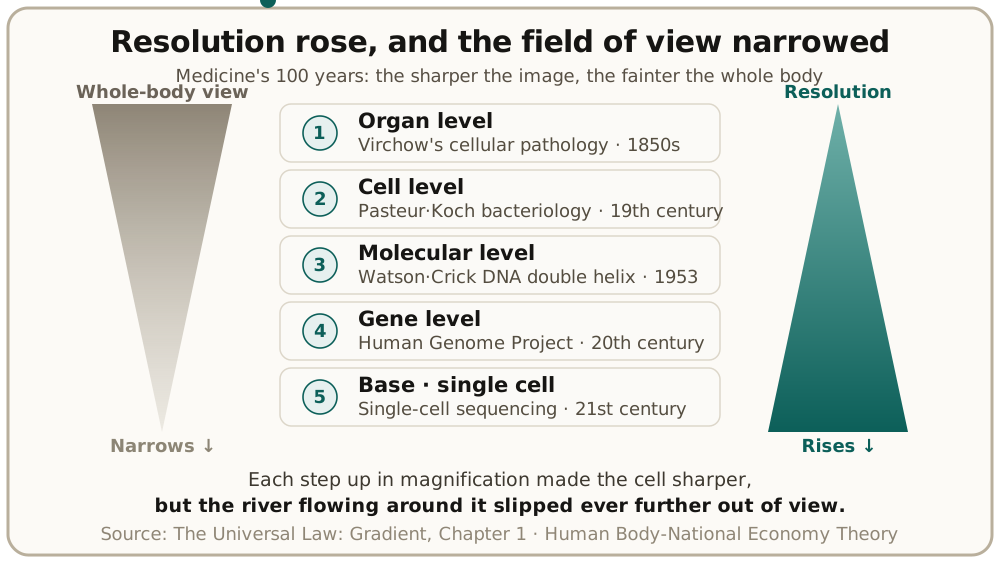
Take medicine as an example. In the mid-nineteenth century, the German pathologist Rudolf Virchow declared that "every cell arises from a cell," and medicine descended from organ-level observation to cell-level observation. In the late nineteenth century, the bacteriology of Pasteur and Koch moved the causes of disease from the world visible to the naked eye to the world of the microscope. In the early twentieth century, biochemistry decoded the reaction pathways of molecules inside cells, and in the mid-twentieth century, when Watson and Crick revealed the double-helix structure of DNA, medicine descended to the molecular level. The Human Genome Project of the late twentieth century pulled resolution down to the level of the base sequence, and twenty-first-century single-cell sequencing now tracks, in real time, gene expression occurring within a single cell. On this journey of vertical descent, humanity achieved countless miracles: the conquest of infectious disease, antibiotics, vaccines, organ transplantation, gene therapy, precision medicine.
But there was a cost. The higher the resolution rose, the narrower the field of view became. While looking at the cell, the tissue became invisible; while looking at the molecule, the relationships between cells became invisible; while looking at the gene, the fact that the whole body is a single flow system receded from view. Each time the microscope's magnification increased by one step, some one part of the body became astonishingly clear, but the view of the body as a whole grew correspondingly dimmer. The sentence written in the prologue holds true again here. However high the microscope's magnification is raised, the cell becomes visible, but the river flowing around that cell becomes, if anything, invisible.
Economics followed the same pattern of fragmentation. Up through the era when Adam Smith's Wealth of Nations and Ricardo's Principles of Political Economy formed a single unified classical school, the economy was treated from the macro perspective of "the flow of the nation as a whole." But after the marginal utility revolution of the late nineteenth century, economics descended into the problem of individual choice, and after Keynes pulled it back up to the macro level in the early twentieth century, horizontal fragmentation accelerated into Keynesian and monetarist, neoclassical and behavioral economics. Entering the twenty-first century, econometrics and behavioral economics descended again into the micro mechanisms of individual decision-making. The direction of fragmentation differed from medicine, but the outcome was the same. While each school sharpened the precision of its own tools, the vantage point that surveyed the economy as a single flow system grew ever thinner.
Fragmentation itself is not a bad thing. Without specialization, humanity would have neither modern medicine nor modern economics. The problem is not fragmentation itself, but the fact that, once fragmented, the pieces are never rejoined. Division of labor produces development, but without reintegration, an overview becomes impossible. If the single system that is the body is split into thousands of diseases with no thread to sew them back together, hypertension, diabetes, and dementia remain forever unrelated names. If the single system that is the economy is split into hundreds of indicators with no thread to sew them back together, a crisis always arrives only as an "unforeseen event."
Three People Who Attempted Integration
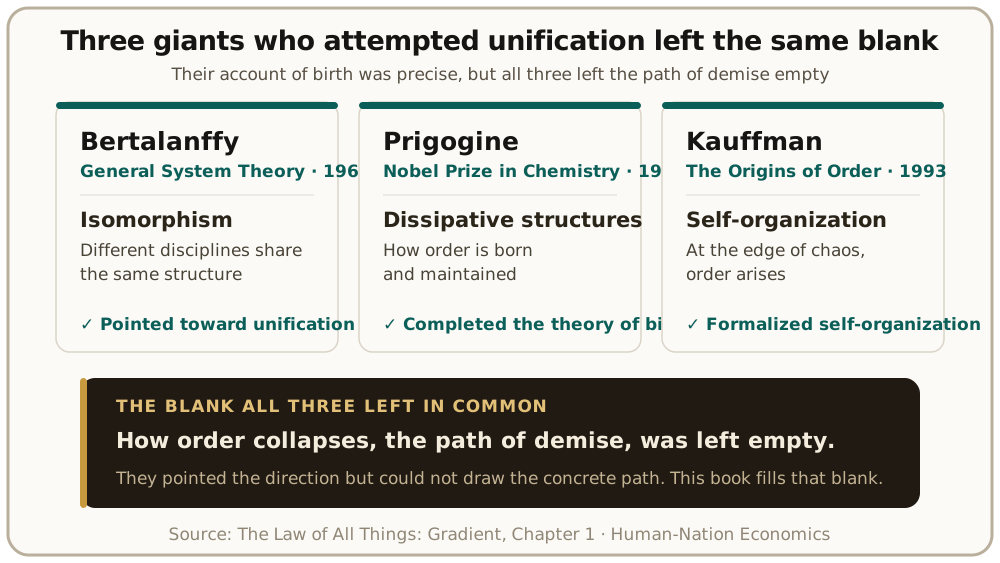
The person who first systematically raised the problem of academic fragmentation was the Austrian biologist Ludwig von Bertalanffy. Beginning with lectures in 1937, he later organized his argument in a 1968 book titled General System Theory. The book's core claim is this: among the systems studied by different disciplines, there exist common laws that hold regardless of the essential nature of the components. He called this "isomorphism." Examples included the fact that biological growth curves and demographic growth curves share the same mathematical structure, and the fact that the feedback loops of neural networks and the feedback loops of a thermostat share the same principle.
Bertalanffy's insight was profound. He pointed out that traditional science had tried to reduce systems to the sum of their parts, and clearly formulated the point that living systems are not closed systems but open systems that exchange energy and matter with their environment. He systematically argued that the equilibrium thermodynamics of physics does not apply as-is to these open systems, and this insight went on to inspire countless fields over the following half century, including systems science, cybernetics, ecology, and organizational studies.
But there was a decisive limitation in Bertalanffy's work. The isomorphism he proposed remained at an abstract level. He showed that various systems share a common mathematical structure, but he did not describe by what concrete path that structure operates and how it collapses. There was a declaration that different disciplines share the same framework, but a concrete account of the order in which a system is born, sustained, and dies within that framework was absent. The direction of integration was pointed out, but the content of integration was left as homework for later generations.
The second giant is the Belgian chemist Ilya Prigogine. Born in Moscow and researching in Brussels, he won the 1977 Nobel Prize in Chemistry, and the reason given was "for his contributions to non-equilibrium thermodynamics, particularly the theory of dissipative structures." Prigogine's most famous experimental case is the phenomenon called Bénard instability. When a liquid is heated from below, at first heat is transferred upward through disordered conduction, but once a certain critical point is crossed, regular hexagonal convection cells suddenly and spontaneously form. It is the moment order is spontaneously born out of disorder. Prigogine mathematically proved that this kind of phenomenon occurs broadly in chemical reaction systems and biological systems as well. That living organisms themselves are a representative dissipative structure, continuously consuming energy to maintain order, became the common understanding of the scientific community after his research.
Prigogine's contribution fundamentally changed the interpretation of the second law of thermodynamics. Where existing thermodynamics rigorously applied the law that "entropy increases" only to closed systems, Prigogine extended this to open systems and showed that as long as the flow of energy is sustained, a system can maintain order. This result was applied broadly to life, weather, chemical reactions, and even to economic phenomena, and the 1984 book Order Out of Chaos, co-authored with Isabelle Stengers, is regarded as the landmark work that conveyed this idea to a general readership.
But Prigogine, too, left a decisive gap. He described in elaborate detail how order is born and maintained, but he did not systematically address by what path that order collapses. There were principle-level statements, such as that a dissipative structure collapses when the energy supply is cut off, but no concrete path was offered for what stages a system passes through as it heads toward collapse when the energy supply gradually diminishes, or for how that collapse repeats across domains. The theory of birth was completed, but the theory of death was left unfinished.
The third giant is the American physician and theoretical biologist Stuart Kauffman. In his 1993 book The Origins of Order, running over seven hundred pages, he formally argued that evolution is not solely a product of natural selection but also a result of self-organization. He showed, through mathematical models and computer simulations, that a complex system, once it meets certain conditions, spontaneously generates remarkable order without any external design, and argued that this self-organization is an important driving force behind the origin of life and evolution. He called the point at which a system exhibits the most complex and adaptive behavior, poised between complete order and complete chaos, the "edge of chaos," and this concept exerted broad influence, from biology to economics.
Kauffman's contribution lies in introducing self-organization as a new axis into evolutionary theory. Since Darwin, the dominant view had been that evolution is shaped by the external pressure of natural selection; Kauffman opened up the possibility that the spontaneous formation of order within a system already operates prior to natural selection. This perspective influenced not only biology, developmental biology, and immunology, but also economics, organizational studies, and artificial life research.
But there was a limitation in Kauffman's work as well. He dealt in depth with how order is born, but he did not systematically describe by what path order, once born, collapses. The concept of the edge of chaos explained only the conditions under which a system maintains an adaptive, complex state; it offered no concrete path for what stages a system passes through as it collapses once those conditions break down. Like Prigogine, his explanation of birth was elaborate, but his explanation of death was left unfinished.
The limitation shared by the three giants can be summarized in one sentence. They proved that integration was possible, but they did not show by what concrete path that integration proceeds. There was a declaration that different disciplines share the same structure, but the path inside that structure was left empty. This very empty space is the space this book seeks to fill.
An Era in Which One Phenomenon Carries Three Names
The second reason integration was blocked was more practical. Each discipline had attached a different name to the same physical phenomenon. When names differ, people fail to even notice that they are looking at the same thing. This is the moment language itself becomes a structural barrier.
Let's take one concrete example. There is a phenomenon that cell biologists call "calcium overload." It refers to a state in which calcium that should remain outside the cell flows excessively into the cell, simultaneously paralyzing the intracellular signaling system and energy metabolism. This is exactly the process of acute cellular damage in myocardial infarction, and the same concept operates in the cellular mechanisms of cerebral infarction and renal failure.
What a cardiologist calls "atherosclerosis" carries a different name but is physically a continuous event with the phenomenon above. It is a state in which cholesterol and calcium deposit on the vessel wall, narrowing the vessel's inner diameter and causing loss of elasticity. As atherosclerosis progresses, blood flow in the distal microvasculature decreases, oxygen supply to tissue falls, and ultimately calcium overload occurs at the cellular level. Macro-level atherosclerosis and micro-level calcium overload are different stages of the same process carrying different names.
Yet what an economist calls "liquidity freeze" is, in essence, another manifestation of the very same structure. It refers to a state in which money, the medium, fails to pass smoothly through the pathways of the financial system and instead stagnates at a particular point. The representative case of this is the freezing of the New York interbank short-term lending market immediately after Lehman Brothers' bankruptcy in September 2008. Deposition at one pathway causes a nonlinear, sharp collapse in the liquidity flow of the entire system, and that sharp collapse causes freeze-ups at the far ends of the system. This physical structure is exactly the same as the structure in which calcium deposition inside a blood vessel causes a nonlinear, sharp collapse in blood flow, and that sharp collapse induces calcium overload at the cellular level.
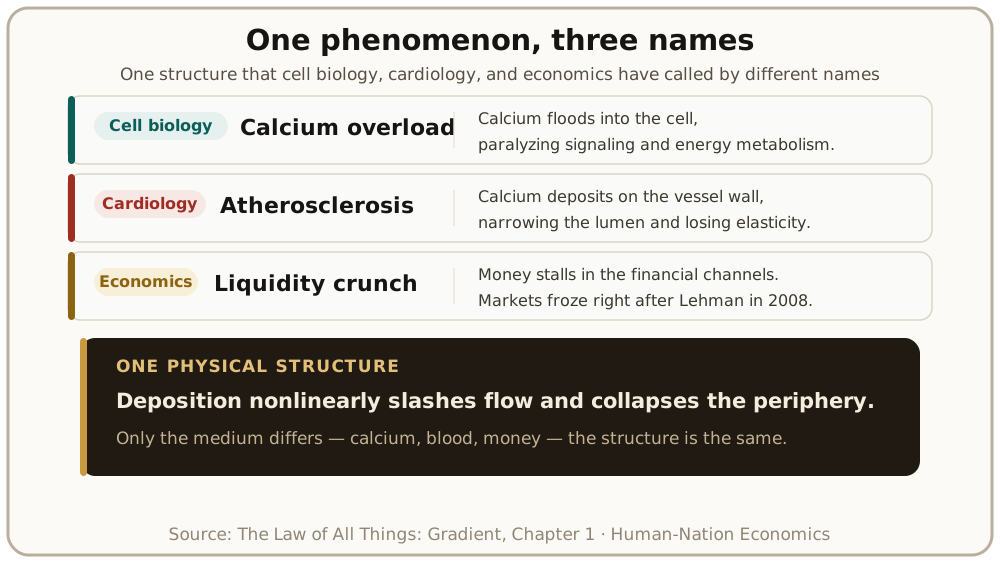
The simple fact that cell biologists, cardiologists, and economists call it by different names has, for over a century, concealed the common structure of these three phenomena. Each field's expert thinks only within their own field's glossary, and when they see a term from another field, they reflexively judge, "that isn't my field." Even if a cell biologist studying calcium overload sees the expression "liquidity freeze" in economic news, it never occurs to them that it shares the same structure as the phenomenon they observe every day. The same is true when an economist studying liquidity crises reads the expression "microvascular dysfunction" in a medical paper. While the same phenomenon was being described in different languages, the common structure sat in a blind spot invisible to anyone.
Technical terminology is a tool of precision within its own field, but a barrier to communication between fields. And the decisive reason academic integration has repeatedly failed lies in the fact that no field has ever possessed a common grammar for translating each other's language without abandoning its own glossary. Without a grammar for translation, the fact that everyone is looking at the same thing can never be proven.
The Space This Book Has Come to Fill
Bertalanffy declared that isomorphism exists between disciplines. Prigogine showed how order is born. Kauffman formalized the principle of self-organization. These three giants pointed toward the direction of integration but did not show concretely where that direction ultimately leads. The homework they left is clear: to bring the abstract declaration down into a concrete path. To translate the languages of different fields into a single physical grammar. To append an explanation of death to the explanation of birth.
This book attempts to handle these three pieces of homework at once.
First, this book does not stop at abstract declaration. It describes the claim that the body and the economy move by the same principle as a concrete five-stage path: the stage in which determinants accumulate, the stage that begins at the critical threshold, the stage in which flow is blocked, the stage in which symptoms manifest, and the stage in which the system reaches collapse. These five stages repeat without exception, whether in the chronic-disease pathway of the human body or the crisis pathway of a national economy. This is integration not as vague isomorphism, but as a reproducible path.
Second, this book translates the terminology of each field into a single physical grammar. Behind the different names, cell biology's "calcium," cardiology's "blood flow," economics' "liquidity," lies one common structure: a single physical principle of "the flow of a medium driven by a gradient." The medium changes, whether calcium, blood, or money, but the reason that medium flows is governed by the same physical law. This book calls this principle the gradient, and will introduce that grammar piece by piece in the chapters that follow.
Third, this book goes beyond the explanation of birth to provide an explanation of death. How a system is born and how it maintains order has already been elaborately treated by Prigogine and Kauffman, so this book fills the space they left behind by describing how a system collapses. And this book aims to prove that the path of that collapse is verifiable with real data across two independent domains: the human body and the macroeconomy. The author's laboratory has reclassified the pathogenesis pathways of the human body's major chronic diseases into this five-stage path, and has applied the same path to 690 months, roughly 57 years, of macroeconomic time-series data from Korea and the United States, producing empirical results. The details of this verification will be covered in the latter half of this book; here, it is enough to make clear that this book does not stop at an abstract claim but presents a concrete, empirically verifiable path.
This is why this book seeks to stand in the space left behind by Bertalanffy, Prigogine, and Kauffman. The three giants pointed in the right direction, but they did not descend all the way to the end along that direction. And the biggest reason they did not descend all the way was not a lack of content for integration, but the absence of a language for integration.
Conclusion
What this chapter has examined comes down to one simple fact. The reason humanity has, until now, failed to understand the body and the economy by the same principle is not that the principle was lacking, but that the languages were different. It was an era in which one phenomenon carried three names, and the giants of each field pointed toward the direction of integration but never delivered a concrete path. This book's place is precisely in that empty space.
The next chapter will properly introduce this book's core concept: the gradient. Gradient is not a neologism coined by this book. It is a principle physics has known for a hundred and fifty years, one that medicine and economics have each simply confined within their own language until now. The next chapter will show how that principle simultaneously explains the flow of blood and the flow of money, and why, the moment that principle collapses, whether cell or nation, the outcome heads toward death without exception.
참고문헌
- Bertalanffy, L. von (1968). General System Theory: Foundations, Development, Applications. New York: George Braziller.
- The Nobel Foundation. (1977). The Nobel Prize in Chemistry 1977: Ilya Prigogine "for his contributions to non-equilibrium thermodynamics, particularly the theory of dissipative structures." https://www.nobelprize.org/prizes/chemistry/1977/prigogine/facts/
- Prigogine, I., & Stengers, I. (1984). Order Out of Chaos: Man's New Dialogue with Nature. New York: Bantam Books.
- Kauffman, S. A. (1993). The Origins of Order: Self-Organization and Selection in Evolution. New York: Oxford University Press.
- Watson, J. D., & Crick, F. H. C. (1953). A structure for deoxyribose nucleic acid. Nature, 171, 737-738.
- Crick, F. (1970). Central dogma of molecular biology. Nature, 227, 561-563.
- Encyclopaedia Britannica. Rudolf Virchow. https://www.britannica.com/biography/Rudolf-Virchow
- Wikipedia. Systems theory (overview and historical sources on Ludwig von Bertalanffy). https://en.wikipedia.org/wiki/Systems_theory
Source: The Universal Law: Gradient, Chapter 1. The text is a faithful rendering of the original manuscript, provided for informational purposes.