
This piece is the opening portion of Chapter 11 (1) of The Declaration of the Age of Physical Economics (Yoon Jong-won, Yoon So-ri, Yoon Jun). It is an academic exposition presenting the authors' physical economics hypothesis, and the body, figures, and citations follow the manuscript as written.
DTDMC, that is, the Five-Stage Collapse Pathway Law, is the law that there is a fixed order to the path along which an economy collapses. Factor, onset, blockade, manifestation, annihilation. These five stages do not skip their order, and they connect as a causal chain in which the interest and the microcalcification accumulated in the earlier stage become the cause of the next stage. Until now we have examined the first two stages of that chain.
In the first stage, factor, through the funnel theory we confirmed how the seeds of economic crisis accumulate. Management's errors of judgment tilt the large direction of the system, and on top of that tilted ground wrong spending habits widen the funnel day by day, and a sudden disaster passes through as the fuse. After three orders of triggers accumulate over five to ten years, pressure pours out through the narrow exit of the funnel. That exit is the DIAH trigger, that is, income polarization, cost explosion, price surge, and monetary sclerosis.
In the second stage, onset, through the outflow theory, we confirmed the process in which, at the moment the accumulation of various cost factors builds up and the DIAH trigger crosses its threshold, the system opens its emergency vault, takes out its savings, and begins to take out loans in order to maintain its cash flow. This compensatory reaction to protect cash flow is itself normal, but in that process loan interest arises. It is irreversible interest. The principal can come back if it is repaid, but interest, once it arises, drains permanently out of disposable income and hardens onto the consumption channel. It is physically the identical structure to the way that in the human body, in the state of calcium deficiency, inflammation, acidosis, and hypoxia, that is, the DIAH state, the calcium melted out of the bones hardens as microcalcification on the walls of the microvasculature and narrows the channels that supply oxygen to cells and expel carbon dioxide.
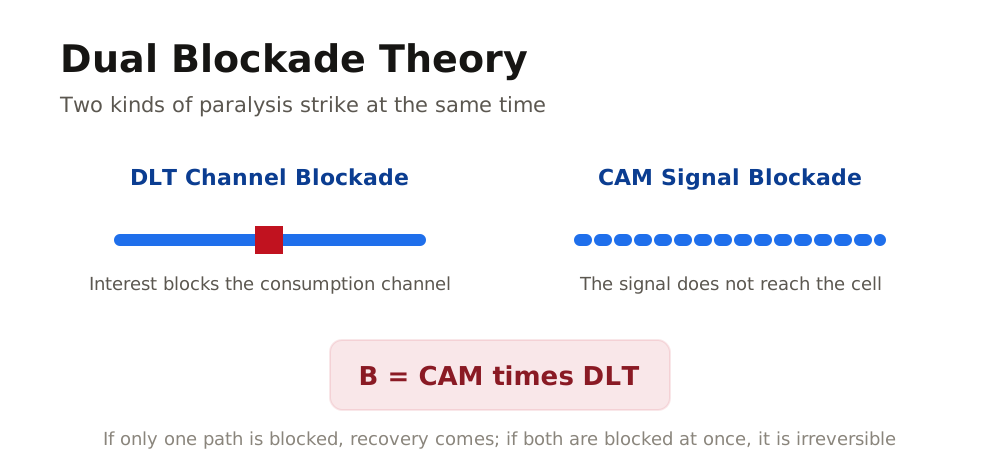
This loan interest is the fundamental cause of the collapse of economic flow. When interest drains out of disposable income every month, the consumption channel narrows, and as the interest burden accumulates, the central bank's policy signal fails to reach the household's wallet. At the moment when the phenomenon of the channel narrowing and the phenomenon of the signal not arriving are caught at the same time, the system falls into a state in which it cannot compensate in any direction. The formal name of this state is the dual blockade theory, and it corresponds to the third of the five DTDMC stages, blockade.
What kind of state the dual blockade is becomes clear if you recall a stifling moment that everyone has experienced at least once. When the sink drain is clogged so the water will not go down, but you also cannot draw fresh water. When the road is jammed at rush hour so you can neither get in nor get out. When, in a cramped room with a broken ventilation fan, oxygen does not come in and carbon dioxide does not go out, and breathing gradually becomes stifling. Incoming and outgoing stopping at the same time, this is the physical substance of the dual blockade. Only one path is blocked, yet both flows are cut off together.
Moving this to the situation of one household, it is as follows. Even when the salary comes in, it drains out as interest; even when the government lowers interest rates, that effect does not reach our wallet; and at the moment the two are caught at the same time, it becomes a state in which neither saving works nor borrowing works. Why the system must stop only when both kinds of blockade are caught at the same time, why the system can hold out if only one is caught, and why this structure is expressed exactly by the multiplicative formula B* = CAM × DLT, we take up in turn.
The Dual Blockade Theory: One Paralysis Made by Two Blockades
The dual blockade theory (Dual Blockade) is the formal theory of the third of the five DTDMC stages, and in the English code it is written CAM-DLT. There are two kinds of blockade. One is the blockade in which the channel itself narrows so that essential resources fail to arrive. In the human body, microcalcification hardens on the vessel walls so that oxygen and glucose fail to reach the cells, and in the economy, interest eats up disposable income so that the cash to be spent on consumption fails to reach the shop in the back alley. The other is the blockade in which, even though the channel remains, the signal fails to be transmitted to the periphery. In the human body, the decomposition and delivery of calcium fail so that cells fail to receive the signal, and in the economy, capital fails to be decomposed and delivered from large corporations to households so that the back-alley economy stops responding. The first is called DLT (Deposition-induced Luminal Throttling, physical channel blockade), and the second is called CAM (Conductance Attenuation Metric, functional-operation signal blockade). The doctrine maps DLT to logistics-network paralysis and CAM to communication-network paralysis.
The distinction between the two blockades is not the directional distinction of artery and vein, but the dimensional distinction of channel blockage and signal blockage. DLT is a change in which the physical width of the channel is reduced. In the human body, microcalcification hardens on the vessel wall and narrows the channel through which oxygen passes, and in the economy, interest drains out of disposable income and narrows the consumption channel through which cash flows. CAM is a change in which the transmission of the signal is cut off. In the human body, the decomposition and delivery of calcium fail so that the cell signal is disturbed, and in the economy, the injected capital fails to be decomposed and delivered from large corporations to households so that the peripheral income-generating pathway is blocked. The two changes operate in different physical dimensions. Even if the channel is open, if the signal does not arrive, the cell cannot respond, and even if the signal is alive, if the channel is blocked, the substance cannot arrive.
Once you go inside the economy, this distinction becomes vivid. For the economy to be alive, a gradient must be maintained, and on top of the gradient, flow must occur. The funding-pressure gradient, the consumption-production gap gradient, and the credit-expectation gradient, these three gradients must operate simultaneously for the economy to breathe. DLT is the state in which, even though there is a gradient, the channel is too narrow to flow. The state in which interest eats up disposable income so the consumption channel has narrowed. CAM is the state in which, even though there is a channel, the gradient itself fails to be transmitted to the cell. The state in which the central bank lowered interest rates to create a gradient, but that signal does not reach the shop in the back alley. In Poiseuille's flow law Q = πΔPr⁴/8μL, CAM attacks ΔP (the pressure gradient), and DLT attacks r (the channel radius). When the two variables decrease at the same time, the flow rate falls as a product.
Dual Blockade Theory Overview: DLT vs CAM Medical and Economic Correspondence and Poiseuille Variables
| Blockade | Formal Name | Medicine | Economy | Poiseuille Variable | Analogy |
|---|---|---|---|---|---|
| DLT | Physical Channel Blockade (Deposition-induced Luminal Throttling) | Microcalcification → reduction of microvascular inner diameter → simultaneous blocking of supply and expulsion | Interest → shrinkage of the consumption channel → suffocation of back-alley commerce | Attacks r (channel radius) | Logistics-network paralysis |
| CAM | Functional-Operation Signal Blockade (Conductance Attenuation Metric) | Blood calcium fluctuation → cell signal disturbance → functional paralysis | Policy signal not arriving → households stop responding | Attacks ΔP (gradient) | Communication-network paralysis |
Interest and Microcalcification: One Substance Makes Two Blockades at the Same Time
In the human body, the substance that makes the dual blockade is the calcium that has drained out of the bones. As confirmed in the outflow theory, when deficiency and inflammation and acidosis and hypoxia, that is, the four DIAH states, worsen at the same time and the blood calcium concentration falls to a dangerous level, parathyroid hormone (PTH) is triggered and releases the calcium stored in the bones into the blood. When this calcium is deposited as a solid on the walls of the microvasculature, channel blockade (DLT) is made. When the same calcium causes concentration fluctuations in the blood, the calcium second-messenger signal inside the cell is disturbed, and signal blockade (CAM) is made. One substance advances two blockades at the same time.
In the economy, exactly the same structure operates. The substance that makes the dual blockade is loan interest. As confirmed in the outflow theory, when income polarization and cost explosion and price surge and monetary sclerosis, that is, the four DIAH states, cross their thresholds at the same time, households and firms and government open their emergency vaults and begin to take out loans in order to prevent their cash flow from being cut off. When interest drains out of disposable income and narrows the consumption channel, it becomes channel blockade (DLT), and when the same interest burden exhausts investment capacity and blocks the income-generating pathway itself, it becomes signal blockade (CAM). The structure in which a single interest makes two blockades at the same time is identical in the human body and in the economy.
When interest accumulates, it branches into two. One branch reduces disposable income and blocks the consumption channel (DLT), and the other branch exhausts investment capacity and blocks the income-generating pathway (CAM). The moment income (supply) and consumption (expulsion) are blocked at the same time is the dual blockade, and it is the physical reason why households and firms and nations cannot get out of debt.
DLT, Physical Channel Blockade: Interest Blocks the Consumption Channel
In the human body, DLT (physical channel blockade) is the process in which microcalcification piles up on the walls of the microvasculature and narrows the inner diameter of the channel. The microvasculature is made up of arterioles, capillaries, and venules with a diameter of 100 micrometers or less, and it accounts for most of the roughly 100,000 kilometers of blood vessels in the human body. Every cell in the human body is in direct contact not with the large vessels but with this microvasculature. Each time microcalcification piles up one layer at a time on the microvascular wall, the supply channel through which oxygen and glucose enter the cell and the expulsion channel through which carbon dioxide and waste leave the cell narrow at the same time. Because supply and expulsion meet at the same place (the same microvascular wall), when one path narrows, both flows decrease together.
In the economy, DLT is the process in which loan interest narrows the consumption channel. Earned income comes in. But loan interest drains out of that income every month. After the interest has drained out, the available cash that remains decreases, and when available cash decreases, consumption decreases, and when consumption decreases, the sales of the neighborhood shop decrease, and when sales decrease, the shop reduces its staff, and when staff are reduced, the income of the laid-off staff disappears so consumption decreases once more. It is the pathway in which interest physically narrows the consumption channel and suffocates, first of all, the back-alley commerce, that is, the cells connected to the microvasculature.
If you follow one month of an office worker who earns a salary of 3 million won, this pathway becomes tangible. 800,000 won drains out as loan interest. If, from the remaining 2.2 million won, 300,000 won for utility bills, 200,000 won for insurance premiums, 150,000 won for transportation, and 50,000 won for communication go out, the real available cash is 1.5 million won. If you subtract food expenses and the children's private-academy fees from this, almost no money remains to be spent at neighborhood shops. From the standpoint of the shops in the neighborhood where this office worker lives, the customer's pocket narrowing is the same structure as the microvasculature narrowing. At the same time that the sales (supply) coming into the shop decrease, the rent and labor costs (expulsion) that must go out of the shop remain the same, and so the two-way exchange is blocked at the same time.
The same structure operates at the firm level as well. After a small or medium-sized firm repays the interest on its working-capital loan each month, the operating profit that remains after buying raw materials and paying employees' wages decreases. When the interest coverage ratio, that is, operating profit divided by interest expense, falls below 1, it means that more money goes out as interest than the money earned through operations. In 2022 in Korea, the proportion of firms with an interest coverage ratio below 1 reached about 40 percent of firms subject to external audit. The funding channel of these firms is already physically narrowed, and it is a phase in which the channel can become completely blocked at even a single small shock.
Looking at how DLT progressed in Korea in 1997 makes the speed of the channel blockade clear. Just before the foreign-exchange crisis, the call rate started in the 12 percent range and soared to the 30 percent range at the end of November. That the rate rose 2.5 times means that the interest arising from the same principal increased 2.5 times, and it means that the consumption channel of households and firms narrowed that rapidly. In 1998, Korea's private consumption expenditure plummeted by about 12 percent compared with the previous year, and in the same year about 22,000 firms were processed as bankrupt. The speed at which interest narrowed the channel and the speed at which the back-alley economy suffocated coincide exactly.
| Stage | Content |
|---|---|
| 1. Interest arises | Interest arises from the loan every month and drains out of disposable income |
| 2. Available cash decreases | The real available cash excluding interest decreases |
| 3. Consumption decreases | When available cash decreases, consumption at neighborhood shops decreases |
| 4. Sales decrease | Back-alley shop sales plummet, the two-way exchange system contracts |
| 5. Employment decreases | When sales decrease, staff are reduced, and the income of laid-off staff vanishes |
| 6. Income decreases | Employment reduction leads to income reduction so consumption decreases once more |
| 7. Channel blockade | The vicious cycle repeats and the consumption channel is physically blocked |
DLT Causal Pathway: From Interest to Channel Blockade
| Category | Cell | Economy | If Blocked | Result |
|---|---|---|---|---|
| Supply | Oxygen (O₂) | Investment capital and productive capacity | Suffocation / production halt | Supply channel blockade |
| Supply | Glucose | Cash liquidity | Economic paralysis | Halt of funding circulation |
| Expulsion | CO₂ | Inflationary pressure | Acidification / decline in currency value | Expulsion channel blockade |
| Expulsion | Toxins / waste | Insolvent firms / bad debt | Toxification / decay | System contamination |
CAM, Functional-Operation Signal Blockade: The Signal Does Not Reach the Cell
In the human body, CAM (functional-operation signal blockade) is the state in which the decomposition and delivery of calcium fail so that the calcium signal fails to reach the cell properly. When the calcium that has come in through food fails to be ionized by stomach acid, or, even if ionized, fails to be absorbed in the intestine, or, even if absorbed, fails to be delivered to the cell, the calcium second-messenger signal inside the cell is disturbed. Because calcium is a second messenger that coordinates the heartbeat and muscle contraction and nerve transmission, when this signal wavers, the cell stops responding even though the channel remains. If DLT is the change that narrows the channel, CAM is the change in which the cell's response itself weakens regardless of the channel.
The process by which CAM progresses is organized as a chain of five stages. The first stage is Input. Calcium comes in through food. In the economy, it is the stage in which policy capital and liquidity are injected into the system. The second stage is Decomposition. Stomach acid ionizes calcium and changes it into an absorbable form. In the economy, it is the stage in which the injected capital is divided from large corporations to small and medium-sized firms, and from small and medium-sized firms to households. The third stage is Flow. The decomposed calcium is absorbed in the intestine and enters the blood. In the economy, it is the stage in which the decomposed capital moves into actual income and consumption. The fourth stage is Absorption. The cell uses calcium as a second messenger. In the economy, it is the stage in which capital is actually used at the periphery of the market, that is, at the back-alley shop. The fifth stage is Outcome. Cell function is normal or unstable. In the economy, it is growth or recession. If the decomposition and delivery are blocked at even any one of the five stages, the entire flow stops.
CAM Five-Stage Chain: The Signal-Transmission Pathway from Input to Outcome
| Stage | Name | Medicine | Economy | If Blocked |
|---|---|---|---|---|
| 1 | Input | Calcium comes in through food | Injection of policy capital and liquidity | Shortage of the raw material itself |
| 2 | Decomposition | Stomach acid ionizes calcium | Distribution from large corporations → SMEs → households | Distribution failure: stops at the large corporations |
| 3 | Flow | Absorbed in the intestine → into the blood | Distributed capital moves into actual income and consumption | Flow severance: income does not arrive |
| 4 | Absorption | The cell uses Ca²⁺ as a second messenger | Actually used at the back-alley shop | Peripheral non-absorption: does not reach the shop |
| 5 | Outcome | Cell function normal or unstable | Growth or recession | System recession |
In the economy, the moment CAM is most vividly revealed is the moment when, even though the central bank lowered interest rates, the sales of the back-alley shop remain the same. The central bank lowers interest rates in order to create a gradient. Once a gradient is made, funds should flow from a high place to a low place. But those funds circulate amply between large corporations and financial institutions, yet do not reach the bank account of the back-alley shop. It is because the process in which capital is decomposed and delivered from large corporations to small and medium-sized firms, and from small and medium-sized firms to households, is blocked. Seen through the causality organized by the doctrine, it is a state in which the accumulation of interest has exhausted investment capacity so that the pathway that generates income itself is cut off. It is the same as the structure in which the aorta is rich with blood, but the cells beyond the microvasculature are suffocating.
Looking at the situation of Korean households reveals the substance of CAM. In 2022, the Bank of Korea raised the base rate and made the funding-pressure gradient strong, but the interest rate that households actually felt was much higher than the base rate. Against a base rate of 3.5 percent, the household loan rate was 5 percent to 7 percent, and the credit-loan rate exceeded 10 percent. The policy signal was amplified nearly threefold in the process of being transmitted from the aorta (commercial banks) to the microvasculature (households). Conversely, when rates are lowered, even if the rate of the aorta goes down, the rate of the microvasculature does not go down by that much. The structure in which, even though a gradient is made, it does not reach the cell, this is the economic substance of CAM.
In the coronavirus situation of 2020 as well, the same structure repeated. When the government paid out emergency disaster relief funds, a considerable portion of the relief funds was consumed on large online platforms. Funds flowed back not to the back-alley shop but to the aorta. Injecting cash directly into the cell (households) is the same as taking a calcium supplement directly. Because it does not go through the stomach-acid decomposition process, the blood calcium concentration temporarily rises. But if you stop the supplement in a state where a structural circulation pathway has not been made, it returns to its original state again. The case in which, in 2024 in Brazil, after President Lula achieved a growth rate of 3.49 percent through the direct payment of Bolsa Família, fiscal deficits and an exchange-rate surge and a rate hike to 15 percent followed, shows exactly this structure. If you release only CAM and leave DLT alone, the dual blockade is not undone.