
This piece is the front part of Chapter 6 (1) of The Declaration of the Age of Physical Economics (Yoon Jong-won, Yoon So-ri, Yoon Jun). It is an academic account presenting the authors' physical economics hypothesis, and the body, figures, and citations follow the manuscript as written.
Earlier, we examined the fact that the national economy moves upon universal laws that operate everywhere in nature. Where there is a difference, capital flows; when the difference disappears, capital stops. When debt is deposited in one place, it does not dissolve on its own; only when two channels are blocked at the same time does the system collapse; and once a critical point is crossed, it switches over all at once. The fact that rivers and stars and ecosystems and the climate all follow the same law, and the fact that the national economy too is an instance of that law's application, the authors verified with 690 months of data from Korea and the United States.
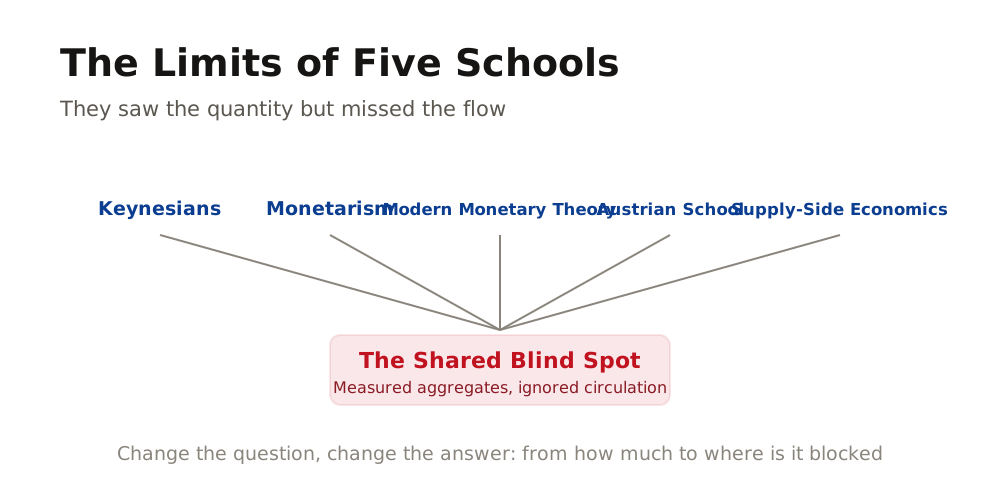
A question remains. If a law that operates everywhere in nature is so clear, why, over 250 years, did economists fail to reach this law? Since the twentieth century, economics has developed rapidly. Mathematical models have grown sophisticated, data-analysis techniques have improved quickly, and scholars who received the Nobel Prize in Economics have each developed their own theories. Yet the capacity to catch crises in advance has remained almost at a standstill. The answer lies in a single blind spot shared by five schools: Keynesianism, Monetarism, MMT, the Austrian school, and supply-side economics.
After a Korean restaurant self-employed owner who opened a shop in 1996 lived through the 1997 foreign exchange crisis, every policy that trickled down to the self-employed was the prescription of one of the five schools. When a stimulus package was announced, it was the Keynesian school's prescription; when the policy rate was lowered, it was the Monetarist prescription; when government debt increased, it was the prescription of Modern Monetary Theory; when voices calling to leave it to the market grew loud, it was the Austrian school's prescription; and when tax cuts and deregulation were announced, it was the prescription of supply-side economics. Yet none of the five schools' prescriptions reached the self-employed owner's shop. Each time, the self-employed owner took the shock head-on with no advance warning. Why was that?
The proposition this chapter will answer is simple. The national economy is not an aggregate but a flow, and collapse is the simultaneous blockage of flow. All five schools looked at the aggregate, and no school saw the simultaneous blockage of the two channels. Let us examine in turn how this proposition applies to the five schools.
Five Doctors, the Same Mistake
A patient collapsed. Five doctors examine the patient in turn. The first doctor diagnoses a shortage of nutritional supply and prescribes injecting nutritional supplements in large quantities. The second doctor diagnoses a shortage of blood volume and says to increase the amount of transfusion. The third doctor says it is fine to transfuse without limit. The fourth doctor says to do nothing and let the body recover on its own. The fifth doctor says it is enough to change the type of nutritional supplement.
All five doctors argued hard about the quantity of the medicine, but no one asked how far that medicine flows along the blood vessels, by what path it reaches the cells, or where it is being blocked. The blind spot shared by modern economics's five schools, Keynesianism, Monetarism, MMT, the Austrian school, and supply-side economics, looks exactly like this. Just as the five doctors failed to save the one patient, the five schools have failed to save the Korean and American economies. Let us examine the five schools in turn.
The Keynesian School: It Saw Only the Quantity of Demand
The theory of the British economist Keynes was one of the most important turning points in twentieth-century economics. In the General Theory, published in 1936, Keynes diagnosed the cause of economic recession as a shortage of aggregate demand. The logic was that when firms cut investment and consumers cut spending, demand across the whole economy falls, and the fall in demand leads to falling production and rising unemployment. So the prescription was for the government to fill the missing demand directly through fiscal spending.
This diagnosis was not wrong. During the Great Depression of 1929, aggregate demand did fall rapidly, and there was clearly an aspect in which government fiscal spending contributed to the recovery. But the Keynesian school's prescription had a structural blind spot. It calculated the quantity of fiscal spending, but it did not sufficiently consider through what path and to whom the spending flows.
The experience after the 2008 global financial crisis laid the blind spot bare. The United States, Europe, and Japan carried out large-scale fiscal spending after the financial crisis. But the fiscal funds flowed first to large corporations through government contracts, and as they passed through subcontracting and re-subcontracting they were diluted and failed to reach the shops in the back alley and households. Asset markets overheated, but the recovery of the real economy was slow. When the Korean restaurant self-employed owner's shop saw sales fall by nearly 30 percent over about six months starting in 2008, the announced stimulus package barely reached that shop.
The patient analogy makes it clear. The doctor diagnosed the patient as short of nutritional supplements and injected a large quantity of them. But because the patient's digestive tract was blocked, the nutritional supplements were not absorbed. The diagnosis that nutrition was lacking was right, but it was the result of failing to see the path by which nutrition is delivered to the cells. The Keynesian school calculated the quantity of fiscal spending, but it did not measure the speed at which the spending reaches the back alley. Flow is the product of quantity and speed. If you look only at quantity and not at speed, then even if you release 4 trillion dollars, the self-employed owner's shop remains dry.
Monetarism: It Looked Only at Quantity and Ignored the Flow
Monetarism, represented by the American economist Friedman, explains the economic system with the equation MV=PQ. M is the money supply, V is the velocity of circulation, P is the price level, and Q is real output. According to the equation, if you control the money supply, you can stabilize prices and output. The core premise of monetarism was that the velocity of circulation is relatively stable. If the velocity of circulation is stable, then you only need to adjust the money supply.
But after 2008 the premise collapsed. According to the analysis by the Federal Reserve Bank of St. Louis, from 2008 to 2014 the U.S. monetary base surged by about fourfold. Over the same period the growth rate of real output was negligible. According to the equation, if the velocity of circulation were constant, prices should have risen greatly. But the actual rate of price increase was under 2 percent. An event occurred in which the money supply increased fourfold yet prices barely rose.
The reason lay in the velocity of circulation. It was the result of the velocity of circulation plunging. Money increased but did not circulate. Liquidity overflowed in the banks, but the banks, rather than lending the money to the real economy, piled it up as excess reserves at the U.S. Federal Reserve or invested it in financial markets. It was the result of looking only at the money supply in the monetarist equation and ignoring the velocity of circulation.
The Collapse of Monetarism's MV=PQ: In the United States from 2008 to 2014, Even With a Fourfold Increase in the Monetary Base, the Flow Stopped
| Category | Theoretical Prediction | Actual Result | Cause |
|---|---|---|---|
| Monetary base | About fourfold increase | About fourfold increase (match) | · |
| Velocity of circulation | Stable (premise) | Plunged to the lowest level on record | Money did not flow to the real economy |
| Prices | Large increase predicted | Under 2% | Velocity plunge offset the money-supply increase |
| Patient analogy | Increasing blood volume improves circulation | Blood increased but did not circulate | Failed to see the blockage of the blood vessels |
The patient analogy makes it clear. The doctor diagnosed the patient as short of blood volume and gave a large transfusion. But the speed of blood flow dropped quickly. Blood increased but did not circulate. Why did it not circulate? Because the blood vessels had narrowed and were blocked. It was the result of monetarism measuring the quantity of blood clearly but failing to see the state of the blood vessels and the path of the blood flow. In physics, the quantity that flows is determined by the product of the cross-sectional area and the flow velocity. If you ignore the fact that the cross-sectional area, that is, the blood vessel, is narrowing and increase only the blood volume, the blood flow may instead stagnate. Poiseuille's Law, which we examined earlier, explains the event exactly. If the radius of a channel narrows by half, the quantity of flow drops to one sixteenth. Even if the money supply increases fourfold, if the channel narrows, the flow does not recover.
The limits of the monetarist prescription showed up most directly at the self-employed owner's shop. From 2008 the U.S. Federal Reserve pulled the policy rate down to effectively 0 percent, and the Bank of Korea moved in the same direction. Funds overflowed in the market. But new loans coming into the self-employed owner's shop did not increase. This was because banks, rather than lending to back-alley self-employed owners, sent funds to highly creditworthy large corporations or to the real estate market. Even as the money supply increased fourfold, the funds reaching the back-alley shop barely changed. The gap between the money supply that monetarism measured and the funds the shop received grew ever wider. Monetarism placed V within the equation yet did not measure V in earnest. Flow is the product of quantity and speed. In a period when V is plunging, even if you increase the money supply fourfold, the flow does not recover.
Modern Monetary Theory: It Did Not Look at the Location of Debt
Modern Monetary Theory is a school that received great attention from the 2010s onward. The Deficit Myth, published in 2020 by the American economist Kelton, is the theory's representative work. Its core claim is that a government that can issue its own currency need not worry about fiscal deficits. The logic is that since the government can issue its own currency and spend at any time, the quantity of debt itself is not a problem. However, since excessive spending can induce price increases, it argues that when prices rise you can raise taxes and withdraw the liquidity.
The theory's blind spot lies in the fact that it discussed the quantity of debt but did not ask where the debt accumulates. When government debt increases, it did not analyze where the loan interest arising from the debt goes, or in which path of the national economy the loan interest is deposited to obstruct the flow.
The patient analogy makes the problem vivid. Within the human body, calcium is an essential substance. If calcium is stored in the bones, it is healthy, but if it is deposited as microcalcification on the walls of the blood vessels, it narrows and blocks the vessels and brings about fatal consequences. The same substance in the same quantity can, depending on its location, either save life or kill. It is the same in the Korean and American economies. If debt is used for productive investment and is generating returns, it becomes the driving force of economic growth. But if the loan interest arising from the debt is drained from households' disposable income and is blockading the consumption path, then the same quantity of debt becomes a poison that suffocates the national economy. It was the result of Modern Monetary Theory discussing the total quantity of calcium but not asking whether the calcium is in the bones or on the walls of the blood vessels.
The self-employed owner's period from 2014 to 2017 shows the difference best. As the Bank of Korea lowered the policy rate step by step, household debt increased rapidly, and the self-employed owner too, short of operating funds, began to depend on loans from financial institutions. The quantity of debt increased, but the loan interest coming out of the debt drained from the shop's account every month. With sales failing to recover, the location where the loan interest was deposited was that shop. Even with the same debt, the result becomes the exact opposite depending on the location from which and the direction in which it flows. A diagnosis that looks only at the total quantity of debt cannot explain why the self-employed owner's shop keeps collapsing further and further. Modern Monetary Theory discussed the quantity of debt but did not analyze the speed at which loan interest drains from the household account every month. Flow is the product of quantity and speed. Even if the quantity of debt is the same, if the speed at which loan interest drains each month is steep, the self-employed owner's shop eventually runs dry.
The Austrian School: It Left the Bleeding Unattended
The Austrian school occupies a distinctive position in the history of economics. Represented by the Austrian-born American economist Mises and the Austrian-born British economist Hayek, this school argues that government intervention should be minimized and the market should be left to find its balance on its own. The logic is that since economic recession is the market's self-cleansing process, artificial intervention only delays the recovery. It is called liquidationism.
The most dramatic case of applying this thought appeared in the early period of the Great Depression of 1929. It is recorded that the then U.S. Treasury Secretary Mellon advised President Hoover to liquidate labor, liquidate stocks, liquidate the farmers, liquidate real estate, and purge the rotten parts of the system. The logic was that if the market cleared out inefficient firms and assets on its own, a healthy economy would grow again.
The result was catastrophic. U.S. GDP fell by about 30 percent from 1929 to 1933, and the unemployment rate reached 25 percent. About one third of farmers lost their land, and thousands of banks closed their doors. Even the American economist Friedman criticized the Austrian school's liquidationism as dangerous nonsense.
The patient analogy reveals how dangerous the prescription is. It is like a doctor telling a patient in acute hemorrhage to do nothing because the body will stop the bleeding on its own. The human body has a capacity for natural healing, but in a situation of massive hemorrhage, if left unattended without intervention, the patient dies of blood loss. A prescription to remove infected tissue may be necessary, but it is something to be done after the bleeding has been stopped. The Austrian school may have been right about the direction of long-term healing, but by refusing acute-phase management it killed cells in massive numbers. A prescription that waits for natural healing while the flow has completely stopped is no different from leaving the patient unattended.
The International Monetary Fund's prescription right after the 1997 Korean foreign exchange crisis also contained some liquidation logic. It was a recommendation to clear out insolvent firms and insolvent banks according to market logic. As a result, in Korea too a great many firms and banks were cleared out, and in the process many people lost their jobs. The self-employed owner's shop went to the very brink of closure. The logic that liquidation is the market's self-cleansing process may have worked at the macro level, but at the micro level it dealt the greatest shock to the weakest people. It was the result of measuring only the quantity of liquidation and not seeing where and how the liquidation proceeds. The Austrian school discussed the necessity of liquidation but did not ask the speed at which the liquidation proceeds. If you treat the acute phase like a chronic phase, the patient dies, and if you treat the chronic phase like an acute phase, the patient weakens. Flow is the product of quantity and speed, and timing is a part of speed.