
This piece is the complete Chapter 10 of Calcium: The Reality of Evolution That Darwin and the Genome Map Missed (Yoon Jong-won). The body, figures, and citations follow the manuscript as written, and the subheadings are the subheadings found within the original.
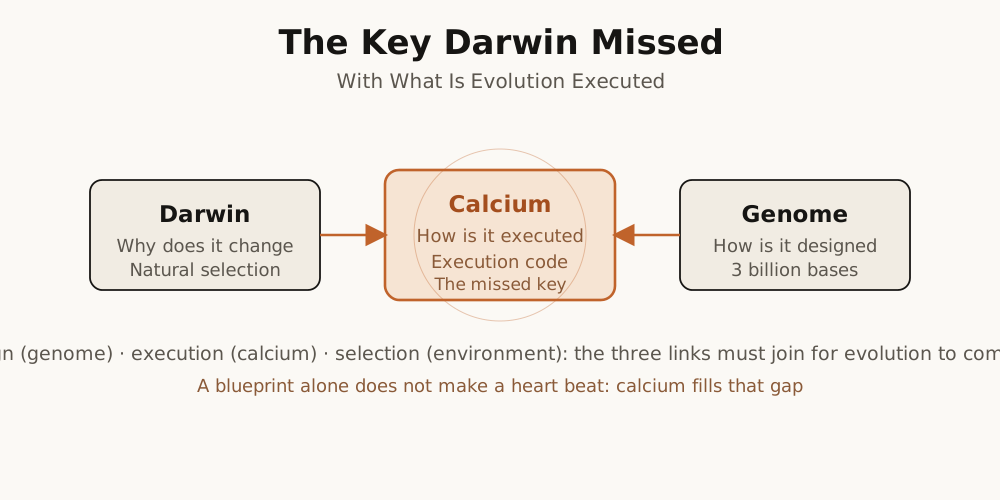
Introduction: A Great Discovery, and the Question Left Behind
In 1859, Charles Darwin put before the world, through On the Origin of Species, a discovery that shook humanity's view of the world. Living things are not unchanging beings created by God; they have changed over long stretches of time, and the driving force of that change is natural selection.
The individual better adapted to its environment survives and leaves more offspring, and as that process repeats over generations the characteristics of the whole species shift. This simple yet powerful principle provided an integrated framework for explaining the diversity and adaptation of life. Darwin's discovery reached beyond biology into philosophy, psychology, and sociology, and even today the theory of evolution stands as the central paradigm of the life sciences.
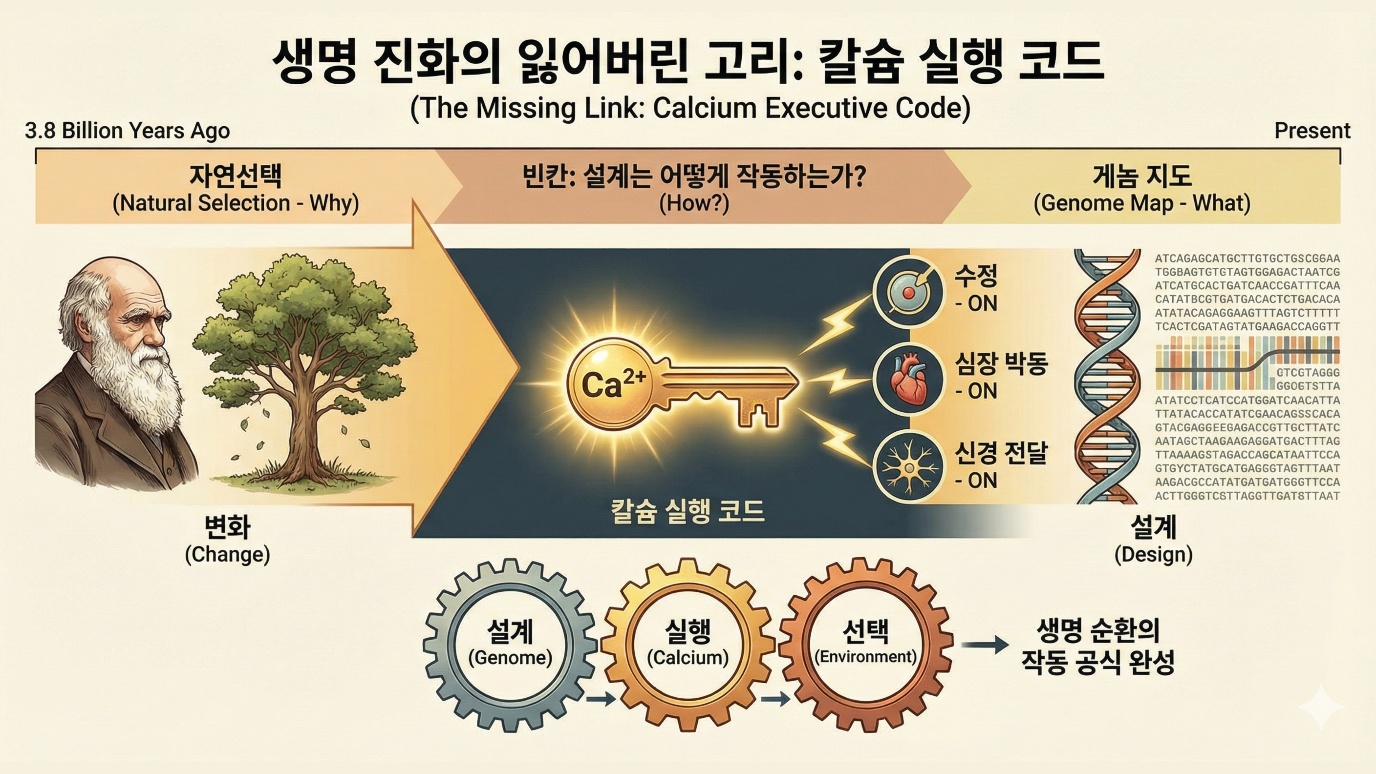
Yet as Darwin himself admitted, his theory had an important empty place. If natural selection explained "what is selected," then "how is that selected characteristic passed to the next generation," and "how does the transmitted information actually build the body," were questions Darwin could not answer. In Darwin's time the material basis of heredity was not known, and the mechanisms of generation and development were barely understood. Entering the twentieth century, Mendel's laws of heredity were rediscovered, and when Watson and Crick uncovered the double-helix structure of DNA the secret of heredity was solved, but the question "how is the information held in DNA translated into a living body" still remains not fully answered. In this chapter we will take stock of what Darwin discovered and what he did not, look at what empty place remains even after the discovery of DNA, and then explore how the calcium execution code can fill that empty place.
What Darwin Discovered
Darwin's core insight was the mechanism of natural selection. Every living thing bears more offspring than can survive, variation exists among the offspring, and some of that variation is favorable to survival and reproduction while some is unfavorable. The individual with favorable variation survives longer and leaves more offspring, and those offspring are likely to inherit the same variation, so as generations repeat the favorable variation spreads through the population. When this process continues long enough, the very characteristics of the species change, and even new species are born.
The power of this principle lies in the breadth of what it can explain. Why the giraffe's neck is long, why the polar bear's fur is white, why the cactus has thorns, why the peacock's tail is splendid: to all these questions natural selection provides a consistent answer. The giraffe with a long neck could eat high leaves and so was favored in survival, the bear with white fur was favored in hunting amid the snow, the cactus with thorns was not eaten by herbivores and so was favored in survival, and the peacock with a splendid tail was chosen by females and so was favored in reproduction. According to several evolutionary biology research institutions, natural selection is the most powerful and comprehensive theory for explaining the diversity and adaptation of life, and it has been supported by countless pieces of evidence over more than 150 years.
Yet Darwin's theory answered "why does it change" but did not answer "how does it change." We understand that it is advantageous for the giraffe's neck to lengthen, but what is that long neck actually made of? With what material, through what process, by what signal do the neck bones grow longer? We understand that the characteristics of the parents are passed to the offspring, but what is it that is passed, and how does it build a new body? In Darwin's time there was no knowledge with which to answer these questions. Darwin proposed the hypothesis that hypothetical particles called "gemmules" are made throughout the whole body and gather into the germ cells, but this was later found to be wrong.
From Mendel to DNA
At almost the same time that Darwin published On the Origin of Species, the Austrian monk Gregor Mendel was discovering the laws of heredity through pea-crossing experiments. Mendel found that the characteristics of the parents are not blended but are passed on as individual "factors." Yet Mendel's work drew almost no attention at the time, and only when it was rediscovered in the early 1900s did it become the foundation of genetics.
Over the first half of the twentieth century, scientists found that these hereditary factors are in the chromosomes, and they revealed that the substance holding the genetic information within the chromosomes is DNA. And in 1953, when James Watson and Francis Crick discovered the double-helix structure of DNA, the material basis of heredity was at last revealed. DNA is a molecule in which four bases, adenine, thymine, guanine, and cytosine, are linked in a long chain, and the sequence of these bases holds the genetic information, and as DNA is replicated that information is passed to the next generation.
The "central dogma" proposed by Crick in 1958 explained that information flows from DNA to RNA and from RNA to protein. The base sequence of DNA is transcribed into RNA, amino acids are linked according to the information of the RNA to make protein, and these proteins take charge of the structure and function of the cell. With this an answer to the question "what is it that is passed" emerged. What is passed from parent to offspring is DNA, DNA holds the information to make protein, and protein builds the body.
According to several molecular biology research institutions, the discovery of DNA and the establishment of the central dogma were a revolution in biology, and over the following decades they made possible enormous advances such as genetic engineering, the genome project, and gene therapy. Yet even with these discoveries a question still remained unanswered. It was the question of how the information held in DNA is translated into a living body.
The Gap Between the Blueprint and the Execution
It is very common to liken DNA to the blueprint of life. But if we think about this comparison even a little more deeply, we come face to face with the plain fact that a house is not built by the blueprint alone. However precise an architectural blueprint may be, without the actual process of laying the bricks, connecting the plumbing, running the wires, and applying the paint, the house remains only lines on paper. The blueprint specifies "what is to be built," but "when, where, and how it is to be built" is not decided by the blueprint alone.
To make this point clearer, let us think about the score of Beethoven's Symphony No. 9. Every note is written in the score. Which instrument should play which pitch, the length and strength of the notes, even the position of the rests are all specified. But having the score alone does not make music. There must be an orchestra, and there must be a conductor. Even the same score becomes entirely different music depending on which conductor leads it, at what tempo, with what dynamics, with what interpretation it is played. The Beethoven conducted by Karajan and the Beethoven conducted by Bernstein use the same score but are different music. The score specifies "what is to be played," but "how it is to be played" is decided by the conductor and the performers.
The relationship between DNA and life is like this too. DNA holds information about which protein is to be made. But "when to make that protein," "where to make it," "how much to make," and "in what order to make it" are not decided by the DNA sequence alone. A cell with the same DNA becomes a brain cell or becomes a heart cell, and the same gene is switched on in one situation and off in another. According to several developmental biology research institutions, every cell of a human being has identical DNA, but depending on which gene is expressed from that DNA, more than 200 different cell types are made. If DNA is the score, then something is playing the role of the conductor.
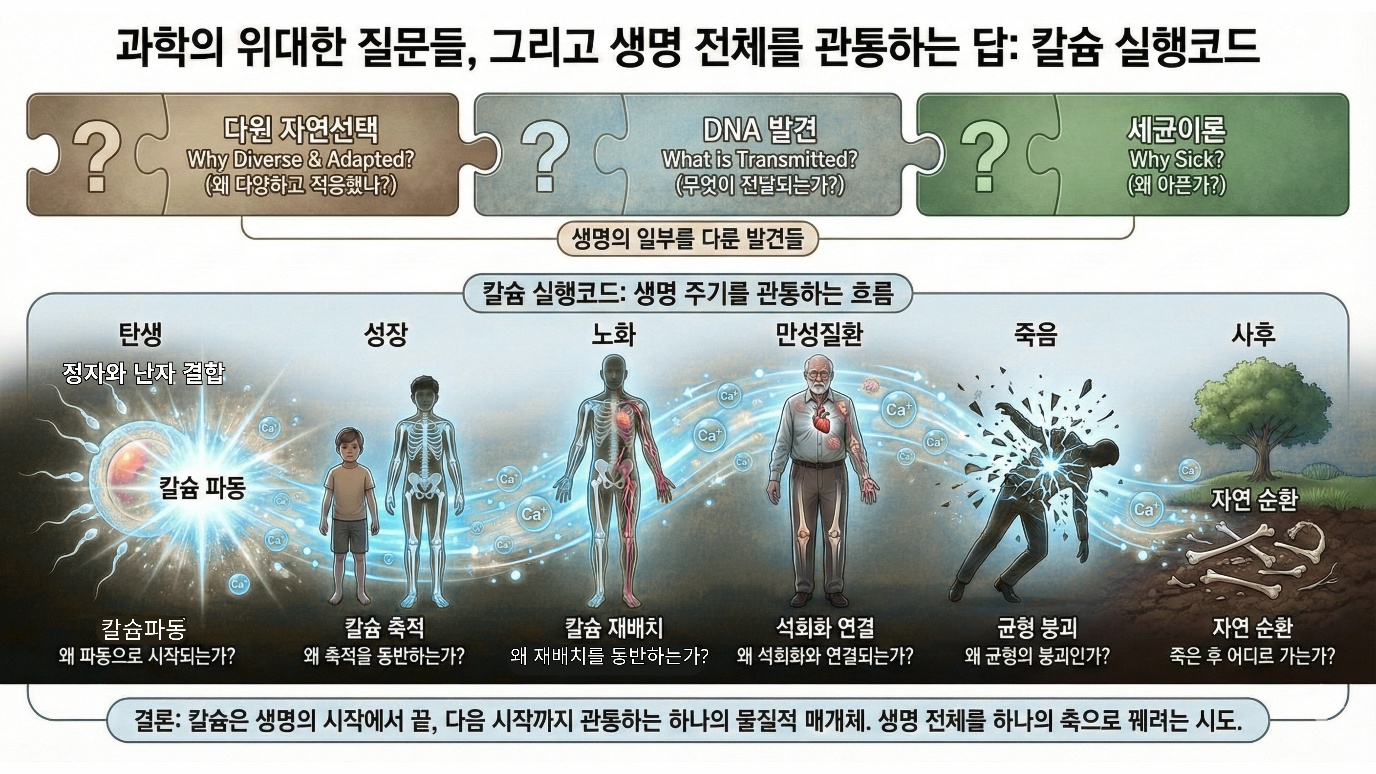
So what is that conductor? What reads the information of DNA and directs that protein be made at the right time, in the right place, in the right amount? What coordinates a single fertilized egg to divide into tens of trillions of cells, and those cells to each take up their own role at their own position and become one integrated organism? The answer this book proposes is calcium.
Calcium Executes
The claim that calcium is the conductor of life did not spring up out of nowhere. Research already accumulated over decades in many fields such as cell biology, developmental biology, neuroscience, and cardiology shows the importance of calcium signaling, and this book is an attempt to connect those fragments into a single picture. If we look at the major moments of life one by one, we can confirm the fact that at each of those moments calcium plays a decisive role.
Let us look at the moment of fertilization, the beginning of life. When the sperm reaches the egg and pierces through the cell membrane to enter, a calcium wave arises within the egg. This calcium wave begins at one end of the egg and spreads across the whole like a ripple, and according to several reproductive biology research institutions, without this calcium wave the egg is not activated and development does not begin. The "information" that sperm and egg have met is transmitted by the joining of DNA, but what receives that information and executes the command "begin development now" is the calcium signal. The calcium wave wakes the egg and fastens the first button of cell division.
In the process of cell division too, calcium plays a key role. At each stage of the cell cycle, that is, at each transition point from G1 phase to S phase, from S phase to G2 phase, from G2 phase to M phase, calcium signaling is involved. Calcium binds with a protein called calmodulin to activate various enzymes, and these enzymes switch on and off the genes that regulate the cell cycle. According to several cell biology research institutions, if calcium signaling does not work properly, cell division halts or proceeds abnormally and can lead to diseases such as cancer.
The process of cell differentiation is even more striking. How does a cell with the same DNA become a nerve cell, a muscle cell, or a bone cell? This is the domain of epigenetics, where chemical marks such as DNA methylation and histone modification regulate the expression of genes. And yet, according to several epigenetics research institutions, a considerable part of these epigenetic changes is triggered by calcium signaling. For example, a transcription factor called NFAT is normally in the cytoplasm, but when the calcium concentration rises it is dephosphorylated by an enzyme called calcineurin, enters the nucleus, and activates specific genes. Which gene is activated depends on the pattern of the calcium signal, that is, on how high the calcium concentration rises, how often it rises, and how long it is sustained.
According to an important study published in 1998, when the frequency of calcium oscillation differs, different transcription factors are activated. A slow calcium oscillation of 2 times per minute activates a transcription factor called NF-κB, and a fast calcium oscillation of 10 times per minute activates NFAT. The same cell, the same DNA, the same calcium ion, and yet when the rhythm of the oscillation differs, an entirely different gene is switched on. This is just like Morse code. As a different combination of dots and dashes becomes an entirely different message, so a different pattern of calcium oscillation executes an entirely different gene program. If DNA specifies "what can be made," then the calcium signal decides "what is to be made here and now."
The process by which bone is made also shows well the dual role of calcium. When a stem cell differentiates into a bone cell, calcium signaling activates key transcription factors such as Runx2 and Osterix. When the differentiated osteoblast secretes collagen a calcium signal is also needed, and it is calcium that is used as the material when hydroxyapatite crystals are deposited onto that collagen. That is, calcium is both the signal that transmits the command to make bone and the material that makes the bone. It performs the roles of signal and material, conductor and instrument, software and hardware, all at the same time.
In the development and working of the nervous system the role of calcium is even more decisive. There are about 86 billion nerve cells in the brain, and among these nerve cells there are hundreds of trillions of synaptic connections, as several neuroscience research institutions estimate. When a nerve cell transmits a signal, and the electrical signal reaches the axon terminal, voltage-dependent calcium channels open and calcium ions pour into the cell. This calcium fuses the synaptic vesicles with the cell membrane so that neurotransmitters are released, and these neurotransmitters stimulate the next nerve cell. Without calcium synaptic transmission does not occur, and without synaptic transmission there is no thought, no emotion, no memory, no consciousness.
Moreover, in the process by which the brain develops, the axon of a nerve cell finding its exact target is also guided by calcium signaling. That the strength of synaptic connections is regulated so that learning and memory are formed, this process called long-term potentiation and long-term depression, is also decided by changes in calcium concentration. A high calcium concentration strengthens the synapse, and a low calcium concentration weakens the synapse. That we learn and remember something, the reason this is possible, is that the calcium signal regulates the strength of the synapse. According to several neuroscience research institutions, the phenomenon of consciousness itself emerges from the synchronized activity among countless nerve cells, and what makes that synchronization possible is calcium-based synaptic transmission. Calcium is, literally, the medium of thought.
Two Codes: The Design Code and the Execution Code
Now we can say that life has two codes. One is the DNA design code, and the other is the calcium execution code.
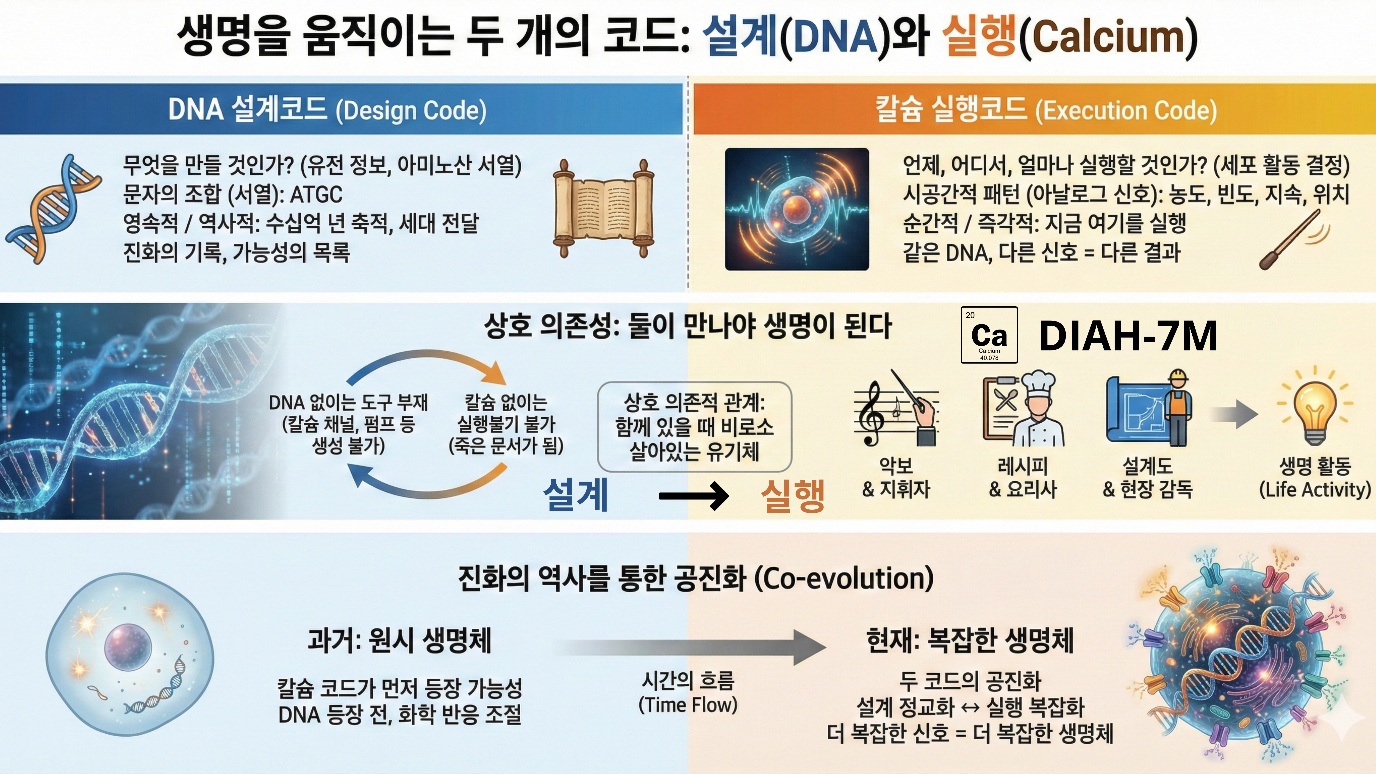
The DNA design code holds genetic information. Which protein can be made, and what the amino acid sequence of that protein is, are written in combinations of the four letters ATGC. This information is passed from parent to offspring, changes little by little through mutation as it crosses generations, and becomes the object of natural selection. The DNA design code is the record of evolution and the list of the possibilities of life. It holds information accumulated over billions of years, and it is passed on across generations.
The calcium execution code holds execution information. It decides "when, where, and how much" a gene is to be expressed, whether a cell is to divide, to differentiate, or to die. This information is not written as a sequence like DNA; it is expressed as the spatiotemporal pattern of the calcium signal. How high the calcium concentration rises, how often it rises, how long it is sustained, at which location within the cell it rises, all hold information. A cell with the same DNA that receives a different calcium signal becomes a different cell, and the same cell that experiences a different calcium pattern expresses a different gene. The calcium execution code is not passed on across generations; it is generated moment by moment and executes the life of the here and now.
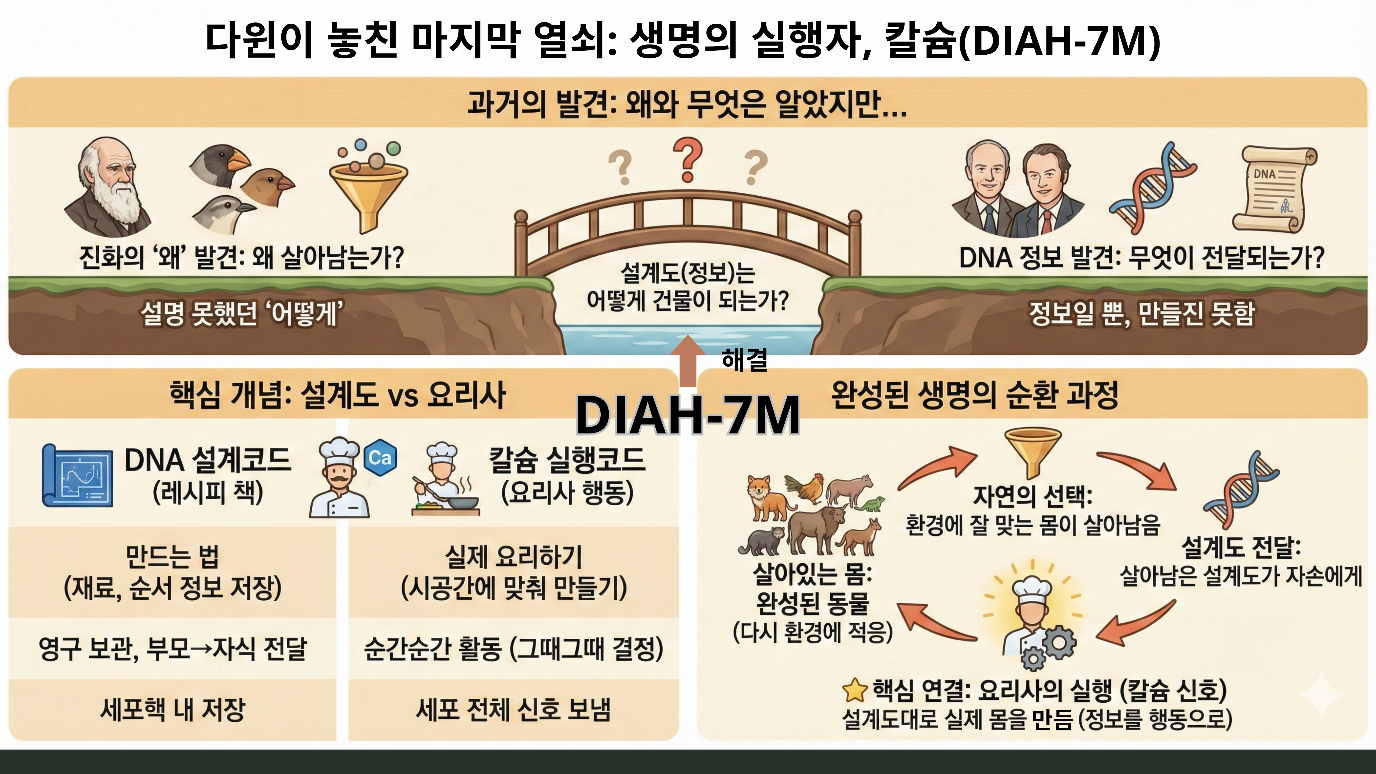
The relationship of the DNA design code and the calcium execution code is mutually dependent. Without DNA neither calcium channels, nor calcium pumps, nor calcium-binding proteins are made, so the calcium execution code itself cannot work. Conversely, without the calcium signal the information held in DNA is not expressed at the right time and place, so DNA becomes a dead document that produces nothing. If the DNA design code is the score, the calcium execution code is the conductor; if the DNA design code is the recipe, the calcium execution code is the cook; if the DNA design code is the blueprint, the calcium execution code is the supervisor at the construction site. With only one of the two there can be no life, and only when the two are together does a living organism at last come to be.
Interestingly, if we look at the history of evolution, there is a possibility that the calcium execution code appeared before the DNA design code. According to several evolutionary biology research institutions, a calcium signaling system is found even in the most primitive life forms, and some scholars conjecture that before DNA and RNA appeared, calcium ions already played a role in regulating chemical reactions. As the DNA design code became more refined, the calcium execution code was refined along with it, and as the kinds of calcium channels increased and calcium-binding proteins diversified, more complex calcium signal patterns became possible, and by that much more complex life forms became possible. The two codes have co-evolved.
Toward a Complete Understanding of Evolution
Darwin discovered natural selection. He answered "what is selected." The individual better adapted to its environment is selected. Mendel and molecular biology discovered DNA. They answered "what is transmitted." Genetic information is transmitted in the form of DNA. The calcium execution code is an attempt to answer "how is it executed." How is the information held in DNA translated into a living body, and the core medium of that translation process is calcium.
If we put these three together, a more complete understanding of evolution becomes possible. Evolution is the process in which variation of the DNA design code is executed by the calcium execution code and appears as a phenotype, that phenotype receives the judgment of natural selection, and the favorable variation is passed to the next generation. Variation of the DNA design code arises through mutation and recombination, execution of the calcium execution code occurs in the process of generation and development, and natural selection occurs in the process by which the resulting individual interacts with its environment.
The four gates of evolution examined from Chapter 1 to Chapter 4 can also be seen again from this viewpoint. That the first cell created a ten thousand-fold difference in calcium concentration between the inside and outside of the cell and laid the foundation of a signaling system, that in the Cambrian animals made calcium-based shells and bones and pioneered new forms and ecological niches, that life which came up onto land evolved the PTH-vitamin D system to maintain bone in a calcium-poor environment, that as the higher brain developed calcium-based synaptic transmission became more refined: all these turning points were the evolution of a new way of handling calcium. The history of evolution is a history of changes in DNA sequence, but at the same time it is a history of the development of the capacity to make use of calcium.
The Integration of the Life Cycle
Earlier, in Chapter 5, we divided the life cycle into the six stages of birth, growth, reproduction, decline, death, and return, and examined them. If we look again at these six stages from the viewpoint of the calcium execution code, the fact that calcium runs through every stage becomes even clearer.
In the birth stage, a calcium wave wakes the fertilized egg. In the growth stage, calcium signaling regulates cell division and differentiation, and calcium becomes the material and builds the bone. In the reproduction stage, calcium signaling regulates the maturation and fertilization of the germ cells. In the decline stage, DIAH conditions mobilize calcium from the bones, and the mobilized calcium executes aging and disease through the 7M pathways. In the death stage, calcium overload triggers cell death, and the heartbeat stops. In the return stage, the calcium of the skeletal remains goes back to soil and sea and becomes the material of the next life.
The DNA design code specifies "what is possible" at every one of these stages, but what decides and executes "what is to be done now" is the calcium execution code. If the DNA design code is the script of life, the calcium execution code is the actor and the director who realize that script upon the stage. As, however excellent the script, without a performance it is not a play, so, however perfect the DNA, without the execution of calcium it is not life.
If we think again about the four gates of evolution examined from Chapter 1 to Chapter 4, each gate was the evolution of the capacity to make use of calcium in a new way. The cell created a difference in calcium concentration and laid the foundation of a signaling system, the multicellular animal made shells and bones out of calcium and gained structure, the land organism evolved a hormone system to manage calcium in a calcium-poor environment, and the higher brain refined calcium-based synaptic transmission to an extreme degree and made consciousness and intelligence possible. Evolution has proceeded in the direction of handling calcium better, and that capacity was itself a core element of fitness.
Conclusion: The Key Darwin Missed
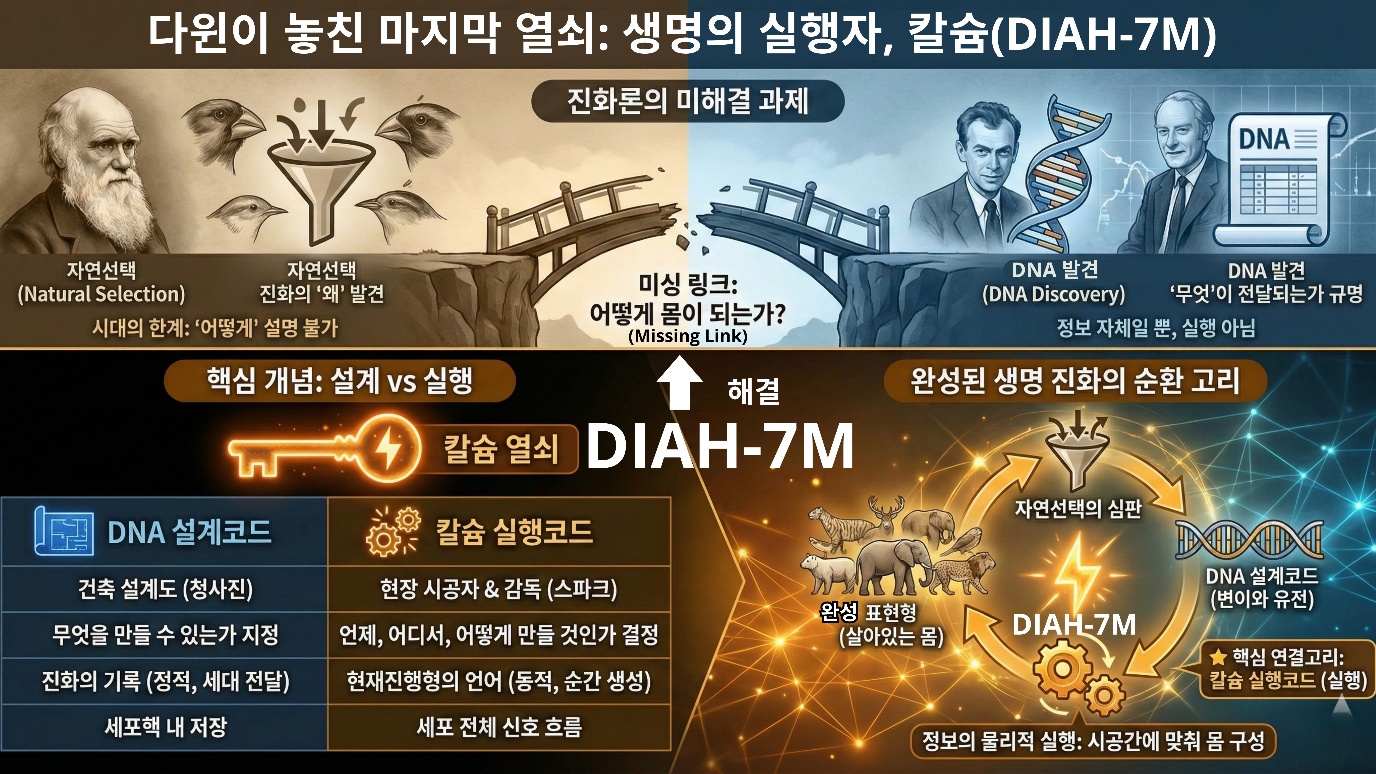
Darwin was the great scientist who discovered the "why" of evolution. But because of the limits of the age he lived in, he could not answer the "how." The discovery of DNA revealed "what is transmitted," but "how the transmitted information becomes a living body" still remains a question not fully answered.
The calcium execution code this book proposes is an attempt to fill that empty place. If DNA is the design code of life, calcium is the execution code of life. If the DNA design code specifies "what can be made," the calcium execution code decides "when, where, and how it is to be made." If the DNA design code is the record of evolution passed on across generations, the calcium execution code is the present-progressive language that is generated moment by moment and executes life.
If Darwin discovered natural selection, and Watson and Crick discovered DNA, the calcium execution code provides the link between them. Natural selection screens the variation of DNA, the screened DNA is executed by the calcium execution code and becomes a phenotype, and that phenotype again receives the judgment of natural selection. As this cycle repeats across generations, life has evolved, and at the heart of that cycle is calcium.
In the next chapter, we will look at where this discovery stands historically, comparing it with the great discoveries of the history of science such as Darwin's theory of evolution, the discovery of DNA, germ theory, and Newton's mechanics.
References
1. Darwin, C. (1859). On the Origin of Species by Means of Natural Selection. John Murray.
2. Watson, J. D., & Crick, F. H. (1953). Molecular structure of nucleic acids: a structure for deoxyribose nucleic acid. Nature, 171(4356), 737-738. doi:10.1038/171737a0
3. Crick, F. (1970). Central dogma of molecular biology. Nature, 227(5258), 561-563. doi:10.1038/227561a0
4. Berridge, M. J., Bootman, M. D., & Roderick, H. L. (2003). Calcium signalling: dynamics, homeostasis and remodelling. Nature Reviews Molecular Cell Biology, 4(7), 517-529. doi:10.1038/nrm1155
5. Clapham, D. E. (2007). Calcium signaling. Cell, 131(6), 1327-1334. doi:10.1016/j.cell.2007.11.028
6. Dolmetsch, R. E., Xu, K., & Lewis, R. S. (1998). Calcium oscillations increase the efficiency and specificity of gene expression. Nature, 392(6679), 933-936. doi:10.1038/31960
7. Bhatt, D. L., et al. (2020). Calcium and cell signalling in disease. Nature Reviews Drug Discovery, 19(11), 775-793. doi:10.1038/s41573-020-0077-2
8. Whitaker, M. (2006). Calcium at fertilization and in early development. Physiological Reviews, 86(1), 25-88. doi:10.1152/physrev.00023.2005
9. Gilbert, S. F. (2014). Developmental Biology (10th ed.). Sinauer Associates. doi:10.1093/icb/icu096
10. Rosenberg, S. S., & Bhalla, U. S. (2019). Calcium signals and neuronal development. Cold Spring Harbor Perspectives in Biology, 11(12), a035329. doi:10.1101/cshperspect.a035329
11. Carafoli, E., & Krebs, J. (2016). Why Calcium? How Calcium Became the Best Communicator. Journal of Biological Chemistry, 291(40), 20849-20857. doi:10.1074/jbc.R116.735894
12. Case, R. M., et al. (2007). Evolution of calcium homeostasis: from birth of the first cell to an omnipresent signalling system. Cell Calcium, 42(4-5), 345-350. doi:10.1016/j.ceca.2007.02.001
13. Dupont, G., Combettes, L., Bird, G. S., & Bhalla, U. S. (2011). Calcium oscillations. Cold Spring Harbor Perspectives in Biology, 3(3), a004226. doi:10.1101/cshperspect.a004226
14. Bhatt, D. L., & Bhalla, U. S. (2023). Calcium signalling in development and disease. Nature Reviews Molecular Cell Biology, 24(5), 345-362. doi:10.1038/s41580-022-00572-6
15. Paudel, S., et al. (2021). Calcium signaling in vertebrate development. Development, 148(12), dev199645. doi:10.1242/dev.199645