
This piece is the opening part of Chapter 2 of Calcium: The Reality of Evolution That Darwin and the Genome Map Missed (Yoon Jong-won). The body, figures, and citations follow the manuscript as written.
Introduction: Darwin's Mystery
Charles Darwin published On the Origin of Species in 1859 and gave the world the theory of evolution by natural selection. This book changed the history of biology, provided an integrated framework for explaining the diversity of life, and remains to this day the central paradigm of the life sciences. Yet, as Darwin himself admitted, his theory held one riddle that was difficult to explain.
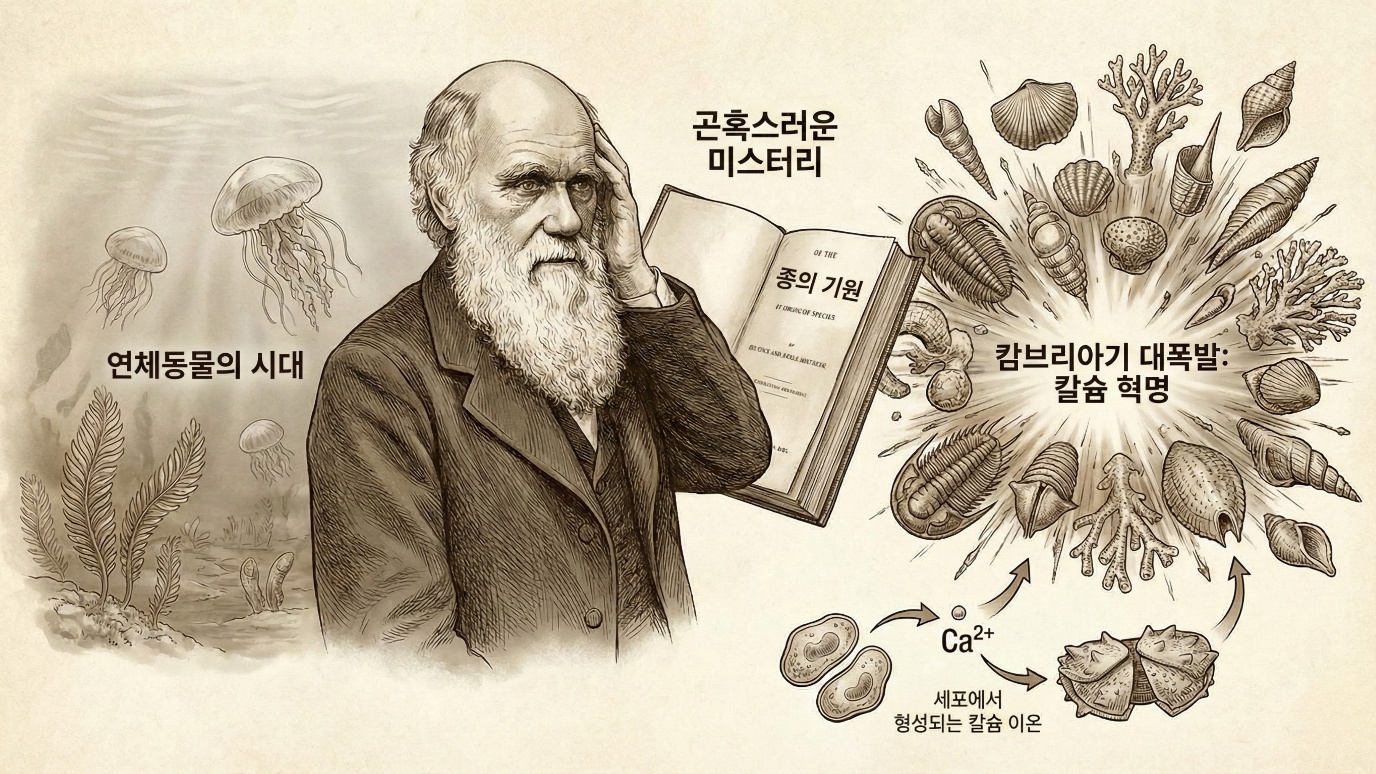
It was the Cambrian fossil record. Darwin called it a "perplexing mystery." According to his theory, evolution had to happen gradually. Small variations had to accumulate across generations, and new species had to appear slowly. Yet the fossil record told an entirely different story. It said that 540 million years ago, in the blink of an eye geologically speaking, almost all animal phyla suddenly appeared. It was not gradual change but an explosive appearance. And these animals had one astonishing thing in common. They all possessed shells and skeletons.
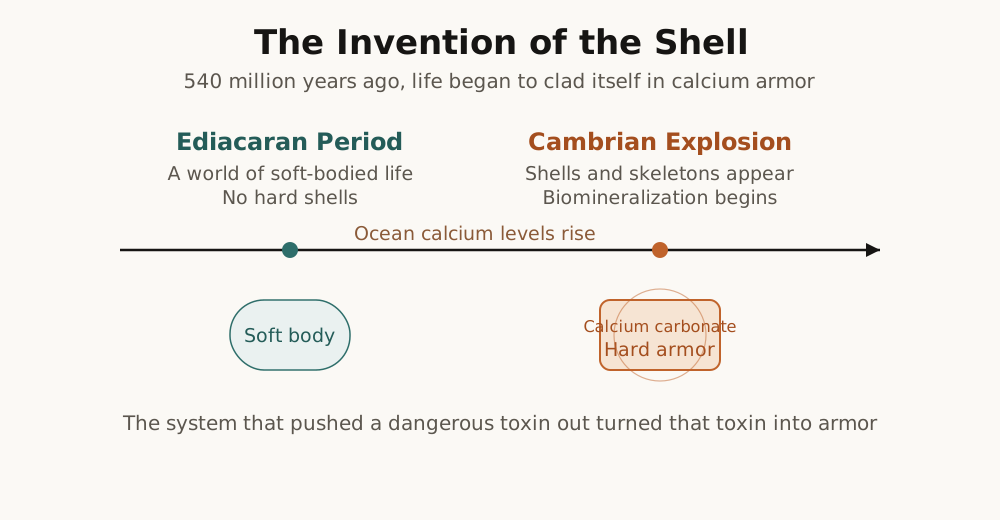
Before the Cambrian, in the age called the Ediacaran, the earth's seas were a world of soft-bodied creatures. These organisms, called the Ediacaran biota, had soft bodies. They were strange forms of life, squishy like jellyfish, undulating like seaweed, and living attached to the seafloor. They rarely left fossils, and so the Precambrian was for a long time misunderstood as "the age when there was no life." But once the Cambrian arrived, the situation changed completely. The hard dorsal shell of the trilobite appeared. The two valves of the brachiopod appeared. The calcium skeletons of corals began to cover the seafloor. For the first time in the history of life, animals began to put on armor. The age of soft-bodied creatures ended, and the age of creatures clad in hard shells opened. What was the material of this armor? Most of it was calcium carbonate and calcium phosphate. The Cambrian explosion was, in short, a calcium revolution. Life went beyond merely managing calcium inside the cell and began to pile calcium up outside the cell to build structures. In this chapter, we will look at how this calcium revolution happened, why it happened, and what significance it holds for the later evolution of life.
The Cambrian Explosion: The Greatest Riddle in the History of Evolution
To properly understand the scale of the Cambrian explosion, we must first grasp the scale of time. The age of the earth is about 4.5 billion years. It was about 3.8 billion years ago that, as the solar system formed and the earth cooled from a mass of hot lava so that seas appeared, the first living organism emerged from those seas. So life has existed for a length of time so long that it is hard to imagine, corresponding to about 85 percent of the earth's history. Yet during this long time, life mostly remained in an invisible microbial state. Bacteria and archaea ruled the seas, and there were almost no organisms visible to the naked eye. It was only 600 to 700 million years ago that multicellular organisms emerged. In the 3.8 billion year history of life, the period during which multicellular organisms have existed is not even 20 percent. And it was 540 million years ago, in the Cambrian, that complex animals explosively diversified.
More astonishing still is the span of time in which this explosion happened. According to the results of precisely measuring the ages of strata at various geological research institutions, most of the major animal phyla appeared intensively within a short span of roughly 20 million to 30 million years. A span of 20 million years may not feel short. Humans appeared only a few million years ago, and civilization began 10,000 years ago. But in the whole 3.8 billion year history of life, 20 million years is not even 1 percent. To make a comparison, out of the 365 days of a year, it is a span of a little more than 3 days. After almost no change all year long, everything changed in 3 days. In this brief moment, the basic blueprints of nearly all animals that exist today appeared. Arthropoda, Mollusca, Annelida, Chordata, Echinodermata. Almost all of the roughly 30 phyla that exist in today's animal kingdom appeared at this time. And in the 500 million years since, hardly any new phylum has appeared. The Cambrian explosion was an event in which all the basic blueprints of animal body plans poured out at once.
Here we must make one important distinction. What exploded in the Cambrian explosion was not the number of species. It was that body plans at the level of phylum, class, and order, that is, the basic body-structure blueprints of organisms, explosively diversified. Species have continued to arise and go extinct ever since. Dinosaurs appeared and went extinct, mammals diversified, and humans appeared. But all of these changes are no more than variations that occurred within the basic body plans established in the Cambrian. We humans belong to the phylum Chordata, and the basic blueprint of Chordata was already established in the Cambrian. A structure with a support structure called the notochord along the back, a neural tube above it, and gill slits. Our ancestor that swam in the seas 500 million years ago also had this basic structure, and we today have the same structure. The vertebral column evolved from the notochord, the brain is the enlarged front part of the neural tube, and the jaw is a transformation of the bones that once supported the gill slits. The Cambrian explosion was an event that created the catalog of basic body plans that evolution could experiment with.
One of the most conspicuous features of the Cambrian explosion is the sudden appearance of shells and skeletons. Most of the Ediacaran organisms had soft bodies. To be left as a fossil there must be a hard part, but because these creatures had no hard part, fossilization occurred only under exceptionally good conditions, for example only when fine sediment rapidly covered them and imprinted their form. That is why fossils of the Ediacaran biota are found in only a few special places in the world. But once the Cambrian began, the fossil record increased explosively. Fossils are found in Cambrian strata anywhere in the world. Why is that? Because animals came to have hard shells and skeletons. Hard shells are easily left as fossils. When an animal dies, the flesh rots away, but the shell remains. That shell is buried in sediment, and when it is replaced by mineral it becomes a fossil. The explosive increase in the Cambrian fossil record is in fact the combined result of an explosive increase in animal diversity and of the appearance of shells making fossilization easier.
If we look closely at the Cambrian fossil record, skeletons made of various minerals appear. Shells made of calcium carbonate, shells made of calcium phosphate, skeletons made of silica, exoskeletons made of chitin. But even among these, overwhelmingly the most common were calcium-based minerals. The hard dorsal shell of the trilobite is calcium carbonate. The two valves of the brachiopod are also calcium carbonate. The skeletons of echinoderms, that is, the ancestors of sea urchins and starfish, are also calcium carbonate. The skeletons of corals are also calcium carbonate. The ancestors of vertebrates began to make bone out of calcium phosphate. The Cambrian explosion was a revolution of biomineralization using calcium. Life began to use calcium in a new way. But to make a shell, calcium alone is not enough. What is needed is a living net that can hold calcium in place and shape it into the desired form, that is, a protein matrix such as collagen. Collagen has a triple helix structure in which three strands of amino acid chains are twisted together, and to make this structure a process is needed that attaches hydroxyl groups to the amino acids proline and lysine. And the enzyme that catalyzes this reaction requires oxygen. In the Cambrian, not only the calcium concentration but also the oxygen concentration of the atmosphere and the ocean surged. According to various geochemical research institutions, between the end of the Ediacaran and the early Cambrian the atmospheric oxygen concentration rose from below 10 percent of the present level to close to the present level. This means it became possible to make the living net that would hold calcium in place. Calcium and oxygen, the two conditions were met at the same time.
Where Did the Calcium Come From: Changes in Ocean Chemistry
What is the reason that animals suddenly began to make shells in the Cambrian? To answer this question, we need to look at how the chemical composition of the sea at that time changed. In 2012, the geologist Shanan Peters of the University of Wisconsin-Madison and Robert Gaines of Pomona College published an interesting paper in the journal Nature. It was the claim that the trigger of the Cambrian explosion was related to a geological phenomenon called the "Great Unconformity." What is the Great Unconformity? This phenomenon was first named in 1869 by the explorer and geologist John Wesley Powell as he explored the Grand Canyon. If you look at the cliffs of the Grand Canyon, at the bottom there is old bedrock billions of years old, and directly on top of it lies young sedimentary rock 500 million years old. The rock record of the billions of years that should have been in between has vanished. It is as if dozens of middle chapters had been torn out of a book. This discontinuity surface is the Great Unconformity. And this Great Unconformity is not only in the Grand Canyon. A similar phenomenon is observed in many places around the world at a similar time.
Peters and Gaines argued that in the process by which this Great Unconformity formed, an enormous amount of ions flowed into the sea. For the Great Unconformity to form, old bedrock must be exposed at the surface. And exposed rock weathers. As rain falls, wind blows, and temperature rises and falls, rock breaks apart and dissolves. The minerals contained in the rock dissolve into water and flow into rivers, and from rivers into the sea. According to Peters and Gaines's calculation, while the Great Unconformity was forming, ions such as calcium, iron, potassium, magnesium, and silica dissolved into seawater in large amounts. In particular, the influx of calcium was prominent. Peters said this in an interview. "The amount of ions that flowed from the continents into the sea during the period when the Great Unconformity was forming was enormous. This fundamentally changed ocean chemistry, and offered organisms new opportunities and challenges at the same time."
Peters and Gaines's hypothesis showed a picture consistent with other studies published earlier. In 2001, the geochemist Tim Lowenstein of Binghamton University and his research team published in the journal Science a study that reconstructed the chemical composition of ancient oceans by analyzing fluid inclusions trapped in ancient rock salt. Rock salt is a mineral that forms as seawater evaporates, and when rock salt crystals form, small droplets of water are sometimes trapped inside them. These droplets, that is, the fluid inclusions, preserve exactly the composition of the seawater at the time that rock salt formed. They are like a time capsule. Lowenstein's team extracted fluid inclusions from rock salt of different eras and analyzed their chemical composition. The result was astonishing. At the end of the Ediacaran, about 544 million years ago, the ocean's magnesium-to-calcium ratio was roughly around 4. But in the early Cambrian, about 515 million years ago, this ratio dropped to a level of 1. That the magnesium-to-calcium ratio dropped from 4 to 1 suggests that it became a "calcium-rich sea" environment in which the calcium concentration had relatively risen greatly. The specific absolute concentrations and the extent of change differ slightly from study to study, but there is a relatively consistent consensus on the point that the early Cambrian was an ocean-chemistry environment in which calcium was easy to use.
Here we must understand the role of magnesium. Magnesium is a "spoiler" that hinders the crystallization of calcium. For calcium carbonate to precipitate as a crystal, calcium ions and carbonate ions must be arranged regularly, but when there are many magnesium ions, magnesium wedges into the calcium's place and hinders crystal growth. Magnesium has a smaller ionic radius than calcium, so it does not fit perfectly into the crystal lattice, and thus it creates defects in the crystal and slows its growth. When the magnesium-to-calcium ratio is high, it is difficult for an organism to make a calcium carbonate shell. Conversely, when this ratio drops, it becomes much easier for calcium to harden into a crystal. That the magnesium-to-calcium ratio dropped in the early Cambrian means, beyond simply that calcium became more abundant, that it became a "sea in which there was no resistance to calcium hardening into bone." Lowenstein wrote this in his paper. "During the period when the Cambrian explosion occurred, the calcium concentration of the ocean rose greatly. The rise in calcium concentration may have stimulated the origin of shell-bearing organisms."
Here a major paradox, and also the great wisdom of life, appears. In Chapter 1 we learned that the cell thoroughly excludes calcium. When the cytoplasmic calcium concentration rises, ATP precipitates, proteins aggregate, and the cell membrane is destroyed, and so the cell dies. Calcium is a poison to the cell. Yet in the Cambrian the ocean's calcium concentration surged. To organisms, this was not a blessing but the air raid of an enormous toxic substance. The pressure of calcium pushing to flow from seawater into the cell became stronger. The cell had to spend more energy to pump calcium out, and even so it would have been difficult to completely prevent calcium from penetrating in. Peters explained this situation this way. "The body has to maintain a balance of ions. When there is too much of some ion, it has to get rid of it. And one way to get rid of it is to make a mineral."
In other words, biomineralization may not have evolved for some purpose in the beginning, but may have started as a response to the environmental challenge of calcium excess. The calcium that had entered the cell had to be dealt with somehow. Pumping it out also had its limits. So the cell pushed it out of the cell and hardened it into a solid. The first shell did not evolve as a shield to fend off enemies, but was closer to a lump of calcium pushed out of the cell in order to survive. This is precisely what evolutionary biology calls co-option, in English exaptation. It is the phenomenon in which a trait that originally evolved for purpose A is later used for purpose B. A calcium-excretion system that began for detoxification, by chance became a hard protective covering and was turned into an innovative weapon that protects the self from predators. In trying to throw away poison, it gained armor. From the very beginning, life defined calcium excess as a poison and mastered the technology of isolating it. 500 million years ago that became the springboard of an evolutionary leap. But in the body of modern humans, uncontrolled calcium isolation becomes a disease called vascular calcification. This irony, in which the success formula of the past becomes the cause of disease in the modern age, is precisely the reason we must learn calcium anew.
The First Shell-Bearing Organism: Cloudina
Just before the Cambrian explosion began in earnest, at the end of the Ediacaran, several kinds of shell-bearing organisms had already appeared. They were the pioneers who played the prelude to the Cambrian explosion. Among them the most famous and the most widely studied is Cloudina. Cloudina was first discovered in Namibia in 1972, and was named after Cloud's farm, the place of its discovery. Cloudina fossils have the form of a tube in which small funnel-shaped structures are stacked layer upon layer. It looks as if several paper cups had been stacked one inside another. The size of an individual structure is only a few millimeters, but these connect to form a tube several centimeters long. It is not certain what kind of animal lived inside this tube. It is presumed that probably a small animal with tentacles lived hidden inside the tube and caught its prey by reaching out its tentacles. Since Cloudina was first discovered in Namibia, its fossils have been found around the world in Oman, China, Siberia, Mexico, Brazil, Spain, Canada, and elsewhere. Being distributed so widely geographically shows that this organism was quite successful at the time. In time, it appears concentrated mainly in the end of the Ediacaran, between about 550 million and 540 million years ago, but there are also reports that in some regions it survived into the early Cambrian.
Cloudina's shell is made of calcium carbonate. According to analyses of the mineral composition of Cloudina fossils at various paleontological research institutions, the original mineral was most likely aragonite. Aragonite is a form of calcium carbonate; its chemical formula is CaCO₃, the same as calcite, but its crystal structure is different. Aragonite has an orthorhombic structure while calcite has a trigonal structure. Aragonite is less stable than calcite and tends to convert to calcite over time, and over more than 500 million years most Cloudina fossils have turned into calcite. But in some exceptionally well-preserved specimens, evidence is found that they were originally aragonite. Aragonite is a mineral commonly found today in the shells of corals and shellfish. That Cloudina used aragonite means that the same kind of mineral used by today's marine invertebrates was already being used 500 million years ago.
But there is an interesting point. Cloudina's way of mineralizing was, compared with later Cambrian animals, structurally simpler and a less sophisticated form of control. Professor Susannah Porter, a paleontologist at the University of California, Santa Barbara, explained the results of her comparative research on the shells of Cloudina and Cambrian animals this way. "Early biomineralizing organisms such as Cloudina did not control the process of making a shell very well. The thickness of the shell is not uniform, and the arrangement of the crystals is also irregular. But by the Cambrian, carbonate-mineralizing organisms come to have complex and sophisticated shells. Their control over the shell became far greater. Microstructures stacked layer upon layer, precisely arranged crystals, mineral deposited exactly only where needed. This shows that biomineralization technology evolved over tens of millions of years."
According to recent research that analyzed Cloudina fossils with high-resolution electron microscopy, this organism made its shell by a method called particle-attachment crystallization. This is not a matter of taking calcium ions and carbonate ions one by one from seawater and piling them onto a crystal lattice, but rather a way of first making amorphous calcium carbonate nanoparticles, that is, ones without a regular crystal structure, and then gathering these nanoparticles and converting them into crystals. What is the advantage of this method? Amorphous nanoparticles can be made inside the cell and secreted outside the cell. And the nanoparticles can be transported to a desired location and then crystallized there. Doing so makes it possible to control, to some degree, where and in what form the crystal will grow. Astonishingly, this method is the same as the one used today by various animals such as sea urchins, mollusks, and corals. That several animal phyla that are phylogenetically distantly related to one another independently chose the same method suggests that this method has some fundamental advantage when it comes to biomineralization.
There was one more important discovery in Cloudina fossils. Holes bored into the shell. Some of the Cloudina fossils found in the Tamengo Formation of Brazil have small holes bored into the shell. The edges of the holes are cleanly bored, so they look not like natural weathering or damage but like something deliberately bored through them. Researchers interpret these holes as being made by predators. It is evidence that some animal bored through Cloudina's shell and ate the soft body inside. Behavior similar to a snail today boring a hole into a clam shell and eating the contents existed even 500 million years ago. This holds a very important meaning. It is that the evolution of the shell may be related to predation pressure. When predators appeared, prey evolved shells for defense. And predators evolved the ability to bore through shells. Prey evolved thicker shells, and predators evolved stronger teeth or more effective hole-boring techniques: a vicious cycle, or, seen from the evolutionary point of view, a development driven by mutual stimulation began. What is called an arms race began, and it is possible that this arms race was one cause of the Cambrian explosion.