
This piece is the opening part of Chapter 8 (1) of The Declaration of the Age of Physical Economics (Yoon Jong-won, Yoon So-ri, Yoon Jun). It is an academic exposition presenting the authors' physical economics hypothesis, and the body, figures, and citations follow the manuscript as written.
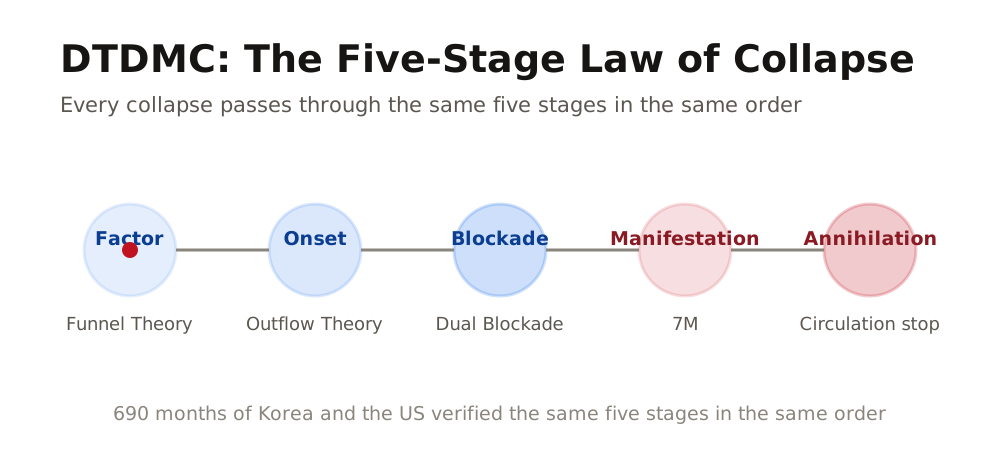
Once the equation that the human body and a nation's economy stand on the same blueprint holds, one question naturally follows. If the blueprint is the same, is the order of collapse the same too? If there is a fixed sequence in the process by which the human body loses its health, is there the same sequence in the process by which a national economy sinks into crisis? Before answering this question, there is one point to address first. Whenever we meet a great crisis, we say "it happened all of a sudden." Looking at the diagnosis received one day, we say "just a month ago I was perfectly fine." The owner whose sales collapsed in some quarter says "up until last year it was okay." The couple who decides one day to end their marriage says "up until a few months ago it was still livable." Yet when a doctor watches a patient over a long time, when an accountant looks into a shop's ledgers, and when a family counselor traces back through a couple's time, almost the same fact is found. That "all of a sudden" was in fact not sudden at all. The illness written on the diagnosis had been progressing little by little for five years, the collapsed sales had been losing customers for three years, and the crack between the couple had also been building up from small quarrels long before. From the outside it looked perfectly fine, but on the inside things had already been proceeding in a fixed order.
So how can we know this fixed sequence, this pathway of collapse? In fact, science has long offered one answer to this question. In the mid-nineteenth century, the German physicist Rudolf Clausius formulated a one-line law in 1865. It is the proposition that whatever does not receive enough energy from outside will eventually fall apart. In daily life this law works everywhere. If you leave a hot cup of coffee on the table, it cools as time passes. A cooled cup of coffee never warms itself back up on its own. A desk you tidied up neatly grows messy after only a few days, but a messy desk never tidies itself up on its own. Our bodies too grow weaker as time passes; there is no such thing as becoming younger today than yesterday. This one-line law has explained the direction in which almost every collapse goes, from the death of a star to the aging of a person.
Yet this law has one great limitation. It tells us the fact that things "eventually fall apart," but it does not tell us through which stages and in what way they fall apart. Suppose a person is losing their health. Where they eventually end up (frailty and death) can be known from this law, but when the first signal appears, what follows next, and which moment is the point of no return cannot be known. Suppose a company is struggling. We know the fact that it may eventually fail, but we cannot know which stage it is in now or what will strike next. It is like an old map on which the point of departure and the destination are marked but the road between them is left empty. In science, such a domain where what happens inside cannot be seen is often called a black box. The direction of collapse had been found out, but the sequence within it remained a black box for a long time.
The tool this book intends to introduce is precisely the work of opening that black box. Think of driving. If you drive with only an old map that lists just the point of departure and the destination, you constantly lose your way and turn onto wrong roads. So the tool we use is navigation. Navigation tells us one more thing. It is the information about which roads to take from departure to destination, where to turn left, where to turn right, and which road is blocked so that you must go around by another road. If the map of collapse that humanity has had until now was an old map, the tool to be introduced now corresponds to navigation. It is a tool that points out, one stage at a time, at which stage the road begins to narrow, at which fork the two roads are blocked simultaneously, and from where things accelerate in only one direction so that there is no coming back. The name of this navigation is DTDMC.
DTDMC is a law that organizes the five stages of collapse. It is a name assembled from the English initials of the five stages. Determinants, Trigger, Dual Blockade, Manifestation, Collapse. The first stage is the period when pressure quietly accumulates, the second stage is the period when that pressure crosses a limit and begins to draw on emergency resources, the third stage is the period when two roads are blocked simultaneously so that there is no longer any way to compensate, the fourth stage is the period when the damage that had been progressing inside comes to the surface, and the fifth stage is the period when the system shuts down or barely comes to a halt with outside help. The most interesting thing about these five stages is the fact that, regardless of the field in which the collapse occurs, it proceeds in the same order. When a star dies, when a river dries up, when a person's body grows old, when a nation's economy meets a crisis, all follow the same five stages in the same order. What flows and where it passes through differ by field, but the sequence of collapse itself is invariably preserved. And there is a clear reason this book calls DTDMC not a metaphor but a universal law. As a result of examining every month of monthly data without missing a single month, 351 months of Korean data and 339 months of American data, 690 months combined, this law has never once falsely reported a crisis that did not exist, nor missed a real crisis. Data spanning 30 years points to one conclusion. The five stages are not a metaphor or a model but a structural law that actually operates.
There have been several grand theories dealing with system collapse, but there was no theory that actually pointed out the sequence of collapse. DTDMC is the law that fills that gap, and it has been confirmed that the same five stages, after first being discovered in medicine, operate identically in stars, rivers, ecosystems, and the climate, and they operate with the same structure in a nation's economy as well. The long-term data of Korea and the United States is the basis for this.
The Gap the Existing Laws Failed to Answer
Let us look a little more closely at the 1865 paper by Clausius noted in the introduction. In that year, in a single paper, the German physicist Rudolf Clausius summarized in one line the great direction flowing within nature. It is that if a system does not receive enough energy from outside, the disorder within it grows greater and greater. The influence this one line holds is enormous. From the death of a star to the aging of a person, the direction in which almost every collapse goes fits entirely within this one line. However, as already noted in the introduction, this law says nothing about the sequence in which collapse occurs. It tells us where things go but does not tell us by which road they go.
About a century and a half later, complexity science, which emerged in the latter half of the twentieth century, answered another question. Complexity science is a relatively young field that deals with phenomena in which many elements are intertwined and therefore show fluctuations that are hard to predict in advance. The Dutch scholar Marten Scheffer and his fellow researchers published a paper in the journal Nature in 2009, summarizing what advance signals a system sends out before a great change. It is the interesting discovery that, once it wavers, it takes conspicuously longer to return to its original state, and the width of that wobble grows larger and larger, and this appears just before a crisis. However, while this theory points out where the critical point (the limit point that, once crossed, moves the system into a different state) lies and what signals are seen before it, it does not deal with how the system arrived at that critical point or which road it passed through. It points out the moment but does not point out the road.
Coming over to the economic field, the American economist Hyman Minsky offered another answer in his 1986 book Stabilizing an Unstable Economy. It is the insight that in stable times debt piles up steadily, and the moment that debt crosses a certain line, a crisis breaks out. This view, often called the financial instability hypothesis, explains well how internal accumulation within the economic system spreads into a crisis. However, it has one limitation. This hypothesis holds only within the single field of the economy. Take it to medicine or the climate or ecosystems and it does not immediately fit. This means that the field it deals with is narrow and the pathway it follows is also short.
One more person must be noted. The Austrian biologist Ludwig von Bertalanffy put forward an answer at the level of the largest picture in his 1968 book General System Theory. He organized the common principle that every system has inputs and outputs, has a boundary that divides inside from outside, and continually exchanges with its environment. It is a large frame that holds across academic fields, but one thing is missing. He did not say by which road, specifically, a system collapses when it collapses. There is a principle, but the stages are empty.
When these four theories are gathered in one place, an interesting fact emerges. In which direction does collapse go, at which moment does the critical point come, how does accumulation within one field spread into a crisis, and what is the principle of systems in general. All four questions have answers. Yet three questions in fact remain unsolved. When collapse occurs, which stage comes after which stage. Is that order the same for stars and the human body and the economy alike. Which stage is the turning point of no return. A universal law that answers these three questions has, at least until now, not been established.
DTDMC is precisely the law that fills that gap. This does not mean it seeks to quarrel with the existing four theories. Rather, it stands in a position of going together with them. It follows exactly the same direction of collapse that Clausius pointed to. The critical point Scheffer noted lies exactly at the third of the five stages, that is, the point where blockade is fully applied. The accumulation of debt that Minsky spoke of falls within the first stage, that is, the factor stage. Upon the large frame of systems in general that Bertalanffy drew, the concrete pathway of collapse is laid. It is a matter of placing the existing theories in a new position and, at the same time, filling in the boxes that had been empty.
The Gap DTDMC Fills: A Comparison with the Existing Grand Theories
| Theory | Question it answers | Question it does not answer |
|---|---|---|
| The second law of thermodynamics | In which direction does collapse go | In which order does collapse occur |
| Critical transition theory (Scheffer) | Where is the critical point and what advance signals exist | The entire pathway up to the critical point |
| Financial instability (Minsky) | How does internal accumulation lead to crisis within the economy | Does it apply to fields outside the economy |
| General system theory (Bertalanffy) | What is the principle of systems in general | The concrete pathway when a system collapses |
| DTDMC | In which order does collapse occur, and how is it the same form across fields | Not applicable |
The Large Frame of the DTDMC Five Stages
The most interesting thing about the five stages is the fact that they keep the same shape regardless of what flows, through what it flows, and what hardens to block the flow. This book calls these three things, respectively, the medium, the channel, and the deposit. The medium is the flowing thing itself, the channel is the road that flow passes through, and the deposit is the residue that lodges in that road and narrows the flow. In a star, nuclear fusion fuel flows; in a person's body, calcium flows; in a nation's economy, cash flows. The name of the flowing thing differs by field, but the shape of the five stages itself is preserved as it is. That is why one and the same law can explain a star and a person's body and the economy together. Let us organize what period each of the five stages is, while also recalling in what shape these stages appear within daily life.
The first stage is the factor. It is the period when pressure accumulates latently, that is, without showing on the surface, piling up steadily. Inside the system the burden is deepening, but from the outside it looks the same as always. It is not hard to recall this stage in our daily life. The period when late-night work continues every day at the company but the person still says "I'm fine" is the factor stage. The period when the account balance is dropping little by little but the card can still be used normally, the period when small quarrels grow frequent between a couple but conversation at the dinner table still continues, the period when a parent starts taking one or two new medicines saying "it's nothing." All of these are the appearance of the factor stage. The macro indicators are all stable, and the people living within that system fail to notice that a crisis is approaching. The length of the latency varies greatly by field. In a star's core it is billions of years, in a person's microvasculature it is decades, in a household it is about five to ten years, and in a nation's economy too it is usually about five to ten years. The lengths differ, but the fact that the moment the latency ends the system moves on to the next stage is the same for all.
The second stage is the onset. The moment the accumulated pressure crosses a certain limit, that is, the critical point, the system begins its emergency action. Critical means the limit point that, once crossed, accelerates the system in a different direction. The essence of this compensatory response converges on one thing. It is to melt down future assets to block the present crisis. In our daily life too this stage appears in a clear shape. When late-night work crosses the limit, a person says "let's just finish this one project" and puts off vacation and draws on the stamina they had stored up. When the household budget tightens, they break a savings account or dip into an overdraft. When a marriage begins to shake in earnest, one side says "let me endure it" and starts drawing on their reserve of emotion. The point when a parent first begins undergoing tests at a large hospital is also the same stage. All are the same in that they draw future resources in advance to block the present crisis. When the central pressure crosses the critical point, a star contracts and heats its outer shell. When blood calcium concentration wavers, a person's body secretes parathyroid hormone (a hormone that acts to raise blood calcium concentration) and draws calcium out of the bone. When foreign exchange runs short, a nation releases its foreign exchange reserves, and a household breaks its emergency savings. The fields differ, but the action is the same. And the fact that this mobilization always leaves a byproduct is the same too. Part of the mobilized resource fails to return to its original place and hardens elsewhere, beginning to narrow the channel.
The third stage is the blockade. It is the decisive stage that lies at the very center of the five stages. At this stage two kinds of blockade are applied simultaneously. Somewhat difficult names are attached to them, but understood in daily terms they are not hard. First, the first blockade is a blockade at the level of signal. Its formal name is CAM (Conductance Attenuation Metric, functional operation signal blockade). It refers to the state in which commands within the system fail to be transmitted all the way to the periphery. Recalled in daily life, the state in which even when the boss announces a new policy at the company it does not get through at all to the frontline staff, the state in which no matter how much a parent speaks to a child it does not reach the child's ears, the state in which even when the government puts out a policy it does not affect the circumstances of the alleyway shop, all correspond to signal blockade. The second blockade is a blockade at the level of the physical. Its formal name is DLT (Deposition-induced Luminal Throttling, physical channel blockade). It refers to the state in which the very road along which the medium flows has narrowed. Recalled in daily life, the state in which no matter how good the work coming in, there are not enough people to handle it, the state in which even though the person wants to work, the body does not follow, the state in which money is out there in the market but simply does not come into the shop's account, all correspond to physical channel blockade.
If only one of the two blockades is applied, the system compensates on the other side and somehow holds on. If the signal does not get through, it delivers the message even by legwork; if the road narrows, it looks for another way. But the moment comes when the two blockades are applied simultaneously. When the signal does not get through and the road is blocked as well, the very means of compensating disappears. From then on, a vicious cycle begins in which, when the signal weakens, function declines, when function declines, the road narrows further, and when the road narrows further, the signal weakens further. What has weakened once calls forth a greater weakening, and that in turn calls forth a still greater weakening. Once it enters this vicious cycle, the system steps onto a road of no return.
The fourth stage is the manifestation. It is the period when the results of the blockade finally reveal themselves outside the system. The damage that had been progressing only on the inside surfaces as macro indicators, as clinical symptoms, as visible events. In daily life this stage appears in a shape that anyone can notice. The event of a person being suddenly rushed to the emergency room one day, the dinner table where a household finally brings up the words "let's get a divorce," the quarter in which a company first begins to cut people from its roster, the period when the front page of a nation's newspaper is filled every day with crisis articles. All are the appearance of the manifestation stage. The damage that had been quietly progressing only on the inside has now become visible to anyone's eyes. The damage unfolds not in one shape but in several shapes. Forms such as obstruction, slowdown, signal cutoff, hardening, overgrowth, disconnection, and structural collapse appear singly or in combination. This book calls these seven forms of damage 7M. All seven begin with the English first letter M, hence 7M.
The fifth stage is the annihilation. When manifestation continues and enough help does not come from outside, it is the period when the system itself shuts down. In daily life this stage arrives in the harshest shape. The event of a person finally passing away, the decision of a household finally scattering, the day a company finally closes its doors, the period when a nation's currency is finally reissued or the form of government changes. All are the ending of the annihilation stage. A star explodes as a supernova or cools into a white dwarf (the small, cold remnant left by a star whose nuclear fusion fuel has been exhausted). A person's body passes through multiple organ failure (a state in which several organs lose their function at the same time) to reach death. Yet there is one interesting point. It is the fact that annihilation is not the end but the beginning of a new cycle. From the remnant of a star the next star is born, and on the ground where one era's economy has collapsed the next era's economy begins. After a household has scattered, the people within it sometimes begin a new life. The fact that collapse is at once the next beginning is the final weight of the five stages.