
This piece is the complete Chapter 14 of Stones in the Body: More Frightening Than Cancer (Yoon Jong-won). It is a narrative containing the author's academic hypothesis, and the body, figures, and citations follow the manuscript as written.
The survival economics that keeps my body from going bankrupt
Once You Have Checked the Map, It Is Time to Take Out the Compass
We have walked a long journey together up to now. We have confirmed that calcium is not a simple material of bone but the master key that governs the entire process of life, from birth to growth, maintenance, decline, death, and return.
Furthermore, we have gained the insight that the hidden axis of evolution that Darwin failed to see, namely the calcium cycle, has determined the direction of the evolution of life.
We have also examined in full detail the pathway by which disease begins at the stage of decline and, passing through the process of death, brings the body down. We also faced the uncomfortable truth that the number one actual cause of death, more than cancer, is cardiovascular disease, and that at its root lies an abnormality of calcium metabolism.
Through the DIAH-7M Aging and Chronic Disease Pathway System, we have become able to survey at a glance the pathway by which aging and chronic disease proceed.
But understanding the pathway alone is not enough. Knowing where the cliff is does not by itself let you avoid the fall. What matters is a concrete alternative that will solve the problem. A diagnosis without an alternative leaves only fear and changes nothing.
This chapter presents exactly that alternative. The flow from birth toward death, which is the principle of nature, is destiny. But we have now come to know the pathway of aging and chronic disease called DIAH-7M.
Now that we know it, our goal becomes clear. It is to slow aging, to prevent painful chronic disease, and to extend the healthy lifespan.
The concrete method for achieving this goal is exactly 'calcium-tech (Cal-Tech).' Let us enter the world of calcium-tech, the skill of protecting and growing my body's life assets.
Two Homework Assignments of Life: Wealth-Tech and Calcium-Tech
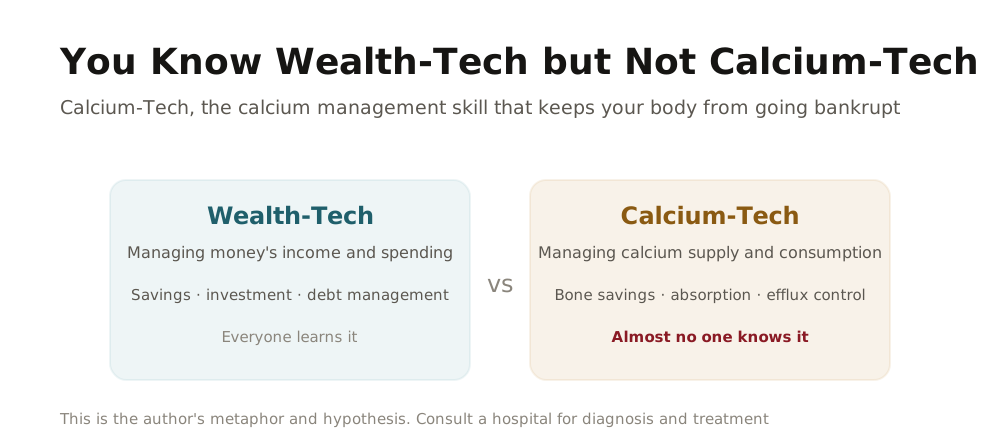
Our management of life and our management of the body resemble each other to a surprising degree. From our young days we devote ourselves to 'wealth-tech (Fin-Tech),' fiercely earning and managing money for a comfortable old age. We deposit assets in the bank, calculate compound interest, and control unnecessary spending, striving to increase our account balance.
But the truth is that we have neglected the task of managing calcium, the currency of life that is far more important than money itself. Now we need to shift our perspective a little.
In the age of a hundred-year life, true asset management is not only increasing the number in the bank account but also beginning, together with it, 'calcium-tech (Cal-Tech),' which protects calcium, the life fund stored in my body's 'bone bank.'
If you fail at wealth-tech, your old age may be a little poor and uncomfortable. But if you fail at calcium-tech and the bone storehouse empties out, the pillar of my body is shaken and life itself can be threatened.
"Just as failing to save money while young means suffering when old, failing to protect the bones while young means there is no old age."
This is the core philosophy of calcium-tech. Furthermore, calcium-tech can be the most certain foundation of the long life free of disease that everyone wishes for, living long without pain, and it can be the sole and powerful practical strategy of slow aging that slows the fiercely flowing speed of the years.
[Conventional wisdom] Wealth-tech (Fin-Tech) is for economic freedom and a wealthy old age, and health management is a separate domain.
[Redefinition] Calcium-tech (Cal-Tech) is for biological freedom and a healthy old age, and protecting the balance of the bone bank (bone density) is true preparation for old age. "If you fail at wealth-tech you can simply live poor, but if you fail at calcium-tech, life is shaken."
The Midlife Crisis: Income Shock and Spending Surge
Why 'calcium-tech,' and why now of all times? It is because our body has passed the expansion period of birth, growth, and reproduction, the great providence of nature, and stands at the inflection point heading toward decline and death.
Nature was designed for the efficiency of evolution. Until the period of growing and reproducing and leaving behind genes, it pours out resources without stint, but once it enters the decline period in which that mission ends, it slowly begins to tighten the money supply. Our body's economic system ends its boom and enters a zone of structural fiscal crisis.
Put in economic terms, this means that a double affliction begins: an income shock in which the money coming in decreases, and a spending surge in which the money that must be spent increases.
Income Shock: The Deposit Window That Nature Narrows
Many middle-aged people ask, "I eat and exercise exactly as I did when young, so why am I not what I used to be?" The answer is simple. It is because nature's clock has moved from growth to decline.
Once you pass the mid-forties, aging causes the secretion of stomach acid (hydrochloric acid) to gradually decrease. Calcium is efficiently absorbed into the body only when it dissolves in strong stomach acid and is ionized, so as the stomach acid thins, the proportion absorbed falls even if you eat the same amount.
It is just like a decline in income efficiency in which, no matter how hard you work, the amount deposited into your account is less than before, and maintaining the blood calcium concentration becomes increasingly burdensome.
Spending Surge: The Cost of Entropy (Disorder)
The fall in income efficiency is already a problem, but to make matters worse, the amount of calcium the body must spend (its outlay) increases. There are four chief culprits behind this.
First, the acidification of the diet. Processed foods, meat-centered meals, coffee, and alcohol tip the blood toward acidity. To defend the blood's acidity level (pH 7.4), the absolute condition of survival, our body draws out calcium, the strong alkaline substance within the bones, and uses it as a neutralizer.
Second, the paradox of medical intervention. The so-called bone injections (steroids) taken to reduce pain as one ages, and various chronic-disease medications, can be factors that reduce the balance of the bone bank.
Steroids, which reduce immediate pain, have an aspect of hindering calcium absorption and promoting its excretion, and in the process by which the liver detoxifies medications taken daily, a considerable amount of calcium is also consumed as an operating cost.
Third, stress and inflammation. Chronic stress and lack of sleep induce inflammation and reactive oxygen species in the body, and to calm these, calcium is once again mobilized.
Fourth, the decline of the oxygen supply. After middle age, cardiopulmonary function falls and activity decreases, so the amount of oxygen supplied to the cells diminishes. When oxygen is lacking, the cell undergoes incomplete combustion, and in this process acidic substances such as lactic acid build up and once again begin a vicious cycle that demands the bones' calcium.
In the end, because of this imbalance, in which "the efficiency of the money coming in falls (deficiency) while the money that must be spent increases because of eating habits, medications, and lack of oxygen (acidosis/inflammation/hypoxia)," our body ends up in a situation where it must melt the bones little by little in order to live.
[Conventional wisdom] The worsening of health after middle age is a simple phenomenon of aging and an unavoidable natural process
[Redefinition] The midlife crisis is a structural fiscal crisis in which 'income shock (lowered absorption)' and 'spending surge (the DIAH environment)' overlap. It is the inflection point at which nature tightens the money supply from the growth period to the decline period, and at this time, without calcium-tech, the balance of the bone bank can only keep decreasing.
My Body's Bankruptcy Report: The Seven Stages in Which Chronic Disease Is Made
Chronic disease does not come overnight. Just as the diligent head of a household shows countless warning signs before personal bankruptcy, or a sound company shows them before it goes under, our body too collapses slowly through certain stages.
The moment the doctor pronounces the name of the diagnosis is not the day the disease began. It is merely the day on which a process that had already been advancing for a long time surfaced. At which point of this process is my body right now?
[Stage 1] The start of chronic disease (Environment): falling income efficiency and rising living costs
Economic analogy: after retirement, fixed income decreases while prices rise and living costs grow. It is the start of deficit finances, in which the account empties while only the money going out increases.
Situation in the body: after middle age, because of lowered absorption (a decrease in income) and the accumulation of acidosis and inflammation (an increase in spending), a barren DIAH environment forms in which there is no choice but to break into the bones and use them. D (deficiency), I (inflammation), A (acidosis), and H (hypoxia) act in combination and begin to knock on the door of the bones' emergency warehouse.
[Chart] The DIAH-7M Chronic Disease Formation Process: The Seven Stages in Which My Body's 'Life Capital' Is Shaken
| Stage | Process name | Life analogy (asset management) | Process in the body (pathological mechanism) |
|---|---|---|---|
| 1 | The start of chronic disease (Environment) | Falling income efficiency and rising living costs | The DIAH environment forms: lowered absorption + accumulating acidosis/inflammation/hypoxia |
| 2 | The spark of chronic disease (Spark) | A sudden need for a large sum arises | The trigger fires: an acute situation demands a large amount of calcium |
| 3 | The pathway of chronic disease (Pathway) | Cashing out the savings account: dipping into retirement funds | The bone bank opens: osteoclasts release calcium |
| 4 | The outflow of chronic disease (Outflow) | Debt repayment: money goes out to repay emergency loans borrowed from many places | Systemic spread: calcium rides the bloodstream and moves here and there |
| 5 | The raw material of chronic disease (Raw Material) | Piling debt and interest: accumulating liabilities | Calcification deposits: it becomes the seed of disease in soft tissue |
| 6 | The manufacturing process of chronic disease (Process) | Credit crunch and asset freeze | The 7M pathological process: obstruction→hardening→disconnection→collapse |
| 7 | The fruit of chronic disease (Fruit) | Final diagnosis: economic hardship confirmed | Chronic disease manifests: hypertension, diabetes, cancer, dementia |
[Stage 2] The Spark of Chronic Disease (Spark): A Need for a Large Sum Arises
Economic analogy: you live on a tight budget, and suddenly something big happens. A moment comes when you urgently need a large sum that is hard to bear, such as a wedding, buying a home, a child's tuition, or a sudden accident.
Situation in the body: to neutralize the polluted internal environment (acidosis and inflammation), the body takes aim at the bone warehouse. The body declares a state of emergency. "Ordinary income is not enough. We must take out the emergency fund at once!"
[Stage 3] The Pathway of Chronic Disease (Pathway): Cashing Out the Savings Account
Economic analogy: to get through the urgent situation, you end up breaking the life savings (the bones) that you had steadily set aside for the future.
Situation in the body: osteoclasts are activated and the efflux of calcium from the bones begins. For the sake of survival, the body melts the bones and releases calcium (the emergency medicine) into the blood. The immediate crisis is passed, but my retirement assets begin to decrease little by little.
[Stage 4] The Outflow of Chronic Disease (Outflow): Debt Repayment
Economic analogy: because you have debts borrowed as emergency loans from several places, the money you took out goes off here and there to repay them. It is hard to grasp where and how much money went out, and in the end nothing remains in your hands.
Situation in the body: the calcium released from the bones rides the bloodstream and spreads throughout the whole body. Being used here and there wherever it is urgent, it falls short where it is actually needed and begins to lodge in the wrong places.
[Stage 5] The Raw Material of Chronic Disease (Raw Material): Piling Debt and Interest
Economic analogy: unable to recover the money that was released, debts begin to pile up here and there. Interest accrues on the principal that was not repaid, and it becomes a liability that is increasingly hard to bear.
Situation in the body: this is the calcification stage in which the calcium that has entered the cells and blood vessels cannot be excreted and simply piles up. Calcium accumulates in the soft tissue that ought to be flexible (muscle, ligament, organs) and becomes a hard stone (calcification). This calcification is exactly the raw material that sets the next stage, the 7M process, in motion.
[Stage 6] The Manufacturing Process of Chronic Disease (Process): Credit Crunch and Asset Freeze
Economic analogy: it becomes hard to hold out any longer and economic activity contracts. Assets are frozen and credit seizes up, and economic function declines.
Situation in the body: the 7M disease manufacturing process, in which the piled-up calcification wrecks the body, goes into operation.
The Seven Pathological Actions That Calcium Leaked from the Bones Causes in the Body
| Mechanism | Name | English name | Action | Scope |
|---|---|---|---|---|
| 1M | Closure and rupture | Obstruction & Rupture | It blocks and bursts | Calcification deposits→lumen closure, stenosis, infarction, rupture, hemorrhage |
| 2M | Dulling | Dysfunction | It grows dull | Calcification deposits→dulled movement of joints/muscles/valves, decline in contraction/relaxation function |
| 3M | Covering and blockage | Coating & Blocking | It is coated and blocked | Calcification deposits→receptor blocking, signal blocking, secretion blocking, insulin resistance |
| 4M | Hardening | Hardening | It hardens | Calcification deposits→fibrosis, calcification, rigidity, loss of elasticity |
| 5M | Overflow and burst | Overflow & Burst | It overflows and bursts | Excess calcium influx→cellular hyperproliferation, hypertrophy, tumor, expansion, apoptosis |
| 6M | Severance | Disconnection | It is cut and severed | Calcification deposits→nerve severance, vascular occlusion, tissue necrosis, apoptosis |
| 7M | Collapse | Collapse | It falls apart | Calcium deficiency→structural collapse of hard tissue (bone, teeth) |
These seven pathological processes do not proceed in order. Depending on the individual's constitution and environment, they proceed alone or in overlapping and combined ways.
[Stage 7] The Fruit of Chronic Disease (Fruit): The Final Diagnosis
Economic analogy: in the end you receive a declaration of bankruptcy from the court. The household economy is severely shaken and becomes a state that is hard to recover from by one's own power.
Situation in the body: the disease names we are diagnosed with at the hospital are finally confirmed. Hypertension, diabetes, cancer, dementia, and stroke are not diseases that arose suddenly but the surfaced result of a process that began at Stage 1 and advanced through Stage 6. Treatment that only picks off the fruit is a mere stopgap, and if the root is not cared for, the same situation can repeat.
[Conventional wisdom] Chronic disease is a misfortune that arrives suddenly one day, and the day the disease name is diagnosed is the day the disease began
[Redefinition] Chronic disease is a product formed through a seven-stage process. The moment you receive the diagnosis name is not the day the disease began but the day on which a process that had been advancing for a long time surfaced.
The Calcium-Tech Solution: Two Strategies to Prevent Bankruptcy
It is wise to prepare before the 7M process completely eats away at my body. If we can delay or avoid, as much as possible, the moment when the doctor confirms the disease name saying "You must take medication for the rest of your life," that would be true health management.
Just as a company that senses a crisis draws up a rehabilitation plan, we too can make a wise choice at this important point. What can we do to avoid the anticipated hardship?
The answer is clear. It is to increase income and reduce spending.
The Income-Increase Strategy: An Efficient Supply of Capital
Many people feel reassured that they are taking calcium supplements, but it is worth checking at least once. Of course, the calcium supplements on the market are also absorbed to a certain degree. But whether that efficiency is sufficient to meet my body's need is another matter.
The limits of synthetic calcium: check the efficiency. Some low-cost synthetic calcium on the market has large, coarse particles and is structured so that its efficiency for the body to accept is low. Especially in the gastrointestinal environment of a middle-aged person whose digestive power has weakened as stomach acid secretion has decreased, such large-particle synthetic calcium has low breakdown efficiency and can cause gastrointestinal discomfort such as gas or constipation. It is similar to a financial product on which you save diligently but pay heavy fees.
Natural and fine particles: an efficient deposit strategy. We can shift our perspective. It is to choose calcium that, so that it can dissolve without difficulty even when stomach acid is insufficient, uses natural raw materials and is body-friendly, and whose particles are small enough to pass easily through the cell membrane. This is a strategy that supplements the diminished gastrointestinal function and raises the bioavailability. Calcium absorbed efficiently in this way can normalize the calcium concentration in the blood and send a signal to the parathyroid, the control tower, that "there are enough funds now, so you can melt the bones less."
The Spending-Control Strategy: Managing the DIAH Triggers
No matter how good the calcium you fill up with, if there are many leaks the effect is halved. It is important to improve the DIAH environment that makes the bone door open.
First, solving D (deficiency): lay the foundation with efficient calcium. We need to broaden the concept of deficiency. It is not simply a shortage from not eating calcium. The environments of inflammation (I), acidosis (A), and hypoxia (H) continuously consume our body's calcium. These are connected to one another and open the bone's door and draw calcium out for use. We need to prepare for this consumption. Efficient intake is more important than simply increasing the amount. It is good to frequently put on the table seaweed, fish eaten whole with the bones, and deep green vegetables, which have high biological affinity with our body and good absorption rates. On top of this, it is even more effective to also take absorption helpers (vitamin K2, magnesium, vitamin D) that will safely guide calcium all the way to the bones.
Second, solving I (inflammation): reduce unnecessary calcium consumption. Inflammation is like a small fire in our body. Just as a fire needs water, when chronic inflammation arises in the body, calcium is mobilized to calm it. Reducing inflammation is itself the way to protect the balance of the bone account. It helps to secure enough sleep time, during which growth hormone is released and repairs the body, and to prevent periodontal disease (bacteria in the mouth), which can be the fuse of whole-body inflammation, through thorough oral care.
Third, solving A (acidosis): ease the burden on the bones. Meat, processed foods, and stress tip our body toward acidity. When the body acidifies, by the instinct for survival it uses the calcium in the bones, an alkaline resource, in order to neutralize the blood. To reduce this burden, it is good to increase an alkaline diet centered on vegetables and fruit and to help the pH balance of the body fluids be maintained even without the sacrifice of the bones.
Fourth, solving H (hypoxia): open up the cell's airway. Oxygen is the kindling that burns nutrients. When oxygen is lacking, the cell undergoes incomplete combustion and produces acidic substances such as lactic acid, and this in turn becomes a cause that demands the bones' calcium. Also, when oxygen is lacking, the path by which calcium moves into the cell narrows as well. If you supply oxygen to every corner of the whole body with deep abdominal breathing and aerobic exercise, the cells breathe well and calcium too can play its proper role in its proper place.
DIAH triggers (four causes of calcium efflux)
| Abbreviation | English | Name | Action | Description |
|---|---|---|---|---|
| D | Deficiency | Deficiency | Bone calcium fills the shortfall | Deficiency of calcium, minerals, vitamin D, and so on → calcium broken down from bone as replacement → blood → supplied to various cells ※ Common: D·I·A·H all cause a drop in blood calcium, which is replenished by breaking calcium down from bone. |
| I | Inflammation | Inflammation | Calcium is mobilized to put out inflammation | Large amounts of calcium consumed in the inflammatory response → calcium broken down from bone as replacement → blood → concentrated at the site of inflammation |
| A | Acidosis | Acidosis | Bone is sacrificed to neutralize acid | Alkaline calcium used to neutralize acid → calcium broken down from bone as replacement → blood → whole-body pH balance |
| H | Hypoxia | Hypoxia | With lack of oxygen, calcium floods into the cell in excess | Cellular oxygen shortage → calcium pump failure → blood calcium over-absorbed into cells → blood calcium shortage → calcium broken down from bone as replacement → blood → re-absorbed into damaged cells → vicious cycle |
Summary of the Calcium-Tech Solution
Foundation: it is good to firmly fill up the foundational funds that sustain life with a calcium supplement whose absorption efficiency has been verified.
Strategy: it is effective to manage, through lifestyle, the four major triggers that cause calcium to leak from the bones, namely deficiency (D), inflammation (I), acidosis (A), and hypoxia (H).
When these two go together, only then do we meet the occasion to control the speed of aging that we had until now considered inevitable, and to turn the direction of our life toward a healthy and dignified slow aging.
[Conventional wisdom] Calcium supplementation is simply eating more calcium pills, and health management is treating individual diseases
[Redefinition] True calcium-tech is a two-track strategy of 'increasing income (supplying calcium with high absorption efficiency)' and 'controlling spending (managing the DIAH triggers).' Efficient absorption is the key rather than simple intake, and it is wise to first manage the places where there are leaks.
The Speed of Aging Is Something You Can Choose
Let us organize it once more. Through this book we have come to know the following.
First, calcium is not a material of bone but the master key that operates life. From heartbeat to muscle contraction, nerve transmission, and hormone secretion, without calcium we cannot live even for a single second.
Second, the bone is a calcium reservoir and the emergency safe of life. When a crisis comes to the body, it melts the bones and draws out calcium for use, and in exchange a debt called calcification piles up.
Third, DIAH (deficiency, inflammation, acidosis, hypoxia) forcibly opens the bone's door, and the 7M process turns that debt into disease. Hypertension, diabetes, cancer, and dementia are all products of this pathway.
Fourth, after middle age is a zone of structural crisis in which income (absorption) decreases and spending (DIAH) increases. If you do nothing, the bone bank heads toward bankruptcy.
And finally, there is the alternative called calcium-tech. If you increase income with an efficient supply of calcium and reduce spending by managing the DIAH triggers, you can slow the speed of aging.
[Comparison at a Glance] Two Homework Assignments of Life
| Category | Wealth-Tech (Fin-Tech) | Calcium-Tech (Cal-Tech) |
|---|---|---|
| Goal | Economic freedom (a wealthy old age) | Biological freedom (a healthy old age) |
| Core assets | Cash, stocks, real estate | Bone (bone density), blood calcium, muscle |
| Crisis factors | Overspending, inflation, investment failure | DIAH (stress/acidosis), aging, calcium efflux |
| Form of hardship | Credit crunch, economic hardship | Osteoporosis, calcification, chronic disease |
| Success strategy | Cut spending, invest in quality assets | Manage DIAH, guard the door of the bone warehouse |
| Core message | "If you do not save while young, you suffer when old." | "If you do not protect your bones while young, your old age is shaken." |
The direction from birth toward death cannot be changed. But its speed differs. Even at the same age of 70, one person climbs a mountain while another lies on a sickbed. What makes that difference is calcium-tech.
If you fail at wealth-tech, you can simply live poor. But if you fail at calcium-tech, you grow old in pain. Which is the more fearful old age?
Right now is the moment of choice. Will you watch the bone bank empty out as it is, or will you begin calcium-tech starting today? And that first step can begin today.
[Conventional wisdom] Aging is an unavoidable flow of nature and a fate the individual cannot control
[Redefinition] The 'direction' of aging cannot be reversed, but its 'speed' can be chosen. Calcium-tech is the skill of riding the flow of aging most gracefully, and its first step can begin today.