
This piece is the complete prologue of The Declaration of the Age of Physical Economics (Yoon Jong-won, Yoon So-ri, Yoon Jun). It is an academic declaration presenting the authors' physical economics hypothesis, and the body, figures, and citations follow the manuscript as written.
On Wednesday, March 8, 2023, SVB Financial Group, the parent company of America's Silicon Valley Bank, disclosed that it had incurred a loss of 1.8 billion dollars in the course of selling off bonds it held. When this news spread, depositors began pulling their money out online, and on the following day alone 42 billion dollars flowed out of the bank. On the morning of Friday, March 10, just two days after the disclosure, the U.S. Federal Deposit Insurance Corporation (FDIC) ordered the closure of this bank, which had total assets of 209 billion dollars. Only two days earlier, this bank's credit rating had been investment grade.
That same month, in a small town in Ohio, the last grocery store remaining in the community closed its doors. To buy groceries, residents must now drive more than thirty minutes by car. The U.S. Department of Agriculture (USDA) calls such areas food deserts, and reported that as of 2023 about 19 million people across the United States live in these food deserts. As large retailers withdrew from small towns with low profitability, America's regional economies were quietly but rapidly disappearing.
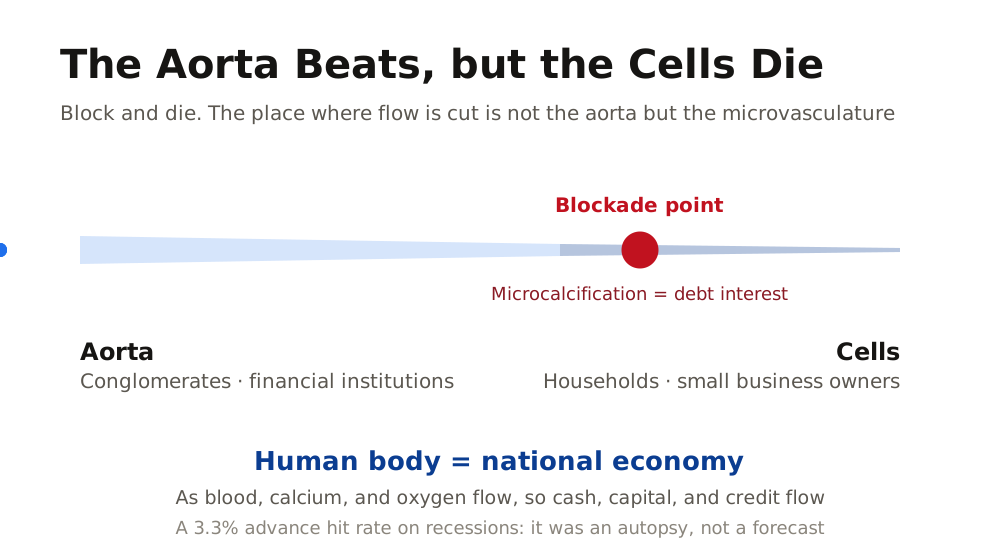
Around that time, the quarterly household debt report released by the Federal Reserve Bank of New York revealed that the credit card debt of American households had exceeded 1 trillion dollars for the first time ever. Wall Street's stock indices were racing toward all-time highs, but in the microvasculature of American households, a microcalcification called interest was quietly being deposited. Washington's macro indicators were sound, but Main Street's microvasculature was already being blocked.
The same structure was at work across the Pacific as well. South Korea's gross domestic product (GDP) growth rate still remained positive, and exports, led by semiconductors, showed strong performance. Yet beneath the surface, business closures among the self-employed reached a record high, household debt on the Bank for International Settlements (BIS) basis had long since surpassed 100 percent of GDP, and the total fertility rate had fallen to 0.72, the lowest level among the member countries of the Organisation for Economic Co-operation and Development (OECD). The aorta was beating. But the cells were dying.
The Report Card of Economic Forecasting: The Uncomfortable Truth the Numbers Tell
This is an age overflowing with experts. In any country in the world, there are thousands of people whose profession is to diagnose and forecast the economy: economics professors, financial analysts, policy researchers, central bank directors, and so on. But what does their actual report card look like?
In 2018, the International Monetary Fund (IMF) economists Zidong An, João Tovar Jalles, and Prakash Loungani published a study analyzing 153 recessions that occurred in 63 countries from 1992 to 2014. In this study, the researchers systematically verified whether the consensus forecast and the IMF forecast had detected each country's recession in advance. The result was shocking. At the point one year before a recession began, the number of cases in which the advance forecast succeeded was just 5 out of 153. In terms of hit rate, that is a mere 3.3 percent. The remaining 148 recessions were missed by the experts entirely.
There is a more astonishing fact. Even in October of the year in which a recession was already under way, that is, at a point just two months before the year's end, the experts were still missing 35 recessions. It is like a doctor still diagnosing a patient as healthy when the patient has already collapsed. And another fact this study revealed is that there was no meaningful difference in accuracy between the forecasts of international organizations such as the IMF and the OECD and the forecasts of private experts such as the Bloomberg consensus.
Bloomberg's analysis of more than 3,200 same-year GDP forecasts by the IMF points in the same direction. The cases that hit within an error of 0.1 percentage point amounted to only 6.1 percent of the total, and the forecast errors were found to be considerable regardless of whether the country was advanced or developing.
The Actual Report Card of Existing Economic Forecasting Systems: It Was an Autopsy, Not a Forecast
| Institution / Analysis Target | Forecast Content | Hit Rate | Source |
|---|---|---|---|
| IMF / Private Consensus | Advance forecast of 153 recessions (1 year prior) | 3.3% (5 of 153) | IMF WP/18/39 |
| IMF GDP Forecast | 3,200 same-year GDP forecasts | 6.1% (within 0.1pp error) | Bloomberg, 2019 |
| Moody's | Maintained SVB credit rating | Bankrupt 48 hours later | Moody's; FDIC, 2023.3 |
| Bernanke (Fed) | Subprime problem contained | Financial collapse 16 months later | Fed, 2007.5 |
| EU Review Committee | Passed Greece's fiscal soundness | Bailout requested 3 years later | EU, 2007 |
What these numbers mean is clear. Existing economic forecasting was not forecasting but autopsy. The cause is analyzed only after the patient has already collapsed, the quarterly report shows data from three months ago, and the credit rating is maintained right up to the brink of default. A diagnosis without forecasting is an autopsy, and an autopsy cannot save the patient.
Paradoxically, according to the analysis of postwar financial crisis data by Robin Greenwood, Samuel Hanson, Andrei Shleifer, and Jakob Ahm Sørensen of Harvard University, the probability that a financial crisis would occur within three years after a credit expansion and an asset price surge appeared together reached about 40 percent. The crisis was not something unpredictable. The signals existed, but the existing forecasting systems failed to read those signals.
The Doctor Who Only Looks at the Aorta: The Fundamental Limits of the Existing Economic Language
The reason existing economic diagnosis fails repeatedly is structural. It is not a lack of ability on the part of any particular expert, but a defect in the very language used to see the economy. Macro indicators such as GDP, interest rates, and the consumer price index are like the blood pressure measured at the aorta of the economy. Just because the blood pressure at the aorta is normal does not mean the microvasculature is not blocked. Just because GDP is growing does not mean the shop in the back alley is alive.
What would happen if, when diagnosing a patient, a doctor measured only the body temperature and then discharged the patient? Even if that patient's liver values were dangerous, kidney function was declining, and calcification was building up in the blood vessels, the patient would be judged healthy as long as the body temperature was normal. Today's economic diagnosis is exactly like this. It judges the health of the economy by measuring only one body temperature called GDP, one blood pressure called the interest rate, and one body weight called the consumer price index.
To diagnose the human body accurately, one must examine not only the circulatory system but the entire body, including the respiratory system, the digestive system, the immune system, the musculoskeletal system, the endocrine system, and the nervous system. The economy is the same. One must examine the entire body, including not only financial circulation but trade, consumption, production, employment, prices, construction, energy, and demographic structure. And rather than viewing the state of each organ system separately, one must read the connections and interactions between the organ systems as well.
Change the Question and the Answer Changes: A New Paradigm of Economic Diagnosis
This book changes the question. Where existing economics asked "how much did it grow?", this book asks "where is it blocked?" When this question changes, the diagnosis changes, and when the diagnosis changes, the prescription changes. The moment we ask why the back alley is dying when the growth rate is sound, we begin to look not at the aorta but at the microvasculature. The moment we ask why money does not reach small business owners even though interest rates were lowered, we begin to trace the path along which policy flows.
This book starts from a single observation. The human body and the economy are two complex systems operating under the same physical laws. This is not a metaphor. When a blood vessel narrows by just 10 percent, blood flow drops by as much as 35 percent, and this is a basic principle of fluid dynamics called Poiseuille's Law. Exactly the same law applies to the phenomenon in which, when interest rates rise, access to funds at the periphery is blocked exponentially.
If It Is Blocked, It Dies: The One Principle That Runs Through This Book
If it is blocked, it dies. This is a law of nature that applies without exception in the human body, in the economy, in a river, and in the atmosphere.
Even if the heart beats, if the microvasculature is blocked, the cells die. Even if the economy grows, if money does not reach the back alley, households and small business owners die. Even if the river's water is abundant, if the tributaries are blocked, the rice paddies downstream go dry. Even if the atmosphere is sufficient, if the airway is blocked, oxygen does not reach the lungs. The common cause of all these phenomena is only one: the collapse of flow.
The Universal Structure of Flow Collapse by System: The Place That Is Blocked Differs, but the Result Is the Same
| System | What Flows | Where It Is Blocked | Result |
|---|---|---|---|
| Human body | Blood, calcium, oxygen | Microvasculature, arterioles | Cell necrosis |
| Economy | Cash, capital, credit | Back-alley economy, households | Small business closures |
| River | Water flow | Tributaries, channels | Downstream drought |
| Atmosphere | Oxygen, air | Airway, alveoli | Suffocation |
There is one decisively important fact here. If the aorta is blocked, one dies, of course, but even if the aorta is normal, if the microvasculature is blocked, the cells die. The reason existing economic diagnosis misses this is that it examines only the aorta. This book examines the microvasculature as well.
Diagnosing the Economy Like the Human Body: The DIAH-7M Economic Health Checkup
We have confirmed the principle that when flow is blocked, the system dies. The problem is how to detect that blockage. Until now, most economic services have concentrated on providing data and interpretation, but a system that comprehensively diagnoses where the flow of the entire economy is being blocked has scarcely existed.
The DIAH-7M Economic Health Checkup was designed precisely to fill this empty area. This system performs a fundamentally different role from existing services in that it is an economic health checkup model that sees the economy as a single organism and comprehensively examines the state of its flow. It connects 59 gauges to the 9 economic domains that correspond to the 9 organ systems of the human body, and combines public statistical data with satellite physical signals to examine the entire body of the economy in real time.
D stands for Deficiency, I for Inflammation, A for Acidosis, and H for Hypoxia, and these four are the four pathological states that give rise to every economic crisis. 7M refers to the seven collapse mechanisms in which these pathological states are manifested in the actual economy. From the Great Depression of 1929 to the collapse of Silicon Valley Bank in 2023, thirteen global crises with different names are all classified by the combination of these four letters.
The Structural Difference from Existing Economic Services: Why DIAH-7M Is Different
To understand this difference, let us compare the structural difference between existing economic services and DIAH-7M.
| Category | Bloomberg | IMF Report | OECD Report | DIAH-7M |
|---|---|---|---|---|
| Basic character | Financial data platform | International economic analysis | Policy research report | Economic diagnosis system |
| Core function | Providing market data | Analyzing economic outlook | Presenting policy direction | Diagnosing economic health |
| Analysis method | Individual indicator analysis | Macroeconomic model | Policy scenario | Diagnosis based on circulatory structure |
| Result representation | Charts and indicators | Outlook report | Policy recommendation | Economic health stage |
| System perspective | Financial information | Economic research | Policy research | Economy = life cycle |
| Crisis hit rate | 6.1% (0.1pp error) | 3.3% (5 of 153) | Similar level | Retrospective validation in progress |
As can be seen in this table, existing services are mostly centered on providing information or on interpretation. DIAH-7M, by contrast, is a platform that sees the economy as a single circulatory system and diagnoses its current state, and this is the core point of differentiation. The very basic philosophy of viewing the economy is different.
| Analytical Perspective | Existing Economic Services | DIAH-7M |
|---|---|---|
| Concept of the economy | Markets and statistics | A circulating life system |
| Core question | "How high is the indicator?" | "Is the flow being blocked?" |
| Unit of analysis | GDP, prices, employment | The entire economic circulatory structure |
| Mode of judgment | Expert interpretation | Structural diagnostic engine |
Put simply, if existing services are instruments that show single figures like blood pressure and body temperature, DIAH-7M is a comprehensive health checkup that judges the state of the whole body through multiple examinations. Another core point of differentiation for DIAH-7M is its data structure.
| Category | Existing Economic Report | DIAH-7M |
|---|---|---|
| Data basis | Government statistics | Public statistics + satellite physical data |
| Data source | Government agencies | NASA and ESA satellites + Bank of Korea and FRED |
| Change detection | After the statistics are announced | Detectable at the pre-statistical stage |
| Verification method | Statistical comparison | Satellite-statistics cross-verification |
| Interpretive frame | Macroeconomic model | Diagnostic interpretation based on human physiology |
Economic activity appears as actual physical signals. When factories and ports move, nighttime lighting brightens; when urban activity increases, the heat island rises; when construction increases, radar signals change. Because statistics are compiled by humans and reported by humans, there are lags and errors, but the physical signals that satellites capture cannot be manipulated. When a factory is switched off, the light disappears, and when a city overheats, the surface temperature rises. Just as a doctor checks inside the body directly with CT and MRI rather than listening only to the patient's words, DIAH-7M looks directly inside the body of the economy with satellites. And by interpreting this physically measured data through a human-body-based circulatory diagnostic frame, it diagnoses structurally where and why the economy is blocked, rather than merely listing figures.
The Position of This Book: The Economic Application of the Five-Stage Collapse Pathway Law
This book operates on the Five-Stage Collapse Pathway Law (DTDMC). Its pathway is the five stages of factor, onset, blockade, manifestation, and annihilation, and the blockade stage is further refined into the dual blockade (CAM-DLT), in which signal blockade (CAM) and channel blockade (DLT) operate simultaneously. The way one person's body collapses, the way one family's relationships collapse, the way one company's operations collapse, and the way one nation's economy collapses all follow the same five stages in the same order.
This book is the one that applies those five stages in earnest to the economic domain. The fact that the universal law that rivers and stars and ecosystems and the climate all follow operates identically in one person's body and in one nation's economy, and the tool that catches the place where that flow begins to be blocked, is DIAH-7M. In Part II of this book, the Five-Stage Pathway Law is established, and in Part III it is verified with 690 months of macro time-series data spanning 351 months of Korea and 339 months of the United States.
A New Language for Caring for the Economy: To the Reader of This Book
This book is an attempt to shift the paradigm of economics. It is an attempt to change the language for seeing the economy, to change the method of diagnosis, and to change the path of prescription. Where the existing economic language measured only the blood pressure of the aorta and declared "this economy is healthy," the language of this book detects even the blockage of the microvasculature and prescribes "here is where it is blocked, and this is the path by which it must be opened."
In the chapters that unfold from here, we first examine the specific blind spots of existing economic diagnosis. The trap of the single indicator, the lag of the after-the-fact report, and the limits of the aorta prescription are the three. Next, we prove by physical law why the human body and the economy share the same structure, and we introduce the whole-body examination system of the economy, made up of 59 gauges and 9 organ systems. And we retrospectively verify, with data from both Korea and the United States, whether this system could actually have detected the crises from the Great Depression of 1929 to the collapse of Silicon Valley Bank in 2023 in advance, and finally we present concrete prescriptions to prevent crises.
If we can care for the economy as we care for the body, crises can be prevented. This is the promise of this book.
References
1. An, Z., Jalles, J. T., & Loungani, P. (2018). How Well Do Economists Forecast Recessions? IMF Working Paper, WP/18/39. doi:10.5089/9781484338643.001
2. Bloomberg News (2019). IMF Forecasts Show It's Hard to Predict the Global Economy. Bloomberg Graphics.
3. Federal Deposit Insurance Corporation (2023). FDIC Creates a Deposit Insurance National Bank of Santa Clara to Protect Insured Depositors of Silicon Valley Bank. Press Release, March 10, 2023.
4. Greenwood, R., Hanson, S. G., Shleifer, A., & Sørensen, J. A. (2022). Predictable Financial Crises. The Journal of Finance, 77(2), 863-921. doi:10.1111/jofi.13105
5. U.S. Department of Agriculture (2023). Food Access Research Atlas. USDA Economic Research Service.
6. Federal Reserve Bank of New York (2023). Quarterly Report on Household Debt and Credit. FRBNY Center for Microeconomic Data, Q1 2023.
7. Bank for International Settlements (2024). Credit to the Non-Financial Sector Statistics. BIS Quarterly Review.
8. Statistics Korea (2024). Vital Statistics: Total Fertility Rate, 2023. KOSTAT Press Release.