
Why Did the Apple Fall?
In 1687, Isaac Newton published his law of universal gravitation. The insight that a falling apple and the Moon orbiting the Earth are expressions of the same force changed the course of science. For the three hundred years since, humanity has used this force to launch satellites, predict planetary orbits, and explore the cosmos.
Yet one question remains.
Why did the apple fall?
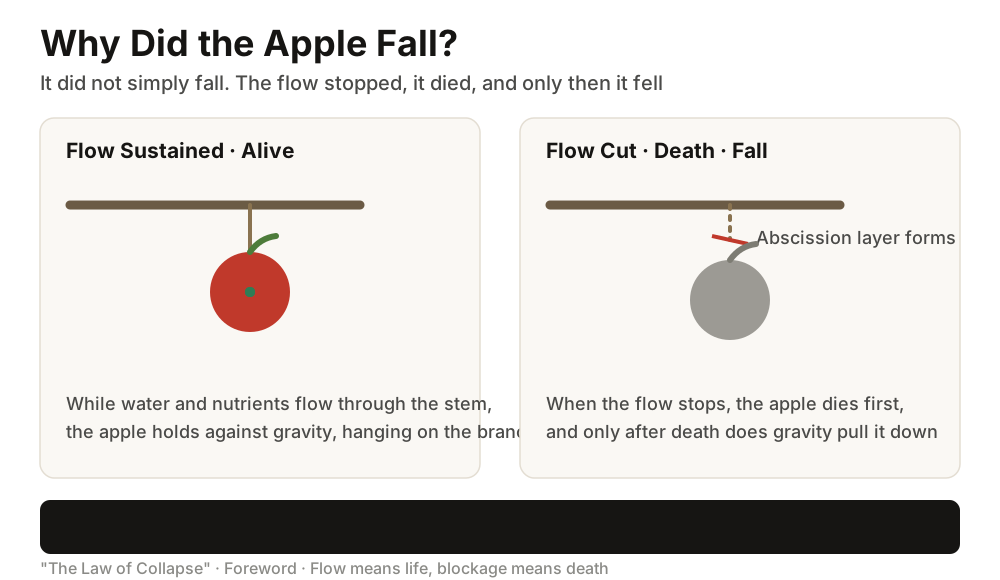
Because of gravity? Not quite. To be precise, the apple did not fall: it died. As long as water and nutrients flowed through its stem, the apple held on against gravity, hanging from the branch. When autumn came and the tree formed an abscission layer that cut off the flow, the apple died. Only after death did it come under the rule of gravity and fall.
Gravity determines the direction of the fall, but it does not determine death, the precondition of the fall. Something that does not exist cannot have a direction. The law that governs life and death is logically prior to the law that governs direction.
So what determined whether the apple lived or died? Flow. As long as the flow was sustained, the apple hung there alive. When the flow stopped, the apple died and fell.
The Score Exists, But No Performer
In 1953, Watson and Crick decoded the double-helix structure of DNA. It was the culmination of a journey that began with Darwin's discovery of natural selection and Mendel's laws of heredity: the journey to read life's blueprint. Since then, humanity has sequenced genomes, edited genes, and entered an era of personalized medicine.
Yet here too, the same shape of question remains.
Who actually executes this blueprint?
However perfect a symphony's score may be, without a performer no music sounds. If DNA is the score of life, who is the conductor that renders that score into physical reality? When a fertilized egg begins cell division, when a muscle contracts, when a synapse transmits a signal, when a hormone is secreted, when a cell dies, at every one of these moments, something must physically carry out DNA's instructions.
Evolutionary theory explains why this design came to exist. But what medium physically drives that design remained outside its jurisdiction.
Direction Exists, But No Path
In 1865, Clausius formulated the second law of thermodynamics. The entropy of an isolated system increases and eventually reaches thermal equilibrium. At equilibrium there is no difference, no flow, and therefore no life. This is one of the most universal truths physics has ever discovered.
Put simply: hot coffee cools, a tidy room grows messy, every system eventually collapses. This is the direction of the universe.
Yet even this great law has a blank space.
We understand that everything eventually collapses, but by what sequence does it collapse?
Thermodynamics tells us the direction: systems move toward equilibrium. But it stays silent on which stages the journey passes through, at what point the process becomes irreversible, and at what point intervention could still slow it down. The verdict has been handed down, but the procedure of execution is left blank.
The Common Blank Space Three Giants Missed
Newton, Darwin, Clausius. Each of these three giants of scientific history gave a great answer. Gravity revealed where all things are headed. Evolutionary theory revealed why life takes the shape it does. Thermodynamics revealed where everything ultimately converges.
Yet all three theories stop before one common question.
When a system collapses, what path does that collapse follow?
How do determinants accumulate, when does the trigger fire, under what conditions does blockade complete, and in what order do symptoms appear? And if that path could be known in advance, could collapse be prevented before it happens?
This is not a question of direction, nor of design, nor of outcome. It is a question of path.
What This Book Is About
This book is about that path.
First, one concept must be understood. The single word that runs through this entire book: gradient.
A gradient is the difference between two points. The difference between high ground and low ground makes water flow. The difference between hot and cold moves heat. The difference between high and low voltage creates electric current. Where there is difference, there is flow; where difference disappears, flow stops. This is the gradient. Physics has known this for a hundred and fifty years, but its full implications have never been properly unpacked.
Consider a cup of coffee. Why does hot coffee cool? Because there is a temperature difference (a gradient) between the coffee and the surrounding air. Heat flows from high to low. As the coffee cools to match the ambient temperature, the gradient reaches zero and the flow of heat stops. Physics calls this state equilibrium. This book calls it death. A system with zero flow is a system that has lost its function.
The essence of flow consists of three elements: energy, gradient, and medium. Energy is the foundation of existence. But energy alone does not flow on its own. A lake full of water holds energy, but without a difference in water level, it does not flow. For energy to convert into flow, a gradient must exist. And that flow is carried out through a medium. In the human body, the medium is calcium. In the economy, the medium is cash. The media differ, but the operating principle is one and the same. As long as the gradient is sustained, the flow is sustained; as long as the flow is sustained, the system is alive. When the gradient disappears, the flow stops and the system dies.
Everyone grasps this principle intuitively. So why has this obvious principle never been used to explain the root path of chronic disease in medicine? Why has it never been used to predict the recurrence of crisis in economics? Why did other disciplines not know what physics already knew?
The answer is simple. Each field was trapped in its own language. A cell biologist writes "calcium overload." A cardiologist writes "atherosclerosis." An economist writes "liquidity freeze." Because the same physical phenomenon (a channel blocking and flow stopping) was given different names in different fields, the structural identity across disciplines went unseen.
A Startling Discovery
This book was written because of one startling discovery.
The path by which blood vessels become blocked in the human body, and the path by which a national economy falls into crisis, are the same.
This is not a metaphor. A five-stage path (determinants accumulate, a compensatory response fires, the byproduct of that compensation deposits in the channel, supply and discharge are blocked simultaneously, and symptoms surface) repeats independently across both domains.
In medicine, the pathways of 242 diseases were mapped onto this structure. In economics, six crises were detected without a single false positive across 690 months of time-series data. For the three endogenous crises among them, warning signs were confirmed six months in advance.
If a law that operates in a cell also operates in a national economy, then this is not a theory confined to one field: it is a law of circulatory systems in general.
After You Read This Book
This book does not explain the world. It changes the eyes with which you see the world.
After reading it, you will understand why you feel uneasy even when your checkup results come back normal, because the values may be normal while the gradient is already slowing. When you read news that GDP is growing, you will start reading which direction the gradient is actually moving beneath that headline. When you see a household's fixed costs rising, you will recognize it not as a simple burden but as the depletion of a circulatory system's margin.
The question Newton missed, the gap Darwin left open, the blank Clausius could not fill: these three gaps converge into one.
Flow.
When flow is sustained, the apple hangs there alive, DNA's instructions are executed, and the system resists entropy. When flow stops, the apple dies and falls, life halts, and the system converges toward equilibrium.
And what creates that flow is the gradient. The path by which the gradient disappears is the subject of this entire book.
How This Book Is Organized
This book has ten chapters and follows a single path from beginning to end.
Chapter 1 confirms that circulation is the survival condition of every system. Chapter 2 reveals where a crisis truly begins: the depletion of margin. Chapter 3 lays out the full skeleton of the five-stage path that runs through every crisis: DTDMC.
Chapters 4 through 8 dig into each stage of this path one at a time: how determinants accumulate (Ch. 4), how the trigger fires (Ch. 5), why dual blockade is a point of no return (Ch. 6), what forms manifestation takes (Ch. 7), and what decides the fork between recovery and collapse (Ch. 8). At every stage, cases from the human body and the economy (and from families, companies, and regions) walk side by side.
Chapter 9 presents the alternative. The point is not to fix, but to prevent. Chapter 10 covers a paradigm shift in diagnosis: learning to read the gradient rather than the absolute value.
The final chapter honestly examines how this theory relates to the great established laws of science: how far it has been validated, and where it remains open. Then the epilogue returns to the emergency room at 3 a.m.
Discovery, Not Invention
The principle this book deals with was not invented.
That gradients create flow has been known to physics for a hundred and fifty years. That flow drops sharply when a channel narrows was proven in the nineteenth century. That a system dies when flow stops is a fact of nature anyone grasps intuitively. What this book has done is not create a new law, but discover and connect a physical phenomenon that already existed in nature.
Just as Newton did not invent gravity, this book does not invent the law of flow. Apples fell before Newton was born, and blood vessels became blocked before this book was written. What had not yet been connected was the fact that falling and blocking follow the same physical path. What physics already knew, medicine did not. What medicine was observing, economics did not know. What economics was experiencing, physics did not treat as its own concern. This disconnect between disciplines has blocked the connection for a hundred and fifty years.
This book bridges that disconnect. By showing that the law operating in a cell also operates in a national economy, it reveals that nature has, all along, been moving by a single grammar.
Let us begin.
At 3 a.m., a 42-year-old man is rushed into the emergency room of a university hospital in Seoul.