
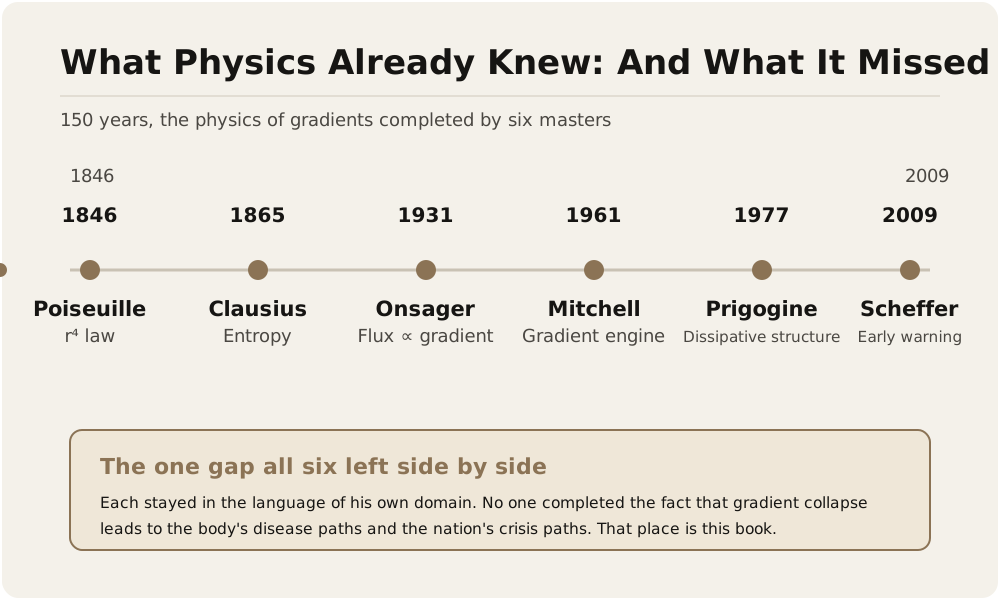
In the previous chapter we learned the nine words that make up the grammar of the gradient. That grammar was not invented by this book. It is the result of a step-by-step accumulation by physics and chemistry over the past 150 years. From 1865, when Clausius defined entropy, to 2009, when Scheffer formalized the early-warning signals of critical transitions, six masters, across a century and a half, took turns clarifying different facets of gradient systems.
This chapter organizes their achievements. But it does not stop at a list of tributes. Alongside each contribution, we also note the gap each master left behind. The six masters worked out the physics of gradients, but none of them stated, in a completed form, the fact that these same principles extend into the disease pathways of the human body and the crisis pathways of national economies. Each worked within the language of his own domain, and the integration that crosses those domain boundaries was left as a task for later generations.
This chapter has six sections: Clausius's entropy and the second law, Poiseuille's r⁴ law, Onsager's flux-gradient proportionality, Prigogine's dissipative structures, Mitchell's chemiosmotic principle, and Scheffer's early warning of critical transitions. Rather than strict chronological order, they are arranged by increasing conceptual difficulty. In each section we summarize the master's achievement, examine how this book makes use of that achievement, and then look at how this book attempts to answer the gap each of them left behind.
By the end of this chapter it should be clear that this book's argument did not arise out of thin air, but is instead a project that extends already-verified physical laws into the still-unmapped territories of disease and economics. This book's place is not to invent new physics, but to extend the scope of long-known physics into two independent domains.
1. Clausius (1865): The Birth of Entropy
The German physicist Rudolf Clausius (1822-1888) was one of the founders of thermodynamics. In 1850, in a paper titled "On the Moving Force of Heat," he first formulated the second law of thermodynamics. The starting point was the statement that "heat does not spontaneously flow from a colder body to a hotter body," and from this simple sentence a vast insight about the entire universe was derived.
In 1865 Clausius announced his second decisive contribution. He mathematically defined the concept of entropy, naming it after the Greek "en-tropie" (transformation within). Entropy refers to the amount of a system's energy that cannot be converted into work, and in a closed system entropy never decreases, only increases or remains constant. The pair of sentences with which Clausius closed this paper is among the most frequently quoted in the history of physics: "The energy of the universe is constant. The entropy of the universe tends to a maximum."
The implication of this statement is dramatic. It means that as time passes, the universe grows progressively more disordered, gradients become uniform, and everything converges toward a state in which no flow can occur. Physicists of the late nineteenth century called this "the heat death of the universe." At the moment cold bodies and hot bodies cease to exist, that is, the moment the temperature gradient disappears, the universe enters an equilibrium state in which no work can be performed.
This book carries Clausius's insight directly into its text. When this book states that "equilibrium is death," that is not a metaphor but a direct consequence of the second law. A system in which the gradient has vanished is a system in which entropy has been maximized, and in that state the flow of a medium cannot occur; a system without flow cannot perform any function. Whether it is a cell or a national economy, the very process of converging toward uniform gradients is the law of increasing entropy that Clausius presented 150 years ago.
However, Clausius left one decisive gap. His thermodynamics was built on the premise of a closed system, that is, an isolated system that does not exchange energy with its environment. Life and economies are not closed systems. Life constantly absorbs energy from food, and economies constantly absorb energy from labor and resources; both are open systems. In Clausius's time there was as yet no theory of how entropy operates within such open systems. That gap would later be filled, in turn, by Onsager and Prigogine.
2. Poiseuille (1846): The Physician Who Was a Physicist, and the Law of Pipes and Flow
Jean Léonard Marie Poiseuille (1797-1869) was a French physician and physiologist. Having studied medicine in Paris, he also attended lectures by leading mathematicians and physicists of his era, such as Cauchy and Arago, at the École Polytechnique, the institution that trained Paris's physicists. He was a rare type of researcher who pursued medicine and physics simultaneously. His lifelong interest was the circulation of blood in the human body.
In 1846, through precisely controlled experiments, Poiseuille determined which variables govern the flow rate of a fluid passing through a tube. The result was startling. Flow rate was proportional to the fourth power of the tube's radius. This law, summarized by the equation Q = (π · ΔP · r⁴) / (8 · μ · L), later became a foundation of fluid dynamics, and its 150-year history was systematically reviewed by Sutera and Skalak in their review paper (Sutera & Skalak, 1993, Annual Review of Fluid Mechanics).
The significance of r⁴ is dramatic, as we saw in Chapter 3. If a blood vessel narrows by 10%, flow decreases by about 34%; at 30% narrowing, flow decreases by about 76%; at 50%, by about 94%. This nonlinearity explains why the human body, despite possessing such large reserve capacity, collapses so abruptly at the critical point. This is why a patient whose coronary artery narrows gradually remains largely asymptomatic, until suddenly, at some point, a myocardial infarction occurs. The change unfolds slowly, but it is experienced suddenly.
This book directly cites Poiseuille's law. The r⁴ nonlinear sensitivity is the physical engine of the dual-blockade pathway this book presents. While deposits accumulate gradually and the effective radius of the passage narrows, the flow rate decreases exponentially according to r⁴. This precipitous decline structurally produces the simultaneous blockage of supply and discharge (the dual blockade), and leads to the abrupt collapse that follows the critical point. The same principle applies to financial pathways. A minute reduction in the capacity of a pathway causes the liquidity flow of an entire financial system to decline nonlinearly and steeply.
The gap Poiseuille left behind is clear. As a physician, he likely had an intuitive sense that the law he discovered governs the progression pathway of vascular disease, but the medicine of his time lacked the conceptual tools to develop this law into an integrated framework for disease pathology. Nineteenth-century research into vascular disease was confined to anatomy and clinical observation, and Poiseuille's mathematical law remained within the specialized domain of fluid dynamics. It would take another century and a half before this law was extended into an integrated pathway for modern conditions such as myocardial infarction, cerebral infarction, diabetic microvascular complications, and chronic kidney disease.
3. Onsager (1931): An Equation Connecting Flow and Gradient
The Norwegian-born American physical chemist Lars Onsager (1903-1976) wrote, at the young age of 27, a paper that changed the course of physics. His 1931 paper in Physical Review, "Reciprocal Relations in Irreversible Processes," is regarded as the starting point of non-equilibrium thermodynamics. The paper attracted almost no attention at the time, but after the Second World War the scientific community began to recognize its value, and it led to the 1968 Nobel Prize in Chemistry.
Onsager's central insight was simple but profound. In a system displaced only slightly from equilibrium, the flux (the magnitude of flow) is linearly proportional to the gradient (the thermodynamic force). In equation form: J = L · ∇. If the gradient doubles, the flux doubles. This relationship holds across all transport phenomena, including diffusion, heat conduction, electrical conduction, and osmosis, and more importantly, it applies not only to a single flux in isolation but also to the cross-effects that arise when several fluxes exist simultaneously.
Underlying this equation is one decisive implication: if the gradient is zero, the flux is zero. In other words, the fact that flow cannot exist without a gradient was now rigorously proven mathematically. The proposition this book repeats, that "when the gradient dies, the flow dies," is not a metaphor but a direct consequence of Onsager's reciprocal relations.
Onsager made a further contribution. By showing that this linear relationship is derived from microscopic reversibility (the principle that physical laws hold even when time is reversed), he answered one of thermodynamics' most fundamental questions: how macroscopic irreversible phenomena connect to microscopic reversible laws. This bridge later became the mathematical foundation that made Prigogine's theory of dissipative structures possible.
The gap Onsager left behind is the flip side of the strength of his work. His equations were mathematically too abstract. The terms "flux" and "gradient" were the language of physicists and chemists, not the language of physicians and economists. It would take a long time before it was explicitly published that the same relationship holds between blood flow and pressure difference in blood vessels, and between the flow of funds and interest-rate differentials in an economy. Onsager's equations possessed universality applicable to every domain, but that application itself was left as a task for later generations.
4. Prigogine (1977): Order Emerges from Flow
The Belgian chemist Ilya Prigogine (1917-2003) was already introduced in Chapter 1, but his contribution needs to be repositioned within the broader flow of the history of gradient science. Born in Moscow and working in Brussels, he received the 1977 Nobel Prize in Chemistry, awarded "for his contributions to non-equilibrium thermodynamics, particularly the theory of dissipative structures."
What Prigogine resolved was a phenomenon that, since the late nineteenth century, had appeared to be a contradiction between the life sciences and thermodynamics. Clausius's second law states that "entropy increases over time." Yet living organisms appear to defy this law. Cells maintain order, and bodies construct countless intricate structures. How can life exist without violating the second law? To this long-standing question, Prigogine offered a clear answer.
His answer was this: the second law applies to closed systems, and in an open system that absorbs energy from outside, a local decrease in entropy, that is, the maintenance of order, is possible. But maintaining that order requires a continuous inflow and expenditure of energy. Prigogine called a system in this state a "dissipative structure." A dissipative structure is one that maintains order by dissipating energy. A representative example is the Bénard convection cell that appears when a liquid is heated. Once a certain threshold is crossed, disordered heat conduction suddenly transforms into a regular hexagonal convection pattern. This is the moment order is spontaneously born out of disorder.
The entire structure of this book stands upon Prigogine's theory of dissipative structures. The human body is a dissipative structure, and so is a national economy. Both systems absorb energy from outside and maintain internal gradients, thereby generating order. The moment the energy inflow stops, or the system can no longer bear the cost of maintaining its gradients, the dissipative structure collapses and the system converges toward an equilibrium state. Order Out of Chaos, co-authored by Prigogine and Isabelle Stengers in 1984, is the celebrated work that conveyed this idea to a general readership.
Yet Prigogine, too, left a gap. His theory was sophisticated on the question of "how does order come into being," but it did not systematically address "by what pathway does that order collapse." There was a general statement that a dissipative structure collapses when its energy inflow is cut off, but no concrete pathway was offered for the stages a system passes through when inflow gradually diminishes or when deposits accumulate along internal pathways, nor for how that collapse recurs across domains. The theory of birth was complete, but the theory of death was unfinished. This gap is the starting point of this book.
5. Mitchell (1961): Life Is a Gradient Engine
The British biochemist Peter Mitchell (1920-1992) proposed the "chemiosmotic hypothesis" in a 1961 paper published in Nature (Mitchell, 1961, Nature 191, 144-148). At the time, the biochemistry community did not accept this hypothesis, because what Mitchell was proposing was an entirely new mechanism of energy conversion, completely different from the prevailing enzyme-coupling model. After a debate spanning seventeen years, Mitchell's hypothesis came to be accepted as established fact, and in 1978 he was awarded, alone, the Nobel Prize in Chemistry "for his contribution to the understanding of biological energy transfer through the formulation of the chemiosmotic theory."
Mitchell's hypothesis can be summarized as follows. The way a cell synthesizes ATP, the energy currency of the cell, is not through a direct enzymatic reaction, but through an indirect transfer of energy that makes use of a hydrogen ion (proton) gradient formed across the inner mitochondrial membrane. That is, the ultimate reason oxygen is used during respiration is that the electron transport chain pumps protons out across the membrane, creating a concentration gradient; and it is the flow of protons re-entering as that gradient collapses that spins the ATP synthase enzyme, producing ATP.
The implications carried within this insight are magnificent. Life is, in essence, a gradient engine. A cell creates a proton concentration gradient, and extracts energy from the flow generated as that gradient collapses. Without a gradient there is no ATP, and without ATP no cellular metabolism can be carried out. All of the cellular-level gradient phenomena discussed in Chapter 2, the resting potential of neurons, the calcium concentration gradient, the sodium-potassium pump, operate upon the prototype of the proton gradient that Mitchell discovered.
This book extends Mitchell's insight from within the cell to the level of tissue, and further to the level of organ systems. If a cell is a gradient engine, then a tissue is a collective gradient engine of cells, an organ system is a network gradient engine of tissues, and the human body as a whole is a hierarchical integration of countless nested gradient engines. The same is true of the economy. An individual or household is a liquidity gradient engine, a firm is a collection of such engines, and a national economy is a hierarchical integration of network gradient engines. Only the medium has changed, from protons to cash; the essential nature as a gradient engine remains the same.
The gap Mitchell left behind lies in the limitation of scale. His theory focused on energy metabolism within the cell, and did not explicitly address how this principle operates in disease pathways at the level of tissue, organ systems, or the system as a whole, nor how the same principle recurs in domains beyond the boundary of the cell, such as the economy. If the chemiosmotic hypothesis integrated cell biology, this book attempts to extend that principle to tissues and systems, describing disease pathways and economic crises in the same language.
6. Scheffer (2009): Early Warning at the Critical Point
The Dutch ecologist Marten Scheffer (1958-) comprehensively organized the theory of critical transitions in a 2009 review paper published in Nature (Scheffer et al., 2009, Nature 461, 53-59). The paper had ten co-authors, and it was a genuine work of integration involving ecologists, climate scientists, and economists working together. In the decade that followed, this paper became one of the most cited papers in the fields of complex systems science and policy.
The core finding of Scheffer's team was as follows. As a complex dynamical system approaches a critical point, that is, the threshold of an irreversible phase transition, the system exhibits statistical signals that are common across domains. Recovery slows down (critical slowing down), the autocorrelation of the time series increases, and the variance of fluctuations rises. These signals have been observed in the abrupt collapse of ecosystems, abrupt shifts in climate, the period immediately preceding a financial market crisis, and even in electrocardiogram changes just before a myocardial infarction.
This finding carries great practical importance. Because phase transitions that occur after the critical point are, in most cases, irreversible or enormously costly to reverse, a signal capable of providing warning before the critical point is reached carries immense value. Scheffer's team presented mathematical methods for extracting these signals, and numerous subsequent empirical studies have supported the validity of this approach. For example, signals of critical slowing down have actually been observed just before desertification in African savannas, just before an abrupt weakening of North Atlantic Ocean circulation, and just before major crashes in financial markets.
This book actively draws on Scheffer's framework. Vocabulary such as critical point, resilience, and critical slowing down was already included in the grammar list of the previous chapter, and will appear repeatedly in the medical and economic case studies that follow. Scheffer's method is used as an analytical tool in this book especially on topics such as the advance signals of the 2008 global financial crisis and the signals of chronic disease approaching a critical point.
Yet the Scheffer paper left behind a decisive gap. The team answered clearly the question of "what statistical pattern appears near the critical point," but they did not systematically answer the question of "why that pattern appears," that is, its physical cause. The explanation for why recovery speed slows down, and what the physical cause of that deceleration is, remained at the level of statistical observation. This book offers one answer to that gap: because the gradient is disappearing. Critical slowing down is the statistical shadow of gradient collapse, and the deceleration of recovery speed is the result of projecting, onto the time axis, the physical weakening of the gradient that restores a system to its original state, that is, its resilience. Where Scheffer described the WHAT, this book presents the WHY.
The Achievements and Gaps of the Six Masters: A Summary
The preceding six sections can be organized into a table. Placing each contribution, this book's use of it, and the gap left behind side by side makes this book's own place clear.
| Master (Year) | Core Contribution | This Book's Use of It | Gap Left Behind |
|---|---|---|---|
| Clausius (1865) | Entropy and the second law: equilibrium, where the gradient has vanished, is heat death | Direct physical grounding for the proposition "equilibrium is death" | Premised on a closed system; no theory of entropy for open systems |
| Poiseuille (1846) | Flow rate is proportional to the fourth power of tube radius (the r⁴ law) | The physical engine of the dual-blockade pathway (nonlinear precipitous decline) | Not extended into an integrated framework for disease pathology |
| Onsager (1931) | Flux is proportional to gradient (J = L · ∇); if the gradient is zero, flow is zero | The mathematical consequence of "when the gradient dies, the flow dies" | Too abstract; not translated into the language of medicine or economics |
| Prigogine (1977) | Dissipative structures: in an open system, order is born from flow | The foundation for viewing the human body and the economy as dissipative structures | Only a theory of birth; the pathway of collapse (death) was left unfinished |
| Mitchell (1961) | Chemiosmosis: life is a proton gradient engine | The prototype for extending from the cell to tissue, organ systems, and the economy | Confined to the cellular scale; not extended to higher scales or to the economy |
| Scheffer (2009) | Early-warning signals of critical transitions (critical slowing down) | An analytical tool for reading advance signals of crisis | Described the WHAT; did not present the WHY (the physical reason) |
Conclusion
Placing the trajectories of the six masters side by side makes one structure clear. Each of them completed the physics of the gradient within his own field. Clausius established the concept of entropy, Poiseuille quantified the law of flow within a pipe, Onsager connected the mathematics of flux and gradient, Prigogine clarified the conditions under which order is born in an open system, Mitchell proved that the transfer of energy in life is grounded in a gradient, and Scheffer formalized the early-warning signals of systemic collapse.
Yet none of them presented, in a completed form, the point at which these principles are strung together, that is, how the collapse of a gradient applies to the concrete disease pathways of the human body and the concrete crisis pathways of a national economy. Each remained within the language of his own domain, and the extension into disease and economics, the two areas closest to people's actual lives, was never carried out systematically.
This book's place is precisely in that extension. It is not an attempt to create new physics. It is a project that moves physical laws, already verified over 150 years, into two domains to which they have not yet been sufficiently applied. This work matters because these two domains are the ones that determine the greatest share of human suffering and anxiety. The true conclusion of this chapter is the fact that the answers to the two questions of when a body breaks down and when a national economy is shaken were already contained within the physics that six masters had built up.
Starting in the next chapter, we will carry this physics into the landscape of the real world. We will look in turn at how rivers, stars, and ecosystems; the cells and tissues of the human body; the flows and collapses of national economies; and the great macroscopic events of history are all arranged under the same physical laws. Chapter 5 will begin with the gradients of the natural world.
참고문헌
- Clausius, R. (1865). Ueber verschiedene für die Anwendung bequeme Formen der Hauptgleichungen der mechanischen Wärmetheorie. Annalen der Physik und Chemie, 125, 353-400.
- Poiseuille, J. L. M. (1846). Recherches expérimentales sur le mouvement des liquides dans les tubes de très petits diamètres. Mémoires présentés par divers savants à l'Académie Royale des Sciences de l'Institut de France, 9, 433-544.
- Sutera, S. P., & Skalak, R. (1993). The history of Poiseuille's law. Annual Review of Fluid Mechanics, 25, 1-20. https://doi.org/10.1146/annurev.fl.25.010193.000245
- Onsager, L. (1931). Reciprocal relations in irreversible processes. Physical Review, 37(4), 405-426.
- Mitchell, P. (1961). Coupling of phosphorylation to electron and hydrogen transfer by a chemi-osmotic type of mechanism. Nature, 191, 144-148. https://doi.org/10.1038/191144a0
- Prigogine, I., & Stengers, I. (1984). Order Out of Chaos: Man's New Dialogue with Nature. New York: Bantam Books.
- The Nobel Foundation. (1977). The Nobel Prize in Chemistry 1977: Ilya Prigogine. https://www.nobelprize.org/prizes/chemistry/1977/prigogine/facts/
- The Nobel Foundation. (1978). The Nobel Prize in Chemistry 1978: Peter D. Mitchell. https://www.nobelprize.org/prizes/chemistry/1978/mitchell/facts/
- Scheffer, M., Bascompte, J., Brock, W. A., Brovkin, V., Carpenter, S. R., Dakos, V., Held, H., van Nes, E. H., Rietkerk, M., & Sugihara, G. (2009). Early-warning signals for critical transitions. Nature, 461(7260), 53-59. https://doi.org/10.1038/nature08227
Source: The Universal Law: Gradient, Chapter 4, "What Physics Already Knew: And What It Missed." The body text is unaltered from the original manuscript and is provided for informational purposes.