
Cut the power, and a city stops. Stop the blood, and a person dies. Cut off logistics, and a factory grinds to a halt. Stop respiration, and cells suffocate. Every system we live inside shares one common premise: something must be ceaselessly flowing.
This is so obvious that we normally never notice it. No one lives consciously aware, moment to moment, that their heart is beating. Few households check every single day the flow of a paycheck coming in and expenses going out. No club tracks, every time, the circulation of dues collected and spent on activities. Almost no small business tracks in real time the process of revenue arising, costs being paid, and profit remaining. Still less does each individual citizen tangibly feel the flow of taxes collected and budgets executed.
Flow is invisible. But the moment flow stops, the fact that it existed reveals itself in the most dramatic way possible. This chapter examines what the true nature of that flow is, and why a system dies without exception when flow stops.
Three Minutes, Several Months, One Quarter: Different Timescales, the Same Outcome
When blood circulation stops, brain cells begin to die within three minutes. The brain accounts for only about 2 percent of body weight, yet accounts for roughly 20 percent of the body's oxygen consumption. The American Heart Association's 2020 CPR guidelines emphasize that immediate CPR after cardiac arrest determines both survival and neurological outcome. Emergency-medicine clinical literature indicates that a brain deprived of oxygen can begin sustaining irreversible damage within roughly four to six minutes, and that survival rates fall sharply once defibrillation is delayed beyond ten minutes. When blood flow stops, the transport of everything necessary for survival (oxygen, glucose, hormones, immune cells) stops with it. A mere three minutes is the distance between circulatory arrest and brain death.
A household's circulation is income. According to the 2023 Survey of Household Finances and Living Conditions, jointly published by the Bank of Korea and Statistics Korea, the average Korean household debt is approximately 91.86 million won, and the sum of the median household's fixed monthly expenses (housing, education, insurance, and loan principal and interest) accounts for a substantial share of income. What happens if income stops flowing in for just three months? In the first month, the household dips into its savings. In the second month, insurance is cancelled. In the third month, credit card payments start falling behind. When the flow called income stops, a household as a system falls into crisis within a matter of months.
The circulation of a club or nonprofit is its dues, donations, and member participation. Once the dues-payment rate starts falling, events shrink. As events shrink, motivation to participate weakens, and as participation falls, the dues-payment rate falls further still. The number of nonprofit civic groups registered with Korea's Ministry of the Interior and Safety grows every year, but the proportion that are genuinely active does not keep pace, and the majority of dissolutions are attributed to financial depletion and member attrition. When the circulation of incoming resources and participation stops, an organization dissolves from the inside out.
A company's circulation is the flow of revenue and cost. Revenue is generated, cost of goods and labor are paid, and the remaining profit is reinvested. This process is a company's lifeline. But what happens if revenue is booked but cash is not collected? This is a solvent-on-paper bankruptcy. A state in which the books show a profit but the vault holds no cash (an income statement in the black while the cash-flow statement is in the red) is the textbook picture of this kind of failure. Financial data such as the Bank of Korea's Financial Statement Analysis show that a considerable share of bankruptcies occur amid a cash-flow crunch that has nothing to do with the profit shown on the income statement. The company was profitable, but the flow of cash was blocked. What determines a company's survival is not the size of its profit, but the circulation of its cash.
A nation's circulation is the flow of tax revenue and fiscal spending. Taxes are collected, that money is spent on public services, infrastructure, and welfare, and that spending in turn stimulates economic activity that flows back as tax revenue. This circulation is what sustains a nation. When this circulation breaks, a nation defaults too. The 2012 Greek fiscal crisis is a case in point. According to IMF World Economic Outlook data, Greece's government debt as a share of GDP surged from about 127 percent in 2009 to about 175 percent in 2011, and the country fell into a vicious cycle in which tax revenue fell while interest payments rose. Ultimately, when the circulatory system of national finances stopped, Greece had to receive a bailout.
The timescale ranges from three minutes to several months, from one quarter to several years. But the outcome is identical. When circulation stops, the system dies. Whether it is an individual body, a household, a club, a company, or a nation: the scale and the name differ, but there is no exception to this principle.
Input and Output: The Two Wheels of Circulation
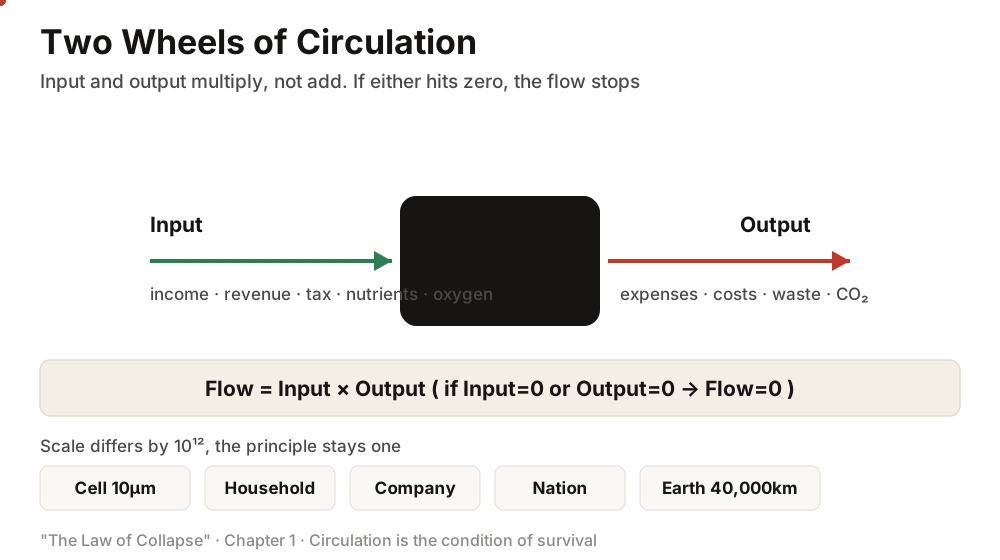
Circulation does not simply mean that something is spinning. Circulation necessarily has two elements: what comes in, and what goes out (input and output). These two must remain uninterrupted and connected for a system to be sustained.
In our bodies, input is food, water, and oxygen, and output is carbon dioxide, waste, and heat. If food stops coming in, energy is depleted; if waste is not excreted, toxins accumulate. According to Guyton's textbook of medical physiology, the kidneys filter approximately 180 liters of blood a day. If this filtration process stops, uremia and electrolyte imbalance progress rapidly in the body, and life can become endangered within days. Cut off the input, and death follows; block the output, and death follows too.
Physics calls this the continuity equation. When a fluid flows through a closed pipe, the principle is that the volume flowing in per unit time must equal the volume flowing out for the system to remain stable. Blood flowing inside a vessel, money flowing in and out of a household, a nation's tax revenue and spending, all follow the same structure as this principle. When inflow and outflow are in balance, the system is sustained; when either side breaks down, the system either stagnates or is depleted.
In a household, input is income and output is spending. As income comes in and flows out as living expenses, education costs, and housing costs, the household as a system is sustained. If spending exceeds income, savings shrink, and once savings run out, debt grows. Conversely, if income comes in but is not spent appropriately (that is, if consumption contracts to an extreme degree), the household itself may hold together, but the circulation of the broader economy the household belongs to slows down. When one person does not spend money, someone else's income falls.
In a company, input is revenue and output is cost. The cycle of purchasing raw materials, manufacturing products, selling them and collecting payment, and purchasing raw materials again must remain unbroken. What happens if products sell but payment collection is delayed? The books show revenue, but the vault holds no cash. This is exactly the solvent-on-paper bankruptcy mentioned above. Output (paying costs) continues, while input (collecting cash) is blocked, breaking the circulation.
In a nation, input is tax revenue and output is fiscal spending. Collecting taxes, investing in infrastructure, providing welfare, and having that stimulate economic activity that flows back as tax revenue again. This circulation is the basic operation of running a country. If tax revenue falls but spending cannot be cut, the state issues bonds, and the interest on those bonds begins eating further into tax revenue, starting a vicious cycle. Conversely, if tax revenue comes in but fiscal spending is not executed properly (that is, if the budget does not flow through to where it is needed), the economy contracts, and next year's tax revenue falls.
When the balance between input and output breaks down in any system, one of two outcomes follows. If input falls, the system stops from energy depletion; if output is blocked, toxins, debt, or inventory accumulate inside and the system suffocates on itself. There is one important point here: input and output operate by multiplication, not addition. No matter how large income is, if the spending pathway is completely blocked, the system stops; conversely, even if the pathway is open, if income drops to zero, the system stops. If either side is zero, the flow halts regardless of the size of the other side. Either way, the outcome is the same: stagnation, and then collapse.
The Universality of Circulation: Different Scale, Different Name, One Principle
A single cell measures roughly 10 micrometers across. The Earth's circumference is roughly 40,000 kilometers. Between these two lies a difference in scale of ten to the twelfth power, a gap almost impossible to imagine. And yet both the cell and the Earth are alive on circulation.
A cell absorbs nutrients and excretes waste through its cell membrane. When this circulation stops, the cell dies. An organ made of cells receives oxygen and nutrients and discharges metabolic byproducts through blood vessels and lymphatic vessels. When this circulation is blocked, the organ is damaged. The human body, made of organs, sustains a grand circulation of blood and oxygen centered on the heart and lungs. According to Levick's textbook of cardiovascular physiology, an adult heart pumps roughly 7,000 liters of blood a day. The total length of the blood vessels, including the capillaries, is estimated at anywhere from several thousand to tens of thousands of kilometers, and blood must flow ceaselessly through this vast vascular network in its entirety. When this circulation stops, a person dies.
The same principle applies identically to systems outside the human body. A household stands on the circulation of income and spending. Income comes in and flows out as living expenses, and those living expenses become someone else's income, flowing again within the economy. A club or nonprofit stands on the circulation of dues and participation. Dues are collected and spent on activities, and those activities return value to members, drawing them back into participation. A company stands on the circulation of revenue and cost. The cycle of investing, producing, selling, and collecting must keep turning for a company to stay alive.
A nation stands on the circulation of tax revenue and fiscal spending. Collecting taxes, investing them in public goods, and having those public goods stimulate economic activity that returns as tax revenue. This circulation is a nation's lifeline. The Earth stands on the circulation of carbon and oxygen, water and energy. Plants absorb carbon dioxide and release oxygen; animals absorb oxygen and release carbon dioxide. This circulation sustains the ecosystem. The circulation by which the ocean absorbs and releases heat regulates the climate.
From a single cell to households, organizations, companies, nations, and the Earth: the scale differs by a factor of ten to the twelfth power, but the principle is one. Something must come in, circulate, and go out. As long as this flow is sustained, the system is alive; the moment this flow is cut, the system dies.
So why do some systems sustain their flow while others see it stop? What sustains circulation, and what stops it? To answer this question, there is something we must understand first: right up until the moment circulation stops, a system looks fine on the surface.
Invisible Flow, Visible Outcome
Circulation has one especially dangerous property. Even while it is slowing down, even right up to the moment it nearly stops entirely, a system continues to look normal on the surface.
Even when a coronary artery is 70 percent blocked, there are typically no symptoms at rest. According to a clinical review of coronary artery disease from the U.S. National Library of Medicine at the National Institutes of Health, the reduction in coronary blood flow begins once stenosis exceeds 50 percent and accelerates sharply beyond 70 percent, yet at rest, symptoms often fail to appear even at fairly advanced degrees of stenosis. The 42-year-old office worker who appeared in the prologue is exactly this case. He had received a "normal" verdict at his checkup a week earlier, but his blood vessels had already been narrowing slowly for decades.
Household finances work the same way. Even after savings fall below one month's worth of living expenses, credit card payments still go through normally, children still go to school, and the people around never suspect a thing. In the 2023 Survey of Household Finances and Living Conditions mentioned earlier, among households holding financial debt, 67.6 percent reported that principal and interest repayment felt burdensome. These households continue their ordinary daily lives on the surface, but in substance they are in a state where a single shock could bring them down.
A nonprofit's deteriorating finances are likewise invisible from the outside. Its events have merely shrunk a little; the organization still exists, its website still runs, and its representatives still attend meetings. But internally, its reserves are running dry, key staff are leaving, and new-member inflow has stopped. What shows on the surface is always the very last thing to appear.
Companies are no different. Revenue can be slowly declining while no one outside knows, right up until the quarterly earnings release. Cash flow can be deteriorating while no one outside can tell, right up until the credit rating is downgraded. According to the Bank of Korea's Financial Statement Analysis, the operating margin of companies that eventually defaulted had already begun declining as early as two years before the default, yet in many cases the credit rating was maintained right up until the moment of default. The deterioration of circulation was already under way, but there was a time lag before it became visible externally.
The national economy is the same. Even while GDP growth stays positive, population may already be draining out of a particular region within it. Even while the national credit rating holds, accumulated fiscal deficits may have already exhausted real response capacity. In most cases, when the macro indicators look normal, the micro-level circulation has already stagnated.
This is the most frightening thing about circulatory stagnation. No alarm sounds while the flow is diminishing, because the system mobilizes its remaining margin to keep up appearances. And the moment even that margin is exhausted, the crisis appears to arrive suddenly. But in reality it did not arrive suddenly. It had been under way for a long time. It simply was not visible.
We will look in the next chapter at what that invisible margin is, the last safety device that absorbs shock. Once you understand that crisis begins with the depletion of margin, you can finally explain why some systems withstand shock and others collapse.
Conclusion
What this chapter has examined comes down to a single principle: to be alive is to be flowing. If blood stops flowing, the brain dies within three minutes. If income stops flowing, a household collapses within months. If cash stops flowing, even a profitable company can go bankrupt within a quarter. If tax revenue stops flowing, even a nation can default. The scale differs, but the outcome is the same.
Circulation must always have both input and output, and once the continuity between the two breaks, the system either depletes or suffocates. This is structurally identical to the continuity equation in physics. And the most dangerous fact of all is that while circulation is slowing down, the system continues to look normal on the surface. The deterioration of flow proceeds out of sight, and only when the last margin is exhausted does it finally erupt into a visible crisis.
The next chapter examines exactly that margin (the buffer) and why the depletion of buffer is the true starting point of every collapse.
참고문헌
- Merchant, R. M., et al. (2020). Part 1: Executive Summary: 2020 American Heart Association Guidelines for CPR and ECC. Circulation, 142(16_suppl_2), S337-S357. doi:10.1161/CIR.0000000000000918
- Statistics Korea, Bank of Korea, Financial Supervisory Service (2023). 2023 Survey of Household Finances and Living Conditions. Statistics Korea press release. https://kostat.go.kr/board.es?mid=a10301010000&bid=215&act=view&list_no=428364
- Ministry of the Interior and Safety (2023). Registration Status of Nonprofit Civic Organizations. Ministry of the Interior and Safety Public Data Portal.
- Bank of Korea (2022). Financial Statement Analysis. Bank of Korea Economic Statistics System (ECOS). https://ecos.bok.or.kr
- International Monetary Fund. World Economic Outlook Database. General Government Gross Debt (% of GDP), Greece. (via FRED: https://fred.stlouisfed.org/series/GGGDTAGRC188N)
- Guyton, A. C., & Hall, J. E. (2020). Textbook of Medical Physiology (14th ed.). Elsevier. Ch. 26: Urine Formation by the Kidneys.
- Levick, J. R. (2010). An Introduction to Cardiovascular Physiology (5th ed.). Hodder Arnold. Ch. 1: Overview of the Cardiovascular System.
- Amanullah, A. M., et al. (2024). Coronary Artery Disease. In: StatPearls. Treasure Island (FL): StatPearls Publishing. PMID: 32809386. https://www.ncbi.nlm.nih.gov/books/NBK564304/
- Statistics Korea, Bank of Korea, Financial Supervisory Service (2023). 2023 Survey of Household Finances and Living Conditions: 67.6 percent reporting repayment burden. Summarized in KDI Economic Information Center (EIEC) policy brief.
- Poole, D. C., et al. (2021). August Krogh: Muscle capillary function and oxygen delivery. Comparative Biochemistry and Physiology, Part A, 253, 110852. doi:10.1016/j.cbpa.2020.110852. PMC 7867635.
This article is a faithful English rendering of Chapter 1 of "The Law of Collapse," provided for informational and educational purposes. The medical and economic statements in this text are not advice for diagnosing or treating any specific condition, nor for making investment decisions. Please consult a qualified professional for matters concerning your health and finances.