
This piece is the complete Chapter 3 of Calcium: The Reality of Evolution That Darwin and the Genome Map Missed (Yoon Jong-won). The body, figures, and citations follow the manuscript as written, and the subheadings are the subheadings found within the original.
Introduction: What It Means to Leave the Sea
About 385 million years ago, on a certain day in the late Devonian, some fish crawled out of the water. This was one of the most dramatic turning points in the history of life. For 3.8 billion years, life had existed only in water. It was born in the sea, grew in the sea, and died in the sea.
Water was the cradle of life, and it was the only world life knew. And yet some brave, or perhaps desperate, creatures left this familiar world and set out on an adventure into an entirely different environment. From water to air, from gills to lungs, from fins to legs. Everything had to change. The way of breathing had to change, the way of moving had to change, the way of retaining moisture had to change. They had to fight a new enemy called gravity. In water buoyancy had supported most of the body weight, but on land one's own skeleton had to bear the entire body weight. The skin dried out, the eyes had to focus in air, and the ears had to detect the vibrations of air rather than of water.
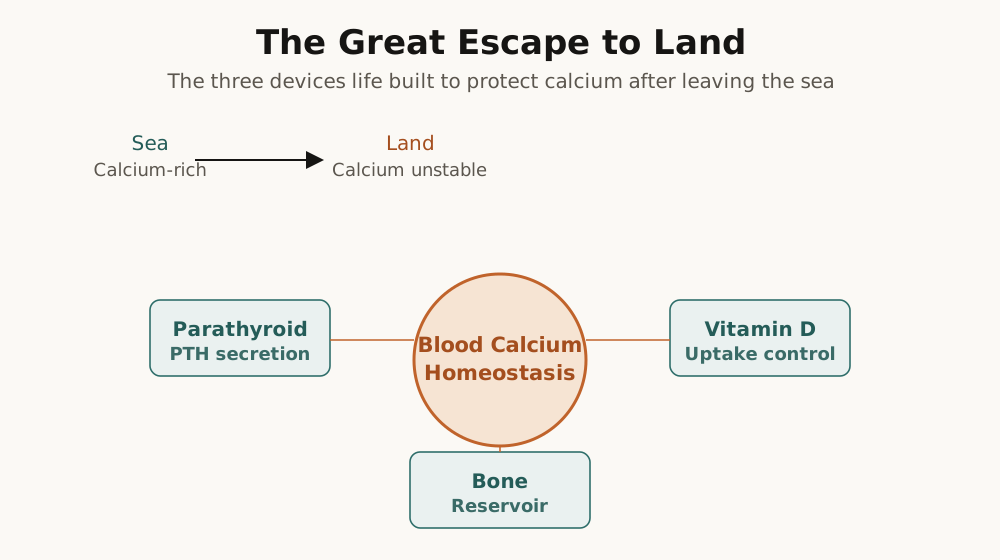
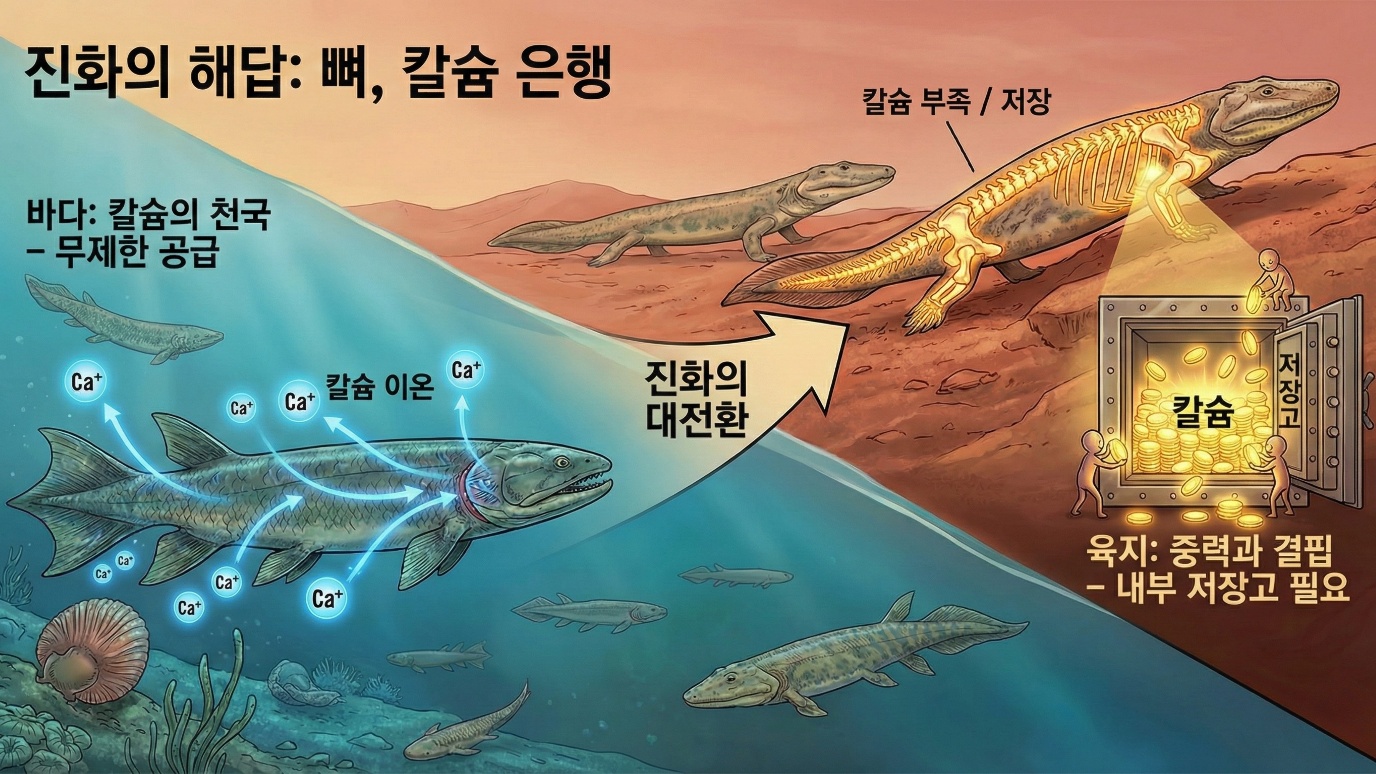
But among all these challenges there is one that has been most overlooked. It is calcium. When we speak of the move onto land, we talk a great deal about breathing and movement and dryness, but we hardly speak of calcium at all. Even textbooks mention lungs and legs and the amnion as the core innovations of the move onto land, but they rarely mention the calcium homeostasis system. Yet the problem of calcium was precisely the decisive factor that divided success from failure in life on land. The sea is a paradise of calcium. Calcium is dissolved abundantly in seawater, and fish can absorb this calcium through their gills at any time. If the blood calcium concentration falls even a little, they need only absorb more from the gills. It is a world in which the very idea of calcium worry does not exist. But land is completely different. There is no calcium in air. There are no gills either. Calcium can be taken in only through food, and the calcium content of food is highly variable, and there are days when food cannot be obtained at all. A migration from an environment rich in calcium to an environment poor in calcium. This was the hidden challenge of the move onto land.
In Chapter 1 we learned that calcium is a signaling molecule involved in almost every function of the cell. For a muscle to contract, calcium is needed; for a nerve to transmit a signal, calcium is needed; for the heart to beat, calcium is needed. Without calcium one cannot live for even a single moment. And yet on land the supply of this essential element is unstable. What should be done? The answer evolution found was an internal reservoir and a precise regulatory system. It was to turn the bones into an enormous calcium bank, and to manage the deposits and withdrawals of this bank with a hormonal system. When calcium is abundant it is stored in the bones, and when calcium is scarce it is drawn out of the bones and used. This is precisely the calcium homeostasis system, and the evolution of this system made life on land possible. In this chapter we will examine how this system evolved, why it had to evolve, and what position it occupies in the evolution of the capacity to control calcium.
The Difference Between Two Worlds: The Upheaval of the Calcium Environment
Let us look at how different the calcium environments of sea and land are, in concrete numbers. The calcium concentration of modern seawater is about 400 to 420 milligrams per liter. At this concentration marine fish can absorb calcium through their gills. The gills are a respiratory organ and at the same time an ion-exchange organ. The epithelial cells of the gills have calcium channels and calcium pumps, so they can actively absorb calcium from seawater or excrete it as needed. In fact, for sea fish calcium is not scarce but rather in excess. As we saw in Chapter 2, the fact that Cambrian organisms began to make shells may also have been a detoxifying response to a calcium excess. In the sea the problem was that there was too much calcium; there was almost never a problem of too little. The sea was, quite literally, a paradise of calcium.
But fresh water is different. The calcium concentration of fresh water is usually on the order of about 10 to 50 milligrams per liter, only about one-tenth to one-fortieth that of seawater. Freshwater fish already live in an environment poor in calcium. Although they absorb calcium through their gills, they cannot absorb it as abundantly as in seawater. The gills of freshwater fish have developed a more efficient calcium-absorption system than those of sea fish, and this is an adaptation to an environment poor in calcium. The first vertebrates to move onto land probably came up onto the land by way of a freshwater environment. According to the fossil record, the first tetrapods, such as Tiktaalik and Acanthostega, are presumed to have lived in freshwater or brackish environments. They would already have been somewhat adapted to an environment less rich in calcium. But the land was an even more extreme environment than fresh water. Land animals cannot absorb calcium from water. This is because they have no gills. Calcium can be taken in only through food, and the calcium content of food is highly variable. If they eat small animals bones and all, or plants rich in calcium, they can take in a great deal of calcium, but if they eat only muscle or plants low in calcium, calcium intake is insufficient. On top of this, there are days when food cannot be obtained at all. When a hunt fails or when food is seasonally scarce, calcium intake becomes scarce as well. It is a situation unimaginable in the sea. In the sea, even when food could not be obtained, calcium could still be absorbed through the gills. But on land, if there is no food there is no calcium either.
The instability of the calcium supply was not the only problem. Calcium demand increased as well. In water, buoyancy supports most of the body weight. This is why a fish scarcely feels its weight in water. And so a fish's skeleton can be relatively weak and flexible and still be fine. It needs only enough supporting power to move its fins and control its direction. But on land the situation is completely different. The skeleton must bear the entire body weight. It must stand against a new force called gravity. This demands harder and stronger bone, and harder, stronger bone requires more calcium. Gravity also imposes continuous stress on the skeleton. With every step, with every leap, an impact is applied to the bone. The bone must adapt to this stress. The regions where much stress is applied must be reinforced, and the regions with little stress must conserve calcium. This means that bone must not be a static structure but must be dynamically remodeled. A situation in which the calcium supply becomes unstable while calcium demand increases. If this problem is not solved, life on land is impossible. Muscles cannot contract, nerves cannot send signals, and the heart stops. How did evolution solve this problem?
The Parathyroid: The Key to Life on Land, Evolved from the Gills
In the human neck there are four small organs. Attached behind the thyroid gland, these organs are called the parathyroid glands, and they are only about the size of a grain of rice. Even all their weight added together comes to only about 120 milligrams. They are so small that even physicians did not know well of their existence until the nineteenth century. When performing thyroid surgery they often removed these organs along with it by accident, and when they did, it was frequent for the patient to die in severe muscle spasms. At first they did not know why. They thought it was because the thyroid had been removed. But as research advanced the true cause was revealed. It was because not the thyroid but the small organs attached behind it, that is, the parathyroid glands, had been removed together with it. Without the parathyroid glands the blood calcium concentration falls sharply, and the muscles, deprived of calcium, throw themselves into uncontrollable spasms leading to death. So small an organ was the key that determined life and death.
The parathyroid glands secrete parathyroid hormone. The main role of this hormone, called PTH by its English abbreviation, is to raise the blood calcium concentration. How does it work? The parathyroid gland has a special protein called the calcium-sensing receptor. This receptor monitors the blood calcium concentration in real time. Just as a thermostat senses the indoor temperature and regulates the heating, the calcium-sensing receptor senses the blood calcium concentration and regulates hormone secretion. When calcium ions bind to the receptor, parathyroid hormone secretion is suppressed, and when calcium ions come away from the receptor, parathyroid hormone secretion increases. This is a very refined feedback system. If the blood calcium concentration falls even a little, the parathyroid gland immediately senses it and secretes the hormone, and when the hormone raises the calcium concentration, secretion decreases. Thanks to this system the blood calcium concentration is maintained within the narrow range of about 8.5 to 10.5 milligrams per deciliter.
Parathyroid hormone raises the blood calcium concentration in three ways. The fastest and most direct way is to release calcium from the bones. Parathyroid hormone acts on bone cells and bone-resorbing cells to send the calcium stored in the bones out into the blood. Bone is an enormous reservoir of calcium, and parathyroid hormone is the key that opens the door of this reservoir. The second way is to promote calcium reabsorption in the kidney. The kidney filters the blood and excretes waste products in the urine, and in this process some calcium is filtered out as well. But because calcium is a precious resource, it must be drawn back into the blood. Parathyroid hormone increases calcium reabsorption in the renal tubules, returning to the blood the calcium that was about to escape into the urine. The third way is to promote the activation of vitamin D in the kidney. Vitamin D is a hormone that increases calcium absorption in the intestine, and parathyroid hormone promotes the activation of vitamin D, thereby indirectly raising calcium absorption.
Where did the parathyroid gland come from? In 2004, a paper by the research team of Anthony Graham of King's College London, published in the journal PNAS, offered a surprising answer. It was that the parathyroid gland evolved from the gills of fish. Graham's team focused on a gene called Gcm-2. This gene is essential for parathyroid development in mammals. Without the Gcm-2 gene the parathyroid gland does not form. The team investigated whether fish, too, have this gene. The result was astonishing. Both the zebrafish and the dogfish had the Gcm-2 gene, and this gene was expressed in the gills. The gills of fish are not only a respiratory organ but also play an important role in calcium absorption. The gills have a calcium-sensing receptor, and a peptide similar to parathyroid hormone is expressed as well. Functionally the gills were already playing a role similar to that of the parathyroid gland. When fish came up onto land the gills lost their respiratory function, but their calcium-regulating function was transferred to a new organ. A part of the gill tissue moved to the inside of the neck and became an independent organ, that is, the parathyroid gland. Evolution recycled an existing structure to suit a new purpose.
The parathyroid gland as an independent organ first appears in amphibians. Frogs have a clear parathyroid gland, and this gland secretes parathyroid hormone and takes part in regulating the blood calcium concentration. The parathyroid gland of amphibians develops from the fourth pharyngeal pouch, and this is exactly the same location where the gills develop in fish. This is decisive evidence that developmentally the parathyroid gland and the gills derive from the same tissue. Why was the parathyroid gland needed in amphibians? Amphibians live a life that goes back and forth between water and land. As tadpoles they breathe with gills in the water and can absorb calcium through the gills as well, but after they metamorphose and become adults they spend a considerable amount of time on land. When in water they can absorb some calcium through the skin, but when on land they cannot use this method. Therefore they needed a system to efficiently manage the bones, the body's internal calcium reservoir. The parathyroid gland is an organ that evolved to meet this need. All land vertebrates, including amphibians, that is, the tetrapods, have parathyroid glands. Reptiles too, birds too, mammals too, all have parathyroid glands. This shows that the parathyroid gland was essential for life on land.
Vitamin D: The Link Between Ultraviolet Light and Calcium
For the calcium homeostasis system to be completed, one more element besides parathyroid hormone was needed. It is vitamin D. The history of vitamin D is as old as the history of life, but it came to play a central role in calcium metabolism only with the land vertebrates. According to several evolutionary-biology research institutions, the vitamin D receptor most likely was originally involved in detoxification and immune regulation, and its function of regulating calcium and bone metabolism appears to have been added on top of that after the move onto land. It was from amphibians onward that vitamin D came to play an essential role in calcium homeostasis, and amphibians, reptiles, birds, and mammals that are deficient in vitamin D all develop rickets. This disease, in which the bones do not mineralize properly and become weak and bent, shows that vitamin D is essential for calcium absorption and bone formation in land animals.
Parathyroid hormone and vitamin D cooperate closely to regulate the blood calcium concentration. When blood calcium falls, hormone secretion increases in the parathyroid gland, and this hormone converts vitamin D into its active form in the kidney. Activated vitamin D promotes calcium absorption in the intestine. At the same time, parathyroid hormone and active vitamin D together promote the release of calcium from the bones. Conversely, when blood calcium rises, parathyroid hormone secretion decreases, and vitamin D activation decreases as well, so calcium absorption in the intestine decreases and calcium release from the bones decreases too. This refined feedback loop maintains the blood calcium concentration within a narrow range. It was an evolutionarily reasonable choice that land vertebrates came to make use of vitamin D for calcium homeostasis. Land animals are exposed to far more ultraviolet light than sea animals, and it is a natural thing that vitamin D is synthesized in the skin by ultraviolet light. Linking the environmental signal of ultraviolet exposure to calcium metabolism was an elegant solution.
Bone: A Living Calcium Reservoir
Many people think of bone as a static structure. They think of it as something that does not change once it is formed, like the pillar of a house. But this is a great misunderstanding. Bone is living tissue. Within bone, blood vessels flow, nerves pass through, and various cells are active. And bone is ceaselessly broken down and remodeled. The skeleton of an adult is completely replaced about once every ten years. The calcium atoms that make up your bones right now are entirely different atoms from those of ten years ago. This process is called bone remodeling. Bone-resorbing cells break down old bone, and bone-forming cells make new bone. Under normal conditions these two processes are in balance. As much is newly formed as is broken down, so the total amount of bone is kept constant. Why is such a complex system needed? There are two reasons.
First, mechanical adaptation. The regions of bone that receive stress must be reinforced. This is why an athlete's bones are stronger than an ordinary person's. The arm bone of a tennis player that holds the racket is thicker and stronger than the arm bone on the other side. A ballerina's foot bones are far denser than an ordinary person's. Through bone remodeling the bone structure can be optimized according to the distribution of stress. In the regions where much stress is applied, bone formation occurs more than bone resorption and the bone is reinforced, while in the regions with little stress, bone resorption occurs more than bone formation and calcium is redistributed elsewhere. This is the way to use a limited calcium resource most efficiently. Second, the calcium-reservoir function. Bone stores more than 99 percent of the body's calcium. To draw out this calcium and use it when needed, the bone must be broken down. Without a bone-remodeling system this would be impossible. If bone were a structure permanently fixed once it is formed, there would be no way to draw calcium out of the bones when blood calcium is scarce. The bone-remodeling system makes bone a dynamic calcium reservoir, allowing calcium to be stored and withdrawn as needed.
Fish, too, have bones. The bony fishes, as their name indicates, have bones. But there is an important difference between fish bone and the bone of land animals. In many bony fishes, bone remodeling takes place in a form focused on skeletal support and growth, rather than being, as in mammals, the central axis of whole-body calcium homeostasis. Because fish can absorb calcium directly from seawater through their gills, they do not depend on bone as a calcium bank as much as land vertebrates do. If calcium is needed, they need only absorb more from the gills. There is no particular need to break down the bones. But from amphibians onward the situation changes. Amphibian bone has bone-resorbing cells, and active bone remodeling occurs. Parathyroid hormone and active vitamin D regulate the formation and function of bone-resorbing cells. Bone began to function as a true calcium reservoir. As one goes toward reptiles, birds, and mammals, the bone-remodeling system becomes still more refined. In the bone of mammals, bone cells are abundantly distributed. Bone cells not only sense mechanical stress but also carry out an endocrine function, communicating by hormones with other organs such as the kidney and the pancreas. Bone is not a silent pillar but is also an enormous endocrine organ that is ceaselessly in conversation with the whole body.
Let us look at how calcium is distributed in the human body. In the body of an adult there is about 1 to 1.2 kilograms of calcium. Of this, 99 percent is in the bones and teeth. It is stored in the form of calcium phosphate, mainly hydroxyapatite. The remaining 1 percent is in the blood and cells. This 1 percent is physiologically important. Blood calcium is involved in almost all physiological functions, such as muscle contraction, nerve transmission, blood clotting, and hormone secretion. It cannot be dismissed just because it is 1 percent. In absolute quantity it is about 10 to 12 grams. And this amount must be maintained within a very narrow range, about 8.5 to 10.5 milligrams per deciliter. If it goes outside this range, serious problems arise. If calcium is too low, tetany occurs in which muscles contract uncontrollably, and if calcium is too high, cardiac arrhythmia and disturbances of consciousness occur. The 99 percent of the bone is a reservoir for this 1 percent. When blood calcium falls it is drawn out of the bones and used, and when it is sufficient it is stored again. Bone is a structural support, but it is at the same time an enormous calcium bank.
There is one more point worth noting. Hydroxyapatite, the main component of bone, stores not only calcium but also phosphorus. Phosphorus is an essential constituent of ATP, the core of energy metabolism, and an element that forms the backbone of DNA and RNA. In Chapter 1 we learned that calcium can bind to the phosphate group of ATP and form a precipitate. Interestingly, in bone it is precisely this reaction that occurs deliberately. Calcium and phosphate bind to form the stable mineral hydroxyapatite, and this provides the strength of the bone. A reaction that is a catastrophe inside the cell becomes a useful reaction in bone outside the cell. The move onto land was also an event in which the two core resources of calcium and phosphorus came to be managed together in a single vault called bone.
Evolutionary Integration: The Third Dimension of Calcium Control
Now let us summarize the evolution of the capacity to control calcium. In Chapter 1 we examined the first dimension. It is intracellular calcium control. Every cell maintains its cytoplasmic calcium concentration at about 100 nanomoles. While maintaining a concentration difference of more than ten thousand-fold with the outside of the cell, it temporarily lets calcium in only when needed and uses it as a signal. This is the most fundamental calcium control, conserved from 3.8 billion years ago. From E. coli to human nerve cells, it is a capacity shared by all living things. In Chapter 2 we examined the second dimension. It is extracellular calcium structures. In the Cambrian explosion, animals began to make calcium-based shells and skeletons outside the cell. The capacity for intracellular calcium management was extended to the outside of the cell. A system that had pushed a dangerous poison to the outside evolved into a system that turned that poison into a hard suit of armor. In this chapter we examined the third dimension. It is whole-body calcium homeostasis. It is the parathyroid-hormone and vitamin D system that evolved in land vertebrates. This system regulates the blood calcium concentration and manages the internal reservoir called bone. Each dimension was built on top of the previous dimension. Without intracellular calcium control, extracellular structures could not have been made. This is because only if one has the capacity to handle calcium precisely can one form shells and skeletons in the desired place and in the desired form. Without extracellular structures, that is, bone, there would have been no reservoir in which the whole-body calcium homeostasis system could operate.
A characteristic of evolution is that it recycles existing things rather than making something entirely new. The calcium homeostasis system is no exception. The parathyroid hormone gene exists in fish as well. But in fish this peptide operates in a dispersed form in various tissues, and the proportion of local action is large. It is not organized into a clear endocrine axis running from the parathyroid gland to the bloodstream, and from the bloodstream to the whole body, as it is in tetrapods. The interpretation of recent evolutionary physiology is that as the parathyroid gland appeared from amphibians onward, this peptide was reorganized into the whole-body calcium hormone we know today. The vitamin D receptor, too, is present in fish. But in fish the role of this receptor is mainly detoxification and immune regulation. Regulation of calcium homeostasis is secondary. In land vertebrates the vitamin D receptor became the central regulator of calcium homeostasis. The parathyroid gland itself, too, derived from the gills of fish. Gill tissue that had performed a calcium-absorption function was converted into an independent organ as it came up onto land. Existing genes, existing proteins, existing tissues acquired new functions in a new context. This is the way of evolution.
Why must the blood calcium concentration be regulated so precisely? As we saw earlier in Chapter 1, calcium is a signaling molecule involved in almost every function of the cell. Muscle contraction, nerve transmission, hormone secretion, cell division. All these processes depend on the calcium signal. For this signal to operate normally, the baseline calcium concentration must be constant. If the baseline concentration wavers, the signal-to-noise ratio falls. It becomes hard to distinguish whether a signal has come or not. Just as the cytoplasmic calcium concentration must be maintained at 100 nanomoles, the extracellular calcium concentration too must be maintained constant. Only if the extracellular calcium concentration is constant can the amount of calcium flowing into the cell be predicted, and the calcium signal operates normally. The blood calcium concentration determines the extracellular calcium concentration. In conclusion, the whole-body calcium homeostasis system plays the role of creating the environment for calcium signaling at the cellular level to operate normally. A macroscopic system supports a microscopic process.
Conclusion: Holding the Sea Within the Body
The move onto land about 385 million years ago was a decisive turning point in vertebrate evolution. Against gravity the body had to be supported, breathing had to be done with air, and in a dry environment moisture had to be retained. But one of the most fundamental challenges was calcium. It was leaving the calcium paradise called the sea and entering a calcium desert. The gills, the calcium-absorbing organ, were lost as well. A new solution was needed. Evolution's answer was an internal reservoir and a precise regulatory system. Bone expanded in function from a simple supporting structure to an enormous calcium bank. A hormonal system composed of the parathyroid gland and vitamin D began to manage this bank.
This system was not made entirely anew. Genes, proteins, and tissues that already existed in fish acquired new functions in a new context. From gills to parathyroid gland, from a local factor to a whole-body hormone. Evolution recycled existing materials to respond to a new challenge. In Chapter 2 we said that vertebrates packed a portable solid sea, in the form of bone, into their bodies and came up onto land. This expression is not a metaphor. The calcium and phosphorus stored in bone, and the hormonal system that manages them, are literally a reproduction of the ionic environment of the sea within the body. Fish live in the sea, but land vertebrates live holding the sea within their bodies. It is no coincidence that the ionic composition of blood resembles that of ancient seawater. We left the sea, but the sea remains within us.
The evolution of the capacity to control calcium reached its third dimension. From intracellular calcium management to the formation of extracellular structures, and then to whole-body calcium homeostasis. Each stage was built on top of the previous stage. In Part 1 of this book we examined how the capacity to control calcium has evolved, and what role it played at each major turning point of life. In the next chapter, as the last of Part 1, we will examine the relationship between calcium and higher intelligence. We will learn why the organ called the brain depends so heavily on calcium, and how the refinement of calcium signaling made higher cognitive functions possible. And in Part 2 we will examine how this refined system breaks down. That the collapse of calcium homeostasis becomes the cause of chronic disease is the DIAH hypothesis, which is the core argument of this book.
References
1. Okabe, M., & Graham, A. (2004). The origin of the parathyroid gland. Proceedings of the National Academy of Sciences, 101(51), 17716-17719. doi:10.1073/pnas.0406116101
2. Bouillon, R., & Suda, T. (2014). Vitamin D: calcium and bone homeostasis during evolution. BoneKEy Reports, 3, 480. doi:10.1038/bonekey.2013.214
3. Suarez-Bregua, P., Cal, L., Cañestro, C., & Rotllant, J. (2017). PTH reloaded: A new evolutionary perspective. Frontiers in Physiology, 8, 776. doi:10.3389/fphys.2017.00776
4. On, J. S., Chow, B. K., & Lee, L. T. (2015). Evolution of parathyroid hormone receptor family and their ligands in vertebrates. Frontiers in Endocrinology, 6, 28. doi:10.3389/fendo.2015.00028
5. Talmage, R. V., & Mobley, H. T. (2008). Calcium homeostasis: Reassessment of the actions of parathyroid hormone. General and Comparative Endocrinology, 156(1), 1-8. doi:10.1016/j.ygcen.2007.11.003
6. Carlberg, C. (2022). Vitamin D in the context of evolution. Nutrients, 14(15), 3018. doi:10.3390/nu14153018
7. Guerreiro, P. M., Renfro, J. L., Power, D. M., & Canario, A. V. (2007). The parathyroid hormone family of peptides: Structure, tissue distribution, regulation, and potential functional roles in calcium and phosphate balance in fish. American Journal of Physiology: Regulatory, Integrative and Comparative Physiology, 292(2), R679-R696. doi:10.1152/ajpregu.00480.2006
8. Holick, M. F. (2018). Vitamin D: part I; from plankton and calcified skeletons (500 million years ago) to rickets. International Orthopaedics, 42(3), 475-480. doi:10.1007/s00264-018-3857-3