
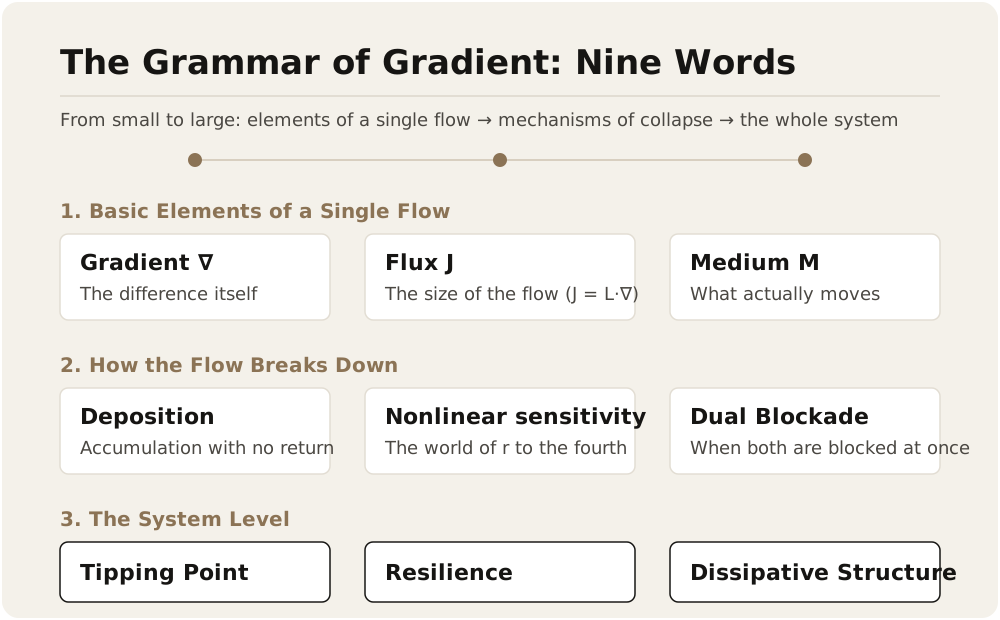
Chapter 1 traced the history of how the disciplines split apart, and Chapter 2 introduced gradient as the common principle that threads through every field. Now we need the grammar of this principle. Grammar is both a list of words and the rules for how those words fit together. This chapter lays out the nine core concepts that will recur, again and again, whenever we describe a gradient system.
You do not need to memorize these nine words. It is enough to get your eyes used to them once, so that when they resurface in later chapters you will naturally recognize, "ah, this is what that meant." Each concept consists of a definition, a brief formula where one is needed, and concrete illustrations from both medicine and economics.
The concepts are arranged from small to large. We begin with gradient, flux, and medium, the basic elements of a single flow; move on to deposition, nonlinear sensitivity, and dual blockade, the mechanisms by which a flow collapses; and close with critical threshold, resilience, and dissipative structure, concepts that operate at the level of the whole system. Follow this order, and the language this book will use on every path ahead will settle naturally into your hands.
1. Gradient: Difference Itself
As defined in the previous chapter, gradient is the difference in a physical quantity between two points. Mathematically it is the derivative of a physical quantity with respect to position: a vector indicating how steeply that quantity changes, and in which direction in space, denoted ∇. For this book, the intuitive meaning is enough. Gradient is difference, and where there is difference, flow becomes possible.
The unit of a gradient depends on which physical quantity the difference concerns. A pressure gradient is expressed in mmHg/cm, a temperature gradient in degrees Celsius per meter, a concentration gradient in mol/(L·cm), a potential gradient in V/m, and so on. In the medical and economic literature, the same mathematical structure appears under different names. Blood pressure differential, oxygen partial-pressure differential, interest rate differential, and liquidity gap are all field-specific expressions of the same gradient.
Gradient is not energy. Energy is a quantity; gradient is a difference. One liter of water has the same amount of energy whether it sits in a reservoir or in the ocean, but water in a reservoir 100 meters above sea level flows, while water in a flat ocean does not. Energy can only do work where a difference exists. Throughout this book, the phrase "the gradient dissipates" does not mean energy has vanished; it means the distribution of energy has become uniform, so that it can no longer do work.
2. Flux: The Magnitude of Flow
Flux (J) is the amount of medium passing through a unit area per unit time. Put simply, it is the magnitude of flow. If gradient is the "difference," flux is the "flow itself" that the difference produces.
The relationship between flux and gradient was formalized in 1931 by Lars Onsager, a Norwegian-born American physical chemist. His reciprocal relations can be summarized as follows: flux is proportional to gradient. In formula form, J = L · ∇, where L is the transport coefficient. When the gradient doubles, the flux doubles as well. This relationship holds across every transport phenomenon in non-equilibrium thermodynamics, including diffusion, heat conduction, electrical conduction, and osmosis. The essential point is that when the gradient is zero, the flux is also zero: without a gradient, no flow can exist. Onsager received the 1968 Nobel Prize in Chemistry for establishing this reciprocal relation.
For a concrete medical example of flux, consider the oxygen that moves from the alveoli into the blood: that quantity is oxygen flux. The plasma filtered at the glomerulus and passed into the renal tubule (roughly 100 to 125 mL per minute in an adult) is glomerular filtration flux. In economics, the volume of funds moving through a particular financial channel is capital flux, and the volume of goods moving from one region to another is logistics flux. In every case, flux is determined in proportion to gradient.
3. Medium: What Actually Moves
Medium (M) is the entity that actually moves within a flow system. If gradient is the cause of flow and flux is its magnitude, medium is the body of the flow. The medium changes as the domain changes.
In the human body there are several media. In the blood vessels, blood is the medium; in cellular signaling, calcium ions; in the respiratory system, oxygen and carbon dioxide; in the nervous system, ions such as sodium, potassium, and calcium; in the endocrine system, hormones; and in the lymphatic system, lymph fluid. In economic systems, the media are money (cash and liquidity), goods (material resources), labor (workforce), and information (credit and signals). In electrical circuits the medium is electrons; in thermal systems, thermal energy; in computer networks, data packets.
The name of the medium differs from domain to domain, but the rule that a medium is carried along a gradient stays the same. This is the core thesis on which the entire book rests. Just as calcium ions flow along the concentration gradient across a cell membrane, cash flows along the liquidity gradient of a financial channel. Only the raw material of the medium changes; the physical law governing the flow does not. This is why, as later chapters alternate between medical and economic cases, readers will not lose their way between the two worlds. Swap one medium for another, and the shape of the law remains unchanged.
4. Deposition: Accumulation That Does Not Return
Deposition refers to accumulated material that builds up irreversibly on the inner wall of a conduit. In medicine, this is the buildup of calcium and cholesterol on the inner wall of blood vessels; in engineering, the buildup of scale inside a pipe; in economics, the accumulated burden of interest and debt within a financial channel. All are field-specific manifestations of this same concept.
The most important property of deposition is irreversibility. Once deposits harden, they do not dissolve spontaneously. A comprehensive review of the pathology of vascular calcification by Demer and Tintut (Demer & Tintut, 2008, Circulation) systematically demonstrated that calcification of the vessel wall is not simple cholesterol buildup but an active process that follows a pathway resembling bone formation. Once calcification reaches the mature stage, it is not removed without surgery or specialized medication, and it expands its range over time.
This same irreversibility recurs in economics. The principal of a loan can be repaid and returned, but interest already paid does not return. A fiscal deficit once confirmed, accumulated public debt, and the traces left by a chronic recession all leave marks on the economic system, and those marks act as the vulnerable pathway for the next crisis. This is why this book repeats the mapping "microcalcification equals interest": both share this common irreversibility. Deposition is a trace that does not return, the physical way in which a system remembers its past.
5. Nonlinear Sensitivity: The World of r to the Fourth Power
Nonlinear sensitivity refers to the phenomenon in which a minute change in input produces an enormous change in output. In gradient systems, the most representative law of this sensitivity is Poiseuille's law. Formulated in 1846 by the French physician and physicist Jean Léonard Marie Poiseuille while he studied the flow of blood inside blood vessels, this law later became foundational to fluid dynamics; its history is systematically documented in a review by Sutera and Skalak (Sutera & Skalak, 1993, Annual Review of Fluid Mechanics).
The core of Poiseuille's law is this: the flow rate through a tube is proportional to the fourth power of the tube's radius. In formula form, Q = (π · ΔP · r⁴) / (8 · μ · L), where Q is flow rate, ΔP is the pressure gradient, r is the radius of the tube, μ is viscosity, and L is the length of the tube. The implication of this r⁴ dependence is dramatic. A 10% reduction in the radius of a tube reduces flow by about 34%; a 20% reduction cuts flow by about 59%; and a 50% reduction cuts flow by about 94%. A blood vessel whose diameter has shrunk by half looks, to the eye, merely "a bit narrower," but physically it is nearly the same as being blocked.
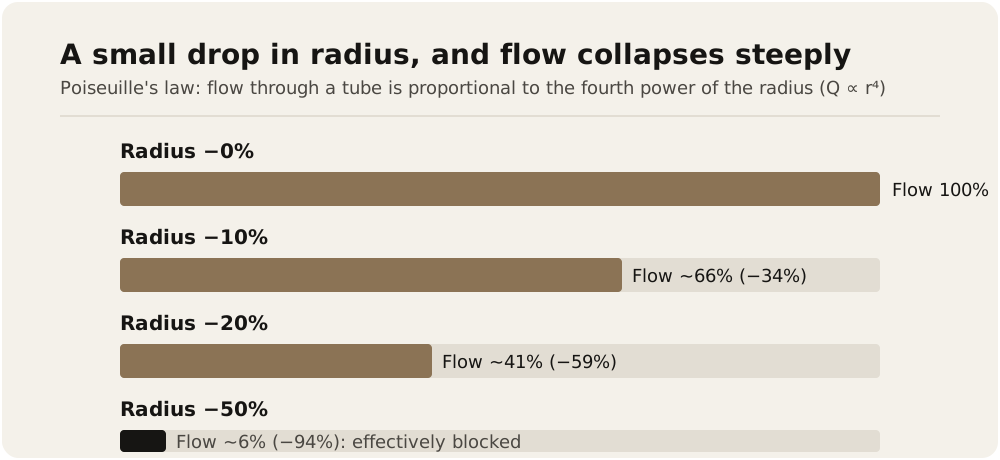
Let us take coronary artery disease as an example of how this nonlinear sensitivity operates in medicine. A patient whose coronary artery diameter has narrowed by 30% is, in most cases, asymptomatic at rest. But under the r⁴ law, this patient's coronary blood flow may already have dropped to roughly 24% of its original level, and the moment oxygen demand spikes from exercise or stress, the threshold can be crossed all at once. The same principle applies to economics. A 20% reduction in the processing capacity of a financial channel is reported in the news as "mild liquidity pressure," but once the r⁴ effect kicks in, the actual loss of flow can reach around 60%. This nonlinearity is why crises appear to arrive "suddenly."
6. Dual Blockade: When Two Things Are Blocked at Once
Dual blockade occupies a central position in the author's research framework (DIAH-7M) and recurs throughout this book. It rests on the observation that a single blockade alone does not cause a system to collapse; irreversible collapse begins only when a functional blockade and a physical blockade are established simultaneously.
In medicine, these two blockades are distinguished as follows. The first, CAM (Conductance Attenuation Metric), the signal blockade, is a functional blockade in which calcium signaling fails to reach the cell. The second, DLT (Deposition-induced Luminal Throttling), the channel blockade, is a blockade in which microcalcification deposited within the lumen and tissue narrows the physical channel for oxygen and waste. These two blockades are not two separate events but two branches from a single root: reduced calcium absorption capacity. One branch disturbs signaling (CAM); the other narrows the channel (DLT). When only CAM or only DLT is present, the system still has room to recover through alternate pathways. But when both blockades hold at once, supply and discharge are cut off together, and the tissue enters an irreversible path toward death.
The same structure is observed in economics. What corresponds to CAM in the economy is policy absorption failure: even when a central bank lowers interest rates or supplies liquidity, that signal fails to reach the real economy. What corresponds to DLT in the economy is the functional narrowing of financial channels caused by the deposition of loan interest. When both blockades are established at once, monetary policy becomes powerless and the flow of liquidity through the real economy is paralyzed. A Nature paper by Haldane and May on systemic risk in financial networks (Haldane & May, 2011, Nature) showed that a financial system's crisis spreads into total system collapse not from the shock of a single node but when that shock combines with structural vulnerability in the network, and this structural vulnerability, too, can be read as a form of the dual blockade condition.
The importance of dual blockade becomes clearer through its converse: a single blockade alone does not bring a system down. As we will see in a later chapter, the COVID-19 economic crisis was a single exogenous shock, and so it ended after a single blow. The 2008 global financial crisis, by contrast, was a dual blockade in which long-accumulated microcalcification of interest combined with the subprime shock, and so it unfolded into a chain of collapse lasting more than six months. This comparison will become one of the central arguments later in the book.
7. Critical Threshold (Tipping Point): The Line You Can Still Return From
A critical threshold is the boundary value beyond which a system can no longer return to its previous state once crossed. Before the threshold, the system returns to its original state even under disturbance; the moment it crosses the threshold, the system transitions abruptly into a new state. This is a universal phenomenon observed across ecology, climate science, finance, and medicine alike.
The representative comprehensive treatment of critical transition theory is the review paper by Scheffer and coauthors published in Nature (Scheffer et al., 2009, Nature). This paper identified statistical signals that ecosystems, financial markets, and climate systems commonly display as they approach a critical threshold: recovery slows, the autocorrelation of time series rises, and the variance of fluctuations increases, all suggesting the system's approach to a critical point. These signals are called critical slowing down.
Within this book's framework, the critical threshold is the point where the irreversibility of deposition meets r⁴ sensitivity. While deposition accumulates slowly, the system maintains itself by compensating for the decline in flow, but the moment the r⁴ effect exceeds the limit of that compensation, flow collapses abruptly. This moment is the critical threshold, and the collapse that follows takes a qualitatively different path from what came before. The apparent suddenness of a heart attack, and the apparent suddenness of a financial crisis, both rest on this abrupt phase transition that follows the arrival at a critical threshold.
8. Resilience: The Force That Lets You Return
Resilience is a system's ability to return to its original state after being disturbed. Since the Canadian ecologist Crawford Holling introduced the concept to ecology in a 1973 paper in Annual Review of Ecology and Systematics (Holling, 1973, Annual Review of Ecology and Systematics), it has become a core concept across economics, psychology, medicine, and a wide range of other fields.
Resilience is measured in two ways. The first is the size of disturbance the system can withstand, that is, its remaining distance to the critical threshold. The second is the speed at which it returns to its original state after disturbance. The closer a system sits to its critical threshold, the slower its recovery becomes, and this very slowdown is observed as the critical slowing down signal mentioned above. In other words, resilience and critical threshold are two sides of the same coin. A system with high resilience sits far from its critical threshold; a system with low resilience sits close to it.
In medicine, examples of resilience include the flexibility of blood pressure regulation, the range of blood sugar control, and the responsive range of the immune system. A healthy body returns quickly to its original homeostasis even after temporary stress, while a body burdened with accumulated underlying deposition from chronic disease either recovers more slowly or fails to recover at all under the same magnitude of stress. Resilience in economics corresponds to shock-absorbing capacity. A healthy economy returns to its original growth path within a certain period even after an external shock, while an economy weakened at its base by accumulated interest deposition and debt fails to recover from a shock of the same magnitude. The principle that declining resilience means moving toward the critical threshold is observed identically in both domains.
9. Dissipative Structure: The Order That Flow Creates
A dissipative structure is a system that maintains order, away from equilibrium, by continuously consuming a flow of energy. This is the core concept behind the work for which the Belgian chemist Ilya Prigogine received the 1977 Nobel Prize in Chemistry, and it serves as the central framework of non-equilibrium thermodynamics, applied broadly across life, weather, and economics.
Conventional thermodynamics teaches that the entropy of an isolated system increases: the second law states that order collapses on its own and disorder increases. Yet living organisms display the opposite phenomenon. Cells maintain order, and the body continually builds a vast array of structures. Prigogine resolved this apparent contradiction: the second law of thermodynamics applies strictly only to closed systems, and in open systems that receive energy from outside, a local decrease in entropy, that is, the maintenance of order, becomes possible. That maintenance, however, requires a ceaseless inflow and consumption of energy. The moment the flow stops, the dissipative structure collapses, and the system converges toward equilibrium, that is, toward disorder.
The entire argument of this book rests on this physics of dissipative structures. The human body is a dissipative structure, and so is the economy. Both take in energy from outside (food, resources, labor) to maintain an internal gradient and, in doing so, create order. When this inflow stops, or when the inflow continues but the internal gradient collapses, that is, when the system can no longer bear the cost of maintaining its gradient because of deposition and dual blockade, the system converges toward equilibrium. And in both living systems and economic systems, equilibrium is death.
The central claim of Prigogine's 1984 book, coauthored with Isabelle Stengers, Order Out of Chaos, can be summarized in a single sentence: the order of the world does not come from stillness, but from flow. This sentence is the physical philosophy that will run through every chapter of this book.
Conclusion
In this chapter we have learned nine words: gradient, flux, medium, deposition, nonlinear sensitivity, dual blockade, critical threshold, resilience, dissipative structure. These words will recur throughout every chapter that follows, growing richer each time they combine with concrete cases from medicine and economics.
With this grammar in place, we can now begin the study of the original sources. The next chapter will trace where this grammar came from: the 150-year scientific history of gradient built up by giants of physics and chemistry such as Clausius, Onsager, Poiseuille, Prigogine, Mitchell, and Scheffer. The next chapter will make clear what answer this book intends to offer for the gap they already understood but never extended into the pathways of disease and the pathways of the economy.
참고문헌
- Onsager, L. (1931). Reciprocal relations in irreversible processes. Physical Review, 37(4), 405-426.
- Holling, C. S. (1973). Resilience and stability of ecological systems. Annual Review of Ecology and Systematics, 4, 1-23. https://doi.org/10.1146/annurev.es.04.110173.000245
- The Nobel Foundation. (1977). The Nobel Prize in Chemistry 1977: Ilya Prigogine. https://www.nobelprize.org/prizes/chemistry/1977/prigogine/facts/
- Prigogine, I., & Stengers, I. (1984). Order Out of Chaos: Man's New Dialogue with Nature. New York: Bantam Books.
- Sutera, S. P., & Skalak, R. (1993). The history of Poiseuille's law. Annual Review of Fluid Mechanics, 25, 1-20. https://doi.org/10.1146/annurev.fl.25.010193.000245
- Demer, L. L., & Tintut, Y. (2008). Vascular calcification: pathobiology of a multifaceted disease. Circulation, 117(22), 2938-2948. https://doi.org/10.1161/CIRCULATIONAHA.107.743161
- Scheffer, M., Bascompte, J., Brock, W. A., Brovkin, V., Carpenter, S. R., Dakos, V., Held, H., van Nes, E. H., Rietkerk, M., & Sugihara, G. (2009). Early-warning signals for critical transitions. Nature, 461(7260), 53-59. https://doi.org/10.1038/nature08227
- Haldane, A. G., & May, R. M. (2011). Systemic risk in banking ecosystems. Nature, 469(7330), 351-355. https://doi.org/10.1038/nature09659
Source: The Universal Law: Gradient, Chapter 3, "The Grammar of Gradient: The Vocabulary the Reader Must Learn." The body text follows the original manuscript and is provided for informational purposes.