
Continuing from the previous part, we look at the changes in education, philosophy, economy, and industry, and at a world where circulation is restored. The cited references follow the manuscript as written.
Education Changes
School education today is finely divided by subject. In biology class students learn about cells and genes, in chemistry about elements and reaction equations, in earth science about strata and climate, and in health class about how to prevent disease, but from the students' point of view this knowledge is often scattered like separate islands. According to many educational research institutions, this kind of fragmented education can give "depth," but it has limits when it comes to cultivating the ability to draw the "whole picture."
The calcium execution code can serve as a bridge that connects these scattered islands. When students learn the properties of calcium ions and calcium carbonate in chemistry class, biology class can carry the story onward into how those calcium ions transmit signals within cells, contract muscles, and build bone; earth science class can carry it onward into the history in which that calcium becomes the shells of coral and shellfish in the sea, forms strata, and stores carbon; and health and physical education classes can connect it to everyday cases of how osteoporosis, arteriosclerosis, and joint disease increase at the same time when calcium balance is broken. It is an education in which, centered on a single element, our body and the Earth, daily life and policy are connected into one story.
Moreover, if the "calcium cycle" enters the textbooks in addition to the water and carbon cycles, students can understand the whole cycle of life, birth, growth, aging, death, and return, more concretely. They can learn the sentence "we come from soil and return to soil" not as a mere metaphor but together with the scientific explanation that "calcium created in the explosion of stars becomes rock, becomes soil, becomes plants, becomes animals, becomes human bone, and then becomes skeletal remains again and returns to the soil." According to many educational institutions, this kind of integrated and story-form education raises students' interest and comprehension and helps to cultivate a perspective that looks at science and the humanities at the same time.
In adult education and lifelong education as well, the calcium execution code can play an important role. Especially for middle-aged and older people in their forties to eighties, understanding "how my bones and blood vessels, my lifestyle habits and the Earth's environment are connected" can become an occasion to reflect on health management and the meaning of life together. From an era in which health lectures, environmental education, and humanities courses were each held separately, it now becomes possible to have integrated education that treats the three fields at once under the single theme of "calcium and circulation."
Philosophy and the Humanities Change
Many thought traditions of the East have long spoken of "circulation." The sayings that spring, summer, autumn, and winter turn, that birth, aging, sickness, and death turn, and that we come from soil and return to soil hold a deep intuition that sees humanity and nature within a single loop of circulation. In the West too, Stoic philosophy and ecological philosophy and the like have developed a view that sees the human being as one part within a cosmic order, but all of this discussion long remained in the "language of feeling and contemplation."
The calcium execution code provides a material basis for this old intuition. Where did the calcium in my bones come from? Many astrophysics and earth science research institutions explain the fact that it came from my mother's bones, before that from the food my mother ate, from the soil in which that food grew, from the rock that makes up that soil, and that the material of that rock was created inside a star that exploded in the distant cosmos. The skeletal remains that are left when we die are mostly calcium compounds, and as time passes this calcium is scattered again into soil and water and enters the bodies of plants and animals to become the material that builds new bone and shell. Seen this way, the sentence "coming from soil and returning to soil" is not only a poem but also a scientific report.
Once we accept this fact, our interpretation of human existence changes too. Rather than a special being separated from the cosmos, I am one passage of circulation in which calcium made in a star lives for a while under my name. This recognition teaches humility on one hand. It is because it makes us realize that the body and time, wealth and status I possess are, in the end, no more than a small wave within an immense circulation. At the same time it teaches dignity. Because even if it is the same calcium, what thoughts it had, what relationships it formed, and what choices it made during my lifetime are a story that is mine alone. The calcium execution code changes the philosophical question "what do I live for" into the concrete question "what circulation did the calcium of my body create in this life."
Economy and Industry Change
According to the World Health Organization and many health economics research institutions, the medical costs spent on managing chronic diseases take up the largest share of each country's health budget, and hypertension, diabetes, cardiovascular disease, arthritis, and dementia are called a "silent tsunami" that eats away not only at an individual's life but also at national finances and productivity. The current system is structured so that after a disease arises, enormous costs are spent on adjusting the numbers and delaying complications, while prevention, lifestyle habits, and nutritional management are allotted relatively few resources by comparison, many institutions point out.
If the DIAH-7M chronic disease pathway system and the calcium execution code pass through scientific verification and are accepted, it will become clearer that investing in prevention is not simply a moral choice but the most economical choice. It becomes possible to analyze that if we reduce the DIAH environment and invest in the lifestyle habits, nutrition, and environmental arrangements that keep the calcium cycle healthy, we can delay the onset and worsening of many chronic diseases at the same time, and that this can be the most efficient path to reducing medical costs, long-term care costs, and social security costs over the long term. National health policy can shift its center of gravity from "support for treatment costs by disease" to "support for prevention and management by pathway," and individuals and communities can take part in health programs that aim not at "the number of times one goes to the hospital" but at "improvement in the calcium aging index and the calcification score."
These changes bring about new industries. Wearable devices that monitor calcium metabolism and calcification, services that periodically track blood ionized calcium, bone density, and vascular calcification to notify of changes in risk, and customized nutrition and lifestyle coaching programs that reflect the calcium execution code and the DIAH-7M pathway can appear. Many medical device and healthcare companies report that they are already developing platforms that show composite indicators in an integrated way, beyond bone density, blood pressure, and blood sugar, and if the calcium execution code is added here, we can also imagine a service that periodically updates "the calcium map of my body."
In the environment and climate field, ocean calcium ecosystem restoration, calcium carbonate based building materials, enhanced mineral weathering, and bio-calcification technology, examined earlier, can grow into a single industrial group, and according to many climate technology related institutions, this kind of calcium based carbon capture and storage technology is projected to become an important target of investment and research for the coming decades along with the energy transition. What is important in this process is that health and environment, economic benefit and the protection of the socially vulnerable must go together. Seen from the perspective of the calcium execution code, everyone, regardless of income, must be able to access the basic living and environmental conditions that reduce DIAH and protect the calcium cycle, so that society's "circulatory health" as a whole is maintained. Because if circulation is blocked only in a particular class, in the end its repercussions return to the whole system.
Of course, a new paradigm will create friction with existing structures of interest. The pharmaceutical industry optimized for selling drugs by disease, the medical system accustomed to a structure of specialties by organ, and the many forces gaining economic benefit from the current disease management model may naturally resist change. But according to the history of science, Darwin's theory of evolution, germ theory, and plate tectonics also met at first with resistance from those trying to protect the existing paradigm, but in the end scholarship and policy moved in the direction that nature and data spoke of. Nature is already operating according to DIAH-7M and the calcium execution code, and as time passes the evidence supporting this pathway will accumulate.
Conclusion: A World Where Circulation Is Restored
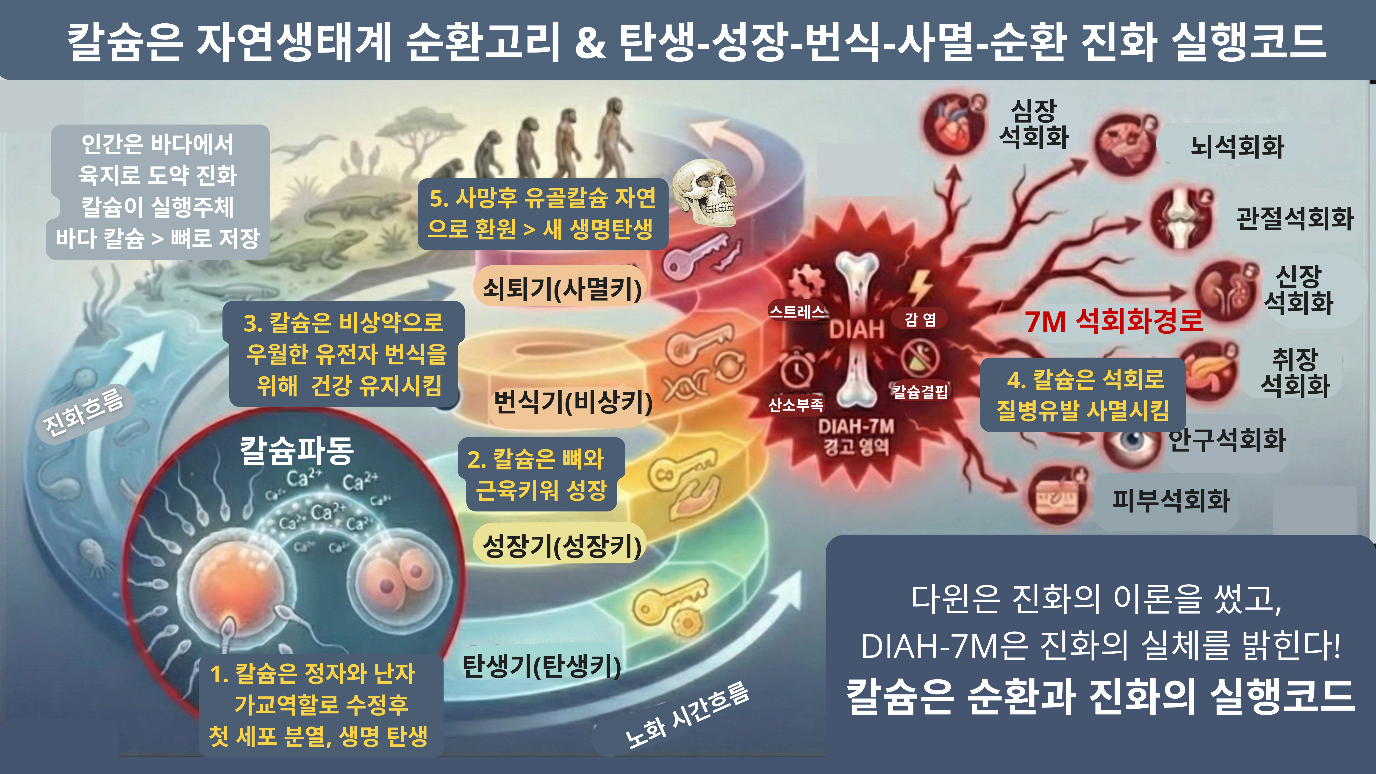
The future this book envisions is not a grand utopia but a picture of realistic change that can be reached when we move "a little earlier, a little deeper" along the direction that nature and science are already speaking of. The view that calcium is the medium of natural circulation and evolution and the execution code of birth, aging, sickness, and death, and the map that is the DIAH-7M pathway system of all diseases, will make medicine understand chronic diseases as a common pathway, will move the gaze from a treatment-centered approach to one centered on prevention and fundamental environmental correction, will present in aging research a new standard that measures and manages aging centered on calcium and calcification indicators, and will make nutrition science reevaluate calcium as the core substance of the cycle of life, changing the standard from "how much you eat" to "how you circulate it."
In the environmental field, it will give rise to the recognition that the carbon problem should be viewed in connection with the calcium cycle, and that a strategy is needed to pursue both the reduction of carbon emissions and the restoration of the calcium based carbon storage system at the same time; and in ecology and earth science, based on the fact that the calcium cycles of the human body and the Earth resemble each other like mirrors, it will create new research topics and indicators. In education, it will weave chemistry, biology, earth science, health, and the humanities together through the common language of calcium, making students and citizens understand "the circulation of life and the Earth" as a single story; and in philosophy and the humanities, the old wisdom that we come from soil and return to soil will gain the material basis of the calcium cycle, leading to a new understanding of the human being that awakens humility and dignity at the same time. In the economy and industry, the resources that were poured into treatment costs by disease will be invested more into improving the DIAH environment and maintaining the calcium cycle, and new industries and jobs connecting health, environment, climate, technology, and education will appear.
At the foundation of all these changes lies one simple principle. "If it flows, it lives; if it is blocked, it sickens." It is so in the human body, so on the Earth, and so in society. When calcium moves smoothly from bone to blood, to cells, and back to bone, the body maintains its health, but when calcium piles up in the wrong places and leaves the places where it should be so that circulation is cut off, disease arises. When carbon turns among the atmosphere, the sea, living things, and rock at a natural pace, the climate is stable, but when it crowds excessively into any one place, the climate sickens. When knowledge, opportunity, and resources circulate fairly among the members of society, the community is healthy, but when they pool and clog in only certain places, distrust and conflict grow. The calcium execution code is a tool that translates this "law of circulation" into the concrete material language of our body and the Earth.
What a reader who has read this book can do is not something grand. First, it is to restore circulation in one's own body. Reducing the DIAH environment of deficiency, inflammation, acidosis, and hypoxia, and calmly practicing habits of eating, exercise, sleep, breathing, and stress management that help keep calcium from being drawn out of the bones excessively, this is the starting point. According to many health institutions, research that these lifestyle habits actually reduce the risk of cardiovascular disease, osteoporosis, diabetes, and dementia has already accumulated sufficiently, and the calcium execution code only explains why that is, and through what pathway such effects appear. Next, it is to share this knowledge with family and friends, colleagues and the local community. The more people who understand the principle of circulation and the connection of bone, blood vessels, and environment, the more an individual's choices lead to society's change.
Going further, we can take part in small practices that protect the environment, safeguard ecosystems, and build a society in which resources and opportunities circulate better. Great changes in policy and technology in the end begin from the recognition and choices of each individual, and the calcium execution code shows that "the choice to protect my body" and "the choice to protect the Earth" are not different things.
Lastly, what this book wants to say is that we have not created something new. Nature has already, from billions of years ago, been using calcium to switch life on, maintain it, and close it, and the circulation in which calcium made in stars turns around the Earth, passes through life, and returns to nature again has never once stopped. We have only read out that old execution code a little late and a little incompletely. But merely by understanding that one line, the way we look at our health and life, at society and the Earth, can change greatly. If we understand circulation, we can understand life, and if we restore circulation, we can restore health. This is the future the calcium execution code will change, and it is the new map this book sought to see together with its readers.
References
1. Berridge, M. J., Bootman, M. D., & Roderick, H. L. (2003). Calcium signalling: dynamics, homeostasis and remodelling. Nature Reviews Molecular Cell Biology, 4(7), 517-529. doi:10.1038/nrm1155
2. Carafoli, E., & Krebs, J. (2016). Why Calcium? How Calcium Became the Best Communicator. Journal of Biological Chemistry, 291(40), 20849-20857. doi:10.1074/jbc.R116.735894
3. Demer, L. L., & Tintut, Y. (2008). Vascular calcification: pathobiology of a multifaceted disease. Circulation, 117(22), 2938-2948. doi:10.1161/CIRCULATIONAHA.107.743161
4. Thompson, B., & Townsend, D. M. (2020). The bone-vascular axis in chronic kidney disease. Nature Reviews Nephrology, 16(12), 695-710. doi:10.1038/s41581-020-00346-5
5. Berner, R. A. (2004). The Phanerozoic Carbon Cycle: CO₂ and O₂. Oxford University Press. doi:10.1093/oso/9780195173338.001.0001
6. Lenton, T. M., & Watson, A. J. (2011). Revolutions that Made the Earth. Oxford University Press. doi:10.1093/acprof:oso/9780199587049.001.0001
7. IPCC (2023). Climate Change 2023: Synthesis Report. Intergovernmental Panel on Climate Change.
8. Riebesell, U., & Gattuso, J. P. (2015). Lessons learned from ocean acidification research. Nature Climate Change, 5(1), 12-14. doi:10.1038/nclimate2456
9. Hartmann, J., et al. (2013). Enhanced chemical weathering as a geoengineering strategy to reduce atmospheric carbon dioxide. Reviews of Geophysics, 51(2), 113-149. doi:10.1002/rog.20004
10. Ridgwell, A., & Zeebe, R. E. (2005). The role of the global carbonate cycle in the regulation and evolution of the Earth system. Earth and Planetary Science Letters, 234(3-4), 299-315. doi:10.1016/j.epsl.2005.03.006
11. Knoll, A. H. (2003). Biomineralization and evolutionary history. Reviews in Mineralogy and Geochemistry, 54(1), 329-356. doi:10.2113/0540329
12. Case, R. M., et al. (2007). Evolution of calcium homeostasis: from birth of the first cell to an omnipresent signalling system. Cell Calcium, 42(4-5), 319-330. doi:10.1016/j.ceca.2007.02.001
13. López-Otín, C., et al. (2023). Hallmarks of aging: An expanding universe. Cell, 186(2), 243-278. doi:10.1016/j.cell.2022.11.001
14. Tyrrell, T. (2008). Calcium carbonate cycling in future oceans and its influence on future climates. Journal of Plankton Research, 30(2), 141-156. doi:10.1093/plankt/fbm105
15. Schuiling, R. D., & Krijgsman, P. (2006). Enhanced weathering: An effective and cheap tool to sequester CO₂. Climatic Change, 74(1-3), 349-354. doi:10.1007/s10584-005-3485-y