
This piece is the front portion of Chapter 5 (1) of The Declaration of the Age of Physical Economics (Yoon Jong-won, Yoon So-ri, Yoon Jun). It is an academic exposition presenting the authors' physical economics hypothesis, and the body, figures, and citations follow the manuscript as written.
Earlier, we examined the universal law at work throughout nature. It is the law that a thing flows only when there is a difference. In rivers, in stars, in ecosystems, in the climate, and in the human body, the same law reveals itself in the same way. If so, how does the same law reveal itself inside a national economy? Inside the economies of Korea and the United States, what is flowing after what, and in what manner?
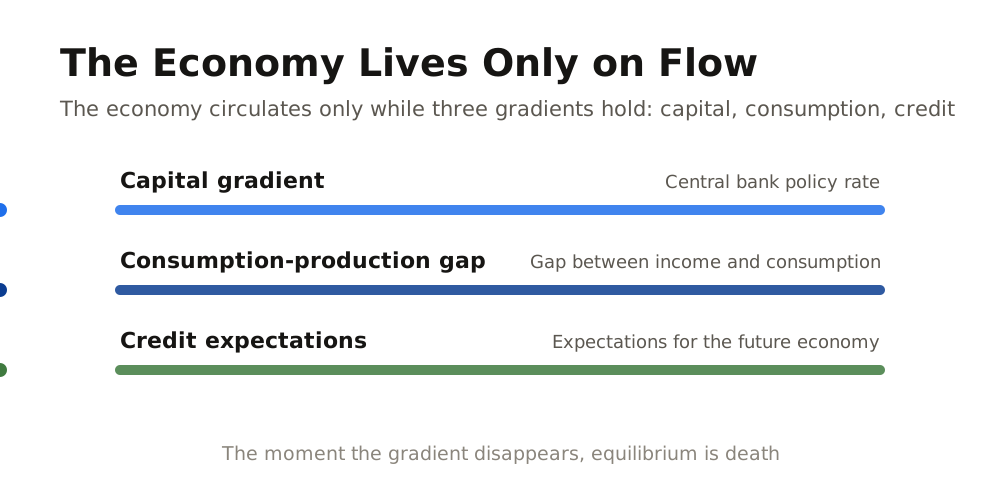
To answer this question, we take a step inside the economy. Inside the economy there is flow everywhere. The capital flowing inside a bank moves upon the difference in interest rates, the income entering households moves along the difference in wage gaps, and the buying and selling signals of the market are decisions made by the difference in credit and expectations. The economic system is a system in which three differences, capital pressure, consumption gaps, and credit expectations, work together in concert. In physics, this difference is called a gradient.
The fact that the gradient is itself the economy becomes clear from a simple comparison. A stopped economy and a flowing economy can have the same GDP. The same money supply, the same debt balance, the same total assets, and the same population are contained in them in almost the same quantities. Yet one is alive and the other is dead. What is it that separates the two states?
By accounting, it is difficult to distinguish the two states. If you look only at the kinds and quantities of the balances, the difference between the two economies is small. What separates the two states is not the balances, but whether the gradient that the balances create is being maintained, and whether flow is occurring upon that gradient. In a living economy, a capital pressure gradient is maintained between the central bank and the market so that capital flows, an income and consumption gradient is maintained between city and city so that logistics flow, and a credit gradient is maintained between expectations about the future so that investment flows. In a stopped economy, the same balances are contained in almost the same quantities, but all the gradients have vanished. Because the gradients have vanished, no flow occurs either.
The economy is not a stopped structure. The economy is the very state in which gradients are being maintained and flow is ceaselessly occurring upon those gradients. That is why the fundamental cause of an economic crisis, too, is a physical event in which flow is blocked and channels narrow, prior to any anomaly in the statistical numbers. That is the reason the book's title speaks of the age of physical economics. In this chapter, we draw a map of the gradients inside a national economy, and unravel in turn how that structure collapses and how the collapse becomes the beginning of a crisis.
The Korean restaurant owner who opened a shop in 1996 was not conscious of the fact that his own shop was floating upon three flows: capital, logistics, and credit. When a customer came in, placed an order, and paid by card, the payment signal passed through the card company and through the bank and entered the shop's account as a balance. With the account balance he paid the rent, bought ingredients, and paid the staff's wages. Capital passed through the shop every day, flowed out, and flowed back in. The shop owner had never looked at the flow separately. It was because it was too natural. But when the flow, one day in 1997, began to slow as if it had suddenly stopped, he did not know what had stopped.
The economy is a system in which flow is maintained
In the 18th century, the French physician Quesnay was the first to organize the insight of flow into economic language. Quesnay's Tableau Économique, published in 1758, drew the economy like a single human body. Quesnay was a physician. So he did not look at the market first but looked at flow first. He drew, in a single table, the picture of the farmer raising grain and selling it to the city dweller, the farmer buying and wearing the clothes made by the city dweller, and money flowing in one direction and returning in the opposite direction in between. This table that Quesnay drew is the first diagram of economics. Quesnay did not construct the assumption that the market balances itself on its own. He held that the economy is alive only when flow is maintained.
Over the 250 years that passed after Quesnay, economics developed with precision at the molecular layer (numbers such as prices, quantities, and interest rates). But the picture of flow that Quesnay saw was gradually hidden beneath the classificatory layer of the schools of thought. As the assumption that the market balances itself on its own dominated economics for 250 years, the perspective that sees how flow arises and how it is blocked grew steadily weaker. The starting point of this book is to return to Quesnay's first picture. It is the work of looking at flow again.
When flow is expressed in the language of physics, it becomes clear. There are two kinds of equilibrium. Stopped equilibrium and dynamic equilibrium. Stopped equilibrium is a state in which two weights press with the same mass from both sides and do not move. Dynamic equilibrium is a state in which flow comes in from one side and the same amount leaves from the other, so that the balance is kept constant. Stopped equilibrium is the equilibrium of death. The dynamic equilibrium in which incoming flow and outgoing flow balance in equal amounts is the equilibrium of the economy.
The economies of Korea and the United States stand upon a dynamic equilibrium in which incoming flow and outgoing flow balance in equal amounts. At every moment capital is released from the central bank into the market and carried to households and firms, and at the same time taxes and savings are recovered from households and firms into the government and the banks. Logistics enter the ports every hour and are carried all the way to the city's back alleys, and at the same time waste and bad debt flow out. While the flows in the two directions balance, we do not separately feel the fact that the economy is alive. It is because the flow is so natural that it is invisible. But if one side stops even for a moment, if a shop owner's card payments are blocked for just one hour, that shop loses its sales for the day.
The economy is the very flow that is newly created at every moment. If a stopped economy is a collection of arrested balances, a living economy is a pattern in which the same balances are ceaselessly flowing. To be alive is the fact of ceaselessly flowing.
This insight gives an important conclusion for economic diagnosis. The fundamental cause of a crisis lies not in the quantity of the balances themselves, but in the manner in which the balances flow. Even if the same amount of capital is in the bank, if it does not flow to the shop, the shop starves, and even if the same amount of stimulus is announced, if it does not flow to the back alley, sales do not recover. To understand a crisis precisely, one must raise one's perspective a level, from the quantity of the balances to the flow of the balances.
How does flow arise? Physics gives a clear answer. For flow to arise, three things are needed: energy, gradient, and medium. Energy creates the gradient, the gradient creates the flow, and the flow occurs through the medium. River water flows along the gradient of height created by gravity, through the medium of water, and electricity flows along the gradient of the potential difference, through the medium of electrons. The economic system, too, follows the same law. The monetary-policy energy produced by the central bank creates a capital pressure gradient between the market and households, and along that gradient the medium called cash flows. River water, electricity, and capital appear on the surface to be different events, but in essence they have the same three terms.
If you recall a city's water and sewage systems, the flow of the economy is revealed clearly. A city is alive upon two kinds of channel system. One is the water supply through which clean water comes in, and the other is the sewer through which used water flows out. The two channels do not operate separately. Only when they operate at the same time within the same city can the city be alive. If even one channel is blocked, the city begins to be paralyzed. It is the same for a national economy. The channel through which capital comes in is the water supply and the channel through which debt and closures flow out is the sewer, and the smallest place where the two systems meet is the back-alley shop and the household. While the incoming flow and the outgoing flow occur at the same time in the back alley, the economy is alive, and when both directions weaken at the same time, the economy begins to be paralyzed.
If it flows, it lives; if it is blocked, it dies. This is the simplest proposition that runs across the entire book. This proposition is not an abstraction, but a physical fact at work at every moment inside a national economy.
Three gradients: capital, consumption, and credit
The gradients at work in a national economy are various, but they can be grouped into three types: capital pressure, the consumption-production gap, and credit expectations. Each of the three drives a different system while at the same time influencing one another and maintaining the flow of the economy as a whole.
The capital pressure gradient is the engine of the economic cycle. When the U.S. Federal Reserve decides the policy rate, that rate sets the pressure between the banks and the market. If the policy rate is 5 percent, the banks borrow capital at a level close to that, and households and firms borrow capital at a rate higher than that. The pressure difference is the physical driving force that pushes capital in one direction. The moment the pressure gradient vanishes, that is, the moment the policy rate reaches 0 and there is no lower place to cut, capital stagnates and the shop begins to lose its capital supply. The fact that, even though the United States pulled the policy rate down to effectively 0 percent right after the global financial crisis of 2008, capital did not reach the back alley, is the proof of this.
The consumption-production gap gradient works at each of the city, industry, and household levels. At the city level, a difference in consumption arises between high-income cities and low-income cities, and the difference makes logistics flow in one direction. At the industry level, a difference in trade arises between places where the unit cost of production is low and places where it is high, and the difference creates exports and imports. At the household level, a difference in savings arises between the amount of income coming in and the amount of consumption flowing out. Just as oxygen diffuses from the alveoli into the blood along a concentration gradient, in the economy a gap in income diffuses consumption in one direction. But if the gap grows too large, the flow stops. A household whose income is too small cannot buy, and because it cannot buy, the market's consumption stops.
The credit expectation gradient drives the finance and investment systems. The expectation that the economy will improve in the future creates present credit. The bank lends present capital believing in future recovery, and the firm makes present investment believing in future sales. The difference in expectations about the future is itself the credit gradient. When expectations are aligned in the same direction, credit increases and investment flows. When expectations scatter, credit is severed and investment stops. The event that occurred in the United States in 2008 is an example of this. When expectations collapsed in an instant, all the banks began to recover their capital at the same time, and the real GDP of the United States in the fourth quarter of 2008 fell by about 8.4 percent on an annualized basis.
The three gradients of capital pressure, the consumption-production gap, and credit expectations do not operate independently of one another. Capital must move by the pressure gradient for the income gaps of households and firms to be maintained, consumption must occur through the income gaps for expectations about the future to be maintained, and future expectations must be stable for the central bank to create the pressure gradient again with the policy rate. The three gradients maintain the life of the economy upon a triangular structure of capital pressure, consumption gaps, and credit expectations that support one another. Within the triangular structure, if any one axis weakens, the other two axes waver along with it, and when the chain crosses a certain critical point, it surfaces as a crisis.
The three gradients are not abstract concepts. They can be measured directly, the results of the measurement are recorded as gauge scores, and when a gauge begins to cross its limit, a warning lights up. The diagnostic system established by the present authors places 59 gauges across 9 domains, and the gauges measure the three gradients of capital pressure, consumption gaps, and credit expectations at the same time. How the measurement works is a story to be dealt with in earnest later on. Here it is enough simply to confirm that the three gradients are measurable physical facts.
The three gradients of one nation's economy
| Type of gradient | Driving principle | Measurement indicator | When the gradient is lost |
|---|---|---|---|
| Capital pressure | Central bank policy rate | Interbank rate, corporate loan rate | Policy rate reaches 0%, capital stagnates |
| Consumption-production gap | Difference between income and consumption | Gini coefficient, retail sales, DSR | Gap exceeds the limit, consumption stops |
| Credit expectations | Expectations about the future economy | Credit spread, expectation of rate hikes | Expectations collapse together, credit is severed |
Cash: capital as medium
Among the countless flows at work in a national economy, the medium that lies most at the center is cash. Cash is the smallest unit of capital, and the most basic unit of flow. But cash is not simple money. It is a medium only while it flows, and when it hardens and sticks in one place, it turns into bad debt. The difference between the two states lies at the heart of a crisis.
It can be likened to the ten-thousand-fold concentration gradient that calcium possesses inside the human body. A difference of about ten thousand times is maintained between the calcium concentration outside the cell and the free calcium concentration inside the cell, so that the cell lives. Something similar happens in the economies of Korea and the United States as well. There is a clear difference between the capital inside a bank and the capital inside a shop's account, and the difference makes capital flow in one direction. The bank releases capital into the back alley, and from the back alley sales come in again and are recovered into the bank. While the two-directional flow occurs every day, the economy is alive.
But when cash begins to stay in one place, its appearance changes. When the capital that has come into a shop cannot flow out every day and begins to pile up inside the shop, it is no longer flowing capital. It is hardened, stuck capital. To put it more precisely, capital that has once hardened and stuck does not return to flow on its own. The shop owner must pull the capital out directly and place it back upon the flow. The event that occurred between 2014 and 2017 in the shop of the owner who opened his shop in 1996 is an example of this. As customers dwindled and the speed at which sales came in slowed, it could not keep up with the speed at which rent and loan interest flowed out equally every month, and the capital inside the shop began to harden in one place.
The fact that capital, once hardened and stuck, does not loosen on its own is a key clue to understanding a crisis. The model that the present authors verified with 690 months of data from Korea and the United States stands upon this fact. Bad debt, once deposited, does not automatically disappear as time passes. The deposit only accumulates monotonically; it does not decrease on its own. The more the bad debt piles up inside the shop, the harder it becomes to create flow again from the shop. Irreversibility is the physical foundation of an economic crisis.
The difference between medium and deposit is not a mere metaphor. A medium is a medium only while it flows, and from the moment the flow stops it turns into a deposit. The same capital was a medium yesterday and becomes a deposit today. The two states are the same in appearance, but the role that capital plays inside the system is exactly opposite. Capital as medium keeps the system alive, and capital as deposit brings the system down.