
In the previous part, we examined the body's three gradients, the ten-thousand-fold calcium gradient across the inside and outside of the cell, and the microvasculature where flow actually happens and actually stops. Now we turn to how that microvasculature becomes locked in place by calcification, by what two pathways calcification proceeds, and how this perspective reexplains essential hypertension and diabetes.
Calcification: The Physical Lock-In of Gradient Collapse
Vascular calcification has long been understood simply as a passive aging phenomenon in which blood vessels "harden" as they grow old. But from the latter half of the 20th century, this view changed fundamentally. A review paper published by Demer and Tintut in the journal Circulation in 2008 (Demer & Tintut, 2008, Circulation 117, 2938-2948) comprehensively established that vascular calcification is not a passive deposition but an active, cell-mediated process similar to bone formation. Under certain conditions, vascular smooth muscle cells transdifferentiate into a phenotype resembling osteoblasts, generate a mineralizing matrix on their own, and deposit hydroxyapatite, the same component as bone, into the vessel wall. In other words, blood vessels do not "harden"; they "manufacture" the calcification themselves.
A review paper published by Shanahan's team in Circulation Research in 2011 (Shanahan et al., 2011, Circulation Research 109, 697-711) laid out the molecular-level regulatory mechanism of this active calcification process. The hypercalcemia and hyperphosphatemia frequently observed in patients with chronic kidney disease activate the osteogenesis-related genes of vascular smooth muscle cells, and these cells secrete matrix vesicles that induce the nucleation of minerals. This process is especially accelerated when inhibitory proteins such as matrix Gla protein (MGP), fetuin-A, and osteopontin become deficient. In the normal state, these inhibitory proteins prevent calcification, but when the functional balance among them collapses, calcification proceeds as a self-promoting process.
The traditional classification by which medicine describes this calcification is based on anatomical location. Intimal calcification, occurring in the vessel's intimal layer, proceeds together with atherosclerosis, with cholesterol, macrophages, and inflammatory responses at its center. This is the main mechanism of coronary plaque rupture and myocardial infarction. Medial calcification, occurring in the vessel's medial layer, proceeds together with aging, diabetes, and chronic kidney disease, and becomes the direct cause of vessel wall stiffening and systolic hypertension. The two calcifications differ in anatomical location, associated diseases, and clinical implications, but physically they perform one common function. They reduce the effective inner diameter of the vessel, strip away its elasticity, and paralyze the system that regulates flow rate and pulse pressure.
From the perspective this book presents, vascular calcification is not a mere pathological finding. It is the process by which a system whose gradient has long been outside the normal range physically fixes that abnormality in place. The most primitive compensatory response the body can make in a state of collapsed gradient is to erect a physical structure around the collapsed pathway, and the material of that structure is the calcium and phosphorus in the blood, with the result being precisely calcification. From this perspective, calcification is both a symptom of gradient collapse and, at the same time, a cause that accelerates gradient collapse, and this duality explains the structural reason chronic disease progresses in a "self-reinforcing" manner.
Endogenous and Exogenous: The Two Pathways of Calcification
If we distinguish the causes of vascular calcification from the standpoint of the origin of the pathway, they can be divided into two: endogenous and exogenous. This distinction carries practical importance in dividing which intervention is effective in the clinic.
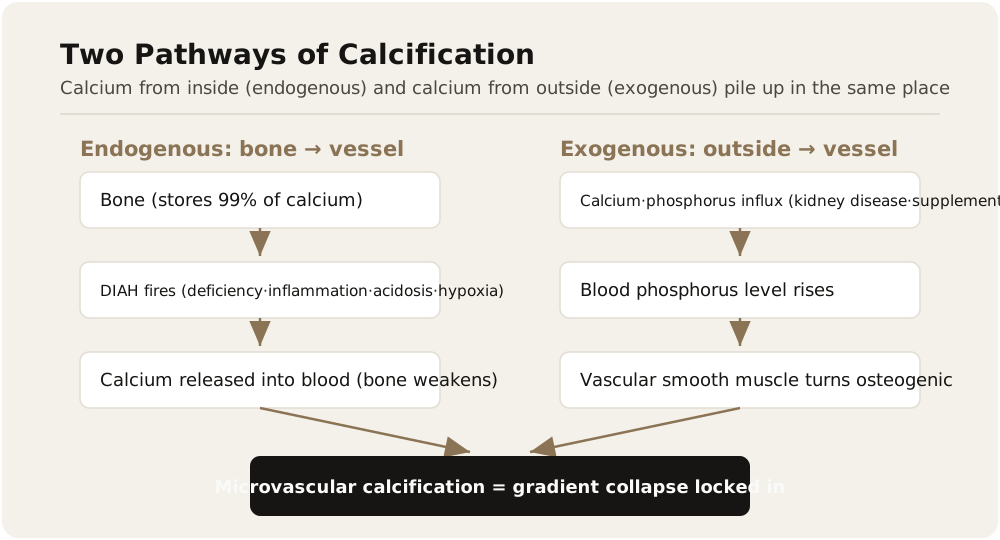
The endogenous pathway is the process by which calcium is redistributed from an existing store within the body. Bone is a vast reservoir storing 99% of the body's calcium, and even in the normal state this calcium is continually under a dynamic equilibrium of resorption and re-accumulation, with a portion constantly released into the blood and returning to bone again. When this equilibrium collapses and the calcium released into the blood exceeds the calcium returning, the excess is deposited elsewhere. The representative "elsewhere" is the microvascular wall. When this process accumulates over the long term, a paradoxical simultaneous progression is observed in which the bone weakens (osteoporosis) and the vessel hardens (calcification). That osteoporosis and vascular calcification are observed simultaneously in the same patient is not two separate symptoms of aging, but two faces of a single material-transport pathway.
What are the factors that trigger this endogenous release? The author's research framework (DIAH-7M) points to four. Deficiency, Inflammation, Acidosis, and Hypoxia. When these four persist singly or in combination, the body mobilizes calcium from bone as an emergency response to correct them, and when this emergency mobilization is repeated, vascular calcification accumulates over the long term. This pathway operates independently of diet or external calcium intake, and it is given the name "endogenous" in the sense that the link between bone and vessel responds sensitively to the metabolic and inflammatory state within the body.
The exogenous pathway is the process by which calcium and phosphorus entering from outside the body raise blood concentrations and deposit directly in the vessel. The representative case is chronic kidney disease. When the kidney cannot properly excrete phosphate, the blood phosphorus concentration rises, and this acts directly on vascular smooth muscle cells to activate osteogenesis-related genes, leading to accelerated calcification. This exogenous pathway is relatively fast and severe, and it is also the main mechanism of the rapid vascular calcification observed in dialysis patients. Long-term use of high-dose calcium supplements, certain drugs (for example, excessive vitamin D supplementation), and high-phosphorus diets are also reported as risk factors of the exogenous pathway.
The two pathways are not independent. When exogenous calcium is additionally introduced in a state where blood calcium is already elevated through the endogenous pathway, calcification accelerates exponentially. Conversely, when a DIAH-inducing situation is superimposed on a state of chronically high phosphorus and calcium via the exogenous pathway, endogenous mobilization is added on top. This interaction provides one physical answer to why some patients' vessels harden far more quickly even with the same diet and the same exercise. In Part 3, Chapter 9 of this book, we will again address quantitatively how these two pathways intersect in the actual progression of chronic disease.
Essential Hypertension and Diabetes: The Blank Space Medicine Left
Modern medicine still leaves the fundamental causes of the two most common chronic diseases unexplained without a complete account. They are essential hypertension and diabetes. According to the hypertension entry in StatPearls, the clinical reference resource of the U.S. National Library of Medicine (StatPearls, Hypertension, NBK539859/NBK538338), about 90 to 95% of hypertension patients worldwide are classified as having essential (or primary) hypertension, for which no specific single cause can be identified. Cases like secondary hypertension, in which a specific underlying disease is found, account for only 5 to 10%, and the vast majority of the rest remain "cause unknown."
Diabetes is similar. Insulin resistance and pancreatic beta-cell dysfunction, known as the pathological mechanism of type 2 diabetes, merely describe the phenomenon; there is no single-cause explanation for why these two progress slowly in certain people. Factors such as genetic predisposition, obesity, lack of exercise, and diet have been identified as risk factors, but there is no integrated explanation of through what final common pathway these factors produce diabetes. And the real problem of diabetes lies not in high blood sugar itself but in the complications by which high blood sugar damages the microvasculature over decades and destroys the retina, kidney, and nerves, yet the mechanism of this microvascular damage is likewise not fully explained.
The gradient perspective this book presents fills this blank space with a single pathway. Essential hypertension is the result of the vascular system that maintains the pressure gradient accumulating microvascular calcification over the long term, so that the r⁴ resistance at the periphery increases. The heart must push blood at a higher pressure to maintain the same tissue perfusion, and the state in which this compensation has become chronic is observed as the blood pressure reading. From this perspective, the word "essential" can be redefined not as "cause unknown" but as a name pointing to "an already-advanced physical condition, namely the accumulation of microvascular calcification."
Diabetes is likewise similar. Insulin resistance is a state in which signal transduction is not properly executed at the cellular level, and for this signal transduction to be executed, both the calcium gradient and microvascular blood flow must be normal. When chronic microvascular damage and disturbance of calcium metabolism accumulate over the long term, the very execution of the insulin signal is physically weakened, and this is observed as insulin resistance. That the complications of diabetes are all microvascular diseases is, from this perspective, no coincidence. Diabetes is a disease of the microvasculature from the very beginning, and blood sugar is its result and symptom.
It is interesting to contrast this interpretation with the latest synthesis in aging research. A review paper published by López-Otín's team in the journal Cell in 2023 (López-Otín et al., 2023, Cell 186, 243-278) comprehensively summarized the twelve hallmarks of aging. They are genomic instability, telomere attrition, epigenetic alterations, loss of proteostasis, disabled macroautophagy, deregulated nutrient sensing, mitochondrial dysfunction, cellular senescence, stem cell exhaustion, altered intercellular communication, chronic inflammation, and dysbiosis. Although these twelve are each described independently, most of them can be reinterpreted as downstream results that are commonly accelerated under the condition of dual blockade and the collapse of flow. The hypothesis that gradient collapse is the upstream cause and the twelve hallmarks of aging are its downstream manifestations is one of the central claims of Chapter 9 of this book.
Conclusion
In this chapter, we reread the human body as a landscape of gradients. The three gradients of pressure, concentration, and voltage drive the flows of blood, oxygen, and signal, and in particular the ten-thousand-fold calcium gradient across the inside and outside of the cell physically executes nearly every function of life. The site where these gradients are actually maintained or collapse is, for the most part, the microvasculature, and microvascular calcification is the form in which gradient collapse becomes physically fixed. And this calcification proceeds along two paths: the endogenous pathway of calcium redistribution from bone to vessel, and the exogenous pathway of direct deposition of externally introduced calcium and phosphorus.
How this perspective fills the blank space medicine left was this chapter's final proposal. The hypothesis that microvascular calcification and gradient collapse lie beneath essential hypertension and diabetes is not yet a consensus of the medical community, but it does not contradict existing observations, and it connects directly, in particular, to the twelve hallmarks of aging and chronic disease. The quantitative verification of this hypothesis will be addressed again in Part 3, Chapter 9, together with the classification of 242 diseases.
In the next chapter, we carry the same grammar into the economy. What corresponds to the body's microvasculature is the economy's alley economy; what corresponds to the body's calcium is the economy's cash; and what corresponds to the body's microcalcification is the economy's interest burden and debt accumulation. That this correspondence is not a mere metaphor but the manifestation of the same physical law on different media, we will confirm in the next chapter together with 690 months of empirical data from Korea and the United States.
참고문헌
- Clapham, D. E. (2007). Calcium signaling. Cell, 131(6), 1047-1058. https://doi.org/10.1016/j.cell.2007.11.028
- Berridge, M. J., Lipp, P., & Bootman, M. D. (2000). The versatility and universality of calcium signalling. Nature Reviews Molecular Cell Biology, 1(1), 11-21. https://doi.org/10.1038/35036035
- Mitchell, P. (1961). Coupling of phosphorylation to electron and hydrogen transfer by a chemi-osmotic type of mechanism. Nature, 191, 144-148. https://doi.org/10.1038/191144a0
- Demer, L. L., & Tintut, Y. (2008). Vascular calcification: pathobiology of a multifaceted disease. Circulation, 117(22), 2938-2948. https://doi.org/10.1161/CIRCULATIONAHA.107.743161
- Shanahan, C. M., Crouthamel, M. H., Kapustin, A., & Giachelli, C. M. (2011). Arterial calcification in chronic kidney disease: key roles for calcium and phosphate. Circulation Research, 109(6), 697-711. https://doi.org/10.1161/CIRCRESAHA.110.234914
- López-Otín, C., Blasco, M. A., Partridge, L., Serrano, M., & Kroemer, G. (2023). Hallmarks of aging: an expanding universe. Cell, 186(2), 243-278. https://doi.org/10.1016/j.cell.2022.11.001
- Sutera, S. P., & Skalak, R. (1993). The history of Poiseuille's law. Annual Review of Fluid Mechanics, 25, 1-20. https://doi.org/10.1146/annurev.fl.25.010193.000245
- Onsager, L. (1931). Reciprocal relations in irreversible processes. Physical Review, 37(4), 405-426.
- Iqbal, A. M., & Jamal, S. F. (2024). Essential Hypertension. In StatPearls. Treasure Island (FL): StatPearls Publishing. https://www.ncbi.nlm.nih.gov/books/NBK539859/
- Prigogine, I., & Stengers, I. (1984). Order Out of Chaos: Man's New Dialogue with Nature. New York: Bantam Books.
Source: The Universal Law: Gradient, Chapter 6, "The Body's Gradient" (2/2). The body text follows the original manuscript verbatim and is provided for informational purposes.