
In the previous chapter, we reread four landscapes of the natural world in the language of gradient. Now we carry the same grammar into the human body. Gradients are everywhere inside the body too. The blood flowing inside a vessel moves on a pressure gradient; the oxygen entering the blood from the alveoli travels along a concentration gradient; and the signal of a nerve cell is an electrical pulse created by the voltage gradient across the cell membrane. The system in which these three gradients interlock with one another is the human body itself.
This chapter's first goal is to sketch a simple map of this landscape of gradients: where each gradient exists and what role it performs. The second goal is to describe by what path disease arises the moment such a gradient collapses, centered in particular on the single most important gradient the human body possesses, the ten-thousand-fold difference in calcium concentration across the inside and outside of the cell.
The third goal is the most contentious part of this chapter. It is to show how diseases whose root cause modern medicine has, for a long time, failed to identify, hypertension and diabetes above all, can be explained in an integrated way as pathways of gradient collapse. The physical basis of this claim lies in the calcification of the microvasculature, the process by which the body physically locks in a collapsed gradient once it has broken down. In the language of medicine this is called vascular calcification; in the language of this book it will be called "the physical lock-in of gradient collapse."
At the end of this chapter, we distinguish two pathways of this calcification: the endogenous pathway, in which calcium migrates from bone into the vessels, and the exogenous pathway, in which externally ingested calcium and phosphate deposit in the vessels. This distinction will play a decisive role when Chapter 9 addresses the actual pathway of aging and chronic disease. Now, let us step inside the human body.
Three Gradients: Pressure, Concentration, Voltage
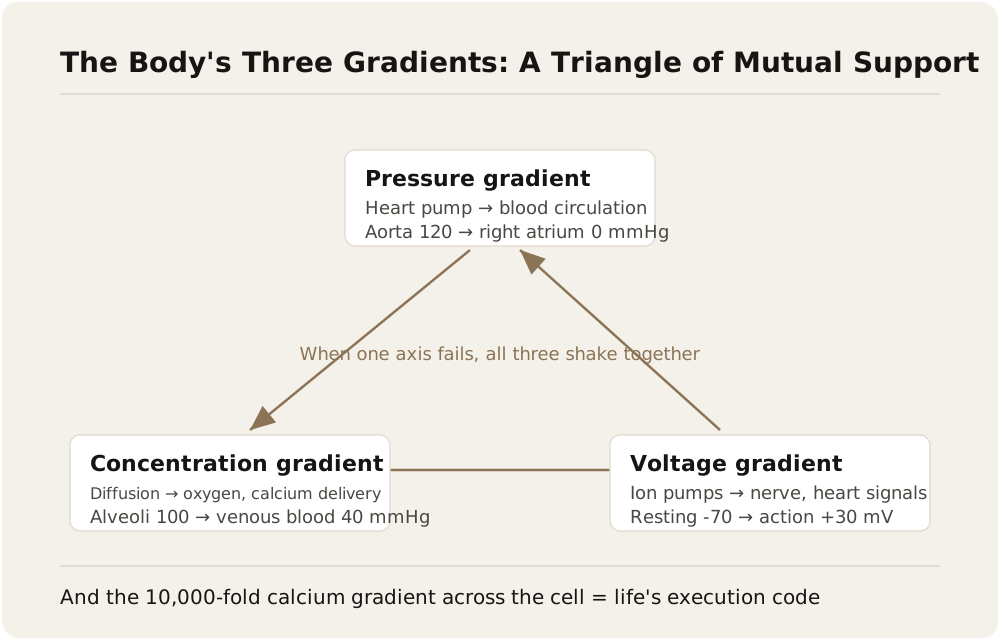
Many gradients operate within the human body, but they can be grouped into three representative types: pressure gradients, concentration gradients, and voltage gradients. Each of these three drives a different system, while at the same time interlocking with one another to sustain the flow of the body as a whole.
The pressure gradient is the engine of blood circulation. As the heart pumps out roughly five liters of blood per minute, left-ventricular systolic pressure reaches about 120 mmHg, and as blood passes through the aorta, small arteries, capillaries, and venules, pressure progressively falls, approaching 0 mmHg by the time it reaches the right atrium. This pressure difference is the physical driving force that pushes blood in one direction. The moment the pressure gradient disappears, that is, the moment the heart stops, blood stagnates and tissue loses its oxygen supply. The fact that the heart beats roughly 100,000 times a day, pumping out more than 7,000 liters of blood, is nothing other than the continuous regeneration of this pressure gradient.
Concentration gradients operate separately at the level of respiration, the kidney, and the cell. The partial pressure of oxygen in the alveoli is about 100 mmHg, while the partial pressure of oxygen in the venous blood entering the pulmonary capillaries is about 40 mmHg. This 60 mmHg difference is the driving force that diffuses oxygen from the alveoli into the blood, and in the tissues, a concentration gradient in the opposite direction delivers oxygen from the blood to the cells. In the kidney, the difference in hydrostatic and colloid osmotic pressure across the two sides of the glomerulus filters plasma, producing roughly 180 liters of primary urine per day in an adult. And at the cellular level, the concentration differences that exist across the inside and outside of the cell execute the signals of life. The single most important of these is the calcium ion gradient, which we will examine in detail in the next subsection.
Voltage gradients drive the nervous system and the heart's electrical system. At rest, a nerve cell's membrane maintains a negative potential, with the inside of the cell about 70 millivolts (mV) lower than the outside; this is called the resting potential. When a stimulus arrives, sodium channels open and the inside of the cell momentarily flips to a positive potential of up to +30 mV; this change propagates rapidly along the axon, generating an action potential. The sodium-potassium pump is the device that continuously regenerates this voltage gradient, moving three sodium ions out and two potassium ions in for every single molecule of ATP it consumes. If this pump stops working, the cell's electrical signal vanishes within minutes. The heartbeat, too, occurs on this same voltage-gradient mechanism, and an electrocardiogram (ECG) is a recording that measures changes in this electrical gradient from outside the body.
These three gradients do not operate independently of one another. Blood must move on the pressure gradient for the oxygen concentration gradient to be sustained; ATP must be supplied to cells through the concentration gradient for the sodium-potassium pump to operate and sustain the voltage gradient; and the voltage gradient must be normal for the heart to beat and regenerate the pressure gradient. The three gradients sustain the life of the human body on a single triangular structure in which each supports the others. Within this structure, when any one axis weakens, the other two axes shake along with it, and when this chain crosses a certain threshold, disease manifests clinically.
Calcium: A Ten-Thousand-Fold Gradient Executes Life
Among the countless concentration gradients present in the human body, the physically most extreme is the calcium ion gradient. The calcium concentration outside the cell is on the order of about 1 millimolar (mM), while the free calcium concentration inside the cell is on the order of about 100 nanomolar (nM). Once the units are standardized, a difference of roughly ten thousandfold is maintained across the inside and outside of the cell membrane. A 2007 review by Clapham published in the journal Cell (Clapham, 2007, Cell 131, 1047-1058) is the representative source comprehensively summarizing the scale and meaning of this gradient, and a 2000 review by the Berridge team (Berridge et al., 2000, Nature Reviews Molecular Cell Biology) describes how this gradient evolved into a universal grammar of signal transduction.
The reason this ten-thousand-fold gradient can be physically sustained is that the cell continuously expends energy (ATP) to pump calcium ions out of the cell. Calcium pumps in the cell membrane and exchange transporters present in the cell membrane and the endoplasmic reticulum carry out this work. If ATP production stops, the pumps stop, and the gradient gradually dissipates. In other words, the very fact that this gradient "is being maintained" is itself evidence of being alive. A cell in which the gradient has disappeared is, by definition, a dead cell. This is the cellular-level version of the statement from Chapter 2, "stationarity is death," and it is the most precise example of what Prigogine's dissipative-structure theory in Chapter 4 calls "when flow stops, order collapses."
Why does this ten-thousand-fold gradient matter so much? Because it is the medium that physically executes nearly every important function of the cell. The first division of a fertilized egg is initiated by an enormous calcium wave that occurs after the sperm enters the egg. Muscle contraction occurs at the moment calcium concentration inside the muscle fiber surges roughly a hundredfold. The release of neurotransmitters at a nerve terminal occurs the moment an action potential reaches the terminal, opens calcium channels, and the calcium that enters fuses vesicles with the cell membrane. Hormone secretion, the activation of immune cells, and ultimately the execution of programmed cell death are all carried out through changes in calcium concentration.
The sentence from Chapter 4, describing Mitchell's chemiosmotic principle, "life is a gradient engine," is most clearly embodied in the calcium gradient. If DNA is the blueprint of life, calcium is the executable code that carries out that blueprint in physical reality. Other ions, such as sodium, potassium, and magnesium, are also essential to the activity of life, but calcium is the only ion that maintains a gradient as extreme as ten thousandfold. The cellular-level events that occur when this gradient collapses, calcium overload, mitochondrial breakdown, programmed cell death, are also the common cellular-level pathway of aging and chronic disease that later chapters will address.
The Microvasculature: Where Flow Happens, and Where Flow Stops
The actual site where the human body's circulation takes place is not the heart or the aorta, but the microvasculature. The microvasculature is a collective term for arterioles, capillaries, and venules, the finest blood vessels, ranging in diameter from a few micrometers to a few dozen micrometers. In a human body inhabited by roughly 37 trillion cells, the estimated total length of this microvasculature is roughly 100,000 kilometers, a length that could wrap around the Earth more than twice. Nearly every cell has at least one capillary within a few micrometers of its location, and this proximity provides the physical condition under which the supply of oxygen and nutrients, and the discharge of carbon dioxide and waste, can occur.
The fact that this is where flow actually happens simultaneously implies that this is where flow actually stops. The nonlinear r⁴ sensitivity of Poiseuille's law, discussed in Chapter 3, operates most dramatically at the level of the microvasculature. In a capillary with a 10-micrometer diameter, if the diameter narrows by just 1 micrometer, flow decreases by about 34 percent; a 2-micrometer narrowing produces about a 59 percent decrease; and a 5-micrometer narrowing produces a 94 percent decrease. These micrometer-scale changes, undetectable by angiography or ordinary ultrasound, decisively determine the actual oxygen supply to tissue.
This is precisely where modern medicine runs into a familiar weakness. Imaging diagnostics commonly used in clinical practice are good at capturing stenosis in relatively large vessels, such as the aorta, the coronary arteries, or the cerebral vessels. But the actual site where most chronic diseases of the human body (diabetic retinopathy, diabetic nephropathy, peripheral neuropathy, and neurodegenerative diseases such as Alzheimer's) begin and progress is the microvasculature, which imaging captures poorly. Even while the large vessels still look fine, the microvasculature may already be extensively damaged, and in fact most chronic disease is precisely the surfaced result of the long-term accumulation of that microvascular damage.
So how does the microvasculature become damaged? The most powerful physical answer to this question is calcification. Calcium and phosphate slowly deposit on the walls of the microvasculature in the form of hydroxyapatite; this deposition strips the vessel wall of its elasticity and narrows its inner diameter, and ultimately, through r⁴ sensitivity, sharply reduces the effective blood flow to tissue. This process proceeds quietly over years to decades, and the moment a critical threshold is crossed, it surfaces as a "sudden" clinical event. Myocardial infarction, cerebral infarction, diabetic complications, chronic kidney disease, and, in a broad sense, aging itself, are all phenomena that manifest at this same common physical site.
The next installment examines how calcium deposits in this microvasculature, physically locking in the collapse of the gradient; how that calcification proceeds along two pathways, endogenous and exogenous; and how this perspective fills the empty space medicine has left around essential hypertension and diabetes.
Source: The Universal Law: Gradient, Chapter 6, "The Body's Gradient" (1/2). The text is a faithful rendering of the original manuscript, provided for informational purposes.