
This piece is the complete Chapter 12 of The Declaration of the Age of Physical Economics (Yoon Jong-won, Yoon So-ri, Yoon Jun). It is an academic exposition presenting the authors' physical economics hypothesis, and the body, figures, and citations follow the manuscript as written.
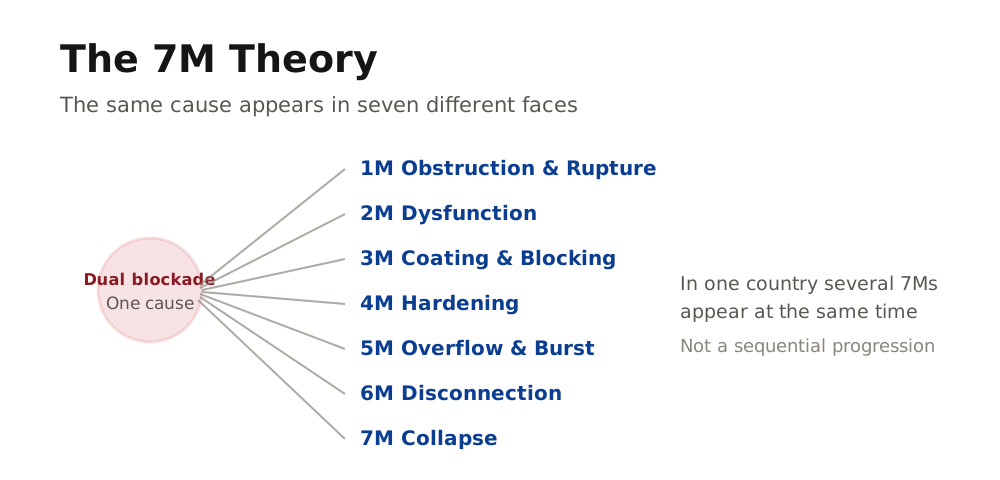
We have come as far as the third of the five stages of DTDMC. The accumulation of cost factors confirmed in the funnel theory converges on the DIAH trigger, the loan interest confirmed in the outflow theory begins to harden and stick to the channel, and we have reached the very moment at which the two kinds of paralysis confirmed in the dual blockade theory, namely channel blockade (DLT) and signal blockade (CAM), are engaged at the same time. If the system endures further while the dual blockade is engaged, the dual blockade begins to be manifested in concrete forms of crisis. The form of manifestation differs depending on which industry, which organ, crosses the threshold first. This stage is the fourth, namely manifestation.
There are expressions that everyone knows in their own body. We say a blood vessel got blocked and burst. We say a joint has grown sluggish. We say the medicine does not work even when taken. The saying that a blood vessel has hardened is also common. We say a tumor has grown. We say a nerve has been severed. We say a bone has weakened and collapsed. It blocks, it slows, it is coated and blocked, it hardens, it overflows and bursts, it is severed, it collapses. Seven forms. The hundreds of chronic diseases that compartmentalized medicine has diagnosed separately converge into one of these seven physical forms, or a combination of two or three of them.
The same seven grains are visible in the economy as well. We say the capital market has frozen (it blocks). We say the economy has fallen into recession (it slows). We say policy is unresponsive (it is coated and blocked). We say regulation has become rigid (it hardens). We say a bubble has burst (it overflows and bursts). We say the supply chain has been severed (it is severed). We say the nation has defaulted (it collapses). Seven in the human body, and converging into seven in the economy as well. The names differ, but the cause is only one. In a state where, by the dual blockade, income (supply) and consumption (discharge) are cut off at the same time, only the form of manifestation differs depending on which organ, which industry, crosses the threshold first. The formal name of these seven manifestations is 7M, and it corresponds to manifestation, the fourth stage of DTDMC.
Before we examine 7M, let us first make three things clear. First, 7M is not a sequential progression. It is not an order in which 2M comes after 1M and 3M comes after 2M; rather, it occurs singly or in combination, simultaneously. Second, the dual blockade is the cause of 7M, not one of the 7M mechanisms. The dual blockade is engaged first, and in that state of dual blockade 7M surfaces. Third, it is usual for two or three of the 7M to be observed at the same time in a single country. In South Korea in 1997, on the foundation of the rigidity of the chaebol structure (4M), the freezing of the capital market (1M), the severing of the supply chain (6M), and national default (7M) proceeded at the same time.
7M Overview: The Everyday Expression, Medical, and Economic Correspondences of the Seven Manifestation Forms
| Mechanism | Name | Everyday Expression | Human Body | Economy | Dual Blockade Link |
|---|---|---|---|---|---|
| 1M | Obstruction & Rupture | Blocks and bursts | Myocardial infarction, cerebral infarction | Acute capital market freeze, bank run | DLT crosses threshold → acute channel closure |
| 2M | Dysfunction | Slows | Arthritis, valve stenosis | Recession, worsening employment | DLT+CAM chronic accumulation → decline in circulation |
| 3M | Coating & Blocking | Coated and blocked | Insulin resistance | Policy unresponsiveness, financial paralysis | CAM surfaces → signal cutoff |
| 4M | Hardening | Hardens | Arteriosclerosis, cirrhosis | Regulatory rigidity, infrastructure aging | DLT long-term accumulation → loss of structural elasticity |
| 5M | Overflow & Burst | Overflows and bursts | Tumor, myocardial hypertrophy | Speculative bubble, asset overheating | CAM signal excess → abnormal expansion |
| 6M | Disconnection | Is severed | Diabetic foot necrosis, vascular dementia | Supply chain collapse, regional extinction | DLT microchannel closure → connection severed |
| 7M | Collapse | Collapses | Osteoporosis, periodontitis | National default, systemic collapse | Calcium (cash) outflow → loss of foundational structure |
1M Obstruction & Rupture: Blocks and Bursts
On September 15, 2008, when Lehman Brothers went bankrupt, the world's financial markets stopped in an instant. With trading in the short-term money market frozen, the issuance of CP (commercial paper) suspended, and the movement of funds between banks halted, two days later AIG had to receive 85 billion dollars in emergency support, and within a week a situation arose in which the U.S. Congress had to pass a TARP of 700 billion dollars in scale. It looked like a sudden explosion, but until that explosion went off, subprime interest arrears had been accumulating for more than two years since 2006. The process by which interest flowed out of disposable income and narrowed the funding channel was converted, at a certain threshold, into acute closure.
The same form in the human body is myocardial infarction. From the patient's standpoint, a myocardial infarction begins one day suddenly, together with a crushing pain that grips the chest. But until that moment, microcalcification had been accumulating on the coronary artery wall for years to decades, and it is the result of microcalcification becoming embedded within the fibrous cap of the plaque, prying that cap open from the inside, and then being converted into rupture at a certain threshold. The accumulation proceeds quietly and at length, but the explosion is sudden and short. It is the same in the economy. Korea's 1997 foreign exchange crisis looked as if it burst suddenly in November, but the bankruptcy of Hanbo Steel had already begun in December 1996, eleven months earlier, and the accumulation of short-term foreign debt by the merchant banks had been under way from far earlier than that.
The economic core of 1M is the acute closure of the funding channel. The process by which interest flows out of disposable income and the channel narrows is the progression of DLT (channel blockade), and the moment at which that narrowed channel, at some point, becomes completely blocked or bursts is 1M Obstruction & Rupture. Every form in which a funding path is suddenly cut off, such as a bank run, a freeze in the short-term money market, a suspension of commercial paper issuance, or a sharp drop in foreign exchange reserves, belongs to this pattern.
2M Dysfunction: Slows
If 1M is the sudden explosion of a blood vessel bursting, 2M is the gradual slowing of a joint stiffening. The state that the Japanese economy has been experiencing for more than 30 years since the collapse of the asset bubble in 1991 is closest to this form. The GDP growth rate stays in the 0 percent range, wages have not risen for 30 years, consumption does not increase, and investment does not increase. It is not a matter of stopping all at once through an acute freeze, but a chronic slowing in which the circulation speed of the entire economy grows a little slower each year.
In the human body, calcific tendinitis of the shoulder shows this form. When calcium-phosphate crystals are deposited in the rotator cuff tendon that moves the shoulder, the tendon's original range of motion begins to shrink. It is not that one day the arm suddenly cannot be raised; rather, today it is a little stiffer than three months ago, and three months from now it will be a little stiffer than today. The same form proceeds in the heart valve as well. When calcium is deposited in the aortic valve, the motion of the valve opening and closing slows, and the efficiency with which the heart sends out blood gradually falls.
In the Korean economy, the signs of 2M became distinct from the late 2010s. The revenue of the self-employed shrinks a little each year, jobless growth becomes entrenched, and the revenue growth rate of small and medium-sized enterprises begins to diverge from that of large corporations. Because it is not an acute crisis, it does not make big news, but it is a state in which the joints of the economy are stiffening a little each year. Interest steadily eats away at disposable income while the consumption channel gradually narrows, and the fact that the circulation speed through the narrowed channel slows each year is the economic substance of 2M Dysfunction.
3M Coating & Blocking: Coated and Blocked
The government lowered interest rates, but the economy does not respond. Fiscal spending was loosened, but consumption does not increase, and support payments were given, but a state in which they do not reach the back-alley shops continues. A state in which policy was clearly injected but the system has stopped responding, this is 3M Coating & Blocking. It is the surfaced form of the CAM (signal blockade) dealt with in the dual blockade theory, and it corresponds to the most frustrating phase in the economy. This is because it is the same as a state in which a therapeutic drug was administered but the patient does not respond.
In the human body, the representative of this form is insulin resistance. The pancreas is secreting insulin normally, but the receptors on the cell surface cannot properly take in the insulin signal. This is because the signal channel is coated and blocked by microcalcification and calcium-protein particles. In a meta-analysis that integrated the data of about 60,000 people, the fact that the prevalence of coronary artery calcification in the group with high insulin resistance was proportionally higher than in the group with low insulin resistance shows that insulin resistance and microcalcification deposition are a co-occurring phenomenon arising from the same root.
The state Japan has been experiencing for 30 years is the economic substance of 3M. The Bank of Japan lowered interest rates to 0 percent, purchased hundreds of trillions of yen in government bonds through quantitative easing, and maintained fiscal spending at the world's highest level as well. The insulin (policy) was clearly injected, but the economy did not respond. This is because capital circulated between large corporations and financial institutions, but was not decomposed and delivered all the way to small and medium-sized enterprises and households. It is because, in the five-stage CAM chain, the passage between decomposition (stage 2) and flow (stage 3) was blocked. It is the same as the structure in which, no matter how much insulin is put into the aorta, if the cell's receptors are coated and blocked, there is no response.
4M Hardening: Hardens
If 1M is a sudden explosion and 2M is a gradual slowing, 4M is the structural change lying at the base of both of them. Tissue that was soft becomes hard, a system that was flexible hardens, and once it hardens, it does not return to its original state even when force is applied from outside. It is the form most commonly observed in aging and chronic disease, and when enough time accumulates, any site eventually progresses to 4M.
In the human body, arteriosclerosis is the representative of this form. When microcalcification accumulates on the blood vessel wall, a state of chronic hypoxia is created, and cells exposed to chronic hypoxia secrete collagen as a protective response, and that collagen builds up within the tissue so that the blood vessel hardens. A normal artery stretches elastically when the heart sends out blood and absorbs the shock of the pressure, but a hardened artery cannot stretch and transmits the pressure as it is. The reason systolic blood pressure rises lies here.
In the economy, 4M is the form in which institutions and industrial structures, once created, do not change and harden. The state in which Korea's chaebol-centered industrial structure has been entrenched for more than 30 years corresponds to this form. The gap between large corporations and small and medium-sized enterprises widens, the gap between regular and non-regular workers hardens, and the gap between the capital region and the provinces becomes entrenched. Japan's lifetime employment and seniority-based systems remaining unchanged for 30 years is the same form. Just as, when an artery hardens, blood pressure swings greatly even at a small shock, when the industrial structure hardens, the elasticity to absorb external shocks disappears, so that the system shakes greatly even in a small crisis.
5M Overflow & Burst: Overflows and Bursts
From 1M through 4M, all were patterns in the direction of flow decreasing or being blocked. 5M is the exact opposite. This is because it is a form in which excess expansion beyond the normal range occurs, and that expansion crosses the limit and bursts. In the human body, when the calcium inside a cell loses its precise regulation and becomes chronically excessive, the cell begins to grow enlarged or to overproliferate beyond the normal growth limit. This becomes a tumor, and becomes myocardial hypertrophy.
In the economy, the representative of 5M is a speculative bubble. A bubble does not arise because money overflows. In a state where normal circulation is blocked by the dual blockade, funds that have lost a place to go crowd into one place and expand abnormally. In the late 1980s in Japan, the state in which the price of commercial real estate in central Tokyo exceeded the value of all the real estate in California in the United States was 5M. In Korea between 2020 and 2021, the phenomenon in which apartment prices doubled in two years and even the generation in their 20s and 30s plunged into leveraged speculation is the same form.
The most important physical feature in 5M is that the excess expansion has a self-reinforcing structure. It is a cycle in which, when the price rises, the expected return rises, and when the expected return rises, more funds crowd in, and when funds crowd in, the price rises further. In the human body, it corresponds to the same self-reinforcing structure in which excess calcium influx induces cell proliferation, and the proliferated cells draw in still more calcium. This cycle does not stop unless it is cut from outside, and the moment it stops, it bursts explosively. The path in which, after the Japanese asset bubble burst in 1991, it led to 30 years of chronic slowing (2M) is the typical case of 5M converting into 2M.
6M Disconnection: Is Severed
If we recall what is happening in Korea's provincial cities, it becomes clear what 6M is. When the young population leaves for the capital region, the revenue of neighborhood shops falls; when revenue falls, shops close their doors; when shops close, the living convenience of the remaining residents declines; and when convenience declines, more of the population leaves. Hospitals disappear, schools are consolidated, and bus routes are reduced. It is a chain in which, when one connection is severed, the other connections that depended on that connection are also severed. As of 2023, of the 228 cities, counties, and districts across Korea, 113 are designated as population-declining regions.
In the human body, the same form is diabetic foot necrosis. When the microvasculature of the foot is blocked by microcalcification, oxygen and nutrients cannot reach the tissue at the tips of the toes. The tissue begins to necrose, and as the microvasculature around the necrotic area is also damaged, the necrosis spreads upward. If 1M is the acute closure of a large blood vessel, 6M is the disconnection of peripheral tissue caused by the chronic closure of the microvasculature. The fact that the one-year mortality rate of calciphylaxis, that is, the disease in which the arterioles of the skin are closed by microcalcification and the skin tissue necroses, exceeds 50 percent shows the lethality of 6M.
In the economy, 6M is supply chain collapse and regional extinction. In 2020, when the global supply chain was severed under the COVID situation, semiconductors, food, and energy were cut off in a chain. It is a structure in which, when the supply at one place is severed, the entire downstream industry that depended on that supply stops. The causation the doctrine points to is clear. When large corporations encroach even on the domain of the back-alley commercial districts, the small business owners (herbivores) go extinct; when the small business owners go extinct, the consumption power of households (the grass) is exhausted; and when consumption power is exhausted, the large corporations (carnivores) also lose the domestic market, so that the entire ecosystem collapses. 6M Disconnection is the form in which the dual blockade severs connections at the level of the microvasculature, and because that severing spreads in a chain, it creates the most extensive damage among the seven patterns.
7M Collapse: Collapses
The six patterns from 1M through 6M have one thing in common. All are forms in which calcium (interest) accumulates in a place where it should not be. Microcalcification accumulates on the blood vessel wall (1M through 4M), calcium flows in excess into the cell (5M), and the microvasculature is closed by calcification (6M). 7M is the exact opposite. It is the form in which calcium flows out of the place where it should be, namely bone and teeth. The phenomenon, within the body of one and the same person, in which calcium flows out of the bone and accumulates in the blood vessels, this paradox in which the place it flowed out of collapses and the place it accumulated is blocked, is called the calcium paradox.
In the human body, osteoporosis is the representative of this form. When the DIAH trigger is activated and parathyroid hormone (PTH) dissolves calcium out of the bone, the structure of the bone itself weakens, so that a fracture occurs even at a small shock. The calcium dissolved out at the same time is deposited as microcalcification on the blood vessel wall and advances arteriosclerosis. The clinical observation that coronary artery calcification accompanies osteoporosis patients is the evidence of this paradox. Because bone and teeth are made of the same mineral, namely hydroxyapatite crystals, the demineralization that occurs in bone appears in the same form in the teeth as well, leading to dental caries and periodontitis.
In the economy, 7M is the form in which the foundational structure of the nation itself collapses. In Korea's 1997 foreign exchange crisis, the fact that the foreign exchange reserves (the bone) drained from 33.2 billion dollars to 3.9 billion dollars corresponds to 7M. Foreign exchange reserves are the bone of the national economy. As calcium (dollars) flowed out of that bone, the national credit structure itself was physically weakened. The same form was repeated in Argentina's 2001 sovereign bond default and Greece's 2010 fiscal crisis as well. The economic core of 7M Collapse is the economic version of the calcium paradox. As cash flows out of foreign exchange reserves, fiscal capacity, and institutional trust (the bone), the national structure collapses, and at the same time the cash that flowed out hardens into interest and is blocking the funding channel.
Several 7M Appear Simultaneously in a Single Country
Just as, in the human body, a diabetes patient starts with insulin resistance (3M Coating & Blocking) and, as time passes, sequentially shows kidney sclerosis (4M Hardening), retinal microvascular closure (1M Obstruction & Rupture), peripheral nerve necrosis (6M Disconnection), and loss of bone mass (7M Collapse), so in the economy too a country's crisis does not remain in one pattern but spreads into several patterns.
In Korea in 1997, the rigidity of the chaebol structure (4M Hardening) lay at the base, on top of which the acute freezing of the capital market (1M Obstruction & Rupture) burst, the chain severing of the supply chain and employment (6M Disconnection) followed, and the national structure collapsed through the exhaustion of foreign exchange reserves (7M Collapse). In the United States in 2008, the collapse of the housing bubble (5M Overflow & Burst) was the trigger point, the capital market froze through the Lehman bankruptcy (1M Obstruction & Rupture), and a state in which, despite quantitative easing, policy did not reach households (3M Coating & Blocking) continued. Japan since 1991 has started with the collapse of the asset bubble (5M), and chronic slowing (2M), policy unresponsiveness (3M), and structural rigidity (4M) have coexisted for 30 years.
The 7M Code Diagnosis of the Three Countries: Korea, the United States, and Japan
| Country | Main Pattern | Secondary Pattern | Period | Progression Path |
|---|---|---|---|---|
| Korea 1997 | 4M Hardening | 1M Obstruction & Rupture | 1996-1998 | 4M (chaebol rigidity) → 1M (freeze) → 6M (disconnection) → 7M (default) |
| United States 2008 | 5M Overflow & Burst | 1M Obstruction & Rupture | 2007-2009 | 5M (housing bubble) → 1M (Lehman freeze) → 3M (policy unresponsiveness) |
| Japan 1991 onward | 2M Dysfunction | 3M Coating & Blocking | 1991 to present | 5M (bubble) → 2M (slowing) + 3M (unresponsiveness) + 4M (rigidity) coexist |
The S-Variant and the C-Variant: Two Conditions That Accelerate 7M
The seven patterns of 7M are the forms in which the dual blockade surfaces in a general environment. But when a specific condition is added, the pattern accelerates or spreads extensively. Those conditions are called the S-variant and the C-variant.
The S-variant is the condition in which an external toxic factor combines with internal vulnerability to accelerate damage. In the human body, environmental toxic substances such as air pollution particles, heavy metals (lead, cadmium, mercury), and microplastics combine with calcium in the blood to form composite crystals. These composite crystals block the cell's signal channel more strongly than pure calcium-phosphate microcalcification and accelerate 3M Coating & Blocking (signal cutoff). In the economy, it corresponds to the condition in which external shocks such as a trade war, economic sanctions, and an exchange-rate attack combine with an already weakened internal structure to deepen 3M (policy unresponsiveness). The fact that the 2018 U.S.-China trade war raised the supply chain reorganization costs of Korean export firms and thereby further narrowed the already narrowed consumption channel of small and medium-sized enterprises is the economic example of the S-variant.
The C-variant is the condition in which damage at one site spreads in a chain to the surroundings. In the human body, when calcium is deposited in the arteriole at one site of the skin and that area necroses, the domino in which the calcium and inflammatory substances released from the necrotic area are deposited again on the surrounding arterioles so that the necrosis spreads upward is the C-variant; and in the economy, the structure in which one company's default spreads in a chain to its suppliers, the suppliers' difficulties to their subcontractors, and the subcontractors' closures to the entire regional economy corresponds to the same C-variant. The process in which, starting from the bankruptcy of Hanbo Steel in 1997, seven chaebol including Sammi, Jinro, and Kia entered a chain of defaults within 12 months is the typical path of the C-variant.
The Five Principles of 7M Determination
When several 7M are observed simultaneously in a single country, there are five principles for determining which is the main pattern and which is the secondary pattern. First, one main pattern and one secondary pattern, up to a maximum of two, are marked in the code. Even if three or more are observed, the code records only up to two, and the rest are described in the body text. Second, the main pattern is determined as the pattern that appeared earlier in time or is structurally more dominant. When the two criteria do not agree, structural dominance takes priority.
Third, when Hardening (4M) and Obstruction & Rupture (1M) are observed together, 4M is the main pattern. This is because the structure must harden first for acute closure to occur on top of it. Korea's 1997 foreign exchange crisis had the rigidity of the chaebol structure (4M) lying at the base, on top of which the freezing of the capital market (1M) burst, so it is marked as 4M main + 1M secondary. Fourth, when Dysfunction (2M) and Hardening (4M) are observed together, it is marked as 4M+2M when hardening is the cause, and as 2M alone when slowing is central and the evidence of hardening is weak. Fifth, in the case of Overflow & Burst (5M) and Disconnection (6M), it is 5M when excess expansion and collapse are central, and 6M when connection severing and necrosis are central.
The Five Principles of 7M Determination: The Rules for Reading a Country's Crisis as a Code
| Principle | Content | Economic Example |
|---|---|---|
| 1 | One main + one secondary, up to 2 codes | Korea 1997 = 4M+1M (4M main, 1M secondary) |
| 2 | Temporal precedence or structural dominance is the main pattern | The pattern that appeared first or is more dominant is the main one |
| 3 | 4M+1M → 4M is main (hardening is the precondition of the freeze) | Chaebol rigidity (4M) first, capital market freeze (1M) is the result |
| 4 | 2M+4M: if hardening is the cause, 4M+2M; if slowing is central, 2M alone | Japan: slowing (2M) central, rigidity (4M) accompanying → 2M+4M or contextual judgment |
| 5 | Distinguishing 5M (excess expansion) vs 6M (connection severing): intracellular overload is 5M, channel severing is 6M | Bubble collapse = 5M, supply chain and regional extinction = 6M |
The Same Cause, Different Faces
The fact that the 7M theory shows converges into one. This is because, whether it be a freeze or a recession or unresponsiveness or rigidity or a bubble or disconnection or default, the cause is only one, and in a state where, by the dual blockade, income (supply) and consumption (discharge) are cut off at the same time, only the form of manifestation differs depending on which industry crosses the threshold first. Just as the aging and chronic diseases that compartmentalized medicine has diagnosed under hundreds of different names branched out from a single body called the microcalcification dual blockade, so the freezes and recessions and bubbles and defaults that existing economics has classified as different types of crisis are the result of branching out from a single body called the dual blockade caused by interest.
Existing economics classifies crises by type. Financial crisis, foreign exchange crisis, fiscal crisis, asset bubble collapse. The classification is precise, but it cannot show the common cause beneath the classification. The 7M theory is not classification but manifestation. When the same dual blockade surfaces in the financial channel it appears as 1M (freeze), when it surfaces in real circulation as 2M (recession), when it surfaces in the policy transmission path as 3M (unresponsiveness), when it surfaces in the industrial structure as 4M (rigidity), when it surfaces in the asset market as 5M (bubble), when it surfaces in the supply chain as 6M (disconnection), and when it surfaces in the national foundational structure as 7M (default). When these seven manifestations accumulate in combination, they reach the fifth stage, annihilation.
In the 690 months of national economic diagnosis, this 7M code system worked not as a tool for classifying the type of crisis after the fact, but as a tool for reading in real time in what form a crisis is progressing. Figures such as GDP and the unemployment rate show a result that has already occurred, but the 7M code shows where it is being blocked now (1M), where it is hardening (4M), and where it is being severed (6M). To read a crisis by the structure of its flow rather than by figures, to diagnose a crisis by the form of its cause rather than by its result. The 7M theory is the tool of that diagnosis, and the place where physical economics diverges from existing economics lies here.
References
1. StatPearls. (2024). Coronary Artery Calcification. StatPearls Publishing.
2. Hutcheson, J. D., Maldonado, N., & Aikawa, E. (2014). Small entities with large impact: Microcalcifications and atherosclerotic plaque vulnerability. Current Opinion in Lipidology, 25(5), 327-332.
3. Rajamannan, N. M., et al. (2011). Calcific aortic valve disease. JACC, 57(13), 1480-1490.
4. Han, Y., et al. (2023). Insulin resistance and coronary artery calcification: A meta-analysis. Frontiers in Endocrinology, 14, 1091554.
5. Chen, Y., Zhao, X., & Wu, H. (2020). Arterial stiffness and vascular calcification. ATVB, 40(5), 1078-1093.
6. Molkentin, J. D., et al. (1998). A calcineurin-dependent transcriptional pathway for cardiac hypertrophy. Cell, 93(2), 215-228.
7. StatPearls. (2024). Calciphylaxis. StatPearls Publishing.
8. Inoue, Y., et al. (2023). Cerebral small vessel disease in vascular dementia and Alzheimer's disease. Molecular Neurodegeneration, 18(1), 46.
9. Khan, M., Jose, A., & Sharma, S. (2022). Physiology, Parathyroid Hormone. StatPearls Publishing.
10. Abou Neel, E. A., et al. (2016). Demineralization-remineralization dynamics in teeth and bone. Int. J. Nanomedicine, 11, 4743-4763.
11. Reinhart, C. M., & Rogoff, K. S. (2009). This Time is Different. Princeton University Press.
12. Minsky, H. P. (1986). Stabilizing an Unstable Economy. Yale University Press.