
This piece is the complete Chapter 8 of Calcium: The Reality of Evolution That Darwin and the Genome Map Missed (Yoon Jong-won). The body, figures, and citations follow the manuscript as written, and the subheadings are the subheadings found within the original.
Introduction: The Question After Death
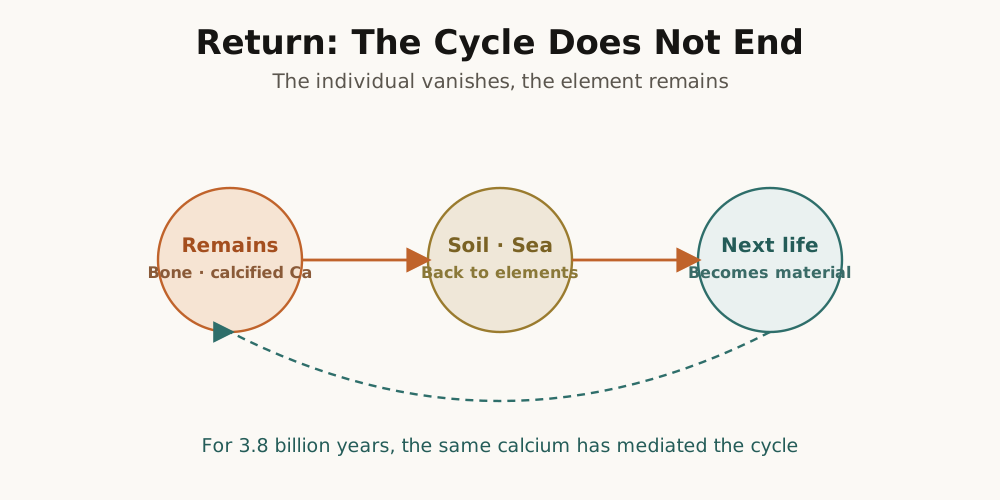
In Chapter 7 we examined the 7M mechanisms. The calcium leaked from the bones executes its exit through seven pathways. Blood vessels are blocked, joints harden, signals are cut off, connections are severed, and in the end the structure collapses. The individual arrives at death. But if we end the story here, something feels missing. In the introduction to Part 2 we presented the six stages of the cycle of life. Birth, growth, reproduction, decline, death, and return. We have examined up through five stages, and the final stage, return, remains. Return means to go back. So what goes back, and to where?
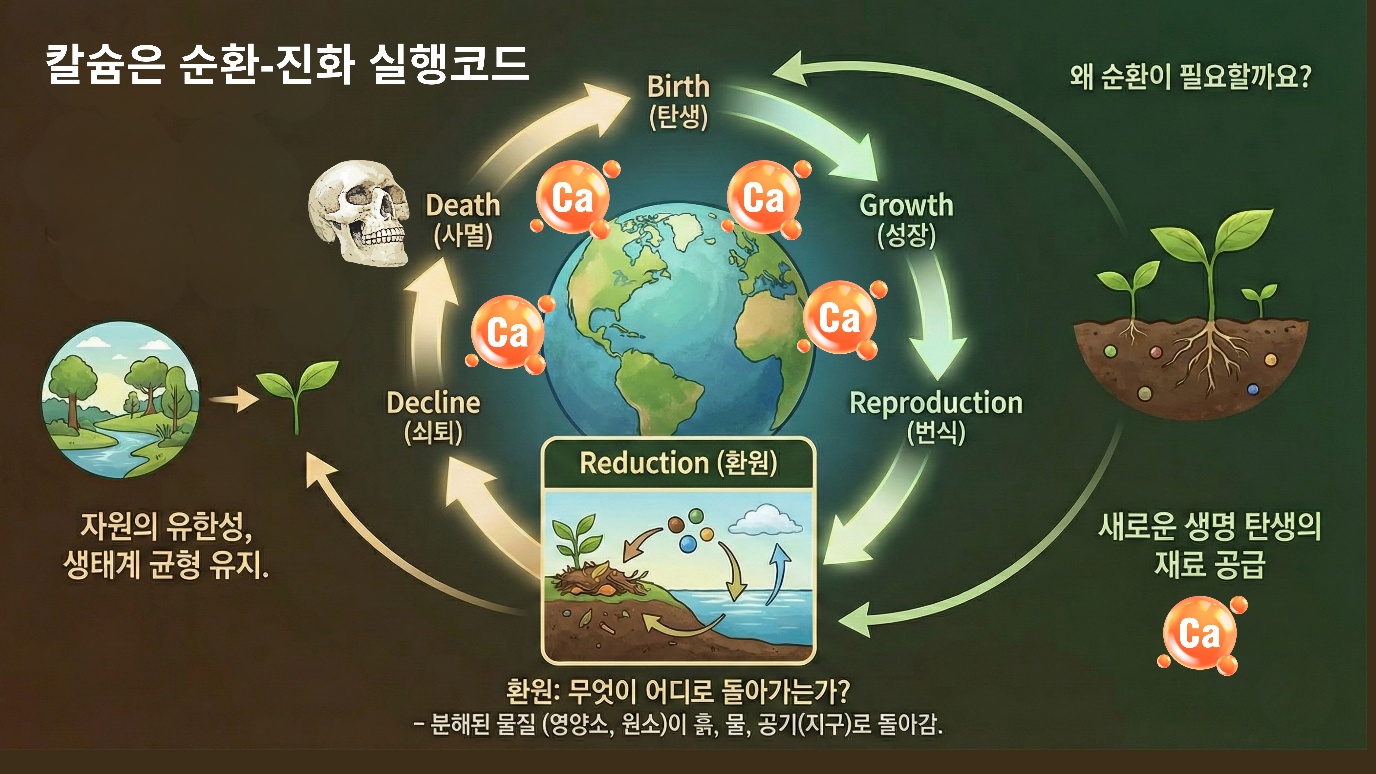
Before answering this question, we need to think first about a more fundamental one. Why must there be a return? Why is a cycle necessary? To answer this, we must think again about the relationship between the earth and life.
A Finite Earth, Infinite Life
The earth is almost a closed system. Energy comes in from the sun and heat escapes into space, but there is almost no coming and going of matter. Except for the occasional meteorite that falls and the minuscule amount of atmosphere that escapes into space, the earth's matter has remained almost unchanged since the earth formed 4.6 billion years ago. The same is true of calcium. The total amount of calcium on earth is fixed. It is not newly made, and it does not disappear. Only its form changes. The calcium that was in rock dissolves into water, is absorbed into living things, and is deposited again to become rock. And yet life has continued for about 3.8 billion years. It is hard to imagine how many living things were born and died during that time.
The number of species that have existed up to now is beyond counting. The number of individuals is literally astronomical. And all these living things used calcium. In cell signaling, in shells, in bones. How could countless living things live for 3.8 billion years on a finite amount of calcium? There is only one answer. Because it was reused. The next organism used the calcium of the dead organism. And when that organism died, the next one used it again. The same calcium atom has passed through the bodies of countless organisms over hundreds of millions of years. This is the cycle. And for the cycle to work, there is something that is absolutely necessary.
Let us imagine for a moment. What would happen if there were no death? The first organism is born and absorbs calcium. It makes bones, makes a shell, uses it in cell signaling. But it does not die. It keeps holding on to the calcium. A second organism is born. This organism also needs calcium. But because the first organism did not return its calcium, the usable calcium decreases by that much. A third, fourth, and fifth organism are born. The usable calcium keeps decreasing. What happens in the end? The calcium is exhausted. A new organism has no material to make bones. No material to make a shell. No material to send cell signals. New life becomes impossible. Without death the cycle stops. When the cycle stops, new life is impossible. Paradoxical as it is, death is a precondition for the continuation of life.
From this perspective we can redefine death. Death is not an end. It is a return of what was borrowed. It is giving back what was borrowed. The 1 kilogram of calcium in your bones is not yours. It was borrowed from the earth. You borrowed it through your mother when you were born, and while living you borrowed more through food. You use it your whole life, and when you die you return it. The next life borrows and uses it. When that life dies too, it returns it. The next life borrows and uses it. This has continued for 3.8 billion years. Return is this process of giving back. It is the sending of the calcium an individual borrowed back into the cycle.
The Process of Return
When an individual dies, where does the calcium go? Let us consider the case of burial. When a body is buried in the ground, the soft tissue decomposes first. Bacteria and fungi are in charge of this work. It takes from several weeks to several months. Carbon and nitrogen are released into the soil. The bones remain longer. Hydroxyapatite resists decomposition. Depending on conditions it can remain from decades to thousands of years. But in the end it decomposes. In acidic soil it decomposes faster. Calcium ions dissolve into the soil water. In the case of cremation it is faster. At high temperature the organic components are burned. What remains is calcium compounds, that is, the cremated remains. When these are scattered on soil or scattered in the sea, the calcium goes directly back into the environment. In either case the result is the same. It only takes time; the calcium eventually returns to the cycle.
Where does the calcium that has returned to the soil go next? Plants absorb calcium through their roots. For plants too, calcium is an essential nutrient. Calcium is needed to stabilize the cell wall, to maintain cell membrane function, and to transmit signals. Plants also have a calcium signaling system. Herbivores eat plants. The calcium that was in the plant enters the animal's body. The animal uses that calcium to make bones, to transmit signals, and to contract muscles. Carnivores eat herbivores. Calcium moves up along the food chain. When that animal dies, it is decomposed again. The calcium returns to the soil. Plants absorb it again. This is the fast cycle on land. On a scale of several years to several hundred years, calcium moves around among living things.
Some of the calcium in the soil follows another pathway. When it rains, some of the calcium in the soil is washed away. It flows into groundwater, into streams, into rivers. The rivers of the whole world carry an immense amount of calcium to the sea every year. In the sea, living things use calcium. Corals make calcium carbonate skeletons. Shellfish make shells. Even very small plankton make calcium carbonate shells. The calcium that was dissolved in the seawater becomes solid structures. When these organisms die, their shells sink to the seafloor. After millions of years they become thick sedimentary layers. After even longer, they become limestone. A study on marine carbonate sedimentation published in 1996 shows that this process has continued throughout the entire history of the earth. When the seafloor rises through crustal movement, that limestone becomes land. This is why fossils of sea creatures are found at the summit of the Himalayas. Washed by rain, it weathers again. Calcium flows into rivers and again into the sea. This is the slow cycle. On a scale of tens of millions to hundreds of millions of years, calcium moves around between rock and sea.
Where Did the Calcium in Your Bones Come From
Now let us think in the opposite direction. Where did the calcium in your bones come from? Directly, it came from food. You took in calcium from milk, cheese, tofu, vegetables, and fish. Where did the calcium in that food come from? The calcium in milk came from the dairy cow. The cow ate grass. The grass absorbed calcium from the soil. Where did the calcium in the soil come from? It came from the weathering of rock, and from the decomposition of dead organisms. If we keep tracing back, how far would we go? Let us imagine a single calcium atom in your bones. That atom has a history of hundreds of millions of years. Three hundred million years ago it may have been in the shell of a trilobite in a Paleozoic sea. The trilobite dies, the shell sinks to the seafloor, becomes limestone, rises up, weathers, goes along a river to the sea, becomes the shell of some organism again, dies again, is deposited again. This process was repeated over hundreds of millions of years. The number of organisms that calcium atom passed through cannot be counted. Trilobites, ammonites, fish, dinosaurs, mammals, and perhaps your own ancestors. At the end of that long journey, that atom is now in your bones.
When you realize this, your perspective changes. Your bones are not yours. To be precise, the calcium in your bones is not yours. What countless organisms borrowed and used over 3.8 billion years, you are now borrowing and using. When you die, you must return it. The next life is waiting. This is the meaning of return. It is not an end but a connection. The end of the individual is the continuation of the cycle.
Why Calcium Mediates the Cycle
Not every substance can mediate such a cycle. There is a reason calcium became the mediator of the cycle. First, calcium is not destroyed. Only its form changes through chemical reactions; the atom itself does not disappear. Even after hundreds of millions of years it remains the same. To cycle, a substance must not be destroyed. Second, calcium changes form easily. In bone it exists as a solid called hydroxyapatite. It does not dissolve. It forms structure. But in an acidic environment it dissolves and becomes ions. It dissolves in water and moves. Under the right conditions it is deposited again and becomes solid. Both storage and movement are possible. Third, calcium passes through both the living and the non-living. When it is in rock it is non-living. When it is absorbed into an organism it becomes part of life. When the organism dies it becomes non-living again. It freely crosses the boundary between the living and the non-living. Thanks to these three properties, calcium becomes the perfect mediator of the cycle. The study of the earth's carbon cycle published in Science in 2000 emphasizes that such biogeochemical cycles are key to understanding the earth system.
Looking at the calcium cycle, we come to realize an interesting fact. Life is not separate from the earth. Life is part of the geochemical cycle. Calcium cycles from rock to soil, to plants, to animals, back to soil, to the sea, to sediment, to rock. Life is a way station where calcium briefly rests in this immense cycle. Your body is part of the earth. It is made of atoms borrowed from the earth. When you die, it returns to the earth. You are a temporary arrangement of earth's matter. This is the deeper meaning of return. A book called Revolutions that Made the Earth, published in 2011, explains in detail how life and the earth have co-evolved. Life changes the earth, the changed earth changes life, and in that process calcium cycles endlessly.
The Cycle and Evolution
Now let us think about the relationship between evolution and the cycle. What is evolution? It is the change of species over time. Variation arises, favorable variation is selected, and it is passed on to the next generation. As this process repeats, species gradually change. For evolution to work, generational turnover is necessary. From the parent generation to the child generation, from the child generation to the grandchild generation. Each time a generation changes, a little variation arises, selection takes place, and species change bit by bit. For generational turnover to happen, two things are needed. New life must be born, and existing life must die. Birth and death. The paper Why do we age? published in Nature in 2000 explains that aging and death are an inevitable product of evolution.
For new life to be born, material is needed. Carbon to make cells, calcium to make bones, phosphorus to make DNA. Where does this material come from? On a finite earth, new material cannot be made. Existing material must be reused. The material of dead organisms must be used. If dead organisms do not return their material, new life cannot be born. The cycle must work for generational turnover to be possible. So the logical order is this. For evolution to work, generational turnover is necessary. For generational turnover to happen, birth is necessary. For birth to happen, material is necessary. For material to be supplied, the cycle is necessary. For the cycle to work, death is necessary. Without death there is no cycle. Without the cycle there is no material. Without material there is no new life. Without new life there is no generational turnover. Without generational turnover there is no evolution. Death is a precondition for evolution.
In this whole process, what does calcium do? At birth, calcium awakens the egg. It is the calcium wave of fertilized-egg activation. During growth, calcium forms bone. It is the hydroxyapatite of the skeleton. During reproduction, calcium is passed to the next generation. From mother to fetus. During decline, DIAH leaks calcium out. From bone to soft tissue. At death, 7M executes the exit. Calcium mediates all of them. At return, calcium goes back into the cycle. So that the next life can use it. A single substance runs through the entire cycle. From birth to return. From the beginning of life to the beginning of the next life. Calcium connects all of it.
Conclusion: The Cycle Is Completed
In this chapter we examined return. It is the final stage of the cycle of life, and the beginning of the next cycle. The reason infinite life is possible on a finite earth is the cycle. Dead organisms return their material, and the next organisms use it. For 3.8 billion years this has repeated. Death is not an end but a return of what was borrowed. The individual returns the calcium it borrowed. The next life borrows and uses it. The cycle continues. Evolution works upon this cycle. The cycle makes generational turnover possible, and generational turnover makes evolution possible. Calcium mediates this whole process. It executes birth, executes growth, executes decline, executes death, and executes return. A single substance runs through the entire cycle of life. In the next chapter we will examine how the cycle at the level of the individual and the cycle at the level of the earth are connected. We will see that the human body, the small cosmos, and the earth, the great cosmos, share the same pattern.
References
1. Berner, R. A. (2004). The Phanerozoic Carbon Cycle: CO₂ and O₂. Oxford University Press. doi:10.1093/oso/9780195173338.001.0001
2. Ridgwell, A., & Zeebe, R. E. (2005). The role of the global carbonate cycle in the regulation and evolution of the Earth system. Earth and Planetary Science Letters, 234(3-4), 299-315. doi:10.1016/j.epsl.2005.02.026
3. Falkowski, P., et al. (2000). The global carbon cycle: a test of our knowledge of Earth as a system. Science, 290(5490), 291-296. doi:10.1126/science.290.5490.291
4. Schlesinger, W. H., & Bernhardt, E. S. (2013). Biogeochemistry: An Analysis of Global Change (3rd ed.). Academic Press. doi:10.1016/C2010-0-66291-2
5. Milliman, J. D., & Droxler, A. W. (1996). Neritic and pelagic carbonate sedimentation in the marine environment: ignorance is not bliss. Geologische Rundschau, 85(3), 496-504. doi:10.1007/BF02369004
6. Morse, J. W., & Mackenzie, F. T. (1990). Geochemistry of Sedimentary Carbonates. Elsevier. ISBN: 978-0-444-87391-0
7. Kirkwood, T. B. L., & Austad, S. N. (2000). Why do we age? Nature, 408(6809), 233-238. doi:10.1038/35041682
8. Williams, G. C. (1957). Pleiotropy, natural selection, and the evolution of senescence. Evolution, 11(4), 398-411. doi:10.1111/j.1558-5646.1957.tb02911.x
9. Follows, M. J., & Dutkiewicz, S. (2011). Modeling diverse communities of marine microbes. Annual Review of Marine Science, 3, 427-451. doi:10.1146/annurev-marine-120709-142848
10. Lenton, T. M., & Watson, A. J. (2011). Revolutions that Made the Earth. Oxford University Press. doi:10.1093/acprof:oso/9780199587049.001.0001