
In Part 1, we reread cancer as a consequence of environment. The four axes of the tumor microenvironment (hypoxia, acidosis, inflammation, and gradient collapse) select cells, the calcium signaling of Overgrowth switches on proliferation, and even the Warburg metabolic shift turns out to be an adaptation to environment. Now we move to the place where that perspective becomes practice: how metastasis spreads along the gradient, and what clinical evidence supports interventions that change the environment.
Metastasis: A Path Opened by the Gradient
The moment cancer decisively threatens a patient's life is not when the primary tumor is confined locally, but when metastasis begins. In most cancer types, more than 90 percent of all deaths arise not from the primary tumor itself but from distant metastasis. And metastasis is precisely the stage that the language of the gradient can explain most clearly.
Metastasis is a sequence of many stages. Cells from the primary tumor breach the surrounding stroma, enter blood vessels or lymphatic vessels, travel through the circulatory system, lodge in a particular organ, and adapt to that organ's environment to form a new lesion. Each of these stages has an extremely low probability. This is shown by the long-standing observation that, of the tens of thousands of tumor cells that enter the bloodstream, only a vanishingly small number actually go on to form metastatic lesions (Chambers et al., 2002, Nat Rev Cancer). So why does this low-probability event ultimately occur in most patients?
This book's answer is environment. It is because the organ that the metastatic cell reaches already has an environment prepared to welcome it. The concept of the pre-metastatic niche, reported by Kaplan's team and Lyden's team in 2005, formalized this picture (Kaplan et al., 2005, Nature; Peinado et al., 2017, Nat Rev Cancer). The primary tumor sends cytokines, exosomes, and stromal proteins ahead of it through the blood to distant organs, and these pre-condition that organ's microenvironment into a state favorable for the tumor to settle. Cells mobilized from the bone marrow converge on the organ, the stroma is reorganized, and vascular permeability changes. As a result, the tumor cell that arrives later sets foot on soil that has already been prepared in its favor.
This observation explains a well-known clinical pattern. Breast cancer strongly prefers to metastasize to bone, lung, liver, and brain; colorectal cancer to liver and lung; prostate cancer to bone; lung cancer to brain, bone, and liver. This organ-specific preference is not simply a matter of anatomical circulation routes, but a matter of each organ's microenvironment providing gradient conditions that better suit a particular tumor. Stephen Paget's "seed and soil" hypothesis, proposed at the end of the nineteenth century, has thus been reconfirmed at the molecular level a century later (Paget, 1889, Lancet).
From the gradient's perspective, metastasis reads as follows: metastasis is established when the environment of the primary tumor and the environment of the metastatic organ share a common pattern of gradient collapse. Bone, in an environment accompanied by osteoporosis and microstructural resorption, more readily accepts metastasis from breast and prostate cancer; the liver, in an environment of fatty liver and chronic inflammation, more readily accepts metastasis from colorectal and pancreatic cancer. The clinical impression that metastasis progresses faster in patients with chronic disease is naturally explained by the view that multiple organs in these patients are already in the early stages of gradient collapse, widening the soil in which metastasis can settle.
What this interpretation means in practice is important. Efforts to prevent metastasis have focused only on blocking the migratory capacity of tumor cells, but interventions that keep the environment of the organs metastasis will reach healthy in advance carry equal importance. Protecting the gradient of a distant organ, specifically, managing that organ's microvascular health, metabolic state, and inflammation level, can actually lower the success rate of metastasis. The following section examines the clinical evidence for this direction.
The Map of Treatment: The Existing Pillars and the Environment as a Layer
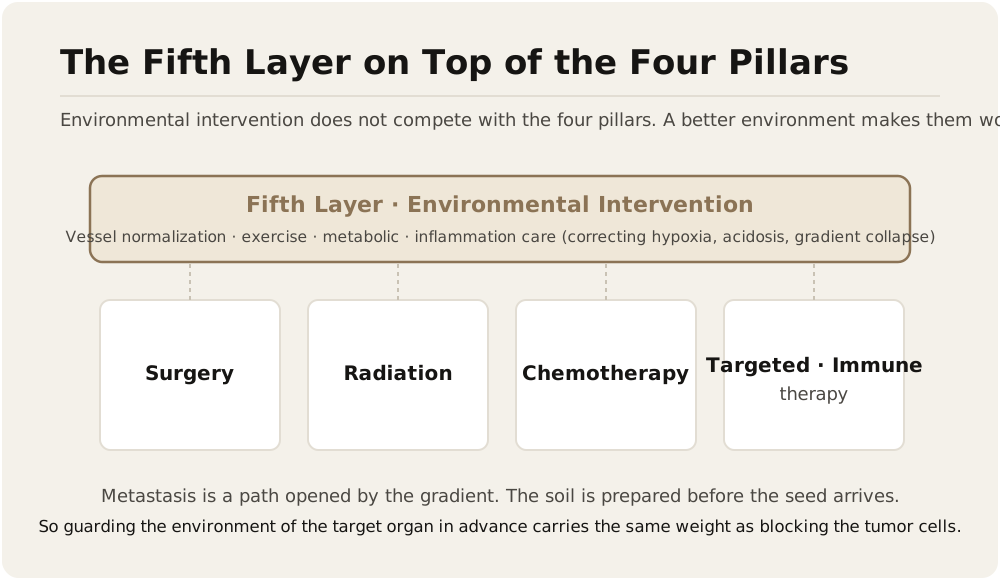
The discussion up to this point is not a narrative that denies existing treatment. Surgery is the most powerful means of directly removing a localized tumor, radiation reduces cells in areas surgery cannot reach, chemotherapy attacks residual cells circulating throughout the body, and targeted therapy and immunotherapy have produced remarkable results in specific molecular subtypes. These four pillars are the substance of modern oncology, and nothing in this chapter diminishes their value.
What this chapter proposes is not a pillar but a layer. On top of the map of treatment supported by the four pillars, we propose adding a fifth layer that changes the environment in which the tumor itself grows. This layer is named environmental intervention, and its content is a bundle of approaches that correct the four axes of the tumor microenvironment (hypoxia, acidosis, inflammation, gradient collapse). This approach is not a new invention. It has accumulated independently across several areas of clinical research over the past twenty years, and the role of this layer, from this book's perspective, is to gather those pieces into a single picture.
What matters is that this fifth layer does not compete with the preceding four pillars. Quite the opposite. When the environment improves, chemotherapy reaches its target more effectively, radiation responsiveness rises, and the effect of immunotherapy is amplified. The following two sections demonstrate this with concrete clinical evidence: one is the concept of vascular normalization, and the other is the measured results brought about by managing exercise, metabolism, and inflammation.
Vascular Normalization: A Strategy for Rebuilding the Microvascular Gradient
The concept of vascular normalization, published in Science in 2005 by Rakesh Jain of Harvard Medical School, is the bridge that connects this chapter's story directly to the clinic (Jain, 2005, Science). Jain's central insight is this: tumor blood vessels are abnormally numerous, but at the same time abnormally poor in function. The vessel walls leak, blood flow is irregular, and the distribution of vessels is disordered. As a result, hypoxic regions form inside the tumor, and chemotherapy drugs fail to reach them. Paradoxically, the prediction is that an intervention that makes the tumor's vasculature "more normal," rather than simply "smaller," can improve drug delivery and raise treatment efficacy.
This prediction has been substantially validated by twenty years of subsequent clinical research. The effect of combining anti-angiogenic agents such as bevacizumab (Avastin) with chemotherapy has been reinterpreted, not as a strategy of simply shrinking vessels to starve the tumor, but as a mechanism that temporarily normalizes vessels to improve the penetration of chemotherapy drugs and the access of immune cells (Jain, 2014, Cancer Cell). Treatment timing has become important, and approaches that use imaging to capture the window of vascular normalization and administer chemotherapy within that window have entered clinical trials.
The concept of vascular normalization speaks the same language as the restoration of the gradient that this book has repeated throughout. If the tumor environment is a state of chronic gradient collapse, then even partially reversing that collapse to restart supply and drainage changes the conditions of treatment. If vascular normalization is a chemical intervention, the exercise and metabolic interventions discussed in the next section are non-chemical interventions that operate in the same direction at a broader level. The two approaches do not exclude but complement each other.
Accumulated Clinical Evidence: Interventions in Exercise, Metabolism, and Inflammation
The most powerful non-chemical intervention for changing the environment surrounding a tumor is exercise. Over the past decade, the clinical evidence in this field has shifted its center of gravity from scattered observations to systematic meta-analyses, and then to randomized controlled trials. The most decisive of these is the CHALLENGE trial, published in The New England Journal of Medicine in 2025. This multicenter randomized trial divided 889 patients who had completed adjuvant chemotherapy after surgery for colon cancer (high-risk stage II or stage III) into a structured exercise program group and a health education group, followed them long term, and reported significantly higher five-year disease-free survival and overall survival in the exercise group (Courneya et al., 2025, N Engl J Med). This is the first randomized-trial-level evidence that exercise, not a drug, improves survival in colon cancer.
Mechanistic research aligns precisely with this clinical result. According to what Betof's team reported in a breast cancer animal model in 2015, regular aerobic exercise reduces hypoxic regions within the tumor, improves vascular perfusion, and as a result raises the responsiveness of chemotherapy (Betof et al., 2015, J Natl Cancer Inst). Exercise lowers systemic inflammatory markers, improves insulin sensitivity, and myokines secreted from muscle directly affect the tumor environment. All of these pathways overlap with the environmental improvement this book has described.
Metabolic intervention follows a similar trajectory. According to what Goodwin's team reported in 2002, among breast cancer patients, the group with high fasting insulin levels had an independently elevated risk of recurrence and death (Goodwin et al., 2002, J Clin Oncol). Numerous subsequent studies have confirmed that obesity, metabolic syndrome, and hyperinsulinemia correlate with prognosis across several cancer types, and in the 2010s, observational studies accumulated suggesting that metformin could reduce recurrence in colorectal, breast, and prostate cancer. It has not been established that metformin itself produces a cancer-prevention effect in all circumstances, but the direction that interventions improving the metabolic environment are not unrelated to tumor progression has become increasingly clear (Pernicova & Korbonits, 2014, Nat Rev Endocrinol).
The management of chronic inflammation lies on the same map. C-reactive protein (CRP) and the neutrophil-to-lymphocyte ratio (NLR), both systemic inflammatory markers, have been confirmed as independent prognostic factors for survival across several solid tumors, and the colorectal cancer prevention effect of low-dose aspirin is increasingly established as one pillar of primary prevention. The long-term follow-up results of a clinical trial reported in The Lancet in 2020 reconfirmed that long-term use of low-dose aspirin meaningfully reduces the incidence of and death from colorectal cancer (Cuzick et al., 2020, Lancet). This too supports the direction that interventions improving the environment, particularly chronic inflammation, change outcomes.
Gathering this clinical evidence into a single picture, it looks like this: exercise reduces hypoxia and gradient collapse, metabolic intervention lowers the insulin and growth-signal axis, and inflammation management alleviates the chronic wound state surrounding the tumor. All three approaches are interventions that change not the tumor cells themselves but the soil in which the tumor grows. No single one of them can cure advanced cancer on its own, but when this fifth layer is placed on top of the existing four pillars, there is a possibility that treatment outcomes will change. This is the substance of the environment-centered intervention that this book describes, and this substance is not a new invention but simply the direction of a change already underway, gathered together anew into a single grammar called the gradient.
Age-Associated Cancer Progression Seen Through Five Stages
Now, organizing this chapter's entire discussion according to this book's formula (accumulation of determinants, trigger, dual blockade / flow collapse, manifestation, collapse), it looks like this.
Stage 1, accumulation of determinants. Decades of accumulated living conditions produce low-intensity, chronic activation of the DIAH square in the relevant organ. Smoking, chronic infection, sustained overnutrition, visceral obesity, lack of exercise, sleep deprivation, chronic stress, and exposure to environmental carcinogens each raise deficiency, inflammation, acidosis, and hypoxia through their own pathways. At this stage there are no symptoms, and imaging or blood tests catch almost nothing.
Stage 2, trigger. At the tissue level, chronic inflammation and precancerous lesions such as epithelial dysplasia and metaplasia appear. Colorectal adenomas, gastric intestinal metaplasia, cervical dysplasia, cirrhotic nodules of the liver, basal cell hyperplasia of the lung, and high-grade prostatic dysplasia all fall into this category. It is a confirmed principle across all cancer types that intervention is most effective at this stage.
Stage 3, dual blockade / flow collapse. The microvasculature and stroma of the relevant tissue enter a state of chronic gradient collapse. Supply and drainage deteriorate simultaneously, and hypoxia, acidosis, and inflammation enter a self-amplifying loop. In this environment, cells activate survival-adaptation programs over the long term, and control of calcium signaling begins to waver. At this stage, some cells accumulate mutations and become candidates for clinical cancer cells.
Stage 4, manifestation. The primary tumor grows to a clinically detectable size and is captured by imaging, endoscopy, and blood markers. This is the stage at which the four pillars of modern medicine (surgery, radiation, chemotherapy, targeted and immune therapy) play their strongest role. At the same time, the tumor at this point already has a fully formed microenvironment, and that environment is connected to the systemic gradient state outside the tumor. This is why environmental intervention begins to carry meaning from this stage onward.
Stage 5, collapse. Metastasis progresses, the gradients of multiple organs collapse in a chain reaction, and systemic collapse of nutrition and immunity follows. Even at this stage the room for environmental intervention does not disappear entirely, but in most cases the gradient that was not managed at earlier stages hardens here into irreversible damage. At this stage, palliative care centers not on restoring the gradient but on managing suffering, and that in itself is a dignified medical act.
Looking across these five stages, one principle that this book has repeated is confirmed once more. Cancer is not a problem of a single cell but a problem of the entire system, and a problem of the entire system can only be properly read in the language of the system. The gradient is precisely that language.
Different Starting Points, the Same Gate to Pass Through: A Convergence Perspective
Earlier in this chapter, we drew a clear boundary. We said that the language of the gradient has its strongest explanatory power in age-associated adult solid tumors, where environment is the primary stage, and that hereditary cancer syndromes, pediatric cancers, virus-driven cancers, and hematologic cancers are not the primary subject of this chapter. This boundary remains valid here, as this chapter closes. Cancers whose primary cause is a germline mutation must first be addressed in the language of genetic testing and prophylactic surgery; virus-induced cancers must first be addressed in the language of vaccination and infection management; pediatric cancers must first be addressed in the language of a developmental approach. The grammar of the gradient does not replace this primary management.
But one observation remains. Even the cancers outside this boundary pass through the same bottleneck as age-associated cancers once they reach the stage of progression after onset. Whether it is hereditary breast cancer, hepatocellular carcinoma that began with hepatitis B virus, or human papillomavirus-related cervical cancer, from the moment the tumor grows beyond a certain size, hypoxic regions form within it, acidosis follows, chronic inflammation becomes fixed, and a landscape of dual blockade unfolds in which an abnormal vascular network and stroma collapse both supply and drainage at once. This landscape is physicochemically identical to the landscape created by processes accumulated over decades in age-associated cancer. Whatever the primary cause was, the tumor must build this environment at some stage in order to grow.
What this fact means in practice is this: the primary cause differs, but the grammar of the environment that accelerates progression is one and the same. The phrase "different starting points, the same gate to pass through" points to precisely this. If so, the meaning of the environmental interventions examined in the latter half of this chapter, vascular normalization, exercise, metabolic management, and inflammation management, is not limited to cancers within the boundary. Because cancers outside the boundary are also placed under the same environmental conditions once they enter the stage of progression, room opens for the same interventions to work in the same direction. Indeed, observations have accumulated that the effect of exercise on recurrence and overall survival in patients with hereditary breast cancer is not greatly different from that in patients with sporadic cancer, and that metabolic and inflammation management affects prognosis in patients with hepatitis-B-related hepatocellular carcinoma. These observations do not collapse the boundary this chapter has drawn, but they do mark the point beyond that boundary that the grammar of the gradient reaches.
It is worth reiterating why this convergence perspective interlocks with the overall structure of this book. The five stages this book has established, accumulation of determinants, trigger, dual blockade, manifestation, collapse, form a structure in which, whatever stages 1 and 2 may be, the same physics operates from stage 3, dual blockade, onward. Age-associated cancer is within the grammar of the gradient from stage 1; special-factor cancers carry a different language through stage 2, but return to the same grammar from stage 3 onward. From a systems perspective, these two pathways are not entirely different stories, but a single story with different starting points. This is the shape of the structure we wished to confirm at the close of this book.
A Question That Sees Cancer Differently
As we close this chapter, we want to note the one shift in framing that we most hope readers will take away from the entire book. Up to now, the question given to patients and families standing before cancer has been this: "How do we defeat this cell?" This question remains important, and every effort to answer it deserves respect. But there is one more question this chapter has tried to open: "What environment is this cell adapting to right now? If we change that environment even slightly, how does this cell's story change?"
This second question does not replace the first. Rather, it is closer to a question that changes the conditions under which the first works better. Surgery, radiation, chemotherapy, and immunotherapy remain exactly where they are, and when a layer called environment is placed on top of them, the picture can change somewhat. This possibility is accumulating as concrete clinical results, and that accumulation is the most tangible piece of the landscape this book has bound together under the name of the gradient.
The next chapter of this book turns this story back into generalized language. Having seen how the grammar of the gradient operates in the extreme case of cancer, we go on to confirm with empirical data that this same grammar operates in exactly the same form in an entirely different domain: the economy. The declaration that the human body and the economy share the same grammar awaits us at the place that closes every chapter so far into a single frame.
참고문헌
- Folkman, J. (1971). Tumor angiogenesis: therapeutic implications. The New England Journal of Medicine, 285(21), 1182-1186.
- Semenza, G. L. (2012). Hypoxia-inducible factors in physiology and medicine. Cell, 148(3), 399-408.
- Corbet, C., & Feron, O. (2017). Tumour acidosis: from the passenger to the driver's seat. Nature Reviews Cancer, 17(10), 577-593.
- Coussens, L. M., & Werb, Z. (2002). Inflammation and cancer. Nature, 420(6917), 860-867.
- Monteith, G. R., Prevarskaya, N., & Roberts-Thomson, S. J. (2017). The calcium-cancer signalling nexus. Nature Reviews Cancer, 17(6), 367-380.
- Cui, C., Merritt, R., Fu, L., & Pan, Z. (2020). Targeting calcium signaling in cancer therapy. Cancers, 12(9), 2527.
- Molkentin, J. D., Lu, J. R., Antos, C. L., Markham, B., Richardson, J., Robbins, J., Grant, S. R., & Olson, E. N. (1998). A calcineurin-dependent transcriptional pathway for cardiac hypertrophy. Cell, 93(2), 215-228.
- Vander Heiden, M. G., Cantley, L. C., & Thompson, C. B. (2009). Understanding the Warburg effect: the metabolic requirements of cell proliferation. Science, 324(5930), 1029-1033.
- Chambers, A. F., Groom, A. C., & MacDonald, I. C. (2002). Dissemination and growth of cancer cells in metastatic sites. Nature Reviews Cancer, 2(8), 563-572.
- Kaplan, R. N., et al. (2005). VEGFR1-positive haematopoietic bone marrow progenitors initiate the pre-metastatic niche. Nature, 438(7069), 820-827.
- Peinado, H., et al. (2017). Pre-metastatic niches: organ-specific homes for metastases. Nature Reviews Cancer, 17(5), 302-317.
- Paget, S. (1889). The distribution of secondary growths in cancer of the breast. The Lancet, 133(3421), 571-573.
- Jain, R. K. (2005). Normalization of tumor vasculature: an emerging concept in antiangiogenic therapy. Science, 307(5706), 58-62.
- Jain, R. K. (2014). Antiangiogenesis strategies revisited: from starving tumors to alleviating hypoxia. Cancer Cell, 26(5), 605-622.
- Betof, A. S., et al. (2015). Modulation of murine breast tumor vascularity, hypoxia, and chemotherapeutic response by exercise. Journal of the National Cancer Institute, 107(5), djv040.
- Courneya, K. S., et al. (2025). Structured exercise after adjuvant chemotherapy for colon cancer. The New England Journal of Medicine, 393(1), 13-25. https://doi.org/10.1056/NEJMoa2502760
- Goodwin, P. J., et al. (2002). Fasting insulin and outcome in early-stage breast cancer. Journal of Clinical Oncology, 20(1), 42-51.
- Pernicova, I., & Korbonits, M. (2014). Metformin: mode of action and clinical implications. Nature Reviews Endocrinology, 10(3), 143-156.
- Cuzick, J., et al. (2020). Use of aspirin for the prevention of colorectal cancer. The Lancet, 395(10217), 53-64.
This article is the second and final installment (2/2) of Chapter 10 of The Universal Law: Gradient. The text follows the original manuscript and is provided for informational purposes. This article is an educational explanation of theory, not medical advice for the diagnosis, treatment, or prescription of any specific condition. Please consult a medical professional regarding any health-related decisions.