
In the preceding three chapters, we applied the grammar of gradient in turn to nature, the human body, and the economy. In this chapter we widen our field of view further, rereading the great events of human and civilizational history in the same language. Our goal in this chapter is to confirm that events from vastly different eras and scales all followed the same physical grammar: determinants accumulate, dual blockade forms, and collapse proceeds.
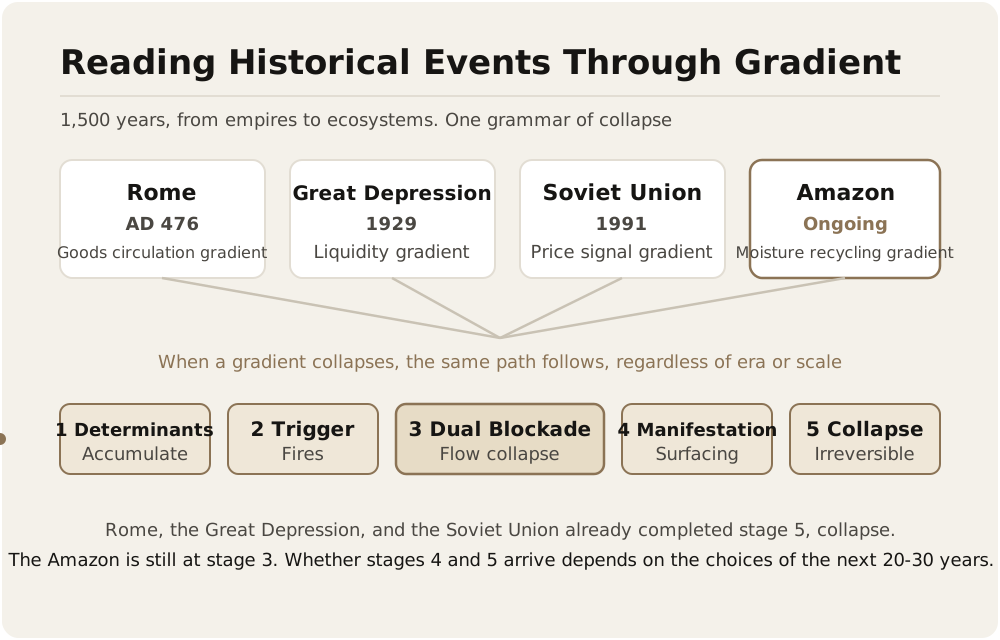
The four events we will examine here are the fall of the Western Roman Empire, the Great Depression of 1929, the dissolution of the Soviet Union in 1991, and the crisis of the Amazon rainforest, which is still unfolding today. In time, they span from 1,500 years ago to the present. In scale, they span from an ancient empire to an ecosystem. Yet these events all follow the common pathway of gradient collapse. This is not because history repeats itself, but because the physical grammar of collapse is the same regardless of era or scale.
For each event, we repeat the same analytical framework used in the previous chapters. What gradient was operating in the system in question. What did the process of that gradient's collapse look like. How does it map onto the five stages, from the accumulation of determinants to collapse. What this repetition confirms for the reader is that the grammar of gradient is not merely a law a scientist proves in a laboratory, but a law that the entirety of humanity's collective experience has already unfolded in accordance with.
History books typically list the causes of an event across the categories of politics, economics, society, military affairs, and culture, and debate the relative contribution of each. This chapter does not aim to propose a conclusion to that debate. Instead, it asks under what physical condition, common to all of them, those various factors functioned. That condition is precisely the maintenance or collapse of gradient. An empire can fall for many reasons, but every empire falls through the same physical stages.
Rome: When the Gradient of Material Circulation Breaks
The official end of the Western Roman Empire is recorded as the year 476, with the abdication of the last emperor, Romulus Augustulus. But this date marks only the symbolic conclusion of a long collapse process spanning 400 years; the collapse itself had been under way for much longer. Oxford historian Bryan Ward-Perkins argued in his 2005 book The Fall of Rome and the End of Civilization, using archaeological evidence, that the collapse of the Western Empire was not a simple "transformation" or "peaceful transition," but the substantive destruction of an entire material civilization.
Reading the way the Roman Empire sustained itself in the language of gradient, the empire was a vast material circulation system. Grain from North Africa, olive oil from Spain, wine from Gaul, tin from Britannia, and silk and spices from the East circulated along a trade network centered on the Mediterranean, and this circulation sustained consumption at the empire's center. At the same time, legions and administrators, taxes and laws flowed outward from the center to the periphery, maintaining the empire's defensive lines. This bidirectional flow, the inflow of goods from periphery to center and the outflow of governing power from center to periphery, was the empire's circulatory engine.
Reconstructing this collapse through the five stages of gradient yields the following. Stage 1, the accumulation of determinants, proceeded over a long period after the end of the Antonine peace in the 2nd century. Repeated civil wars and the instability of imperial succession, the collapse of monetary trust caused by the long-term debasement of silver content, the weakening of the production base due to a declining supply of slaves, repeated epidemics including the Antonine Plague of the late 2nd century, and mounting pressure from Germanic peoples beyond the border. These determinants accumulated over centuries. Stage 2, the trigger, is commonly dated to the year 376, when the Goths, pushed by pressure from the Huns, crossed the Danube into imperial territory. This event led to a crushing defeat of the Roman army at the Battle of Adrianople in 378, decisively exposing the cracks in the border defenses.
Stage 3, dual blockade and the collapse of flow, formed in the first half of the 5th century. On one hand, the inflow of goods from periphery to center was cut off by the settlement and plunder of migrating Germanic peoples. On the other hand, the legion pay and administrative resources that needed to flow from center to periphery were depleted. The simultaneous formation of blockades in both directions marks the structural moment of the empire's death, and the sack of Rome by Alaric in 410 and the plunder of Rome by the Vandals in 455 are the events in which this collapse surfaced most dramatically. Stage 4, manifestation, is clearly recorded in the archaeological record: a sharp decline in the quality of pottery, the contraction of Mediterranean trade networks, the shrinking of cities and the loss of public buildings, declining literacy, and, as Ward-Perkins emphasized, even the observation that living standards in some regions regressed to pre-Iron Age levels. Stage 5, collapse, continued for a long time even after the symbolic conclusion of 476, and it took Western Europe several centuries to recover the material civilization level of antiquity.
What makes this collapse interesting from the standpoint of gradient is that the long-standing historical consensus that the fall of Rome cannot be reduced to a single cause is naturally explained within the grammar of gradient. The various political, economic, military, and cultural factors each contributed to the weakening of different gradients (materials, currency, governing power, population), and dual blockade formed when these gradients simultaneously fell below the critical threshold. It is this complex gradient collapse, rather than a single cause, that distinguishes the fall of Rome from other brief turnovers of empire.
The Great Depression: The Global Collapse of the Liquidity Gradient
On October 24, 1929, Black Thursday, 12.9 million shares were traded in a single day on the New York Stock Exchange as the stock market crash began. On the following Black Monday, October 28, the Dow Jones Industrial Average fell 12.8% in a single day, and on Black Tuesday, October 29, 16.4 million shares were traded as the crash continued. The Dow, which had peaked at 381 in September 1929, fell to 41.22 by July 1932, an 89% decline from its peak, and it took until November 1954, 25 years, to recover its 1929 level. By 1933, roughly half of American banks had closed their doors, and the unemployment rate reached about 25%, meaning one in four people had lost their job.
The key to reading this crisis in the language of gradient is that the Great Depression was not merely a stock market decline, but a structural collapse of the global liquidity gradient. The "Roaring Twenties" of the 1920s was a period in which cheap credit and stock speculation combined to push asset prices far beyond the foundation of the real economy. During this period, the United States became the world's largest creditor nation, and Europe's World War I reparations and debts were being refinanced through New York, creating a complex web of international finance. At the center of this web was the American supply of credit, and at its periphery were the various economies that depended on that credit. It was a state in which the center-periphery gradient was extremely asymmetric.
Tracing the five stages of this collapse yields the following. Stage 1, the accumulation of determinants, proceeded throughout the 1920s. Margin buying for stock purchases exploded, the agricultural sector had already been in years of stagnation due to overproduction and falling prices, and consumer goods manufacturing was also piling up inventory due to insufficient demand caused by low wages. Beneath the surface of visible prosperity, the gradient between real economic activity and asset prices had widened to a dangerous level. Stage 2, the trigger, was the Federal Reserve's interest rate hike in August 1929, the stock market tremors of September, and Black Thursday on October 24.
Stage 3, dual blockade and the collapse of flow, formed over 1930 and 1931. On one hand, the supply of credit contracted sharply. A cascade of failures among major banks drove depositors into runs on their deposits, and banks responded by calling in loans and liquidating assets, causing the money supply to contract rapidly. On the other hand, real demand collapsed. A surge in unemployment and the collapse of asset values caused consumption to plummet, and companies cut production and employment. It was a textbook dual blockade in which supply (credit) and outflow (demand) were cut off at the same time. At the time, the Federal Reserve, constrained externally by the gold standard, failed to supply sufficient liquidity, a policy failure recorded as having further deepened the dual blockade.
Stage 4, manifestation, appeared as a global chain reaction in 1931-1933. The 1931 failure of Austria's Creditanstalt bank became the fuse for Europe's financial crisis, and as Britain abandoned the gold standard, world trade contracted sharply. A competitive protectionist race began as countries raised tariff barriers against one another, and the volume of world trade fell by about 66% between 1929 and 1933. By 1933, roughly half of American banks had failed, unemployment reached 25%, and farm income had fallen by 50%. Policy interventions aimed at averting Stage 5, collapse, followed: Roosevelt's New Deal, abandonment of the gold standard, the introduction of federal deposit insurance, and the reconstruction of international trade. Ultimately, it was the wartime mobilization of World War II that pulled the economy back up.
The lesson this crisis offers this book is clear. The rise in asset prices in the 1920s was a gradient asymmetry with no foundation in real economic activity, and the larger such an asymmetry becomes, the more violent the collapse at the critical point. That the Federal Reserve's 1929 interest rate hike was not the "cause" of the collapse but its "trigger" mirrors the same structure by which Lehman Brothers' bankruptcy was not the cause of the 2008 crisis but its trigger. Both crises are cases in which years of accumulated gradient distortion met an external shock at a particular moment and converted into dual blockade. History does not repeat the same events, but the grammar of collapse repeats.
The Soviet Dissolution: The Gradient Failure of the Centrally Planned Economy
On December 25, 1991, Mikhail Gorbachev resigned as President of the Soviet Union, and the following day the Supreme Soviet formally declared the dissolution of the USSR. The month before, on December 8, the leaders of Russia, Ukraine, and Belarus met in the Belovezha Forest and agreed to dissolve the Soviet Union and establish the Commonwealth of Independent States (CIS), and even before that, the three Baltic states and several other republics had already declared independence one after another. The Soviet Union, born in 1922, dissolved after 69 years of existence into 15 independent states, and this dissolution is recorded as the most dramatic macro-collapse event of the latter half of the 20th century.
The first thing to note when reading the Soviet economic system in the language of gradient is that this was a system that deliberately suppressed price gradients. In a market economy, prices function as an information signal that reflects the gradient between supply and demand and coordinates resource allocation. The Soviet centrally planned economy sought to replace this signaling function with the state's planning apparatus, and as a result, the vast pricing system spanning raw materials to consumer goods was determined politically. This decision served the intentions of the state, but from the standpoint of the efficiency of resource allocation, it accumulated systematic distortion. An economy in which the price gradient does not function cannot properly detect which sectors are short of resources and which are in surplus.
Reconstructing the five stages of this collapse yields the following. Stage 1, the accumulation of determinants, began in earnest in the 1970s. Productivity growth stagnated, the technology gap with the West began to widen, and military spending continued to increase relative to the size of the economy. The decline in international oil prices in the 1980s caused a sharp drop in Soviet foreign currency earnings, which decisively weakened the country's capacity to import food and consumer goods. Stage 2, the trigger, was Gorbachev's rise to power in 1985 and the introduction of the perestroika (restructuring) and glasnost (openness) reforms. These reforms were intended to rebuild the economy, but by dismantling the maintenance mechanisms of the existing planned system, they created a vacuum before a replacement system could take hold.
Stage 3, dual blockade and the collapse of flow, formed over 1989-1991. On one hand, the function of allocating resources from the center to the localities ceased to work. The existing planned system had been dismantled, a new market system had not yet taken hold, and the republics began refusing to pay taxes to the central government. On the other hand, the legitimacy of governance flowing from the localities to the center weakened rapidly. The 1989 chain collapse of communist regimes in Eastern Europe stirred the desire for independence among the republics within the Soviet Union as well, and beginning with the Baltic states in 1990-1991, one republic after another declared independence. It was a state in which the supply side of the economic circulation and the outflow side of the political circulation were blocked simultaneously, that is, an economic-political dual blockade.
Stage 4, manifestation, appeared starkly through the first half of 1991: shortages of daily necessities and long lines, signs of hyperinflation, regionally varying price distortions, and the spread of strikes and ethnic conflicts. The hardline coup attempt of August 19 was a last attempt to halt the collapse, but instead, failing within three days, it accelerated the collapse. The image of Yeltsin standing atop a tank to denounce the coup became the symbol of the moment when the old regime's last authority crumbled. Stage 5, collapse, was completed with the Belovezha Accords in December, Gorbachev's resignation on Christmas Day, and the independence of each of the republics. The Russian economy of the following 1990s underwent a severe contraction, with GDP shrinking by about 50%, and this aftermath persisted for more than a decade.
The reason the Soviet dissolution is a special case from the standpoint of gradient is that it is the outcome of a historical controlled experiment testing whether a system that suppresses price gradients can remain sustainable over the long term. Gradient distortion also occurs in market economies (as in the cases of 1929 and 2008) and sometimes leads to catastrophic collapse. But because a centrally planned economy lacks the self-correcting function of the price gradient altogether, it displays the structural characteristic of distortion accumulating undetected for decades before surfacing all at once at the critical point. This is history's largest-scale case demonstrating how a system collapses when the gradient is not where it "should" be.
The Amazon: The Weakening of an Ongoing Moisture Gradient
If the three preceding events are completed history, the crisis of the Amazon rainforest is an event still under way. Brazilian atmospheric scientist Carlos Nobre and George Mason University ecologist Thomas Lovejoy, in a joint paper published in the journal Science Advances in 2018 (Lovejoy & Nobre, 2018, Science Advances), warned that if the Amazon crosses the critical point of 20-25% forest loss, its moisture cycling system will no longer be able to sustain the rainforest ecosystem, and most of the region will undergo an irreversible transition to a savanna-like ecosystem. As of 2023, about 17% of the Amazon has already been lost, and several monitoring agencies report that in the eastern region of the Brazilian Amazon that figure has reached 31%.
To understand how the Amazon operates in the language of gradient, we must go back to the isotope research of Brazilian scientist Eneas Salati in the 1970s. Salati's team, in a paper published in the journal Water Resources Research in 1979 (Salati et al., 1979, Water Resources Research 15), empirically demonstrated, through analysis of the oxygen isotope ratios in rainwater, that rainfall within the Amazon is the result of moisture flowing in from the Atlantic being recycled 5 to 6 times. In other words, the Amazon is a vast moisture-recycling system that generates roughly half of its own rainfall by itself. The engine of this system is the water vapor gradient between the atmosphere and the soil and vegetation, and this gradient is continuously regenerated by the transpiration of the trees.
Reconstructing the pressure being applied to this system through the five stages yields the following. Stage 1, the accumulation of determinants, has proceeded over the 50 years since the 1970s. Highway construction sharply increased accessibility for farms and ranches, large-scale deforestation for cattle and soy began, and rising global demand for agricultural products accelerated the pace of deforestation. At the same time, rising global average temperatures have lengthened the dry season and increased the frequency and intensity of fires. Stage 2, the trigger, is difficult to pin to a single event, but the successive large-scale droughts of 2005, 2010, and 2015-2016 are interpreted as the first signal. The fact that extreme dry seasons, once rare, began recurring at roughly ten-year intervals is a signal that the stress on the gradient system was approaching its critical threshold.
Stage 3, dual blockade and the collapse of flow, is assessed as being partially under way at present. On the supply side of moisture, the reduction in the number of trees performing transpiration due to deforestation is weakening the intensity of internal moisture recycling. On the outflow side of moisture, rising temperatures are increasing the atmosphere's capacity to hold water vapor, and the lengthening dry season is causing moisture to be lost more rapidly. The structure in which supply and outflow are simultaneously turning unfavorable is the same physical pattern as the dual blockade seen in economics and medicine. Notably, observations have already been reported in parts of southeastern Brazil that the forest has shifted from being a carbon sink to being a carbon source, which is empirical evidence of this functional transition.
Stage 4, manifestation, has partially already begun, and full manifestation is projected to occur between 2030 and 2050. According to Nobre's estimate, synthesizing multiple observations and models, if current trends continue, the critical point is expected to be reached around 2039. Should Stage 5, collapse, be reached, calculations indicate that 50-70% of the Amazon would convert to a savanna-like ecosystem, the biodiversity of countless species would be threatened, and roughly 200 billion tons of carbon currently stored in the forest would be released into the atmosphere, collapsing the physical foundation of the world's climate response. This collapse has not yet been sealed, and it remains a future that can be avoided depending on the collective response of the world.
This case is included in this chapter for two reasons. First, it demonstrates in real time that a vast system within the natural world follows the same five stages of gradient collapse. Second, it is a rare case in which it is not past history but our present choices that can determine the final stage of the collapse. Rome, the Great Depression, and the Soviet Union are already completed history, and we are merely observers after the fact. But the Amazon is still in Stage 3, and whether Stages 4 and 5 arrive depends on the collective decisions of the next 20 to 30 years. The question of whether the grammar of gradient can function as a predictive tool is tested most concretely in this case.
Conclusion
In this chapter, we reread four historical events in the language of gradient: the collapse of Rome's material circulation, the collapse of the Great Depression's liquidity gradient, the collapse of the Soviet centrally planned economy, and the collapse of the Amazon's moisture recycling. They vary widely in time, spanning 1,500 years; in space, from Europe to South America; and in scale, from an empire to an ecosystem. Yet these events all followed the same grammar: five stages in which determinants accumulate over decades, dual blockade forms at a particular moment, and, passing through manifestation, collapse is reached.
What does this recurring grammar mean. It does not mean that history was predetermined, or that the same events repeat in the same way. The specific causes and unfolding differ every time. But so long as a system is a circulatory system, its collapse cannot help but follow the grammar of gradient. This is because the laws of nature do not discriminate by era or place. The materials of an empire, the liquidity of a national economy, and the moisture of a rainforest all move under the same physical constraints.
Starting with the next chapter, we enter the most empirically grounded part of this book's argument. Chapter 9 reinterprets human aging and chronic disease as a concrete pathway of gradient collapse. Chapter 10 dissects cancer, its extreme case, in detail. Chapter 11 verifies how the same pathway operates in the economy using 690 months of empirical data from Korea and the United States. The grammar reflected in the mirror of historical events in this chapter will be reconfirmed quantitatively, starting with the next chapter, in the concrete empirical domains of the human body and the economy.
참고문헌
- Ward-Perkins, B. (2005). The Fall of Rome and the End of Civilization. Oxford: Oxford University Press.
- Heather, P. (2005). The Fall of the Roman Empire: A New History of Rome and the Barbarians. Oxford: Oxford University Press.
- Friedman, M., & Schwartz, A. J. (1963). A Monetary History of the United States, 1867-1960. Princeton: Princeton University Press.
- Eichengreen, B. (1992). Golden Fetters: The Gold Standard and the Great Depression, 1919-1939. Oxford: Oxford University Press.
- Kennedy, D. M. (1999). Freedom from Fear: The American People in Depression and War, 1929-1945. Oxford: Oxford University Press.
- Kotkin, S. (2001). Armageddon Averted: The Soviet Collapse, 1970-2000. Oxford: Oxford University Press.
- Gaidar, Y. (2007). Collapse of an Empire: Lessons for Modern Russia. Washington, DC: Brookings Institution Press.
- Lovejoy, T. E., & Nobre, C. (2018). Amazon tipping point. Science Advances, 4(2), eaat2340. https://doi.org/10.1126/sciadv.aat2340
- Salati, E., Dall'Olio, A., Matsui, E., & Gat, J. R. (1979). Recycling of water in the Amazon Basin: An isotopic study. Water Resources Research, 15(5), 1250-1258. https://doi.org/10.1029/WR015i005p01250
- Scheffer, M., Carpenter, S., Foley, J. A., Folke, C., & Walker, B. (2001). Catastrophic shifts in ecosystems. Nature, 413(6856), 591-596. https://doi.org/10.1038/35098000
Source: The Universal Law: Gradient, Chapter 8, "Reading Historical Events Through Gradient." The body text follows the original manuscript verbatim and is provided for informational purposes.