
This article is the full text of the Prologue of The Declaration of the Age of Physical Medicine (Yoon Jong-won). It is an academic declaration presenting the author's hypothesis of physical medicine, and you must not discontinue any currently prescribed medication on your own. The body text, figures, and citations follow the original manuscript.
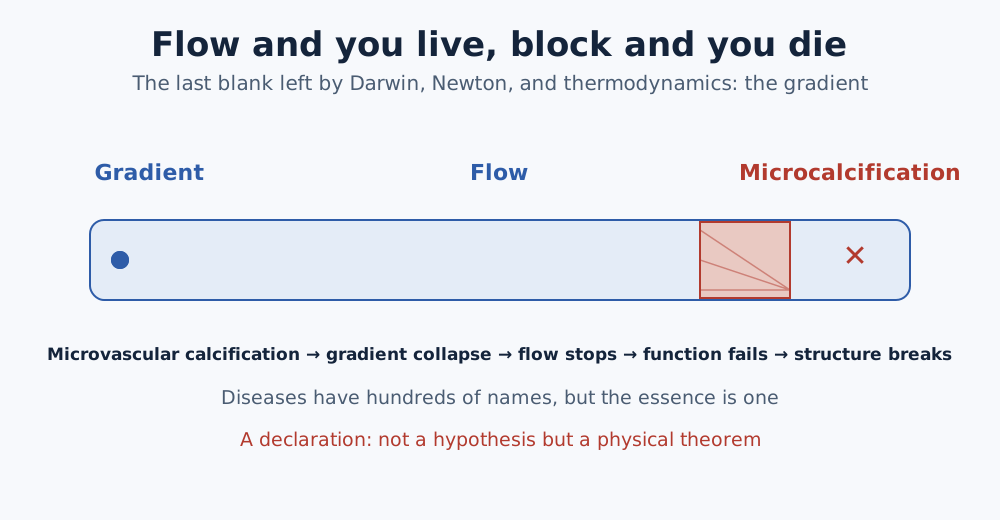
There were great giants of science who rewrote the history of humanity. Newton, with the laws of force and motion, built the physical framework by which the universe and objects move. Thermodynamics proved the absolute directionality of nature: that every system collapses toward disorder the moment its flow stops. And Darwin revealed the providence of evolution, how living things desperately adapt and change to survive in a harsh environment.
These vast laws of the universe and of life achieved the dazzling accomplishments of science, but before the very process by which humans fall ill and grow old, they long remained a great blank. Disease was finely divided into roughly 17,000 to 55,000 diagnostic classifications under the ICD-11 standard and handled separately within one person's body, molecular-level gene mutations were placed in the seat of every answer, and on top of that, a single picture converging on the underlying reality of aging and chronic disease was, in the end, never filled in.
The root cause of aging and chronic disease is microcalcification.
This book calls out the single key that fills that blank. It is gradient. And the physical identity of the decisive place where that gradient collapses within the human body is microcalcification. These two propositions are the spine of this book. Atherosclerosis, diabetic complications, chronic renal failure, Alzheimer's, osteoporosis, and aging-associated adult solid cancers, which specialty medicine has handled separately, all converge in their progressive-phase underlying reality to one place. It is the deposition of microcalcification occurring on the microvascular wall, and the simultaneous blockade of supply and discharge that this deposition creates. The names are merely divided into more than 200 kinds; in the underlying reality, that event is one.
This declaration certainly sounds shocking. It is because it is a different picture from the specialty system that medicine has built over 100 years. And so this book is the work of unraveling, step by step, how that declaration holds, following verified academic materials, the everyday life of one person, and the physical structure of the human body. The reason for placing the conclusion first is simple. The clearer the place we are to arrive at, the clearer the meaning of the road leading there also becomes.
The One Law That Moves the Universe, Gradient
Here is one universal law of nature. From the expansion of the universe to the smallest cell of the human body, every system that operates exists only on top of a difference of pressure and concentration and height, that is, a gradient. Only when this gradient is maintained does water flow and life circulate. And when this gradient stops or reverses, the flow at that place is cut off. At the place where the flow is cut off, collapse begins.
A river flows from a high place to a low place, heat moves from a hot place to a cold place, and oxygen moves from a place of high concentration to a place of low concentration. That river water blocked and rotting, that heat piling up in one place and exploding, and that a star of the universe collapses at its end are the surfacing, at different places only, of one and the same law. Every collapse in the world begins on top of a gradient. The flow within the human body is also on top of the same law. When the gradient of oxygen collapses in the microvasculature, the cells at that place lose their flow, and at the place that has lost flow, the underlying reality of aging and chronic disease begins. The view that places the aging and chronic disease of the human body in one seat of the universal law, this is the reason this book bears the name physical medicine.
How Far Does the Answer of Molecular Mutation Reach
There is one standard solution in medicine. It is the answer that a mutation arose in a gene, that mutation accumulated and the cell's control function collapsed, and smoking, radiation, carcinogens, chronic inflammation, and aging are the risk factors that caused that mutation. This answer is accurate. It is the standard formulation that specialty medicine has piled up over a century, and this book does not deny that standard.
But there is a person who, hearing this formulation, goes one step further. Why does that mutation arise? The explanation returns again that reactive oxygen oxidizes DNA, ultraviolet light twists the structure of DNA, radiation breaks the strands of DNA, and replication errors occur during the process of cell division. And going one step further, the solution follows that chronic inflammation and chronic hypoxia lower the DNA-repair capacity, making damage accumulate more easily. And here one question begins to grow. Then why does that chronic hypoxia begin?
To the Cell, Oxygen Is the Power Supply
A person dies if they cannot breathe for just 3 minutes. The brain suffers irreversible damage 4 minutes after the oxygen is cut off. The heart becomes hard to restart 6 minutes after it stops beating. At the place where oxygen is cut off, life collapses that quickly.
It is exactly the same at the cellular level. A cell can maintain normal energy metabolism only when there is oxygen, and when oxygen becomes deficient, energy production collapses, and on top of that collapse the DNA-repair function drops, the reactive-oxygen balance breaks, chronic inflammation becomes fixed, and in the end DNA damage accumulates. Just as the power supply is to a computer, oxygen is the power supply to a cell. If DNA is the design code, oxygen is the power supply for that design to be executed.
Why Does That Hypoxia Begin
Let us once follow the road by which oxygen enters the human body and reaches the cell. The nose and airway are the first entrance. Next, gas exchange occurs in the alveoli of the lungs. Oxygen is carried loaded onto the red blood cells in the blood. It branches from the large arteries into the small arteries, and again into the still smaller microvessels. Finally it crosses the wall of the microvessel and reaches the cell. Carbon dioxide and waste products leave by following the same road in reverse. If even one section narrows, the flow collapses.
And the place that imaging tests can catch reaches only to the large vessels. The resolution of standard imaging is around 0.5 millimeters, and the microvessels beyond that are below the limit of imaging. Each person receives a different diagnostic name, but in the end the event is occurring at the same place. It is the microvasculature. If you add up all the smallest capillaries within the human body and the arterioles and venules that connect them, their length reaches about one hundred thousand kilometers. It is a length corresponding to two and a half times the circumference of the Earth. Wherever in this vast web the flow narrows, the cells at that place fall into chronic hypoxia. If that place happens to be the heart, it surfaces as atherosclerosis; if it happens to be the brain, as Alzheimer's; if it happens to be the kidney, as chronic renal failure; if it happens to be the pancreas, as diabetic complications; if it happens to be the bone, as osteoporosis. The name is merely different for each organ; the event of the underlying reality is one.
What Happens in the Microvasculature
In the microvasculature, not one but two events occur at the same time. When the pathway narrows, the road by which oxygen and nutrients enter is blocked, and at the same time the road by which carbon dioxide and waste products leave is also blocked. The event in which what should enter cannot enter, and what should leave cannot leave, occurs all at once at the same place. In this book we call this event dual blockade. If only one road were blocked, the human body could recover by compensation, but when the two roads are blocked simultaneously, recovery mode ends and it switches to survival mode. And that switch is irreversible.
What is the physical identity of this blockade? It is microcalcification. When the mineral most familiar to us, calcium, known to make bone hard, leaves the bone on top of the human body's emergency signal and settles on the microvascular wall, the mineral crystal it creates is microcalcification. The event in which that microcalcification simultaneously blockades the two dimensions of the microvasculature's pathway and signal is microcalcification dual blockade. This is the most central underlying-reality event in this book, and the molecular formalization of the proposition that the progressive-phase underlying reality of aging and chronic disease converges to one place.
The Adaptation Darwin Saw, and Cancer
At this place Darwin appears again. In a suffocating hypoxic environment where oxygen is cut off and waste products pile up, the cell begins to change itself simply to survive. It turns on an adaptation program that normal cells do not use, changes glucose metabolism, summons new vessels, evades immune surveillance, and even acquires the ability to move across the boundary of neighboring cells. The cell that survives at the end of this desperate adaptation is the being we call a cancer cell. The place where the providence of nature that Darwin called adaptation and mutation in a harsh environment occurs most violently within one person's body is precisely here.
In the end, aging and chronic disease were not a sudden breakdown of genes. They were the tearful event of survival that cells wage in order to survive on top of the physical environment of a collapsed gradient. The moment one realizes this clear physical underlying reality, the way medicine views this event becomes new by one stage.
Turning the Gaze to Physical Medicine
The flow up to here demands one decisive shift of view. The place DNA mutation has occupied in specialty medicine is very important, but above that mutation is chronic hypoxia, above chronic hypoxia is the collapse of microvascular flow, and in the physical underlying reality of that collapse is microcalcification dual blockade. If so, the place medicine's gaze must turn to is not only the lowest molecular event but also the physical dimension of flow and pathway and structure above it.
This book calls this shift of view physical medicine. It is a view that lays one more layer on top of drug-centered chemical medicine and molecular-level molecular medicine. It is the road of setting up the lost gradient again, physically restoring the blocked flow, and restoring the collapsed ecosystem of the human body itself. This view does not deny molecular medicine. Rather, it is the work of filling in, on top of it, the seat of the underlying reality that specialty medicine did not see. If DNA is the design code and oxygen is the power supply, the microvasculature is the pathway through which that power flows, and microcalcification is the physical event that blockades that pathway. Design, power supply, pathway, blockade. Only when these four places gather in one seat does the underlying reality of the human body's aging and chronic disease become clear.
The Road This Book Unfolds
The conclusion has already been declared. The root cause of aging and chronic disease is microcalcification. And that microcalcification is created when the four signals of deficiency, inflammation, acidosis, and hypoxia are chronically pulled, and the human body, with the same emergency prescription, releases calcium from bone. Binding the English initials of these four signals, we call it DIAH. We formalize, in the middle part of the book, that this DIAH trigger is both the signal that starts aging and chronic disease and the final gateway of all death, that is, the DIAH four gateways.
The calcium released from DIAH settles on the microvascular wall and creates microcalcification dual blockade, and that dual blockade splits into seven clinical patterns, that is, the forms of blocking and bursting, dulling, being covered and blocked, hardening, overflowing and bursting, severing, and collapsing, surfacing as the more than 200 diagnostic names of specialty medicine. We call these seven clinical patterns the 7M, and the five-stage integrated pathway from their start to their end DTDMC. Determinants, Trigger, Dual blockade, Manifestation, Collapse. How these five stages progress on the time axis of one person's aging and chronic disease is described in the latter part of the book.
At the end of all these roads, one fact will become clear. The fact that atherosclerosis, diabetic complications, Alzheimer's, osteoporosis, and aging-associated adult solid cancers, which specialty medicine has diagnosed separately, are in the underlying reality the surfacing, at different places only, of one and the same event. And the fact that the identity of that one event is microcalcification, and the road by which that microcalcification is created and accumulated is the pathway leading from the DIAH trigger to DTDMC.
This book is a journey of fitting in the last piece that runs through the aging and chronic disease of the human body, that is, gradient and microcalcification, on top of the great framework of science that the giants built. It is an attempt to fill in the blank that had never been filled among the more than 200 disease names, and to organize the most fundamental road of the physical recovery of the human body into a single thread. Now it is time to turn the gaze to physical medicine.