
The main body of this book, from beginning to end, is gradient. Chapter 9 is no exception. This chapter is not a chapter to explain hypertension or diabetes. This chapter is a chapter that confirms how the grammar of gradient established earlier (the five stages in which determinants accumulate, the trigger is pulled, dual blockade forms, manifestation follows, and it concludes in collapse) is concretely realized in the domain of the human body. We look at five diseases in turn later on, but each disease is only an empirical case of this grammar, not the protagonist of this chapter. The protagonist is gradient, and disease is the face that gradient reveals differently from organ to organ.
In Chapter 6, we confirmed that three basic gradients (pressure, concentration, voltage) drive flow in the human body, and that among them the roughly ten-thousand-fold calcium concentration gradient across the inside and outside of the cell is the medium that executes nearly every major function of life. Chapter 9 shows how these three gradients wear down over a long time scale, and why that wearing-down is the physical body of the phenomenon modern medicine calls "chronic disease." A gradient does not collapse in a day. A gradient dilutes gradually over years and decades, and the moment that dilution crosses a certain threshold, it appears clinically like a "sudden" event.
The reason we selected five diseases in this chapter is partly because these five account for most of humanity's health burden, but also because the fact that all five follow the same grammar in different organs is visible at a glance. What collapses in hypertension is the pressure gradient; what collapses in diabetes is the signal-transduction gradient; what collapses in Alzheimer's is the perfusion gradient of the brain's microvasculature; what collapses in degenerative arthritis is the blood-flow gradient of the subchondral bone; and what collapses in chronic kidney disease is the filtration gradient of the glomerulus. The organs differ, the media differ, and the clinical courses differ. But all five pathways proceed in accordance with the same five stages.
The question I want to leave at the end of this chapter is this: "What gradient in my body is now gradually diluting?" The moment one comes to hold this question, the reader is no longer a passive recipient of a disease name. Nor a consumer of drugs that manage symptoms. One becomes a person who reads one's own body in the grammar of gradient. This shift is the sole goal of this chapter.
Let me first write down, before we begin, the single sentence that runs through this entire chapter: "The cell is not the cause but the response." That cells behave abnormally in the body of a chronic-disease patient is not because the cell itself has broken down, but because it is a rational adaptation to the microenvironment in which the cell is placed (an environment in which both directions, supply and outflow, have worsened). If one accepts this single sentence, the landscape of chronic-disease medicine changes. In place of drugs that attack the broken cell, interventions that correct the reason the cell is behaving that way (that is, the long-term decline of the gradient) come to take the true seat of treatment.
Let me add one three-second analogy. Imagine our body as a vast building connected by tens of millions of rooms. Each room has one intake vent through which fresh air enters and one exhaust vent through which stale air leaves. To be healthy means that the intake and exhaust of every room move together, and chronic disease is a state in which the intake and exhaust of a particular floor have narrowed simultaneously. If only the intake narrows, the person in the room is short of breath but can hold on; if only the exhaust narrows, it is stifling but one can hold on. If both narrow at the same time, that room gives up on recovery and chooses only survival. This is precisely the most intuitive picture of the state this book calls dual blockade and the collapse of flow.
A Disease That Does Not Heal Even After Ten Years of Medication: The Deadlock of Chronic-Disease Medicine
You have been taking blood pressure medication for ten years, but your blood pressure is unchanged. Stop the medication and it rises immediately. You have been taking diabetes medication for five years, but your HbA1c climbs slowly, and the doctor increases the dose or adds a drug. Your joints hurt and you go to the hospital, and along with a diagnosis that the cartilage has worn down, you receive a prescription for anti-inflammatory painkillers. Your memory is worsening, but you are told there is no specific treatment until a dementia diagnosis comes. Your kidney values are getting worse little by little, but since dialysis is not yet needed, you are told to wait and watch. These five scenes are the answers that today's chronic-disease medicine most often returns to patients.
These answers have a common structure. Symptoms can be managed, but the cause is not explained. Even while the symptoms are being managed, something continues to progress somewhere in the body. The direction of progression is consistently the same side, that is, the worsening side. According to the World Health Organization's (WHO) 2024 global health estimates, about 74% of deaths worldwide occur from non-communicable chronic diseases such as cardiovascular disease, cancer, chronic respiratory disease, and diabetes. The U.S. Centers for Disease Control and Prevention (CDC) reports that about 60% of American adults have at least one chronic disease, and about 40% have two or more at the same time. Between the two realities of managed symptoms and progressing disease, most modern people are placed.
This book names the cause of this deadlock simply. It is because when modern medicine searches for the "cause," it mostly looks inside the organ. If it is heart disease, it looks at the heart; if kidney disease, at the kidney; if brain disease, at the brain. This approach is excellent for acute trauma or infection, but in chronic disease it gets stuck every time at the same point. This is because the true cause of chronic disease is not inside the organ in question. The true cause lies in the process by which the gradient that turns that organ has worn down over years and decades. The organ is merely the stage of the result, not the domicile of the cause.
Put the same thing differently and it is this. Chronic disease is not a "problem of deficiency" but a "problem of delivery." Existing medicine approaches it in the language of "supplementing what is lacking." If blood pressure is high, a drug to lower blood pressure; if blood sugar is high, a drug to lower blood sugar; if cholesterol is high, a statin is prescribed. This approach corrects the numbers but does not correct the delivery pathway itself. From the perspective this book proposes, the cause of chronic disease is not the numbers but the pathway. It is as the accumulated result of a state in which the pathway narrows, the pathway becomes blocked, and the medium fails to be properly delivered at both ends of the pathway that abnormalities in the numbers surface. The numbers are the symptom, and the gradient decline of the pathway is the disease.
This chapter unfolds this perspective concretely in five diseases. But before entering the five stories, there are three foundations that must first be laid. First, why the twelve hallmarks that recent aging research has organized must be reinterpreted not as cause but as result. Second, why the four DIAH factors that form the basis of this book (deficiency, inflammation, acidosis, hypoxia) operate in only one direction. Third, how the dual blockade these factors create surfaces as seven damage patterns through the medium of calcium. Having laid these three foundations first, we then reread the five diseases in the language of gradient on top of them.
The Twelve Hallmarks of Aging Are Not the Cause
The paper by López-Otín's team published in the journal Cell in 2013 (López-Otín et al., 2013) was a summary that became a landmark in the field of aging research. It bundled the hundreds of aging-related studies that until then had been reported in fragments into nine common features and gave them the name "Hallmarks of Aging." In 2023, the same authors expanded this list to twelve (López-Otín et al., 2023, Cell 186:243-278). The twelve are as follows: genomic instability, telomere attrition, epigenetic alterations, loss of proteostasis, disabled macroautophagy, deregulated nutrient sensing, mitochondrial dysfunction, cellular senescence, stem cell exhaustion, altered intercellular communication, chronic inflammation, and dysbiosis.
This list is regarded as the most refined summary of aging research. But from the perspective of this book, this list has one structural gap. It is the fact that none of these twelve is the "cause" of aging. All twelve are phenomena observed at the cellular level, and there is still no consensus on what the reason is that these phenomena worsen simultaneously. López-Otín's team itself, while acknowledging that these twelve mutually influence one another, reserves judgment on which of them is upstream and which is downstream.
From the perspective this book proposes, the upstream cause of the twelve hallmarks is gradient collapse. Genomic instability is observed in a state where the supply of energy and substrate that the cell needs for damage repair has slowed; telomere attrition is accelerated when the metabolic conditions of cell division worsen; and loss of proteostasis surfaces when the bidirectional flow of protein synthesis and disposal worsens at the same time. Mitochondrial dysfunction is the result of a microenvironment in which the supply of oxygen and substrate has decreased nonlinearly in accordance with the r⁴ law, and cellular senescence and chronic inflammation are accelerated when the cleanup function weakens and waste products linger. Altered intercellular communication is observed when the delivery efficiency of signaling media such as hormones and cytokines drops at the microvascular level.
In other words, most of the twelve hallmarks can be reinterpreted as downstream results of the accumulated state in which supply and outflow slow simultaneously in the microenvironment around the cell (the state this book calls "dual blockade and the collapse of flow"). If this reinterpretation is correct, aging is not the simple sum of the twelve, but the surface appearance of a single common upstream source (the long-term decline of gradient) that produces the twelve simultaneously. In the remaining part of this chapter, we will look at that upstream source divided into two stages: the four DIAH factors and dual blockade.
There is one point to note. This reinterpretation does not negate the work of López-Otín's team. Rather, it presents a higher principle that explains why the twelve phenomena they organized move together in the same direction within the same time frame. The twelve remain valid indicators of aging, and the thread that strings those indicators into one is the grammar of gradient this book proposes. To understand aging is not to memorize twelve symptoms, but to see the single process moving together behind them.
The DIAH Square: Deficiency, Inflammation, Acidosis, Hypoxia
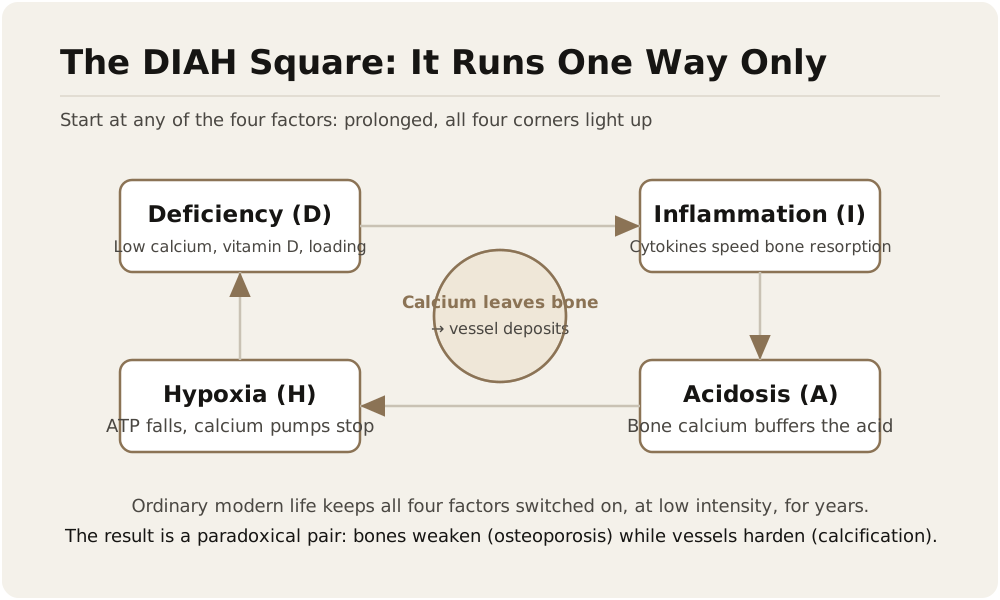
In Chapter 6, we confirmed that microvascular calcification is the physically fixed form of gradient collapse, and we examined the fact that this calcification proceeds via an endogenous pathway in which calcium moves from bone to vessel and an exogenous pathway in which external calcium and phosphorus are deposited. We mentioned in passing that the endogenous pathway has four triggers, and those four are precisely the DIAH that this book points to as the upstream factors of gradient collapse in the domain of the human body. Deficiency, Inflammation, Acidosis, Hypoxia. Although these four appear on the surface to be different causes from one another, the core of this framework is that they all operate in only one direction.
By one direction, this is what is meant. The four factors each, by their own pathway, lower the blood calcium concentration or make it unstable, and within seconds the body secretes parathyroid hormone (PTH) to mobilize calcium from bone and restore the blood concentration. According to the endocrine physiology organized in the clinical reference resource of the U.S. National Library of Medicine (StatPearls, Physiology, Parathyroid Hormone, NBK499940), even a very small decrease in blood calcium is enough for PTH to be secreted almost immediately, stimulating osteoclasts and moving calcium from bone into the blood. This response itself is, in the short term, a safety device that protects life. Because the heartbeat and nerve conduction are extremely sensitive to a narrow range of blood calcium, without this safety device we would collapse from arrhythmia at even a slightly longer gap between meals.
The problem is when this safety device is repeated over the long term. The calcium drawn from bone must pass through the blood and return to bone again, but when the repeated mobilization becomes prolonged, the amount drawn out gradually exceeds the amount returning, and that excess is deposited somewhere other than its original place (mainly the microvascular wall and soft tissue). It is precisely for this reason that the paradoxical simultaneous progression is observed in which bone weakens (osteoporosis) and vessels harden (calcification). The World Health Organization's (WHO) 2021 report notes that about one-third of women and about one-fifth of men over the age of 50 worldwide are at risk of osteoporotic fracture, while at the same time reporting that the prevalence of vascular calcification in the same age group is increasing rapidly. That the two phenomena progress simultaneously in the same population is because they share a common physical root.
Let us look at deficiency first. Deficiency is on the surface the simplest factor. If calcium is lacking, it is drawn out and used; if vitamin D is lacking, calcium absorption decreases so it is drawn out and used again; and even if bone-building materials such as magnesium, vitamin K, and protein are lacking, the burden on the storehouse grows. But deficiency is not only about diet. Deficiency of physical stimulus in which gravity and body weight load are not placed on bone, deficiency of life inputs such as sleep, sunlight, and water, deficiency caused by drugs such as steroids, proton pump inhibitors, and diuretics, and hormonal deficiency of estrogen, testosterone, and growth hormone all operate in the same direction. In particular, astronaut research (Lang et al., 2004, J Bone Miner Res) showed that a prolonged microgravity environment significantly decreases bone density on a monthly basis. Sedentary living and long-term hospitalization on the ground are likewise the same in direction, only weaker in the intensity of the load reduction.
Inflammation is the pathway by which the immune system consumes large amounts of calcium while maintaining a defensive response, and as a result blood calcium becomes deficient and is again drawn from bone. According to what studies organized in an immunology journal (Azuma et al., 2018, Immune Network) and a clinical investigation journal (Teitelbaum, 2000, Science) have established, inflammatory cytokines such as TNF-α, IL-1, IL-6, and IL-17 directly accelerate bone resorption by promoting the differentiation of osteoclasts through a signaling molecule called RANKL. Chronic infection, autoimmune disease, stress-induced inflammation, metabolic inflammation, environmentally derived inflammation, and the so-called inflammaging that arises from aging itself all converge on this pathway. The Italian aging researcher Franceschi, in a 2014 paper (Franceschi & Campisi, 2014, J Gerontol A), quantitatively showed that this low-grade chronic inflammation is an independent risk factor for morbidity and mortality in the elderly.
Acidosis is the pathway by which the alkaline calcium within bone is mobilized to neutralize acidic waste products in the body. As a nephrology journal (Bushinsky, 2004, Kidney Int) and a recent review (Alexy & Remer, 2022, Curr Opin Nephrol Hypertens) summarize, chronic acid load accelerates, in the short term, the physicochemical release of calcium from bone and, in the long term, cell-mediated bone resorption. The actual conditions corresponding to this range widely, from a high-protein, low-vegetable diet, dietary habits centered on ultra-processed foods, and heavy drinking, to reduced excretory capacity due to chronic kidney disease, respiratory acidosis in which carbon dioxide stagnates due to reduced lung function, and metabolic hyperactivity acidosis due to hyperthyroidism. On the surface it is felt only as everyday symptoms such as excess stomach acid, heartburn, and chronic fatigue, but on the inside the calcium of bone is being cut away little by little to catch the acid.
Hypoxia is the most primal trigger of the four factors. When tissue does not receive enough oxygen, ATP production decreases, and when ATP decreases, the calcium pump of the cell membrane stops working, and when the pump stops, the high calcium concentration outside the cell leaks into the cell without control. A study published in a cardiovascular pharmacology journal in 1992 (Silver & Erecińska, 1992) quantitatively measured that in neurons exposed to hypoxia for two hours, ATP decreased by 43% while intracellular calcium concentration rose irreversibly, and a 2018 review in the journal Aging and Disease (Wu et al., 2018, Aging Dis) organized the pathway by which this calcium overload leads to mitochondrial dysfunction and cell death as the common mechanism of ischemia-reperfusion injury. When hypoxia is repeated, the calcium homeostasis at the cellular level is shaken, and that instability raises the demand for blood calcium, repeatedly activating the entire DIAH pathway.
These four factors are not independent. Deficiency weakens immunity and leads to infection and inflammation; inflammation piles up metabolic products and summons acidosis; acidosis stiffens the microvasculature and worsens hypoxia; and hypoxia in turn induces tissue damage and inflammation, increasing the burden of repair in a deficient state. The four factors are connected into a single square and feed back on one another. This is the reason this book calls these four factors the DIAH square. It is because, regardless of which vertex it begins at, once prolonged, it is a convergent structure in which all four vertices become activated.
There is one more important observation. The four DIAH factors overlap exactly with the everyday living conditions of modern people. A diet centered on processed foods creates deficiency and acidosis simultaneously, chronic stress and lack of sleep induce inflammation and hypoxia simultaneously, and sedentary living and lack of exercise are joint amplifiers of all four factors. Smoking raises inflammation and hypoxia together, and heavy drinking raises deficiency and acidosis together. In other words, the "ordinary life" of modern people is a structural condition that keeps the four factors turned on at low intensity for a long time simultaneously, and this low-intensity, long-term activation gradually wears down the gradient of the microvasculature over decades. This is the reason chronic disease appears "as a matter of course" not from a particular bad habit but from modern life itself.
The author's framework distinguishes the DIAH factors into primary, secondary, and tertiary according to their intensity of operation and time scale. Primary factors are fundamental, slowly acting background conditions. Aging itself, the lifetime changes of hormones, genetic predisposition, and basic body type and metabolic rate belong here. Primary factors are difficult for an individual to change in the short term, but they create the fewest waves in that pace. Secondary factors are conditions that accumulate through habitual repetition. Diet, amount of exercise, sleep pattern, stress management, drinking, and smoking fall in here. What most greatly governs the actual pace of progression of chronic disease is these secondary factors, and the accumulation of everyday choices determines the direction of the gradient over years. Tertiary factors are triggers that operate acutely. Infection, trauma, drug side effects, and extreme psychological shock belong here, and these drop the system one level lower with a single event, and if the subsequent recovery is not complete, they create a new baseline. When reading the progression of a person's chronic disease, the practical value of this classification is that the primary and tertiary differ from patient to patient, but the secondary is, for the most part, a domain that can be touched.
We decided to lay three foundations, and so far we have laid two. That the twelve hallmarks of aging are not cause but result, and that the four DIAH factors draw the calcium of bone out in one direction and deposit it in the vessels. The one remaining is how the turning point these four factors create, that is, dual blockade, forms, and why it surfaces as seven damage patterns. In the following part 2, we will look at the two faces of dual blockade and the 7M, and with that grammar we will reread the first disease, hypertension.
This article is part (1/3) of the three-part series covering Chapter 9 of The Universal Law: Gradient. The references are consolidated in part (3/3). The body text follows the original manuscript and is provided for informational purposes.