
In the previous part 1 we examined the foundations (the twelve hallmarks of aging, the DIAH square), and in part 2 the mechanism (dual blockade, the 7M) and the first disease (hypertension). Now we read the remaining four diseases in turn. The signal-transduction gradient of diabetes, the brain microvascular perfusion gradient of Alzheimer's, the subchondral bone blood-flow gradient of degenerative arthritis, and the glomerular filtration gradient of chronic kidney disease. The organs and media differ, but the grammar is one.
Diabetes: The Process by Which the Signal-Transduction Gradient Becomes Blocked
A rise in blood sugar is often cited as the representative symptom of diabetes, but what actually determines a patient's life and lifespan is not blood sugar itself. The true danger of diabetes lies in its long-term complications (retinopathy, nephropathy, peripheral neuropathy, cardiovascular disease, foot ulcers and amputation), and these complications are all, without exception, microvascular diseases. The clinical reference resource of the U.S. National Library of Medicine (StatPearls, Diabetic Nephropathy, NBK534200) establishes that diabetic nephropathy is the largest cause of end-stage renal failure in developed countries, and a review from Vanderbilt University Medical Center in the U.S. (Fowler, 2008, Clinical Diabetes 26:77-82) specified that the microvascular triad of retinopathy, nephropathy, and neuropathy is the complication structure characteristic of diabetes.
Read in the language of this book, diabetes is formalized as follows. The rise in blood sugar is not the cause but the result. The true cause is a state in which the signal-transduction gradient at the cellular level is chronically blocked. Insulin is secreted from the pancreatic beta cells, travels through the blood to reach peripheral tissue, and then binds to the insulin receptor of the cell membrane, calling the glucose transporter (GLUT4) to the inside of the cell. If the flow weakens at any point of this signal chain, the same amount of insulin fails to produce the same effect, and the body compensates by secreting more insulin. When this compensation reaches its limit, blood sugar begins to rise, and that rise is captured as a number and clinically earns the name "diabetes."
The physical cause by which this signal transduction weakens is precisely the CAM axis of dual blockade. The receptors of the cell membrane are covered, the calcium-dependent steps of the internal signal chain are damaged, and the microvasculature of the peripheral muscle and liver tissue that insulin must reach narrows simultaneously. As the 2023 meta-analysis published in Frontiers in Endocrinology (Xu et al., 2023, Front Endocrinol) showed, HOMA-IR, an indicator of insulin resistance, significantly correlates with the prevalence and progression speed of coronary artery calcification. That is, signal blockade (CAM) and channel blockade (DLT) are progressing simultaneously in the same person's body, and clinically this appears as the high co-occurrence rate of diabetes and cardiovascular disease.
Reorganized through the five stages, it is as follows. Stage 1, the accumulation of determinants, is the low-intensity long-term activation of the DIAH square such as a high-calorie, high-sugar diet, visceral obesity, lack of exercise, chronic inflammation, and lack of sleep. Stage 2, the trigger, is the appearance of the early signals of insulin resistance (a borderline rise in fasting blood sugar, instability of postprandial blood sugar, a gradual increase in HbA1c). Stage 3, dual blockade and the collapse of flow, is a state in which the decline of cellular signal function (CAM) and the calcification and hardening of the peripheral microvasculature (DLT) form simultaneously, and at this stage blood sugar control is not maintained without drugs. Stage 4, manifestation, is the surfacing of microvascular complications. Stage 5, collapse, is the accumulation of organ damage leading to end-stage renal failure, blindness, amputation, and cardiovascular death.
This framework also explains the long-standing clinical observation of why strict blood sugar control alone does not dramatically improve the long-term prognosis of diabetes. Large-scale clinical trials such as the ACCORD study and the ADVANCE study published in the New England Journal of Medicine in 2008 showed that intensified blood sugar control slows some microvascular complications but showed no clear benefit in macrovascular mortality. In the language of gradient, this result is only natural. It is because lowering the numbers is lowering the result, not correcting the cause. The true cause is the long-term blockade of the signal-transduction gradient that has progressed over decades, and this is not resolved by controlling the single variable of blood sugar. Only when diet, exercise, sleep, weight, and inflammation management move simultaneously does the direction of the gradient change.
The order in which diabetes complications appear can also be reread from this perspective. In most patients, what surfaces first is microvascular change in the retina, next albumin leakage in the renal glomeruli, next sensory decline in the peripheral nerves, and last atherosclerotic events in the large vessels. This order is almost inversely proportional to the microvascular density of the organ in question. That is, gradient decline surfaces clinically first from the tissues most densely packed with microvasculature in the body (the retina, the renal glomeruli, the vascular endothelium of the peripheral nerves), and tissues that depend on relatively larger vessels surface late. This order testifies that diabetes is essentially not a "disease of blood sugar" but a "disease of the microvascular gradient." Blood sugar is merely the most easily measured single indicator of this systemic gradient decline.
Alzheimer's: A Disease in Which the Brain's Microvasculature Collapses First
Alzheimer's is one of the diseases that has received the most research funding and produced the least result over the past 30 years. The amyloid hypothesis, dominant since the early 1990s, pointed to the amyloid beta protein accumulating in the brain as the cause, numerous anti-amyloid therapeutics were developed, and the vast majority of these failed in clinical trials, showing no meaningful cognitive improvement, and were dropped. Even some recently approved anti-amyloid antibodies succeeded in reducing amyloid in the brain but did not fundamentally change the rate of cognitive decline. The question this repeated failure has posed to the medical community is clear. If amyloid is not the cause, what is the cause?
The most compelling alternative to this question is the vascular hypothesis. This hypothesis, organized by the Zlokovic team of the University of Southern California in the journal Trends in Neurosciences in 2005 and in Nature Reviews Neuroscience in 2011, argues that the primary lesion of Alzheimer's is the functional abnormality and reduced blood flow of the brain's microvasculature, and that amyloid accumulation and tau protein aggregation are the result of this vascular abnormality, not the cause (Zlokovic, 2011, Nat Rev Neurosci 12:723-738). A 2023 review by Tarawneh of the University of New Mexico (Tarawneh, 2023, Biomolecules 13(5):830) went a step further and explicitly raised the possibility that Alzheimer's is essentially an endotheliopathy. Recent imaging studies are showing that loss of the brain's capillaries and decline in endothelial function are observed several years before cognitive decline. Amyloid appears more than ten years before symptoms, but the vascular abnormality appears even earlier than amyloid.
This hypothesis brings Alzheimer's naturally into the grammar of this book. Alzheimer's is the story of dual blockade occurring in the special organ that is the brain. The brain has a unique microvascular structure called the blood-brain barrier, and through this barrier not only the supply of oxygen and glucose but also the discharge of metabolic waste including amyloid is carried out. When the function of the microvasculature weakens, it is not only supply (glucose, oxygen) that decreases but discharge (amyloid clearance) that decreases at the same time. The conclusion of recent isotope-labeling studies, that amyloid accumulates not because production has increased but because clearance is not working, corresponds exactly to this picture.
The epidemiological observation that midlife hypertension raises the risk of Alzheimer's in old age is also naturally interpreted within this framework. Long-term follow-up studies such as the Honolulu-Asia Aging Study showed that midlife hypertension significantly raises the risk of developing Alzheimer's 25 years later. In the language of gradient, the reason is simple. Midlife hypertension applies repeated impact to the brain's microvasculature, and the accumulation of this impact wears down the function and structure of the microvasculature more quickly decades later. That the pressure gradient damage of the large vessels ultimately converges into the dual blockade of the brain's microvasculature is what appears as dementia in old age.
Organized through the five stages. Stage 1, the accumulation of determinants, is the result of general cardiovascular risk factors such as midlife hypertension, diabetes, dyslipidemia, smoking, and chronic inflammation operating identically on the brain's microvasculature as well. Stage 2, the trigger, is a decrease in cerebral blood flow and initial leakage of the blood-brain barrier, and at this stage the efficiency of amyloid clearance begins to drop. Stage 3, dual blockade and the collapse of flow, is a state in which the decrease of glucose supply and the decrease of metabolic waste discharge form simultaneously. Stage 4, manifestation, is the appearance of amyloid and tau accumulation and early cognitive decline. Stage 5, collapse, is brain atrophy and severe dementia. If this reconstruction is correct, the most effective point of intervention for Alzheimer's is not amyloid treatment but the maintenance of microvascular health in midlife, and this is the paradox that the clinical failures of the past 30 years have taught us most greatly.
There is one more important conceptual shift. Over the past 20 years there was a debate between the "hypothesis that amyloid accumulation is due to increased production" and the "hypothesis that it is due to failure of clearance," and the current consensus accumulated by isotope-labeling studies leans far more toward the latter. That is, the brain of an Alzheimer's patient is not making more amyloid; it is failing to properly clear away the amyloid it has made. The main pathways of this clearance are precisely discharge through the blood-brain barrier and the recently spotlighted glymphatic system pathway. Both pathways depend on the function of the microvasculature and the flow of interstitial fluid in the brain parenchyma. In other words, amyloid accumulation is not the cause of gradient collapse but the result, and the fundamental condition that accumulates that result is the long-term decline of the microvascular gradient. This perspective is the practical reason Alzheimer's research is now moving from an amyloid-centered focus to a vessel- and barrier-centered one.
Degenerative Arthritis: When the Blood Flow of the Subchondral Bone Is Cut Off
What an arthritis patient hears most often at the hospital is "the cartilage has worn down." The treatment options run to anti-inflammatory painkillers, injections, and, in the late stage, joint replacement surgery. There is a recent discovery this standard pathway is missing. It is that the first change of arthritis begins not in the cartilage but in the bone right beneath the cartilage, that is, the subchondral bone. Since 2007, studies have accumulated showing that blood-flow abnormalities and bone marrow edema of the subchondral bone are observed on MRI several years earlier than the structural damage of the cartilage, and that those blood-flow abnormalities correlate spatially with the severity of arthritis.
A 2007 study by the Aaron team published in the Annals of the New York Academy of Sciences (Aaron et al., 2007, Ann N Y Acad Sci 1117:124-137) showed the temporal precedence of subchondral bone perfusion using contrast-enhanced MRI in a guinea pig arthritis model, and a subsequent series of clinical MRI studies repeatedly confirmed that vascular changes and bone marrow edema of the subchondral bone marrow spatially overlap with the severity and pain of arthritis in human knee arthritis patients. A 2021 review by the Li team published in Bone Research (Hu et al., 2021, Bone Research 9:20) established that the subchondral bone plays a central role in the initiation and progression of arthritis, and that abnormalities of bone marrow edema, angiogenesis, and nerve distribution precede cartilage destruction. The view that arthritis is not a disease of the cartilage but a disease of the vascular gradient supporting the cartilage has thus accumulated.
The bone beneath the joint has a very dense vascular network, and this vascular network supplies the cartilage with oxygen, nutrients, and metabolic substrate. Because the cartilage itself has almost no blood vessels, the metabolism of the chondrocytes depends entirely on the blood flow of the subchondral bone. When the blood flow of the subchondral bone weakens, the nutritional state of the cartilage worsens first, the repair function of the chondrocytes declines, and the microdamage that piles up from the daily mechanical load accumulates without being repaired. At the same time, the subchondral bone itself undergoes bone marrow edema and microfractures and loses the structural support capacity of the joint. That these two directions (the decline in supply of cartilage nutrition and the decline in support of bone structure) progress simultaneously is the true nature of arthritis dual blockade.
Reconstructed through the five stages, it is as follows. Stage 1, the accumulation of determinants, is the long-term accumulation of factors such as mechanical load due to obesity, weakening of the muscles around the joint due to lack of exercise, repeated microtrauma, post-menopausal hormonal change, and chronic inflammation. Stage 2, the trigger, is the stagnation of subchondral bone vessels and the initial appearance of bone marrow edema. Stage 3, dual blockade and the collapse of flow, is a state in which the supply of cartilage nutrition and the structural support of the subchondral bone are damaged simultaneously. Stage 4, manifestation, is pain, reduced joint range of motion, and cartilage loss and osteophyte formation on radiographs. Stage 5, collapse, is the complete loss of joint function and the need for surgical replacement. This framework explains why artificial cartilage transplantation or cartilage-regeneration drugs have not shown as much effect as expected. It is because they did not restore the vascular gradient that keeps the cartilage alive, rather than the cartilage itself.
Emphasizing once more the special nature of the tissue that is cartilage makes the persuasiveness of this interpretation clearer. Cartilage is one of the few tissues in the human body into which blood vessels do not enter. Chondrocytes take in the oxygen and nutrition that have diffused from the subchondral bone side through the interstitial fluid around them, and they send out waste products by the same pathway. So the fate of the cartilage depends almost entirely on the gradient state of the subchondral bone side. When the perfusion of the subchondral bone decreases, the cartilage must endure the daily mechanical load in a state where it does not receive oxygen and substrate, and as the energy needed for repair becomes deficient, microdamage piles up. Under this condition, it is only natural that a drug or injection acting directly on the cartilage itself has difficulty producing an effect. It is because cartilage is a tissue that comes back to life only when the upstream flow is restored, not a tissue that regenerates by receiving stimulation from downstream.
Chronic Kidney Disease: The Long-Term Consumption of the Filtration Gradient
The kidney filters about 180 liters of plasma a day. Considering that the total plasma of an adult body is about 3 liters, this number means that the kidney processes the entire body's plasma about 60 times within a day. What drives this vast filtration process is the difference between the hydrostatic pressure and the colloid osmotic pressure on the two sides of the glomerulus, that is, the filtration gradient. Chronic kidney disease is the process by which this filtration gradient is slowly consumed over a long term, and clinically it is summarized and recorded by the number called the estimated glomerular filtration rate (eGFR).
The distinctive point of chronic kidney disease is that it begins as a disease of a single organ, the kidney, and results in the accelerated aging of the systemic vascular system. A 2021 review in the journal Circulation (Jankowski et al., 2021, Circulation 143:1157-1172) established that chronic kidney disease patients show markedly higher risk in the morbidity and mortality of cardiovascular disease compared with the general population, and that this risk is not explained by traditional risk factors alone. A 2024 review in Circulation Research (Shroff et al., 2024, Circ Res 134:693-712) showed that the core mechanism of this phenomenon is accelerated vascular calcification, and that the speed and severity of vascular calcification in chronic kidney disease patients far outpace those of same-age patients with normal kidney function. A histology study has been reported that the prevalence of radial artery calcification in dialysis patients reaches 45 times that of the normal group.
This structure has been organized into the clinical concept of "CKD-MBD (chronic kidney disease-mineral and bone disorder)." In summary, when kidney function declines, the excretion of phosphate decreases, and when the blood phosphorus concentration rises, vascular smooth muscle cells convert to an osteogenesis-like phenotype and deposit hydroxyapatite on the vessel wall. At the same time, the activation of vitamin D weakens, calcium absorption in the intestine decreases, and this deficiency stimulates parathyroid hormone secretion to additionally mobilize calcium from bone. The result is the extreme simultaneous progression of osteoporosis and accelerated vascular calcification, and this is also the reason the main cause of death in dialysis patients is not renal failure itself but cardiovascular events.
Organized through the five stages. Stage 1, the accumulation of determinants, is the result of the long-term microvascular damage of upstream chronic diseases such as hypertension and diabetes being concentrated in the kidney, a microvasculature-intensive organ. Stage 2, the trigger, is the appearance of microalbuminuria and a slight decrease in eGFR. Stage 3, dual blockade and the collapse of flow, is a state in which the structural decline of glomerular filtration function and the acceleration of systemic vascular calcification form simultaneously. Stage 4, manifestation, is the appearance of uremic symptoms, anemia, bone disease, and cardiovascular events. Stage 5, collapse, is end-stage renal failure and dialysis dependence, and ultimately cardiovascular death. At every point of these five stages, the one principle this book repeatedly states is confirmed. The kidney is not an independent organ, the disease of the kidney is not a disease of an organ, and the true body of the disease is the long-term decline of the microvascular gradient that has spread throughout the entire human body.
Let me note once more the meaning albuminuria holds in this story. The filtration membrane of the glomerulus is an extremely intricate structure composed of three layers (endothelial cells, basement membrane, and podocytes), and these three layers together regulate filtration according to the size and charge of molecules. A healthy filtration membrane hardly passes at all a negatively charged protein 6.5 nanometers in size, such as albumin. That albumin begins to appear in the urine even in trace amounts means that this intricate structure is already being locally damaged. From this perspective, albuminuria is not a "mild early symptom of kidney disease" but a "warning light that the systemic microvasculature is already undergoing a certain level of gradient decline." In fact, epidemiological results have been repeatedly reported that people with microalbuminuria have a heightened risk of cardiovascular disease before kidney problems, and this supports this book's interpretation that the kidney is a window into the systemic gradient.
Five Scenes, One Grammar
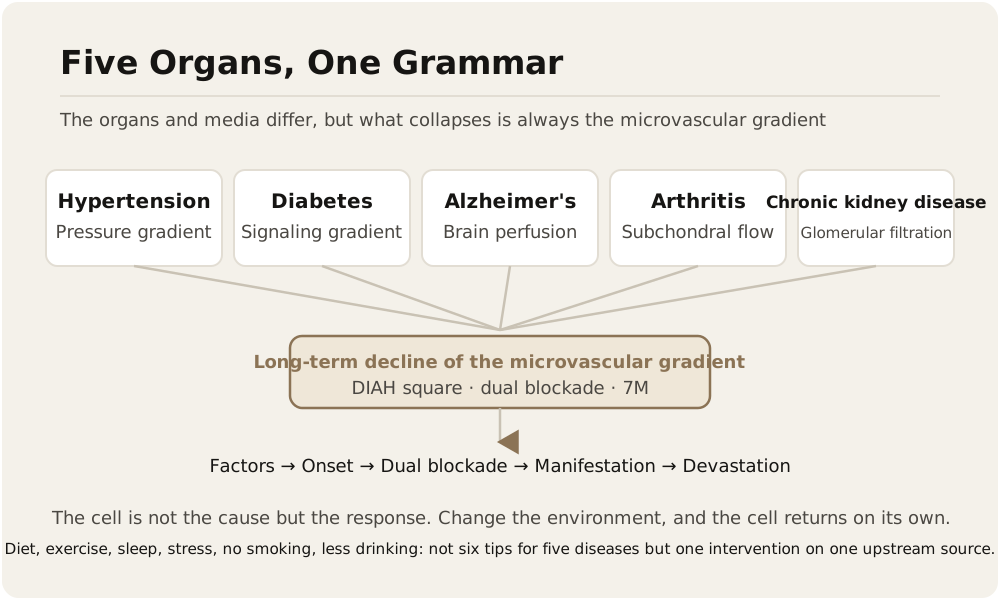
In this chapter we examined diseases of five different organs, but the five stories were in fact one story. Hypertension is the story of the pressure gradient wearing down, diabetes the story of the signal-transduction gradient becoming blocked, Alzheimer's the story of the brain microvascular perfusion gradient collapsing first, degenerative arthritis the story of the subchondral bone blood-flow gradient being cut off, and chronic kidney disease the story of the glomerular filtration gradient being consumed over a long term. The protagonist was, each time, the gradient, and the organ was the stage on which that gradient was revealed.
The one practical conclusion this realignment brings to medicine is this. The true point of intervention for chronic disease lies not inside each organ but in the everyday low-intensity activation of the DIAH square and the long-term decline of the microvascular gradient that this activation creates. This is the reason "obvious" recommendations such as diet, exercise, sleep, stress management, quitting smoking, and moderating alcohol are not obvious. These six are not six different pieces of advice for different diseases, but another name for a single intervention that simultaneously corrects the common upstream source of all five diseases. Seen in the language of gradient, these six are one.
If I may add one more thing, this chapter is also the chapter that most concretely proves this book's single-sentence declaration that "the cell is not the cause but the response." That cells behave abnormally in the body of a chronic-disease patient is not because the cell itself has broken down, but because it is a rational adaptation to the microenvironment in which the cell is placed (an environment in which both directions, supply and outflow, have worsened). The reason drugs that change the cell often fail is that a drug attacking the cell does not correct the reason the cell is doing so in order to survive. Change the environment, and the cell returns on its own. This simple principle is the core of this entire chapter, and in cancer, the extreme case to be addressed in the next chapter, this principle is revealed most dramatically.
The next chapter is device 5 of this book, that is, the chapter deepening an extreme case. Digging all the way down deep into the single phenomenon of cancer, it addresses why the targeted anticancer drugs of the past half-century did not reach the cure that was expected, why the frame that defines cancer as an "enemy" was bound to fail structurally, and what new points of intervention open up when cancer is reread as the result of an environment. The second single-sentence declaration, that cancer is not the rebellion of cells but the result of an environment, is the spine of the next chapter.
참고문헌
- López-Otín, C., Blasco, M. A., Partridge, L., Serrano, M., & Kroemer, G. (2023). Hallmarks of aging: An expanding universe. Cell, 186(2), 243-278. https://doi.org/10.1016/j.cell.2022.11.001
- López-Otín, C., Blasco, M. A., Partridge, L., Serrano, M., & Kroemer, G. (2013). The hallmarks of aging. Cell, 153(6), 1194-1217. https://doi.org/10.1016/j.cell.2013.05.039
- Iqbal, A. M., & Jamal, S. F. (2024). Essential Hypertension. StatPearls. https://www.ncbi.nlm.nih.gov/books/NBK539859/
- Lang, T., LeBlanc, A., Evans, H., Lu, Y., Genant, H., & Yu, A. (2004). Cortical and trabecular bone mineral loss from the spine and hip in long-duration spaceflight. Journal of Bone and Mineral Research, 19(6), 1006-1012.
- Franceschi, C., & Campisi, J. (2014). Chronic inflammation (inflammaging) and its potential contribution to age-associated diseases. The Journals of Gerontology Series A, 69(Suppl 1), S4-S9.
- Bushinsky, D. A. (2004). Acid-base imbalance and the skeleton. Kidney International, 65(5), 1731-1737.
- Silver, I. A., & Erecińska, M. (1992). Ion homeostasis in rat brain in vivo: intra- and extracellular [Ca²⁺] and [H⁺] in the hippocampus during recovery from short-term, transient ischemia. Journal of Cerebral Blood Flow and Metabolism, 12(5), 759-772.
- Demer, L. L., & Tintut, Y. (2008). Vascular calcification: pathobiology of a multifaceted disease. Circulation, 117(22), 2938-2948. https://doi.org/10.1161/CIRCULATIONAHA.107.743161
- Shanahan, C. M., Crouthamel, M. H., Kapustin, A., & Giachelli, C. M. (2011). Arterial calcification in chronic kidney disease: key roles for calcium and phosphate. Circulation Research, 109(6), 697-711. https://doi.org/10.1161/CIRCRESAHA.110.234914
- Zlokovic, B. V. (2011). Neurovascular pathways to neurodegeneration in Alzheimer's disease and other disorders. Nature Reviews Neuroscience, 12(12), 723-738. https://doi.org/10.1038/nrn3114
- Sweeney, M. D., Sagare, A. P., & Zlokovic, B. V. (2018). Blood-brain barrier breakdown in Alzheimer disease and other neurodegenerative disorders. Nature Reviews Neurology, 14(3), 133-150.
- Tarawneh, R. (2023). Microvascular contributions to Alzheimer disease pathogenesis: Is Alzheimer disease primarily an endotheliopathy? Biomolecules, 13(5), 830. https://doi.org/10.3390/biom13050830
- Calvo-Rodriguez, M., & Bacskai, B. J. (2021). Mitochondria and calcium in Alzheimer's disease: from cell signaling to neuronal cell death. Trends in Neurosciences, 44(2), 136-151.
- Hu, Y., Chen, X., Wang, S., Jing, Y., & Su, J. (2021). Subchondral bone microenvironment in osteoarthritis and pain. Bone Research, 9(1), 20. https://doi.org/10.1038/s41413-021-00147-z
- Aaron, R. K., Dyke, J. P., Ciombor, D. M., Ballon, D., Lee, J., Jung, E., & Tung, G. A. (2007). Perfusion abnormalities in subchondral bone associated with marrow edema, osteoarthritis, and avascular necrosis. Annals of the New York Academy of Sciences, 1117, 124-137.
- Jankowski, J., Floege, J., Fliser, D., Böhm, M., & Marx, N. (2021). Cardiovascular disease in chronic kidney disease: Pathophysiological insights and therapeutic options. Circulation, 143(11), 1157-1172. https://doi.org/10.1161/CIRCULATIONAHA.120.050686
- Shroff, R., Long, D. A., & Shanahan, C. (2024). Mechanistic insights into vascular calcification in CKD. Circulation Research, 134(6), 693-712.
- Amann, K. (2008). Media calcification and intima calcification are distinct entities in chronic kidney disease. Clinical Journal of the American Society of Nephrology, 3(6), 1599-1605.
- Amanullah, A. M., et al. (2024). Diabetic Nephropathy. In StatPearls. https://www.ncbi.nlm.nih.gov/books/NBK534200/
- Fowler, M. J. (2008). Microvascular and macrovascular complications of diabetes. Clinical Diabetes, 26(2), 77-82. https://doi.org/10.2337/diaclin.26.2.77
- Hutcheson, J. D., Maldonado, N., & Aikawa, E. (2014). Small entities with large impact: Microcalcifications and atherosclerotic plaque vulnerability. Current Opinion in Lipidology, 25(5), 327-332.
- Xu, J., et al. (2023). Insulin resistance and coronary artery calcification: A systematic review and meta-analysis. Frontiers in Endocrinology. PMC10711676.
This article is the final installment (3/3) of the three-part series covering Chapter 9 of The Universal Law: Gradient. The body text follows the original manuscript and is provided for informational purposes. This article is an educational explanation of theory, not medical advice for the diagnosis, treatment, or prescription of any specific condition. Please consult a medical professional regarding any health-related decisions.