
In Part 1, we examined the principle and grammar of the gradient, and how, over the past 150 years, this principle was gradually revealed in physics and chemistry, step by step. From Part 2 onward, we now carry this principle into concrete landscapes. Nature, the human body, the economy, history: this is the stage where we confirm, one by one, that these four domains, which appear extremely different from one another, all run on the same physical grammar.
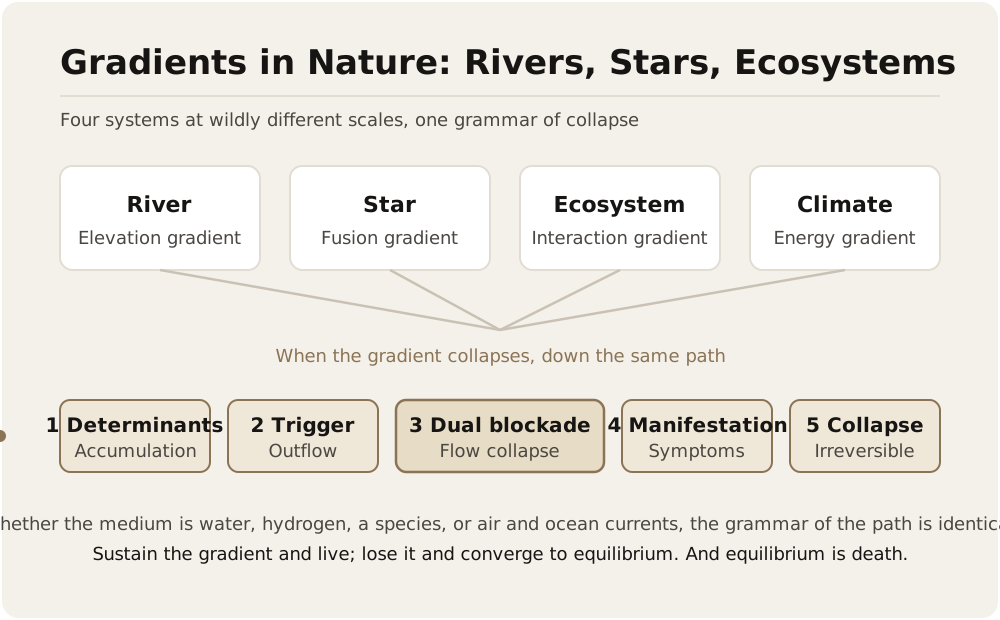
This chapter begins with the natural world. Rivers, stars, ecosystems, climate. We will look in turn at how four systems of entirely different scale are all sustained on a gradient, and collapse the moment that gradient breaks down. A river flows on an elevation gradient; a star shines on the temperature and density gradient of nuclear fusion; an ecosystem maintains stability on the gradient of interactions among organisms; and the climate system circulates on the enormous energy gradient between the equator and the poles.
The reason we examine these four cases is simple. First, we confirm that the collapse phenomena we have already long observed in nature already follow the physical grammar this book presents, so that in later chapters we can see how the same grammar operates in the human body and the economy. What nature shows us is not a metaphor for the body or the economy. It is the same physical law manifesting on a different medium.
In each subsection, we will confirm three things in order. What gradient is operating in that system. By what path the system collapses when that gradient breaks down. And how that collapse corresponds to this book's five stages: determinants, trigger, dual blockade/flow collapse, manifestation, collapse. These three questions will become the standard analytical framework repeated in the discussions of the body and the economy in later chapters.
Rivers: When the Elevation Gradient Disappears, the River Dies
A river flows because the elevation upstream is higher than downstream. It is not because water itself has a will to flow. The difference in elevation, that is, the gradient of gravitational potential energy, pushes water in one direction. This elevation gradient is the driving engine of the river as a system. If this gradient disappears at any stretch of the river, the flow stops at that point, and the river turns into a lake or a swamp.
But what twentieth-century humanity learned was something else. A river's death occurs not because the elevation gradient disappears, but because the supply of water flowing on that gradient itself is cut off. The Aral Sea is the representative case. Once the world's fourth-largest inland lake, the Aral Sea began shrinking rapidly after the Soviet Union, in the 1960s, diverted massive quantities of water from the Amu Darya and Syr Darya rivers for cotton-irrigation projects. According to NASA Earth Observatory data, the Aral Sea has lost 88 percent of its area and 92 percent of its water volume since 1960, shrinking by 2007 to about 10 percent of its original size. This is precisely the scene the UN Secretary-General described, after a 2011 site visit, as "one of the planet's worst environmental disasters."
If we re-describe what happened at the Aral Sea in the language of gradient, it reads as follows. Stage 1, accumulation of determinants: decades of expanding irrigation infrastructure and inefficient water use. Stage 2, trigger: the construction and operation of large-scale canals from the early 1960s onward. Stage 3, dual blockade/flow collapse: as the inflow from the two major rivers fell below a critical threshold, evaporation loss exceeded inflow replenishment. Stage 4, manifestation: a fivefold increase in salinity, extinction of most fish species, collapse of the fishing industry, frequent dust storms, and a sharp rise in respiratory and kidney disease among local residents. Stage 5, collapse: shrinkage to below 10 percent of the original lake, disintegration into three separate, irrecoverable remnant lakes. The D-T-D-M-C path operated exactly as described, in a single case from nature.
From a broader perspective, a 2008 paper in the journal Science, co-authored by Milly and seven others (Milly et al., 2008, Science 319, 573-574), shocked the academic community with the declaration that "Stationarity Is Dead." Throughout the twentieth century, water resource engineering was built on the assumption (stationarity) that a river's flow rate varies within a fixed probability distribution. Dam sizes, levee heights, and urban water-supply capacity were all designed under this assumption. What the Milly team declared was that, because of climate change, this stationarity assumption is no longer valid. Rivers have entered a zone of change from which they do not return. This was the moment the scientific community officially acknowledged that the death of a river is not an isolated event but the systemic consequence of a reorganization of the climate gradient.
Stars: When the Nuclear Fusion Gradient Goes Out, the Star Dies
A star is an enormous mass of gas that compresses itself through gravity. This gravitational compression pushes the temperature and density at the core to extremes. Once sufficient temperature and density are reached, a nuclear fusion reaction begins, in which hydrogen nuclei fuse with one another into helium. The energy released by this reaction creates outward pressure, and at the point where this radiation pressure exactly offsets gravitational contraction, the star becomes a stable main-sequence star. The Sun is at this stage right now.
The fact that a star gives off light is described in the language of gradient as follows. An enormous energy gradient exists between the high temperature and high density of the core and the low temperature and low density of the surface, and along this gradient, heat flows by radiation and convection, released at the surface in the form of light. This flow is sustained as long as hydrogen, the fuel for the fusion reaction, continues to be supplied without interruption. In other words, a star, too, is a form of dissipative structure. It is unique in that it generates energy internally rather than receiving it from outside, but the driving principle is identical. As long as the gradient is sustained, the star shines; the moment the gradient breaks, the star dies.
This process unfolds over billions of years. As the hydrogen at the core is gradually exhausted, the rate of the fusion reaction falls, and the cost of sustaining the energy gradient rises. When gravity begins to win out again, the core contracts, the temperature rises further, and an even more extreme reaction begins in which helium fuses into carbon. At this stage the star's outer layer expands into a red giant. A star the size of the Sun ends here, but a sufficiently heavy star fuses, in sequence, through carbon, oxygen, neon, and silicon, all the way to iron. Once it reaches iron, further fusion no longer releases energy but only absorbs it. This is the moment the fuel gradient is physically exhausted. At this moment the star's core can no longer stop contracting, and as the energy vacuum created at the core sucks in the outer layers all at once, a supernova explosion occurs.
If we re-describe the death of a star in this book's five stages, it reads as follows. Stage 1, accumulation of determinants: long-term consumption of hydrogen fuel. Stage 2, trigger: a critical decline of the fuel gradient due to exhaustion of core hydrogen. Stage 3, dual blockade/flow collapse: the balance between gravity and radiation pressure breaks down, and the condition for sustaining energy flow fails. Stage 4, manifestation: red-giant expansion, synthesis of heavier elements, unstable pulsation. Stage 5, collapse: a supernova explosion or collapse into a white dwarf. This path unfolds on a timescale of billions of years, but the grammar of collapse itself is identical to that of a river or the human body. The moment the gradient can no longer be sustained, the flow is cut, and the system transitions irreversibly into a new state. The fact that the calcium a supernova explosion scattered across the universe is, billions of years later, present in the Earth and in our own bodies shows that this vast cycle of gradients ultimately lies under the same physical law.
Ecosystems: When Resilience Is Depleted, the Regime Shifts
An ecosystem is a web of interactions in which countless species eat and are eaten, compete, and coexist with one another. The secret to how this web is sustained is a complex balance of gradients. The population gradient between predator and prey, the spatial gradient of nutrient concentration, and the temporal gradient of photosynthetic efficiency interlock with one another to form the stable state of the system as a whole. This stable state is not static. It is a state that dynamically maintains balance under constant disturbances such as seasons, weather, and population fluctuations.
A 2001 paper in Nature by the ecologist Marten Scheffer's team, "Catastrophic Shifts in Ecosystems" (Scheffer et al., 2001, Nature 413, 591-596), comprehensively organized how this balance breaks down. Its core observation is as follows. Different ecosystems, such as lakes, coral reefs, oceans, forests, and semi-arid regions, commonly possess multiple stable states, and under gradual stress, once a critical threshold is crossed at some point, they suddenly shift to an entirely different state. A shallow lake, for example, maintains either a clear state rich in aquatic plants or a turbid state with algal blooms; when nutrient inflow is below a critical level the clear state is stable, and when it exceeds that level the turbid state becomes stable.
The decisive fact is that this transition is not gradual. While stress gradually grows, the ecosystem remains nearly unchanged. Then, the moment a critical threshold is crossed, it shifts abruptly, and afterward, even if the stress is returned to its original level, the system does not return. This is called hysteresis. The case in which a Caribbean coral reef, once it shifted to an algae-dominated state, did not recover even after nutrient concentrations improved, and the case in which the southern Sahara, which shifted abruptly from green grassland to desert thousands of years ago, did not return even after climate conditions improved, are both real manifestations of hysteresis.
The core concept the Scheffer team emphasized is resilience. An ecosystem's resilience is its ability to return to its original state after a disturbance, and this resilience is slowly whittled away by gradual stress. An ecosystem's outward appearance may look fine even while its internal resilience has already nearly bottomed out. In this state, a single ordinary disturbance is enough to push the system past the threshold and into another state. To our eyes it looks "sudden," but physically it is only the moment at which the simultaneous, long-running depletion of gradient and resilience finally surfaces. From this perspective, sustainable management is not about locking a system into a fixed state, but about maintaining resilience. This insight will be repeated exactly, later, in the management of chronic disease in the human body and the prevention of economic crisis.
Climate: The Distribution of Gradients Is Being Reorganized
The phrase "climate change" is popularly understood through the image of "the Earth getting warmer," but this is language that points only at the surface of the phenomenon. Physically, climate change is a process in which the distribution of energy gradients across the Earth system is being reorganized. The temperature gradient between the equator and the poles, the thermal gradient between atmosphere and ocean, the water-vapor gradient between continents and oceans, the pressure gradient between the Northern and Southern Hemispheres. All of these gradients drive atmospheric circulation and ocean currents, and this flow has stabilized the Earth's climate.
A 2008 paper by Lenton and co-authors, published in the Proceedings of the National Academy of Sciences (Lenton et al., 2008, PNAS 105, 1786-1793), established that the Earth's climate system possesses several tipping elements, each with its own distinct critical threshold. The complete loss of the Greenland ice sheet, the summer disappearance of Arctic sea ice, the savannization of the Amazon rainforest, an abrupt shift in the West African monsoon, and the weakening of the Atlantic Meridional Overturning Circulation (AMOC). The paper warned that these tipping elements could cross their critical thresholds one after another once global average temperature exceeds a certain level, including the possibility of cascading tipping, in which the transition of one element triggers the transition of another.
One representative case is the weakening of the Atlantic Meridional Overturning Circulation, the North Atlantic current system that includes the Gulf Stream. This circulation is an enormous heat-gradient engine that carries warm equatorial water to the North Atlantic and sends the cold deep water of the North Atlantic back south. A 2021 paper in Nature Geoscience by Caesar and four co-authors (Caesar et al., 2021, Nature Geoscience 14, 118-120) reported that this circulation is at its weakest state in the last thousand years, with the onset of substantial weakening dating from the mid-twentieth century. As meltwater from the Greenland ice sheet flows into the North Atlantic, the density gradient of seawater shrinks, and this is the structure by which the driving force of ocean-current circulation is weakened. Of course, there is disagreement within the ocean-science community over the precise magnitude of recent weakening, and whether the AMOC will fully collapse within the twenty-first century remains uncertain. But there is broad agreement that the system is moving in the direction of a critical threshold.
What these two papers together say is clear. Climate change is not simply a rise in temperature, but a process in which the distribution of energy gradients across the entire Earth is being reorganized, and this reorganization creates the possibility of critical transitions at multiple points. Some transitions are already under way, some are close to their threshold, and some still have margin remaining. Summarized in this book's five stages, humanity is currently, for most tipping elements, in Stage 3 (the zone where early signals of dual blockade/flow collapse are accumulating). Preventing entry into Stage 4 (abrupt manifestation) and Stage 5 (irreversible collapse) is the collective task that must be carried out within the time that remains. This is why climate change needs to be discussed with the physical definition of "a reorganization of gradients," not "warming."
Conclusion
In this chapter, we reread four landscapes of the natural world in the language of gradient. A river flows on an elevation gradient; a star shines on a nuclear-fusion gradient; an ecosystem maintains stability on the gradient of interactions among organisms; and the climate system circulates on an Earth-scale energy gradient. These are systems of vastly different scale, yet all follow the same physical law. As long as the gradient is sustained, the system is alive; the moment the gradient collapses, the system converges toward an equilibrium state, and that equilibrium is death.
More important is that the same collapse path is observed in all four cases. Accumulation of determinants, trigger, dual blockade/flow collapse, manifestation, collapse. The death of a river, the death of a star, an ecosystem's regime shift, and a climate tipping point all follow these five stages. Whether the medium is water, hydrogen, a species, or air and ocean currents, the grammar of the path is identical. This book's central claim is that this same grammar repeats later in the chronic diseases of the human body and the crises of national economies.
The next chapter carries this grammar into the human body. We will look, in turn, at where in our body which gradients are operating, at what disease arises by what path when those gradients break down, and at why modern medicine still leaves the root cause of essential hypertension or diabetes as "unknown." The core of the next chapter is exactly how precisely the landscape we have seen in nature repeats itself inside the human body.
참고문헌
- Scheffer, M., Carpenter, S., Foley, J. A., Folke, C., & Walker, B. (2001). Catastrophic shifts in ecosystems. Nature, 413(6856), 591-596. https://doi.org/10.1038/35098000
- Lenton, T. M., Held, H., Kriegler, E., Hall, J. W., Lucht, W., Rahmstorf, S., & Schellnhuber, H. J. (2008). Tipping elements in the Earth's climate system. Proceedings of the National Academy of Sciences, 105(6), 1786-1793. https://doi.org/10.1073/pnas.0705414105
- Milly, P. C. D., Betancourt, J., Falkenmark, M., Hirsch, R. M., Kundzewicz, Z. W., Lettenmaier, D. P., & Stouffer, R. J. (2008). Stationarity is dead: Whither water management? Science, 319(5863), 573-574. https://doi.org/10.1126/science.1151915
- Caesar, L., McCarthy, G. D., Thornalley, D. J. R., Cahill, N., & Rahmstorf, S. (2021). Current Atlantic Meridional Overturning Circulation weakest in last millennium. Nature Geoscience, 14, 118-120. https://doi.org/10.1038/s41561-021-00699-z
- Kippenhahn, R., & Weigert, A. (1990). Stellar Structure and Evolution. Berlin: Springer-Verlag.
- NASA Earth Observatory. (2018). World of Change: Shrinking Aral Sea. https://earthobservatory.nasa.gov/world-of-change/AralSea
- Prigogine, I., & Stengers, I. (1984). Order Out of Chaos: Man's New Dialogue with Nature. New York: Bantam Books.
Source: The Universal Law: Gradient, Chapter 5, "Gradients in Nature: Rivers, Stars, Ecosystems." The text is a faithful rendering of the original manuscript, provided for informational purposes.