
In Part 1, we saw that physics and chemistry already placed the grammar of gradients at their center. Dissipative structures, critical slowing down, and Turing's morphogenesis were all different expressions of the same language. We now move to three fields where that language is used most directly as a design principle: engineering, information systems, and ecosystems.
Engineering: Design Principles for Fluids, Structures, and Networks
Engineering is the field where the grammar of gradients is used most directly as a design principle. Fluid mechanics designs perfusion through pressure gradients, electrical engineering designs power grids through potential gradients, and thermal engineering designs heat exchangers through temperature gradients. Structural engineering calculates the safety of buildings through stress gradients, and traffic engineering predicts road capacity through gradients in vehicle density. Across engineering as a whole, the gradient is the starting point of design, and flow is the outcome of design.
The engineering field that resonates most deeply with the perspective of this book is fluid mechanics. In Chapter 9, we repeatedly confirmed that the laminar-flow equation formulated by Jean Léonard Marie Poiseuille in the 1840s makes blood flow proportional to the fourth power of the vessel radius. This r⁴ law is the design standard for water and sewage pipes in civil engineering, the core of pipeline design in chemical engineering, and a design principle for fuel systems in aerospace engineering. This book's claim was that the same law operates in blood vessels and equally operates in the financial systems of the economy. In engineering, this law has already been verified for nearly two hundred years, and it is a natural consequence that this verification extends into medicine and economics.
Another classical concept from fluid mechanics is the Reynolds number. According to what Osborne Reynolds demonstrated experimentally in 1883, fluid flow transitions nonlinearly from laminar flow to turbulent flow the moment the Reynolds number crosses a specific threshold. This transition is not gradual but abrupt, and the flow characteristics before and after the transition are qualitatively different. It is worth noting that this phenomenon shares the same structure as the critical collapse of the gradient grammar. The moment a state variable (flow velocity) crosses a certain threshold, the dynamics of the entire system undergo a qualitative shift. The moment a chronic disease in the human body crosses a threshold and turns from a manageable condition into a progressive disease, and the moment an economy crosses dual blockade and shifts from recovery mode into survival mode, are both expressions of this Reynolds-type transition.
Structural engineering also provides an important case of the gradient grammar. Modern structural engineering calculates the stress distribution inside a building or mechanical structure through the finite element method, and treats as a design principle the fact that cracks begin and spread nonlinearly at points where the stress gradient exceeds a threshold. When this concept is translated into medicine, it connects directly to the research on microcalcification by the Harvard Hutcheson team that we saw in Chapter 9. The finite element analysis result showing that a localized concentration of microcalcification in the fibrous cap inside a plaque amplifies the mechanical stress on the cap by more than fivefold is a case in which the structural engineering principle of stress concentration operates just as it does in the vessel wall. The language of engineering and the language of medicine completely overlap at this point.
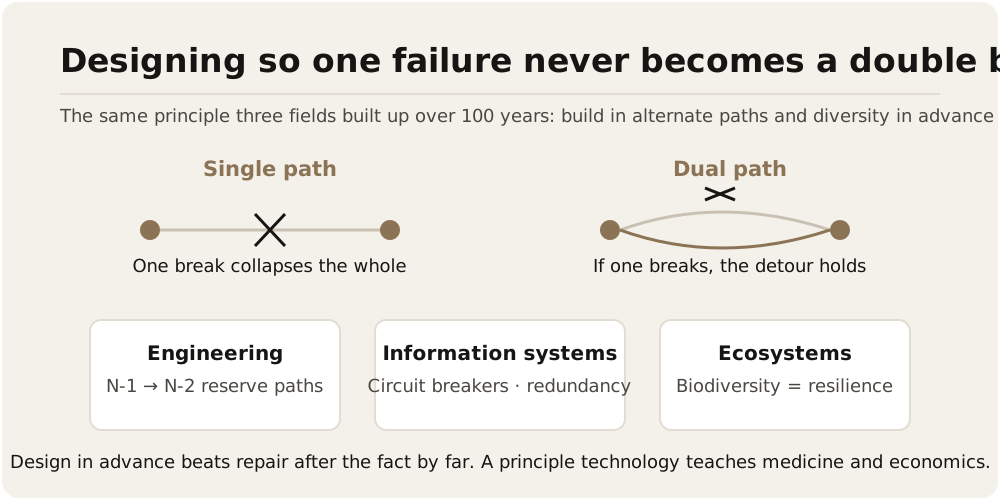
Recent engineering also actively employs the gradient grammar in the domain of network design. The design of power grids, communication networks, transportation networks, and logistics networks all proceeds on the principle of securing distributed alternative routes so that flow does not pass exclusively through a specific bottleneck. The state this principle pursues is resilience, in which the entire system does not collapse even if one route is blocked. This concept of resilience runs through both Holling's ecological resilience and the gradient resilience of this book. When designers build a bridge, lay a transmission line, or configure the backup circuits of a data center, they are already designing the system so that dual blockade cannot occur. Engineering is the oldest and most successful field of application of the gradient grammar.
The event that most starkly revealed the historical importance of this principle is the 2003 North American blackout. On the afternoon of August 14 that year, a single transmission line failure that began in Ohio, combined with a failure of the control system to detect it, spread into a cascading failure, and within about nine hours roughly fifty million people across the northeastern United States and eastern Canada lost power. The final report released in April 2004 by the joint task force established by the U.S. Department of Energy and Canada's Department of Natural Resources (U.S.-Canada Power System Outage Task Force, 2004) documented this event as a textbook case of cascading failure in which a single fault propagated through an entire system. While the alarm processor in a regional utility's control room failed to function normally and operators failed to recognize the situation, transmission lines whose voltage had dropped due to overload were automatically shut down one after another, and this shutdown led to overload in yet other sections, so that within just a few minutes the entire system entered collapse. This event revealed the industrial reality of nonlinear collapse that occurs when a system's supply pathways and its situational-awareness pathways break down at the same time.
After this event, the United States and Canada strengthened the power grid's N-1 standard to N-2 and mandated the construction of dual and triple backup routes at major nodes. Reinforcement of the same principle was applied to global nuclear safety standards after the 2011 Fukushima nuclear accident in Japan, to cloud infrastructure design after Amazon Web Services' major outage in 2017, and to internet backbone operations after Facebook's BGP routing failure in 2021. All of these adjustments point in the same direction: building slack into the design in advance so that a single failure does not escalate into a dual blockade. As the field of engineering has accumulated this principle for more than a hundred years, it has become close to a design philosophy with the force of law, and importing this principle into medicine and economics is one direction this book proposes.
Information Systems: Communication, Networks, Distributed Systems
In information systems, the language of gradients was formalized in Claude Shannon's 1948 paper on information theory in the mid-twentieth century (Shannon, 1948, Bell System Technical Journal). Shannon defined information as entropy and formalized the capacity of a communication channel as a function of the signal-to-noise ratio. The core of this formalization is the view that information flows through a channel, and that this flow is constrained by the physical characteristics of the channel and the level of noise. This view resonates with the gradient grammar because the flow of information, too, is simultaneously constrained by two directions of capacity: supply on the transmitting side and processing on the receiving side. When one side collapses, flow decreases; when both sides collapse at the same time, communication breaks down.
The dynamics of the modern internet are a large-scale empirical case of this principle. Much of the problem that network engineers deal with every day is congestion, which occurs when traffic concentrates on a specific node or link, and once this congestion crosses a threshold, packet loss increases nonlinearly and the throughput of the entire network drops sharply. This phenomenon was first observed in the form of what came to be called congestion collapse in the early internet in the late 1980s, and it subsequently triggered the development of TCP congestion control algorithms. The dynamics revealed by internet congestion collapse are structurally isomorphic to the dual blockade of the economy described in this book. When a decline in supply capacity and a decline in processing capacity occur at the same time, the system collapses nonlinearly.
The 1999 paper published in Science by Albert-László Barabási and Réka Albert was a watershed moment in network science (Barabási & Albert, 1999, Science). The two showed that real-world networks such as the World Wide Web, biological protein interaction networks, and citation networks follow not random connection but a power-law distribution, and they named this property the scale-free network. An important characteristic of scale-free networks is that connections are concentrated on a small number of hub nodes, and a malfunction in one of these hubs can lead to the collapse of the entire network. This structure is repeatedly observed in the microvascular network of the human body, in the financial system of the economy, and in the food webs of ecosystems.
Distributed systems engineering directly reflects the gradient grammar in its design in order to manage this vulnerability. Designers of large-scale cloud services adopt cross-region replication and automatic failover as a basic principle so that the failure of a specific data center does not lead to the collapse of the entire service, and microservice architecture has adopted the circuit breaker pattern as a standard to prevent the cascading failure in which overload in a single service spreads to adjacent services. All of these design decisions pursue one thing: avoiding a state of dual blockade in which capacity on both the supply side and the processing side collapses at the same time. The language of software architecture and the medical language of this book are saying exactly the same thing at this point.
The greatest insight that the experience of information systems returns to the framework of this book is the fact that, in responding to dual blockade, advance design is overwhelmingly more efficient than after-the-fact recovery. Just as internet engineers build dual routes in advance in preparation for failure, preventive intervention in medicine and preventive regulation in the economy can achieve far greater effect at far lower cost than reversing a collapse that is already underway. This perspective is also accumulating in medicine and economics, but in information systems it has been established as an almost absolute principle. Cross-domain learning always runs in both directions, and in this case technology has something to teach medicine and economics.
Ecosystems: Resilience and Critical Transitions
Ecosystems are a domain into which the gradient grammar fits very naturally, but they are also a domain where the degree of formalization is looser than in the human body or the economy. The decisive milestone in this domain is the 1973 paper on resilience published by Crawford Stanley Holling in Annual Review of Ecology and Systematics (Holling, 1973, Annu Rev Ecol Syst 4:1-23). The concept Holling introduced is as follows: the stability of an ecosystem should be measured not only by its capacity to restore itself (stability) after a small disturbance around a single point, but also by its capacity to remain within the same functional domain without shifting into an entirely different state (resilience). This concept of resilience changed the paradigm of ecology as a whole over the following decades and became a central term in the study of social-ecological systems.
In Holling's framework, the collapse of an ecosystem is not a simple decline in function but a regime shift into a different state. Cases such as a clear lake transitioning into a turbid, algae-dominated lake, an abundant coral reef transitioning into an algae-dominated reef, and an extensive tropical rainforest transitioning into savanna all fall into this category. These transitions commonly share the feature that the system appears to remain healthy until it crosses a certain threshold, and then, the moment it crosses that threshold, rapidly moves into a new state. According to what the Marten Scheffer team summarized in Nature in 2001, this critical transition is preceded by signs such as lengthening recovery time and increasing variability of the state variable (Scheffer et al., 2001, Nature). The 2009 Nature paper by Scheffer that we relied on in Chapter 11 as the predictive basis for economic crisis is a theoretical extension of this 2001 observation.
What are the actual cases of dual blockade in ecosystems? The clearest example is coral reefs, where ocean acidification and rising water temperature proceed simultaneously. As two basic functions, oxygen supply and calcium carbonate skeleton formation, decline at the same time, large-scale coral bleaching and collapse have been observed in cascading fashion across several sea regions since the 2010s. In the case of the Amazon rainforest, as a decline in evapotranspiration caused by logging and a change in precipitation patterns caused by climate change proceed simultaneously, a hypothesis has been proposed that once a certain threshold is crossed, the rainforest may fail to sustain its own water cycle and shift into savanna (Nobre et al., 2016, PNAS). Both of these cases have a dual-blockade structure in which two axes, either supply and discharge or inflow and maintenance, collapse at the same time.
The cascading bleaching of Australia's Great Barrier Reef in 2016-2017 is the event that most dramatically demonstrated this structure. According to long-term monitoring data from the Australian Institute of Marine Science (AIMS), sea surface temperatures during the summers of those two years remained one to two degrees Celsius above average for periods of several months each, and as a result the coral's symbiotic algae (zooxanthellae) departed en masse, producing bleaching, in which the coral turns white, across roughly two-thirds of the reef (Hughes et al., 2017, Nature). On the supply side, the coral loses its carbon source through the departure of the symbiotic algae; on the discharge side, acidified seawater impedes the deposition of the calcium skeleton. The simultaneous collapse of these two axes fundamentally altered, in just two summers, a massive ecosystem that had evolved over hundreds of thousands of years. Researchers commonly judge that recovery from this event requires at least ten to twenty years, and that if climatic conditions do not recover, a genuine return to the original state may in effect be impossible.
The collapse of the Atlantic cod fishery in the North Atlantic is another textbook case. Throughout the twentieth century, the coastal waters of Newfoundland, Canada, were a world-class cod fishery, but catches began to plummet from the late 1980s, and in July 1992 the Canadian government declared a complete moratorium on cod fishing. The cause of this collapse is not singular. Decades of overfishing, changes in competition for food among species, and fluctuations in sea temperature acted simultaneously, and the moment these conditions crossed a certain threshold, the cod population shifted into a state in which it could no longer sustain its own reproduction. Even now, thirty years after the ban, the population has recovered only a fraction of its former level, and some researchers assess that, under the current cold, low-nutrient environment, a return to the original productivity of the fishery is effectively impossible. The observation made earlier in this chapter, that regime shifts in ecosystems are irreversible, is concretely confirmed here.
The gradient grammar of ecosystems shows one important difference from medicine and economics: recovery after a transition is far slower, or in practical terms impossible. A chronic disease in the human body remains largely reversible as long as it is before Stage 5 collapse, and an economic crisis can be recovered from on a timescale of a few years. But a regime shift in an ecosystem demands a recovery time measured in decades, and in many cases a return to the original state is blocked in principle. This difference means that the importance of prevention in ecosystems is greater than in any other domain. Intervention while the gradient is still within a recoverable range is decisive, and in most cases technical recovery is close to impossible once the threshold has been crossed.
At the same time, ecology returns a concept to the framework of this book as well: the insight that biodiversity is a source of resilience. A simplified system has high efficiency but is vulnerable to a single disturbance, while a system that maintains diversity can have other parts substitute in function even if some parts are damaged. This principle is translated, in the economy, into industrial diversity and supply chain distribution; in information systems, into distributed architecture; and in medicine, into the functional reserve of organ function. In that humanly designed systems can learn the wisdom that ecology has accumulated through millions of years of natural experiment, the learning between ecosystems and other domains has a strong reciprocity.
This article is part (2/3) of the three-part series covering Chapter 12 of The Universal Law: Gradient. The references are consolidated in part (3/3). The body text follows the original manuscript and is provided for informational purposes.