
This piece is the complete Chapter 14 of The Declaration of the Age of Physical Economics (Yoon Jong-won, Yoon So-ri, Yoon Jun). It is an academic exposition presenting the authors' physical economics hypothesis, and the body, figures, and citations follow the manuscript as written.
Existing Economic Reports, After-the-Fact Reports That Record Results
There exist several reports that tell us the state of a national economy. The International Monetary Fund's (IMF) World Economic Outlook (WEO) takes the GDP growth rate forecast as its central axis, and the Organisation for Economic Co-operation and Development's (OECD) Economic Outlook likewise puts its weight on growth and price forecasts. The Bank of Korea's economic outlook separately releases the growth rate, prices, and the current account every quarter, and the U.S. Federal Reserve's Beige Book weaves together the qualitative narratives of twelve regional Federal Reserve Banks. The Bank for International Settlements' (BIS) credit-to-GDP gap judges an alert by whether a single indicator has crossed a threshold. On the financial front line, the Bloomberg Terminal provides real-time quotes and recession-probability models, and this probability value is immediately reflected in investors' decisions.
These reports each have value in their respective roles, but in common they share one structural limitation. They are all result reports. They measure and record how much GDP fell, how much the unemployment rate rose, how much prices jumped. They describe accurately what happened after a crisis broke out, but they cannot tell us where the crisis has passed through and where it is heading. Recording a result and tracing a path are fundamentally different tasks. Translated into medical terms, it corresponds to the task of filling in a chart after a patient has collapsed, saying "the blood pressure fell by this much and the body temperature rose by this much."
This difference is the same as the difference between a car navigation system and a traffic-accident report. A traffic-accident report records the point of collision, the scale of damage, and the number of casualties after the accident has occurred. It is an accurate and important document, but it cannot tell the driver "if you go this way now it is dangerous, so take a detour." A navigation system grasps the current location in real time, shows the state of the path ahead, and warns in advance if there is a congested stretch. Whereas existing economic reports have performed the role of the traffic-accident report, a navigation system that tracks in real time which path the national economy is currently on has not existed.
The BIS credit-to-GDP gap exceeded its threshold several times in Korea in the 2010s, but the number of cases that actually led to a crisis is 0. Bloomberg Economics' recession-probability model output a U.S. recession probability of 100% in October 2022, yet the U.S. economy continued to grow throughout 2023 and 2024. Columbia University statistician Andrew Gelman publicly criticized this model's calibration error. This is the result produced by a method that issues an alert immediately as soon as a single indicator crosses a threshold. Translated into the human body, it is the same as judging every disease with a single thermometer.
The GDP flash estimate comes out one month after the quarter ends, and the final figure two months after. Employment statistics are released one month later, the current account two months later. During the 2008 global financial crisis, the fact that U.S. GDP had turned to negative growth was officially confirmed only in January 2009, and the point at which the National Bureau of Economic Research (NBER) officially declared a recession was 12 months after the start of the crisis. Translated into medical terms, it is like deciding today's course of treatment while looking at an X-ray taken a month ago.
The financial market, consumption, employment, trade, and prices are each released as separate reports. An integrated diagnosis that asks "where is it blocked at the same time" does not exist. The Bloomberg Terminal shows thousands of economic indicators in real time, but that is a collection of individual gauges, not an integrated diagnosis. During the 2008 crisis, a seizing up of the financial market, a plunge in consumption, and a collapse of employment happened simultaneously, but even after the fact no report rendered the judgment that these three phenomena were "the same symptom arising from a single blockade." Translated into the human body, it is the form in which cardiology, pulmonology, and gastroenterology each write a separate opinion but never once hold a joint consultation.
A Comparison of Existing Economic Reports
| Report | Issuing Institution | Frequency | Method | Core Limitation |
|---|---|---|---|---|
| WEO | IMF | Semiannual | Centered on GDP growth forecast | Frequent after-the-fact revision, structural blockade not measured |
| Economic Outlook | OECD | Semiannual | Growth, price forecast | Single indicator, no composite judgment |
| Economic Outlook | Bank of Korea | Quarterly | Growth, prices, current account in parallel | Released separately by item, no integrated blockade judgment |
| Beige Book | U.S. Fed | 8 times/year | Qualitative narrative of 12 regional Feds | No quantitative judgment, subjective interpretation |
| Credit/GDP Gap | BIS | Quarterly | Single-indicator threshold alert | Frequent false alarms, cannot distinguish single blockade |
| Recession-probability model | Bloomberg | Monthly | Probability computed from 13 indicators | A probability estimate, not a path diagnosis, 100% false alarm in 2022 |
There is a common point that emerges from this table. All seven systems ask "how will the result turn out." They estimate what the growth rate will be, what percent the probability of a recession is, whether credit is excessive or not. But not a single one asks "where is the flow of the economy blocked right now." Result prediction and path diagnosis are fundamentally different questions. A doctor estimating "what percent is the probability that this patient will suffer a myocardial infarction within six months" and diagnosing "the third branch of this patient's coronary artery is currently 70% narrowed" are not the same thing. The former deals with probability, the latter deals with physical fact.
Why We Read the Economy as the Human Body
The DIAH-7M report outputs the current state of the U.S. economy like this. "Microcalcification (interest on debt) is blocking cash flow. Oxygen does not reach the microvasculature (small businesses, households). Even if you transfuse the aorta (large corporations, finance), it does not reach the microvasculature. A direct injection into the microvasculature is needed." Within a single paragraph are contained where it is blocked, what happened as a result, and what must be done.
Rendering the same phenomenon in the idiom of existing reports goes like this. "The liquidity of the financial market has seized up, so that credit supply to small and medium enterprises is contracting, and it is analyzed that the transmission effect of monetary policy is appearing to a limited degree." It is an accurate sentence and a standard expression current in academia and policy authorities. But this sentence does not bring into a single breath where it is blocked and therefore what must be prepared. The phenomenon that the two idioms point to is identical. It is a state in which money crowds only into the large channels and does not reach the small ones. The difference lies in the speed of understanding.
The place where the difference between the two idioms actually parts ways is policy priority. When an existing report lists "GDP decline, unemployment rate rise, consumption contraction" in parallel, the fact that the three indicators worsened simultaneously is visible, but which is cause and which is result is not visible. If it is not distinguished whether unemployment rose because GDP fell, whether consumption fell because unemployment rose, or whether GDP fell because consumption fell, one cannot decide where to inject resources first. In the human-body model, the causal path appears in a single sentence. The order in which microcalcification accumulates in the microvasculature so that oxygen does not reach the cells, and the cells lose function so that the entire organ slows, follows naturally. The cause is microcalcification, the result is the slowing of the organ, and the target of treatment is the microvasculature.
"Even if you transfuse the aorta (large corporations), it does not reach the microvasculature (households)." This single line settles in a single breath the trickle-down debate that has continued for decades in existing economics. The fact that no matter how hard the heart (the central bank) pumps, it cannot send oxygen through a blocked blood vessel, and the answer to why the money released into the market through quantitative easing did not lead to household consumption, are already contained within the structure of the human body. Where resources must be concentrated is derived, beyond metaphor, as physical structure.
There is a translation code that runs through this entire book. Cash is calcium, savings are bone, the interest on debt is microcalcification, and inflationary pressure is CO₂. With four equations, economic phenomena are translated into human-body phenomena. Thereafter every report is written upon these equations.
The Same Economic Phenomenon, a Comparison of 2 Descriptions
| Existing Report Description | DIAH-7M Human-Body Description |
|---|---|
| Contraction of credit supply to SMEs due to financial-market liquidity seizure | Microcalcification (interest on debt) blocks the microvasculature (small businesses, households) so that oxygen (liquidity) does not reach the cells |
| Weak recovery of private consumption despite a base-rate cut | It is a diabetic state in which the cells do not respond even when insulin is administered. Policy does not take effect |
| Pressure on the current account from a widening trade deficit | Respiration is blocked so that CO₂ (inflationary pressure) is not discharged, and the intake of oxygen (foreign currency) is also weakening |
| A decline in disposable income following a surge in the unemployment rate | Large-scale cell necrosis is under way. The supply of calcium (income) to the cells (households) is cut off |
| Limited stimulus effect despite fiscal expansion | Even if you transfuse the aorta (large corporations), it does not reach the microvasculature (households). A direct injection into the microvasculature is needed |
DIAH-7M, the World's First National-Economy Diagnostic Navigation
DIAH-7M maps 59 gauges onto 9 organ systems. The circulatory system (A1) is currency and the flow of funds, the respiratory system (A2) is trade, the digestive system (A3) is consumption, the nervous system (A4) is policy and market signals, the immune system (A5) is financial stability and fiscal defense, the endocrine system (A6) is prices and public finance, the musculoskeletal system (A7) is industrial production and housing, the labor and vulnerable class (A8) is employment and household debt, and the regenerative system (A9) is capital formation and the external sector, these being the nine axes. On each axis hang 4 to 10 gauges. Unlike the existing method that summarizes the economy with a few aggregate figures such as GDP, the unemployment rate, and prices, just as a precise human-body examination measures all organs simultaneously, this system too measures 9 organs simultaneously.
An alert is not triggered from a single gauge. Consumption slowing for one month alone does not change the grade. Only when two months of consecutive slowing is joined by exchange-rate fluctuation, when the two conditions of accumulation and combination are satisfied at the same time, does an alert finally light up. The reason the BIS credit-to-GDP gap, which issues an alert immediately as soon as a single indicator crosses a threshold, rang falsely in Korea in the 2010s is decided by this design difference.
Blockade is divided into 2 kinds. Channel blockade (DLT), in which the channel itself narrows so that funds cannot pass, and signal blockade (CAM), in which the channel is intact but the policy signal does not reach households. The state in which household disposable income is shaved away by interest burden so that there is no money to spend at all is DLT, and the state in which the government sends support payments to households but that money is sucked into large platforms and does not reach the back-alley economy is CAM. Only when both blockades hold simultaneously is it finally judged a crisis. The fact that in a state where only one side is blocked the system recovered on its own was confirmed in 690 months of data. Translated into the human body, these correspond respectively to a state in which the microvascular channel is blocked, and a state in which the channel exists but the cell receptors do not respond to the signal.
Government statistics are released only after one month has passed since the quarter's end. The final figure is two months later. Greece under-reported its fiscal deficit for several years in order to join the eurozone, and the point at which this fact came to light was the ignition point of the European fiscal crisis. When there is a limit in the statistics themselves, a signal from outside the statistics is needed. Nighttime-lighting satellites measure the activity level of cities and factories each month. Surface-temperature satellites capture the heat of industrial operation. Radar satellites detect changes in built structures. When 3 kinds of independent physical signals point in the same direction, it is not a measurement error but a real change. It is the same as the structure in human-body diagnosis of not trusting the patient's self-report alone but looking together at the electrocardiogram, the blood test, and the CT.
DIAH-7M is diagnosis, not prediction. It does not calculate a recession probability. It measures only where it is blocked right now. Just as a blood-pressure gauge does not calculate the probability of a myocardial infarction six months later, this system too does not compute a future probability. External shocks such as war or a pandemic are like traffic accidents and lie outside the diagnostic range of a blood-pressure gauge. Not confusing prediction and diagnosis is this system's self-discipline.
The 4 design choices, namely 9-axis decomposition, the accumulation-and-combination condition, the dual-blockade filter, and satellite verification, ultimately converge into three independent diagnostic layers. Structural diagnosis is the place that measures how much the economic blood vessels have narrowed over the course of several years, and blockade diagnosis measures each month, with 59 gauges, whether the flow is blocked right now. Empirical diagnosis verifies from space whether satellites confirm changes in actual economic activity. When the three answers converge, the diagnosis is confirmed. This is because a single layer alone cannot escape the limits of statistical lag and revision.
268 years have passed since François Quesnay compared the circulation of funds to blood in the "Tableau Économique" in 1758. In the meantime there have been intermittent attempts to liken the economy to a living organism, but they remained metaphors. There has been no case that developed into a diagnostic system that measures the economy's flow as a physical quantity and points to the blocked location. DIAH-7M is the world's first system that has filled that empty place.
A Structural Comparison of Existing Reports and the DIAH-7M Triple Diagnostic System
| System | Structural diagnosis (weakening): has the path narrowed | Blockade diagnosis (occlusion): is the flow blocked | Empirical diagnosis (verification): is it actually so | Integrated judgment |
|---|---|---|---|---|
| IMF WEO | None | None | None | GDP growth forecast (result prediction) |
| OECD | None | None | None | Growth, price forecast (result prediction) |
| Bank of Korea | None | None | None | Released separately by item (no integration) |
| Fed Beige Book | None | None | None | Qualitative narrative (no quantitative judgment) |
| BIS | Partial (single credit/GDP gap indicator) | None | None | Single-indicator threshold (frequent false alarms) |
| Bloomberg | None | None | None | Recession-probability estimate (not a path diagnosis) |
| DIAH-7M | Structural-vulnerability gauge | 9-axis gauges, signal-and-channel dual-blockade judgment | Nighttime-lighting, surface-temperature, radar satellites, 3 kinds of physical verification | Diagnosis confirmed upon triple convergence (690-month verification) |
Existing systems answer "will a crisis come?" with a probability. DIAH-7M answers "where is it blocked right now?" with a location and a degree. Not predicting the destination but showing the state of the current path in real time, that is the essence of physical-flow path diagnosis.
A Summary of Core Terms
The following three tables are not new concepts. They gather in one place the equations and definitions established in the earlier flow. When reading diagnostic results in later chapters, these definitions appear repeatedly.
| Human-Body Substance | Economic Correspondence | Core |
|---|---|---|
| Calcium | Cash (liquidity) | The thing that flows. The role of blood |
| Bone | The emergency vault (savings) | The place where 99% of calcium is stored. Drawn out and used in a crisis |
| Microcalcification | The interest on debt | The thing that hardens and blocks the blood vessel. Once hardened, it does not return |
| CO₂ | Inflationary pressure | The thing that accumulates and rots the cells. Different in character from microcalcification |
The Four-Element Equation
| Code | Name | Economic Meaning | Surfacing |
|---|---|---|---|
| D | Deficiency | Income does not reach the standard of living, so one lives by borrowing | Income polarization |
| I | Inflammation | Costs increase faster than income | Cost explosion |
| A | Acidosis | Owing to the fall in the value of money, one must borrow more to buy the same thing | Price surge |
| H | Hypoxia | Owing to the cutoff of fund circulation, a vicious cycle of short-term high-interest borrowing | Monetary sclerosis |
The DIAH Trigger 4 States
| Code | Name | Human-Body Pathology | Economic Surfacing |
|---|---|---|---|
| 1M | Obstruction & Rupture | Vascular occlusion, hemorrhage | Acute seizure of the capital market, bank run |
| 2M | Dysfunction | Decline of joint, muscle function | Recession, deterioration of employment |
| 3M | Coating & Blocking | Receptor blockade, insulin resistance | Policy non-response, paralysis of the financial system |
| 4M | Hardening | Tissue fibrosis, calcification | Regulatory rigidity, failure of structural reform |
| 5M | Overflow & Burst | Cell hyperproliferation, tumor | Speculative bubble, asset overheating |
| 6M | Disconnection | Nerve severance, vascular occlusion | Supply-chain collapse, regional extinction |
| 7M | Collapse | Collapse of bone, tooth structure | National default, systemic crisis |
What the Report Outputs
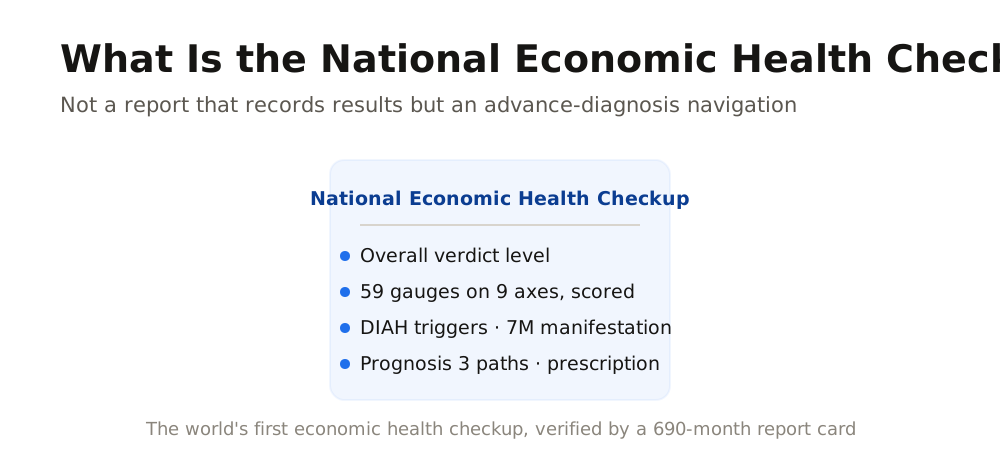
DIAH-7M outputs one report each month. That report contains 5 pieces of information. The overall health grade, the blockade state, active triggers, the 9-axis organ-system scores, and the manifestation stage and prescription. Taking the April 2026 U.S. report as an example, we look at the measured values of each piece of information.
The overall health grade is output in 5 levels from Level 1 to 5. Level 1 is stable, Level 5 is crisis. In April 2026 the U.S. economy is Level 2 (Attention). The Level 0 baseline does not mean health. It only means that the deterioration has not crossed the threshold; beneath the surface an imbalance may be accumulating. The basic principle of medicine that the absence of symptoms does not mean the absence of disease is stated as the system's most basic boundary.
The blockade state is displayed with CAM and DLT each shown. When both hold simultaneously, it is judged a dual blockade and the most urgent alert is triggered. In April 2026, in the United States both blockades are normal, a state of no dual blockade detected.
The active triggers display which of the 4, Deficiency (D, income polarization), Inflammation (I, cost explosion), Acidosis (A, price surge), and Hypoxia (H, monetary sclerosis), is currently switched on. The trigger in an active state in the United States in April 2026 is the single one of Inflammation (cost explosion). Beside the remaining 3 triggers in a latent state, too, there follows the boundary phrase "latent does not mean absent."
The 9-axis organ-system scores spread out in a single table the score, stage, and summary of each of the 9 organ systems. Which organ is most ill is visible at a glance. The axes that entered the attention stage in the United States in April 2026 are the three of the digestive system, the immune system, and the endocrine system. The most vulnerable system is the immune system (financial stability, fiscal defense), at 61 points out of a possible 100. The immune system's low score is confirmed simultaneously in four data points. Federal government debt is 122.5% of GDP. Annual interest payments are 3.9% of GDP. The fiscal deficit is 5.8% of GDP. Of every 100 won of taxes the government collects, 34 won disappears into interest payments. Translated into the human body, it corresponds to a state in which most of the energy of the immune cells is exhausted in dealing with existing infections, so that almost no capacity remains to respond to a new shock.
The manifestation stage is divided into 7 surfacing patterns from 1M (Obstruction & Rupture, acute seizure) to 7M (Collapse, systemic crisis). In April 2026 the United States is at the 2M (Dysfunction) stage. There follows the assessment that the first symptoms are appearing and that it is a point at which the window for prevention is gradually closing. The prescription is presented, matched to the active triggers and the blockade state, in human-body treatment metaphors such as "easing the cost burden," "gradual ventilation," and "direct injection into the microvasculature." Within a single report are contained the location, the cause, the stage, and the prescription all together.
The 690-Month Report Card
DIAH-7M was verified on public macro data spanning 351 months of Korea (January 1997 to March 2026) and 339 months of the United States (January 1998 to March 2026), 690 months in total. The crises judged as dual blockades are the four Korea-U.S. cases of the 2008 global financial crisis and the 2020 COVID shock. Korea's 1997 foreign-exchange crisis and the 2003 credit-card crisis are, by the measured verdict, cases in which a single-blockade advance warning of CAM (signal blockade) alone led into crisis (a measurement under the observational limit of the 25 gauges then in operation). All four crises followed the five-stage collapse pathway law (DTDMC) of factor to onset to blockade to manifestation to annihilation in the identical order. The number of cases in which the pathway reversed is 0. All 3 single blockades in which only one channel was blocked and which recovered on their own did so without a systemic collapse.
The verification result of the 2008 global financial crisis, in the chronological order of events, is as follows. In June 2007, two hedge funds under Bear Stearns went bankrupt. In August 2007, BNP Paribas suspended redemptions on three asset-backed securities funds. On March 16, 2008, it was announced that Bear Stearns would be sold to JPMorgan Chase at 2 dollars per share. In that same month, DIAH-7M judged the U.S. economy to be in a dual blockade. It was the first month in which the three axes of fund circulation, consumption, and prices entered the warning stage simultaneously. On September 15, 2008, Lehman Brothers filed for bankruptcy. On December 1, 2008, the National Bureau of Economic Research (NBER) retroactively declared the start point of the U.S. recession to be December 2007. DIAH-7M's blockade judgment was 8 months ahead of NBER's official declaration, and was output 6 months before Lehman's bankruptcy.
The number of false alarms, that is, cases of wrongly signaling a crisis that did not exist, is 0. The number of missed detections, that is, cases of missing a real crisis, is also 0. Over the 690 months, not a single misjudgment occurred. The detection of the recovery point was also accurate. During the global financial crisis, DIAH-7M's blockade-release point coincided within 1 month with Korea's KOSPI absolute bottom and the U.S. S&P 500 bottom, and was 2 months ahead of NBER's official declaration of the recession's end. The convergence pattern of the triple diagnosis for each crisis, and the concrete content of the satellite signals, are laid out one by one in the flow that follows.
The 690-Month Verification Summary Report Card
| Item | Korea | United States |
|---|---|---|
| Verification period | 1997.1 to 2026.3 (351 months) | 1998.1 to 2026.3 (339 months) |
| Dual-blockade occurrence | 7 months / 351 months (2.0%) | 7 months / 339 months (2.1%) |
| Crisis detection | 4 cases (IMF, card, GFC, COVID) | 2 cases (GFC, COVID) |
| Accuracy | 7/7 (100%) | 7/7 (100%) |
| False alarms | 0 | 0 |
| Missed detections | 0 | 0 |
| Lead detection | GFC 6 months, COVID 5 months | GFC 6 months |
| Recovery detection | 2/2 (100%) | 2/2 (100%) |
References
1. An, Z., Jalles, J. T., & Loungani, P. (2018). How Well Do Economists Forecast Recessions? IMF Working Paper, WP/18/39.
2. Bank for International Settlements (2023). BIS Credit-to-GDP Gap. BIS Statistics.
3. Bloomberg Economics (2022). US Recession Probability Model, October 2022 Update.
4. BNP Paribas Investment Partners (2007). BNP Paribas Investment Partners temporarily suspends the calculation of the Net Asset Value of the following funds: Parvest Dynamic ABS, BNP Paribas ABS Euribor and BNP Paribas ABS Eonia. Press release, August 9.
5. Board of Governors of the Federal Reserve System (2024). The Beige Book: Summary of Commentary on Current Economic Conditions. Federal Reserve.
6. Drehmann, M., & Juselius, M. (2013). Evaluating Early Warning Indicators of Banking Crises: Satisfying Policy Requirements. BIS Working Papers No. 421.
7. European Commission/Eurostat (2010). Report on Greek Government Deficit and Debt Statistics. COM(2010) 1 final, January 8.
8. Gelman, A. (2023). Bloomberg News makes an embarrassing calibration error. Statistical Modeling, Causal Inference, and Social Science (blog), October 22.
9. International Monetary Fund (2024). World Economic Outlook: Steady but Slow. IMF.
10. JPMorgan Chase & Co. (2008). JPMorgan Chase To Acquire Bear Stearns. Press release, March 16. (SEC Form 425).
11. Lehman Brothers Holdings Inc. (2008). Lehman Brothers Holdings Inc. Announces It Intends to File Chapter 11 Bankruptcy Petition. Press release, September 15.
12. Loungani, P. (2001). How Accurate are Private Sector Forecasts? Cross-Country Evidence from Consensus Forecasts of Output Growth. International Journal of Forecasting, 17(3), 419-432.
13. Loungani, P. (2010). Forecasting Recessions: Consensus and Disagreement. IMF Research Bulletin, 11(1).
14. National Bureau of Economic Research (2010). US Business Cycle Expansions and Contractions. NBER.
15. Organisation for Economic Co-operation and Development (2024). OECD Economic Outlook, Volume 2024 Issue 1. OECD Publishing.
16. Quesnay, F. (1758). Tableau Économique. Versailles.