
At 3 a.m., a 42-year-old man is rushed into the emergency room of a university hospital in Seoul. A week earlier, his company checkup had come back "normal." Acute myocardial infarction. A coronary artery has become blocked, and his heart muscle has begun to die. The medical team asks, "Did he show any symptoms before this?" His wife answers, "He seemed perfectly fine..."
That same night, a circuit breaker trips on the New York Stock Exchange. A market that had been hitting record highs a month earlier plunges seven percent in fifteen minutes. A major investment bank declares a liquidity crisis, and banks refuse to lend to one another. "How could this happen so suddenly?"
That same year, the last elementary school in a small town in South Jeolla Province closes its doors. Ten years earlier it had over two hundred students; now it has twenty-three. Young families left one by one, chasing better education for their children. Half the storefronts in town sit empty, and the shops that remain have seen their revenue cut in half. A county official said, "We didn't do anything wrong in particular. At some point, people just stopped coming."
That same month, a couple in Seoul signs their divorce papers. Both worked, but mortgage interest and private tutoring fees consumed over seventy percent of their income. Conversation disappeared, leaving only mutual exhaustion. Twelve years into their marriage, the people around them were shocked: "I thought they were doing well."
That same quarter, a mid-sized manufacturer with twenty years of history files for court receivership. It had been profitable the year before. But a spike in raw material prices, combined with delayed payment collection, dried up its cash, and the bank refused further loans. Three hundred forty employees lost their jobs overnight.
That same year, international headlines pile up: a climate warning that global average temperature has crossed 1.5 degrees above pre-industrial levels. Reports of record-high youth unemployment. Statistics showing the total fertility rate hitting yet another historic low. News that a semiconductor shortage from supply-chain bottlenecks has halted auto factories. Analyses of social-media algorithms amplifying fake news to distort election outcomes. Forecasts that an aging population will exhaust the national health insurance fund within five years.
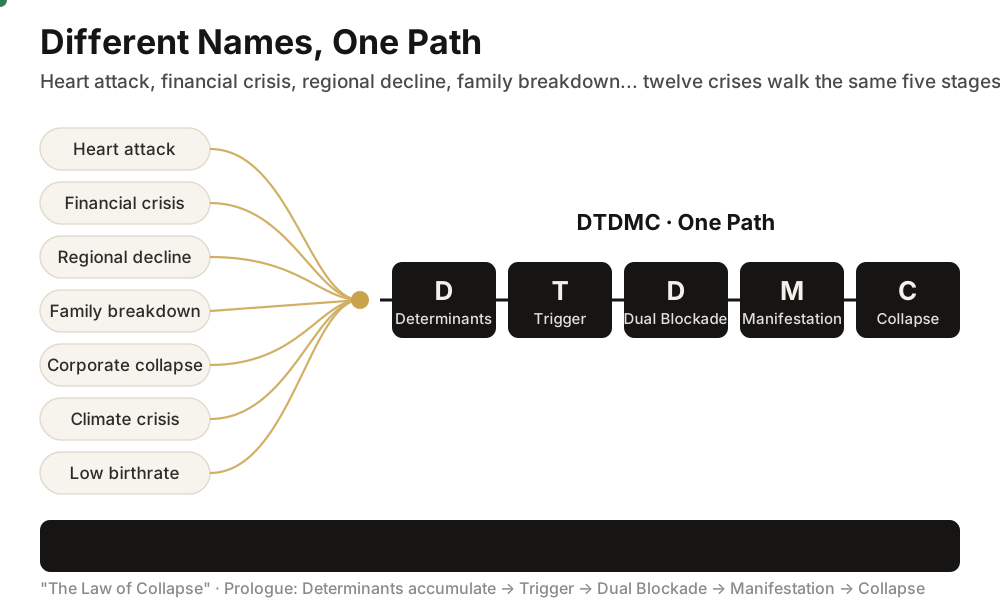
These crises all carry different names: heart attack, financial crisis, regional decline, family breakdown, corporate bankruptcy, climate crisis, youth unemployment, low birthrate, supply-chain collapse, information distortion, healthcare crisis. Different experts handle each one. Different government agencies oversee each one. Different prescriptions are written for each one.
But step back and look at these crises together, and a pattern emerges that is, frankly, unsettling in how identical it is.
Flow Means Life, Blockage Means Death
The essence of what this book has to say is simple.
To be alive is to be flowing.
If the heart stops, the brain dies within three minutes. Without flowing blood, no oxygen, nutrients, or immune cells can be delivered. This is not a story about the human body alone. If income stops flowing into a household, crisis arrives within months. If dues and participation stop flowing through an organization, it falls apart. If revenue stops flowing through a company, it can go bankrupt while still showing a profit on paper. If tax revenue stops flowing into a nation, its finances collapse. If people and spending stop flowing through a region, commercial districts die, schools close, and villages disappear. If carbon is not absorbed and simply accumulates on Earth, the climate system collapses. If accurate information stops flowing through a society, democracy breaks down. If opportunity stops flowing to young people, an entire generation's vitality disappears.
When flow stops, death follows. Whether it is a cell, a household, a company, a city, a nation, or the planet. There are no exceptions.
Yet we do not see the process by which flow stops. The 42-year-old office worker's blood vessels had been narrowing gradually over decades, without symptoms. That town in South Jeolla had been losing population for ten years, while public services continued as usual. That couple's conversations had been dwindling for five years, while the people around them thought they were "doing well." That company's cash cushion had been shrinking for three years, while its financial statements still showed a profit.
Right up until the moment flow stops completely, the system looks fine on the surface. This is a property common to every crisis.
A crisis is not made by shock. It is made by stagnant flow. The shock is merely the trigger; the real cause is a circulatory stagnation that has already been under way for a long time.
Every Crisis in the World Walks the Same Path
We have always clung to the name of the problem. "This is a financial crisis." "This is an environmental problem." "This is a low-birthrate problem." "This is a healthcare problem." Once a name is attached, an expert in that field is summoned, and a prescription is issued in that field's language. But that prescription usually only treats the symptom: it does not explain why the problem worsened along that particular path in the first place.
Placing a stent in a heart-attack patient is emergency treatment that opens a blocked vessel, but the stent contains no answer to "why did the vessel become blocked in the first place?" Cutting interest rates is a measure to stimulate the economy, but the rate cut contains no answer to "why isn't the market responding?" Paying a birth subsidy is population policy, but the subsidy contains no answer to "why aren't young people responding to the incentive to have children?" Injecting a budget into a region is a balanced-development policy, but the budget contains no answer to "why does that money leak out toward the capital region instead of circulating locally?"
This book looks not at the name of the problem, but at its path.
And tracing that path has led to a striking discovery. From heart attacks to household collapse, corporate bankruptcy, regional decline, financial crisis, climate change, youth unemployment, low birthrate, income polarization, generational conflict, healthcare crisis, and supply-chain collapse, every crisis in the world, without exception, passes through the same five stages.
First, determinants accumulate. Pressure builds quietly. In the body, chronic inflammation and nutritional imbalance accumulate. In a household, fixed-cost burden and a lack of communication accumulate. In a company, technical debt and market saturation accumulate. In a region, population outflow and industrial monoculture accumulate. On the planet, carbon emissions and ecological destruction accumulate. At this stage there are no symptoms at all. The seeds of every crisis are always sown in peaceful times.
Second, a survival mode begins. Once accumulated pressure reaches a limit, the system begins melting down long-term assets to defend against the immediate threat. In our bodies, calcium is dissolved out of bone to maintain blood calcium levels. In a household, insurance is cancelled, savings are broken, loans are taken out. In a company, retained earnings are drawn down and new investment is frozen. A nation issues bonds, pulling forward future tax revenue. Young people pull forward future income through student loans, and the planet emits carbon beyond what its forests and oceans can absorb. At this stage, too, everything looks normal on the surface. In fact, "right now, while it still looks fine" is the most dangerous moment of all.
Third, dual blockade occurs. This is the core of the book, and the common cause running through every crisis in the world.
When the outflow of long-term assets continues, two blockades occur simultaneously.
One is signal blockade (CAM). Energy is not absorbed at the system's smallest operating unit, and the execution switch turns off. If a cell does not absorb calcium, immunity, contraction, and secretion cannot execute. If a neighborhood shop does not absorb consumer spending, employment and reinvestment cannot execute. Signal blockade is exactly what is happening when a rate cut fails to revive investment, or a policy announcement fails to move conditions on the ground.
The other is channel blockade (DLT). The physical pathway itself becomes obstructed. Just as calcium that has leached from bone turns into microcalcification and blocks capillaries, fixed costs and non-performing debt block the income pathway, and housing and childcare costs block the life-course pathway. Just as blood flow drops sharply, proportional to the fourth power of the radius, when a vessel narrows even slightly, any pathway's flow collapses sharply the moment it narrows even a little.
Signal blockade alone, or channel blockade alone, the system can withstand. But when both occur at once, a self-reinforcing loop kicks in where deterioration breeds further deterioration. When the signal breaks down, function declines and the channel blocks further; when the channel blocks, conditions worsen and the signal grows even more unstable. This is the point of no return, the critical threshold. Heart attacks, financial crises, regional decline, family breakdown, and the crossing of climate tipping points all occur at the moment this self-reinforcing loop of dual blockade crosses that threshold.
Fourth, symptoms appear. Once dual blockade exceeds the limits of compensation, visible symptoms finally surface. Blood pressure rises, credit card payments fall behind, revenue declines, storefronts sit empty, glaciers melt, news coverage turns extreme. But by the time symptoms are visible, dual blockade has already progressed substantially.
Fifth, the path forks into recovery or collapse. The outcome is decided by remaining buffer capacity, the timing of intervention, and whether the signal and the channel are restored simultaneously. The result is not luck: it is the logical consequence of the path taken.
DTDMC: One Physical Law Running Through Every Crisis in the World
Until now, we have treated each crisis as a separate event. We have divided health into the domain of medicine, the economy into the domain of economics, the environment into the domain of environmental science, and education into the domain of education, seeking solutions in each field's own language. But just as hypertension, diabetes, and arthritis progress simultaneously inside one patient's body, low birthrate, polarization, regional decline, and youth unemployment are progressing simultaneously in our society, and these are not separate problems, but the same phenomenon unfolding along one shared path.
DTDMC, presented in this book, integrates that shared path into a single system.
The determinants of a problem accumulate quietly for years (D, Determinants). The moment accumulated pressure crosses a limit, the system begins melting down long-term assets (T, Trigger). The byproduct of that compensation hardens in the channel, blocking the signal and the pathway simultaneously (D, Dual Blockade). The result of that blockage erupts into visible symptoms (M, Manifestation). And depending on remaining capacity, the system recovers or collapses (C, Collapse). The initials of these five stages spell DTDMC.
| Stage | Name | Description |
|---|---|---|
| D | Determinants | The seeds of the problem accumulate quietly |
| T | Trigger | Accumulated pressure crosses a limit, and a compensatory response that melts down long-term assets fires |
| D | Dual Blockade | The byproduct of compensation deposits, blocking both signal and channel at once |
| M | Manifestation | Visible symptoms erupt |
| C | Collapse | Recovery or collapse. The end of the path |
The core discovery of this theory is that the pathway system originating in medicine (DIAH-7M), in which four triggers, Deficiency (D), Inflammation (I), Acidosis (A), and Hypoxia (H), force the outflow of long-term assets, whose deposited byproduct accumulates into dual blockade (signal blockade CAM: impaired calcium absorption, and channel blockade DLT: lumen and passage blockage by deposits), leading to seven manifestations (7M), is observed with the same structure not only in medicine but across the economy, society, the environment, and individual lives.
This is not a metaphor. The statement "the economy becomes blocked the way a blood vessel becomes blocked" is not a figure of speech. The decline in blood flow inside a vessel and the decline in the flow of funds inside an economy correspond structurally to the same physical principle: Poiseuille's law, in which flow drops sharply, proportional to the fourth power of the radius, as a channel narrows. This book systematically presents the structural correspondence with nine physical principles: the continuity equation, Poiseuille's law, entropy, the diffusion law, Ohm's law, the Bernoulli principle, the law of inertia, positive feedback, and the critical-threshold principle.
DTDMC does not deny established, validated knowledge. It is the work of aligning facts already proven in medicine, economics, sociology, and environmental science along a single shared path. Calcium homeostasis established by endocrinology, the inflammatory response established by immunology, the liquidity trap established by economics, class entrenchment established by sociology, all of this knowledge had been scattered across different journals, but DTDMC shows that it all operates along one common path. DTDMC is the first integrated interpretive framework to systematically present this structural identity with the principles of physical flow.
One clarification up front: this book does not predict what your blood pressure in mmHg will be, or by what percentage GDP will grow. Physical laws come in two kinds: laws of quantity, which calculate "how much," and laws of path, which diagnose "in what order does it collapse." Newton's F=ma is a law of quantity. DTDMC is a law of path. Which stage are we in right now, and has dual blockade been established or not: that judgment is the entirety of this book. And that judgment is a validated one: it detected six independent crises with 100 percent accuracy across 690 months of economic data from Korea and the United States.
Not Fixing It, But Preventing It From Happening
So what is the solution? The essence of the alternative this book presents is, again, simple.
Not opening what is blocked, but preventing the blockage from ever forming.
When the body is steadily replenished with calcium whose absorption is proven, blood calcium levels stabilize. When blood calcium is stable, the emergency order from the parathyroid hormone does not fire. Without that emergency order, calcium does not leach from bone. Without outflow, microcalcification does not form. Without calcification, the channel does not block. At the same time, when calcium is steadily absorbed by cells, signal blockade does not occur either. This is not opening a blocked vessel with a stent: it is removing the very reason the vessel would block.
This principle applies identically to every domain.
When a family has ten minutes of conversation every day, emotions are absorbed and trust circulates. When trust circulates, conflict does not accumulate. When a continuously circulating local currency is injected into a neighborhood economy, spending is absorbed and circulated within the region. Because it does not leak outward, capital does not calcify. When first jobs and asset-building opportunities are absorbed by the young, opportunity circulates and outflow across generations is contained. When classrooms are guaranteed enough teachers and small class sizes, learning is absorbed and less leaks out into private tutoring. When carbon sinks are restored on Earth, carbon is absorbed and atmospheric accumulation is contained.
The alternative rests on one principle: inject what gets absorbed and circulated at the fundamental unit, and outflow is contained, and blockade is cut off at the source. This works identically in a cell, in a family, in a classroom, in a neighborhood, in a nation, and on the planet.
The Journey This Book Guides You Through
Chapters 1 through 3 confirm that circulation is the condition of survival, reveal that the depletion of margin is the true starting point of crisis, and then lay out the skeleton of the book's central design: the five-stage DTDMC path.
Chapters 4 through 8 dig into each of the five stages one at a time: how determinants accumulate (Ch. 4), how the trigger fires (Ch. 5), why dual blockade is a point of no return (Ch. 6), what forms manifestation takes (Ch. 7), and what decides the fork between recovery and collapse (Ch. 8).
Chapter 9 presents the alternative. The point is not to fix, but to prevent. Inject what gets absorbed and circulated at the fundamental unit, and outflow is contained, and blockade is cut off at the source.
Chapter 10 covers a paradigm shift in diagnosis: how to read the gradient rather than the absolute value, and why forecasting the leading path, rather than watching a lagging indicator, is the only viable survival strategy.
This is not a specialist text in any single field. It is not a health book, an economics book, or a social commentary. It is an integrated guide that reveals why every problem in the world worsens along the same path, and presents, together, how to read that path and how to change it.
Only Those Who Read the Path Survive
Let us return once more to the emergency room at 3 a.m. We can now read, as a path, what happened inside the 42-year-old office worker's blood vessels.
For decades, determinants accumulated: insufficient calcium absorption and chronic stress. The DIAH trigger fired, and calcium began leaching from bone. As the leached calcium turned into microcalcification and deposited on the vessel wall, channel blockade progressed, while the cell's calcium signaling system was destabilized, and signal blockade progressed simultaneously. When dual blockade crossed the critical threshold, a blood clot formed and the vessel closed completely.
The same path was operating in that town in South Jeolla. Determinants accumulated: industrial monoculture and lack of infrastructure. As young people began to leave, the region's long-term asset, its population, drained away. Signal blockade, in which young people stopped responding to policy signals, and channel blockade, in which spending was sucked toward the capital region, progressed simultaneously. When the self-reinforcing loop (population decline killing the commercial district, and the dying district driving further population decline) crossed the critical threshold, the school closed and the village began to disappear.
The same path was operating in that household, in that company, in the financial markets, in that young person's life, in the climate system, in the information ecosystem. The names are all different. The path is one. Determinants accumulate → Trigger fires → Dual blockade → Manifestation → Collapse.
This book says: do not cling to the name of the problem; read the path instead. If you can read the path, you can judge which stage you are in now, whether the signal is blocked or the channel is blocked, and what needs to be absorbed at the fundamental unit. If you can judge that, you can change direction before crossing the point of no return.
Flow means life, blockage means death. Only those who read the path survive the next crisis.
Now, let us step into that path.