
This piece is the opening portion of Chapter 21 (1) of The Declaration of the Age of Physical Economics (Yoon Jong-won, Yoon So-ri, Yoon Jun). It is an academic exposition presenting the authors' physical economics hypothesis, and the body, figures, and citations follow the manuscript as written.
Why Not Every Crisis Can Be Handled with the Same Tool
The fact that the same diagnostic result produced different recovery speeds in two patients is contained within 690 months of two-country data. The 2008 global financial crisis and the 2020 coronavirus shock are those two cases. In both crises, the output of the diagnostic engine was "dual blockade." This means they were events to which the same diagnostic name was assigned according to the same criteria for judgment. Yet the time it took for the blockade to be released differed by a factor of six. In the 2008 global financial crisis, in both countries the blockade was maintained for 6 months, and in the 2020 coronavirus shock, in both countries the blockade was released after just 1 month.
This single fact, that the diagnosis was the same but the recovery speed differed, leads to the conclusion that a crisis cannot be handled as a single kind. The same principle operates in medicine as well. When two patients come to the emergency room complaining of the same symptom of chest pain, if one had temporary chest pain from a few days of overtime work and the other had a myocardial infarction from arteriosclerosis accumulated over several years, the same medication cannot be prescribed. A doctor who issues the same prescription just because the surface symptoms are the same cannot save the patient. This is because the same prescription is sufficient for one patient and insufficient for the other.
The fact that the same principle operates in economic crises as well is clearly contained within the two-country track record. The foreign exchange crisis South Korea experienced in 1997 and the coronavirus crisis South Korea experienced in 2020, the global financial crisis the United States experienced in 2008 and the coronavirus crisis the United States experienced in 2020. In all four crises the intensity of the surface shock was similar, or the coronavirus was even greater, but the essence of the crisis was completely different. Because the essence differed, the prescription had to differ, and the recovery speed had to differ as well.
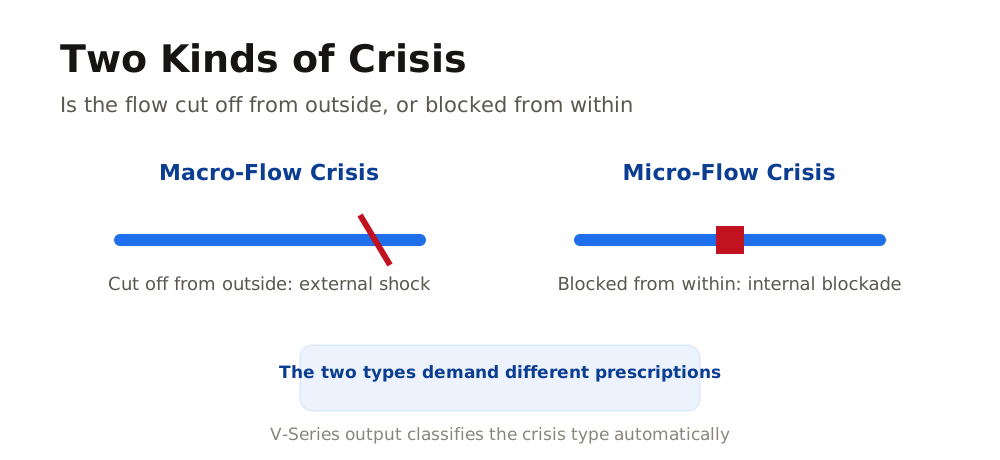
If the four crises are classified not by their surface appearance but by their operating mechanism, two groups are formed. One group consists of crises in which a shock that came from the outside immediately blocked the great highways of the economy, namely the market, interest rates, and the exchange rate. The coronavirus belongs here. The other group consists of crises in which household debt and interest burdens accumulated from within gradually narrowed the back alleys of the economy, namely households and consumption, until they finally exploded. The global financial crisis, the IMF foreign exchange crisis, and the credit card debacle belong here. The two groups are called macro-flow crises and micro-flow crises.
The qualification for this two-type classification to be established as an academic proposition is secured along two lines. The first line is the universality of the classification. Every crisis case within the 690 months of two-country data, combining Korea's 351 months and America's 339 months, is classified as one of the two types, and there is no case outside the classification. The second line is the verifiability of the classification. The V-Series structural diagnostic tool produces different outputs for the two types, the blockade diagnostic tool shows different detection times for the two types, and the 7M manifestation pattern appears differently in the two types. The result that three independent tools classify the same crisis in the same direction proves the objectivity of the classification system.
The history of failed attempts to handle the two types with the same tool is contained within the two-country data. In the 2008 global financial crisis, the U.S. Federal Reserve cut the benchmark interest rate from 5.25% to a level near 0%, a cumulative 525 bp cut, and the Bank of Korea also cut a cumulative 225 bp over the same period. Yet the blockade was not released by interest rate cuts alone. The reason the blockade stage was maintained for 5 months lies in the path by which the prescription reaches its target. The prescription of an interest rate cut takes effect only when the signal passes through large financial institutions and reaches households, but in a state where microcalcification had thickly accumulated in the household microvasculature, that signal could not reach the microvasculature.
The same prescription took effect immediately in the coronavirus crisis. Right after the blockade was established in April 2020, both countries carried out direct support to households, and the blockade was released after just 1 month. Korea directly deposited emergency disaster relief funds of 14.3 trillion won from the first supplementary budget, up to 1 million won per household, and the United States, out of the 2.2 trillion dollars of the Coronavirus Aid, Relief, and Economic Security Act (CARES Act), disbursed 1,200 dollars per person by deposit from the Internal Revenue Service. The result that the same prescription of a direct injection into the microvasculature was immediately absorbed in the coronavirus crisis but was not absorbed in the global financial crisis points to the essential difference between the two crises. It becomes possible to assess that a sameness of surface does not mean a sameness of essence.
The 9 Classification Criteria of Macro-Flow Crises and Micro-Flow Crises
| Classification Criterion | Macro-Flow Crisis | Micro-Flow Crisis |
|---|---|---|
| Starting point of the shock | External (virus, war, financial panic) | Internal (interest burden, household debt, contraction of consumption) |
| Bodily analogy | Traffic accident (even a healthy person gets hurt) | Arteriosclerosis to myocardial infarction (gradual progression) |
| Path that is blocked | Large arteries (market, interest rates, exchange rate) immediately | Microvasculature (households, consumption, employment) gradually |
| State of the microvasculature | Not the determining variable for the prescription's arrival | The key variable for the prescription's arrival |
| Detection timing | Same month (simultaneous with the external event) | About 6 months in advance (tracking structural accumulation) |
| V-Series output | Low or undetected | High or medium |
| 7M manifestation pattern | 1M (acute infarction) + 6M (supply chain rupture) immediately and simultaneously | 1M + 2M (slowdown) + 3M (exhaustion) + 6M sequentially or in combination |
| Prescription principle | Direct injection into the microvasculature (direct support to households) | Structural cleaning + direct injection combined |
| Verified cases | Korea and U.S. coronavirus 2020 | Korea IMF 1997, Korea credit cards 2003, Korea and U.S. GFC 2008 |
The fact that all 9 classification criteria shown in this table have been verified with 690 months of two-country data determines the academic weight of the classification system. Each and every classification criterion outputs a different value for the two groups, and that output operated consistently across the verified cases. The universality of the classification is proven in that it is not the result of one classification criterion happening to divide the two groups, but the result of all 9 criteria dividing the two groups in the same direction. The assessment is derived that the classification of crisis types is not an incidental function of the diagnostic system but an academic proposition embedded in the foundation of the system's design.
The two-type classification is a resource needed not only for the accuracy of diagnosis but also for the accuracy of the prescription. Applying a micro prescription to a macro crisis leads to a result in which the funds are not recovered but flow into asset markets, driving up real estate and stock prices. Applying a macro prescription to a micro crisis leads to a result in which the funds remain in large financial institutions and do not reach the microvasculature. The five months of policy non-response at the beginning of the global financial crisis is the direct verification of that second case. The task of dividing the two types and applying the prescription suited to each type is the branching point that determines the efficiency of crisis response.
The Crisis in Which Flow Is Cut Off from Outside: The Definition and Operating Mode of the Macro-Flow Crisis
A macro-flow crisis is a crisis in which an acute shock applied from the outside immediately blocks the large arteries of the economy. The parts corresponding to the large arteries are the market, interest rates, the exchange rate, and the global supply chain. At the very moment an external event occurs, the shock reaches the large arteries, and that arrival immediately halts all flows. The coronavirus pandemic is the clearest case. The event of the World Health Organization declaring a pandemic on March 11, 2020 produced the result that every country received the same kind of shock at the same point in time. California in the United States entered the first statewide lockdown in the United States on March 19, and by the end of March more than 90% of the U.S. population was placed under stay-at-home orders. In Korea as well, social distancing was expanded nationwide over the same period.
The way an external shock blocks the large arteries is unrelated to the degree to which the microvasculature has narrowed. This is the first branching point that divides macro crises from micro crises. Transposed to the human body, a traffic accident is the closest analogy. If a normally healthy person gets into a traffic accident, a fracture may occur, and a patient whose arteriosclerosis had been progressing normally will not fracture if they do not get into an accident. Because the accident comes from the outside and applies a shock immediately, the everyday state of health has no effect on the occurrence of the accident itself. However, the everyday state of health does affect the speed of recovery from the accident. A person who was healthy recovers faster, and a person who had an underlying condition recovers more slowly.
This analogy fits the two-country coronavirus data of 2020 exactly. Both countries received the coronavirus shock in the form of a macro crisis, and both countries released the blockade after just 1 month with the prescription of a direct injection into the microvasculature. The reason that 1-month recovery was possible, however, is that in both countries the microvasculature was in a clean state right before the coronavirus, a fact recorded in the V-Series data. America's 2019 V-Series was close to the healthiest state within the 339-month verification period. The proportion of income households used each month to repay debt was 9.7%, the lowest level since the 1980s, the savings rate had recovered to 7.5%, and housing prices were at a stable stage at about 4.2 times household annual income. Korea's 2019 V-Series was also at the undetected stage, and right before receiving the external shock of the coronavirus, the Korean household microvasculature was likewise in a clean state.
The reason the detection timing of a macro crisis becomes the same month lies in the operating mode of the crisis itself. In a micro crisis, the internal accumulation process proceeds over several months to several years, so the diagnostic tool can catch the signal before the crisis ignites while tracking that accumulation process. In a macro crisis, because the shock arrives at the very moment the external event occurs, there is no accumulation process itself. In a state where there is no accumulation, the signal of accumulation cannot be caught. The result that in the coronavirus case the blockade diagnosis caught the dual blockade in April 2020 is that the tool operated precisely at the earliest point at which it could catch it. Demanding a 6-month advance detection for a macro crisis is like demanding that a blood pressure gauge predict a traffic accident.
If we trace the timeline of the U.S. coronavirus, the operating mode of a macro crisis becomes clear. On January 21, 2020, the first coronavirus case was reported in Washington State, on March 11 the World Health Organization declared a pandemic, and on March 13 the Trump administration declared a national emergency. On March 19, California entered a statewide lockdown, and on March 23 the S&P 500 hit its low of 2,237.40. That was the result of a 33.9% drop in about a month from the peak of 3,386.15 (February 19). In that same April, the U.S. blockade diagnosis output a dual blockade, and the triple trigger of D (income polarization), I (cost explosion), and H (monetary sclerosis) was activated. Simultaneous warning signals emerged across multiple axes. In the second quarter of 2020, U.S. GDP recorded an annualized -31.4%, the largest quarterly decline since the Second World War.
The timeline of the Korean coronavirus also showed a similar macro-crisis pattern, but one different signal was caught alongside it. In Korea, a weak leading signal was caught in the blockade diagnosis in November 2019, a signal blockade ignited in January 2020, and a dual blockade was established in April. Unlike in the United States, there is a reason a leading signal of about 3 months existed in Korea. In the latter half of 2019 the Korean economy was seeing its exports slow due to the aftermath of the U.S.-China trade dispute and falling semiconductor prices, and faint stress was being detected in some gauges. The result was that the external shock of the coronavirus was applied on top of this faint stress, causing the strength of the signal to grow rapidly. Yet Korea's V-Series maintained the undetected stage right before the coronavirus, and the blockade period was likewise limited to just 1 month, the same as the United States. The result is that the essential characteristics of a macro crisis were maintained in the Korean case as well.
If we examine the 7 surfacing patterns of a macro crisis, the aspect in which 1M (acute infarction) and 6M (rupture) manifest immediately and simultaneously is revealed. 1M is an acute infarction of the capital market. The result that the S&P 500 dropped 33.9% in a month is the direct measurement of 1M. Korea's KOSPI also dropped from the 2,200 line to 1,439 over the same period, about 33%. 6M is a rupture of the supply chain. As lockdowns halted factories and paralyzed ports, Korea's exports fell 24.3% in April year on year, and U.S. manufacturing production fell 12.7% over the same period. The fact that 1M and 6M manifested immediately and simultaneously is because a macro crisis blocks the large arteries and the entrance to the microvasculature at the same time. This was the result of capital flows and logistics flows halting all at once.
Macro-Flow Crisis Verified Cases (Korea and U.S. Coronavirus 2020)
| Item | Korea Coronavirus 2020 | U.S. Coronavirus 2020 |
|---|---|---|
| External shock event | 3.11 WHO pandemic declaration, social distancing expanded nationwide | 3.11 WHO pandemic declaration, 3.13 national emergency, 3.19 California first lockdown |
| Advance detection timing | 2019.11 weak leading signal, 2020.1 CAM ignition, 2020.4 dual blockade | 2020.4 dual blockade (same-month detection, macro standard) |
| Blockade stage signal | Crisis stage, simultaneous warning across multiple axes, D+I+H triple trigger | Crisis stage, simultaneous warning across multiple axes, D+I+H triple trigger |
| V-Series just before the blockade | Undetected (2019 structural health) | Very low (V13 9.7%, V6 7.5%, V4 4.2 times) |
| Shock measurement (GDP) | 2020 Q2 -3.2% | 2020 Q2 -31.4% (annualized), largest since the Second World War |
| Shock measurement (market) | KOSPI about -33% from peak, 3.19 low 1,439.43 | S&P 500 -33.9%, 3.23 low 2,237.40 |
| 1M acute infarction manifestation | KOSPI plunge immediately | S&P 500 -33.9% over a month immediately |
| 6M supply chain rupture manifestation | Exports April -24.3% | Manufacturing production -12.7% |
| Prescription fund scale | First supplementary budget 14.3 trillion (0.74% of GDP) | CARES Act 2.2 trillion dollars (10.5% of GDP) |
| Prescription arrival timing | 4.30 passed, 5.4 disbursement of up to 1 million won per household begins | 4.11 first deposits begin, deposits to 88 million households completed by end of April |
| Blockade release | 2020.5 (1-month blockade) | 2020.5 (1-month blockade) |
The two-country parallelism shown in this table is the direct verification of the macro-crisis classification. The same external event (the WHO pandemic declaration) applied the same kind of shock to both countries at the same time, both countries' blockade diagnoses output a dual blockade in the same April, both countries' V-Series were at a stage below the danger threshold, and both countries released the blockade after just 1 month. The scale of policy funds differed by a factor of 14 between the two countries, but the prescription principle of funds reaching households directly was identical in both countries, and the recovery time was identical in both countries. The result that the prescription principle is the variable that determines recovery time, and not the absolute scale of policy funds, is revealed in the comparison of the two countries.
Whether the second case of a macro crisis is the 1997 Korean foreign exchange crisis requires additional examination. The surface of the 1997 foreign exchange crisis appears to be an external shock. The plunge of the Thai baht in July 1997 was the ignition point, on October 23 Hong Kong's Hang Seng Index plunged 10.4% in a single day, spreading the crisis across all of Asia, and on November 21 Korea applied to the IMF for a bailout. Yet the first signal of the blockade diagnosis came in May 1997. That is 2 months before the plunge of the Thai baht and 6 months before the IMF bailout. The fact that the Korean blockade diagnosis caught a signal before the external event points to the result that the 1997 crisis was not an external-shock type but an internal-accumulation type that ignited by way of an external shock. The accumulation of the external debt structure proceeded from 1994 through 1996, and in a state where that accumulation had reached its critical point, the external trigger of the Thai baht plunge provided the ignition point. The 1997 foreign exchange crisis is classified as a variant of a micro crisis and does not fall under macro crises.
The Crisis in Which Flow Is Blocked from Within: The Definition and Operating Mode of the Micro-Flow Crisis
A micro-flow crisis is a crisis that explodes after debt, interest burdens, and the contraction of consumption accumulated from within have gradually narrowed the microvasculature. The parts corresponding to the microvasculature are households, back-alley commerce, small and medium-sized enterprises, and the labor market. The essence of this crisis is not that a shock comes from the outside but that pressure grows from the inside. Until the external event occurs, the surface of the crisis is not visible, but beneath that surface the interest on debt is accumulating on the walls of the microvasculature in the form of microcalcification. When the critical point is reached, a single small external trigger becomes the ignition point, and the accumulated pressure bursts all at once.
Transposed to the human body, a myocardial infarction due to arteriosclerosis is the closest analogy. From one's thirties, cholesterol begins to accumulate in the arteries. In one's forties, cholesterol combines with calcium and adheres firmly to the vessel walls, forming microcalcification. In one's fifties, as the microcalcification thickens, the cross-sectional area of the vessel narrows. Because the patient normally feels no chest pain, they do not know they are a patient. In one's sixties, when the cross-sectional area of the artery crosses the critical point, the space for blood flow to pass through becomes insufficient, and the moment a small external trigger such as light exercise or cold is applied, a myocardial infarction ignites. The ignition point of the outbreak is the external trigger, but the essence of the outbreak is 30 years of internal accumulation. The same time structure operates in micro crises as well.
Within the 690 months of two-country data there are 4 micro crises. In Korea, the 1997 IMF foreign exchange crisis, the 2003 credit card debacle, and the 2008 global financial crisis were micro crises. In the United States, the 2008 global financial crisis was a micro crisis. In all 4, an external trigger provided the ignition point, but the essence of the outbreak was internal accumulation over several years. The fact that in all 4 the blockade diagnosis output its first warning signal about 6 months before the external trigger event directly shows the time structure of a micro crisis.
The 1997 Korean foreign exchange crisis is a case of an external-debt-type micro crisis. In the mid-1990s, Korea's external debt structure was rapidly weakening. The proportion of short-term external debt soared from 40% in 1994 to 45% in 1995 and 58% in 1996, and more than half of the external debt was short-term that had to be repaid within a year. The average debt ratio of Korean companies exceeded 387% in 1996 and 500% in 1997, and a mismatch structure of borrowing foreign currency short-term and tying it up in long-term investments accumulated. The current account deficit grew from 4.5 billion dollars in 1994 to 8.5 billion dollars in 1995 and 23.1 billion dollars in 1996, a fivefold increase in two years. The surface GDP growth rate looked sound at 7.0% in 1996 and 5.9% in 1997, but behind that growth the external debt structure was rapidly collapsing. In May 1997 the Korean blockade diagnosis ignited its first signal blockade, and at the same time the Korean government's official position was "Korea is different from Thailand." Six months later, on November 21, Korea applied to the IMF for a bailout, and on December 4 the IMF approved a standby loan on the scale of 15.5 billion SDR.
The picture captured by a satellite looking down on the Korean mainland from space over the same period directly shows the physical contraction of the foreign exchange crisis. Korea's nighttime light activity index fell 8.1% from 8.84 (DN unit peak) in 1996 to 8.12 in 1997, and in 1998 recorded a cumulative decline of 10.5% to 7.91. Before it began to recover to 8.52 in 1999, the result over about 2 years was that nighttime activity in the cities and industrial complexes of the Korean mainland fell by more than about 10% compared to an average year. Over the same period the average surface temperature of the Korean mainland fell by about 1.3 degrees, from 24.48 degrees in 1997 to 23.22 degrees in 1998. This is the result of the urban heat island weakening as downtown industrial activity decreased, and it is a satellite measurement directly linked to the state in which the operating rate of Korean manufacturing factories fell by about 60% compared to an average year in 1998. The result is that data captured from space, separate from government statistics, objectively confirmed the physical contraction of the 1997 crisis.
The 2003 Korean credit card debacle is a case of a self-generated micro crisis. The decisive characteristic of the credit card debacle is that it was an event in which households collapsed in a state with no external shock, with inflation stable, and with the exchange rate stable. Korea's consumer price inflation rate was 2.7% in 2002 and 3.5% in 2003, within the Bank of Korea's price stability target range. Foreign exchange reserves exceeded 150 billion dollars, a level incomparable to that just before the 1997 foreign exchange crisis. The reason households collapsed nonetheless lay in the competition to issue credit cards and the accumulation of household interest burdens. At the end of 2002, the number of credit cards issued in Korea was 104.8 million, a period when each person held an average of 4.6 cards. The household credit balance was 444 trillion won in 2002, a 28% increase over the previous year, and a structure in which a considerable portion of household disposable income flowed out each month as credit card interest and fees became entrenched. In May 2003 the Korean blockade diagnosis ignited a signal blockade, and 6 months later, in November, the LG Card default moratorium event occurred. The nighttime light activity in Korea captured by satellite also recorded a contraction in the same direction over the same period. The result that it fell 4.4% from 8.50 in 2001 to 8.13 in 2002, and recorded a cumulative decline of 12.2% to 7.46 in 2003 when the credit card debacle reached its peak, is data measuring from space the deep scar a self-generated micro crisis left on the real economy.
The 2008 Korean global financial crisis is a case in which a crisis that ignited in the United States was transmitted, but its essence is a micro crisis. The external trigger, the bankruptcy of Lehman Brothers, occurred on September 15, 2008, and before that external event the Korean blockade diagnosis output its first warning signal in March 2008. That is about 6 months of advance detection. What was happening inside the Korean microvasculature during those 6 months shows the time structure of a micro crisis. Korea's household Gini coefficient rose to the 0.340 level entering the 2000s, with income polarization accumulating, household interest burdens were gradually increasing, and in the export-dependent Korean economic structure, cracks in the U.S. household sector had begun to affect Korean exports. In September 2008 the Lehman bankruptcy provided the external trigger, and at the same time the Korean blockade diagnosis output a dual blockade.
The U.S. global financial crisis of the same year is the clearest case of a micro crisis. It was an event in which an external trigger was applied in a state where microcalcification had been deposited most thickly inside the American household microvasculature. The proportion of income households used each month to repay debt reached its peak at 13.0% in 2005 and 13.2% in 2006, and a state in which about one-eighth of household disposable income disappeared each month as debt repayment lasted for more than 2 years. Housing prices rose to 5.1 times household annual income in 2006, with latent microcalcification near its peak, and the personal savings rate fell to 2.6% in 2005 and then remained at a low state around 2.8% again in 2007. The emergency vault was nearly emptying. The U.S. V-Series output the high stage during this period, and the blockade diagnosis output its first warning signal in March 2008. That was the point at which about 6 months remained until the external trigger, the Lehman bankruptcy.