
This piece is the first part of Chapter 5 of Calcium: The Reality of Evolution That Darwin and the Genome Map Missed (Yoon Jong-won). The body, figures, and citations follow the manuscript as written.
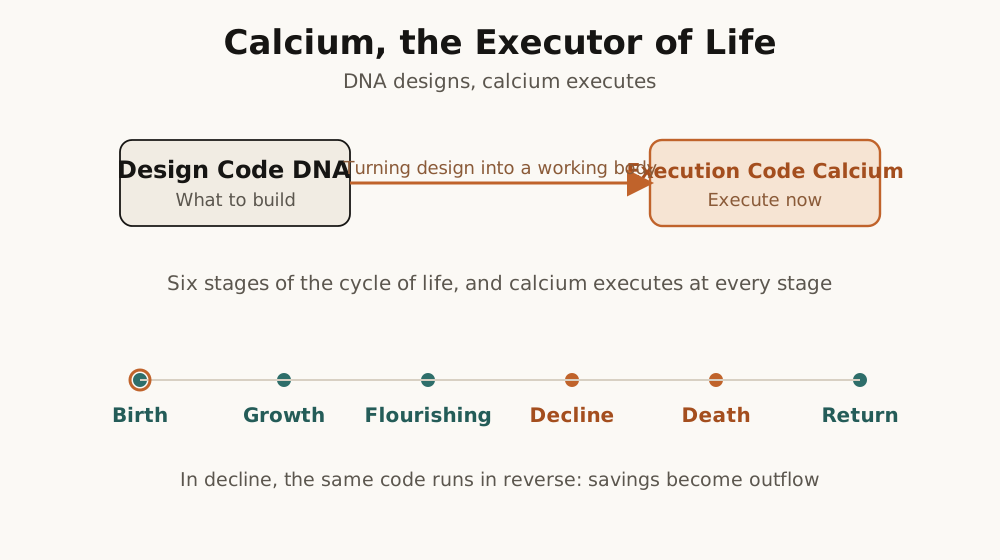
Introduction: DNA Designs, Calcium Executes
Ever since James Watson and Francis Crick discovered the double-helix structure of DNA in 1953, we have called DNA the blueprint of life. In DNA is recorded the method for making proteins, encoded when a cell must divide, and written down in what order development must proceed.
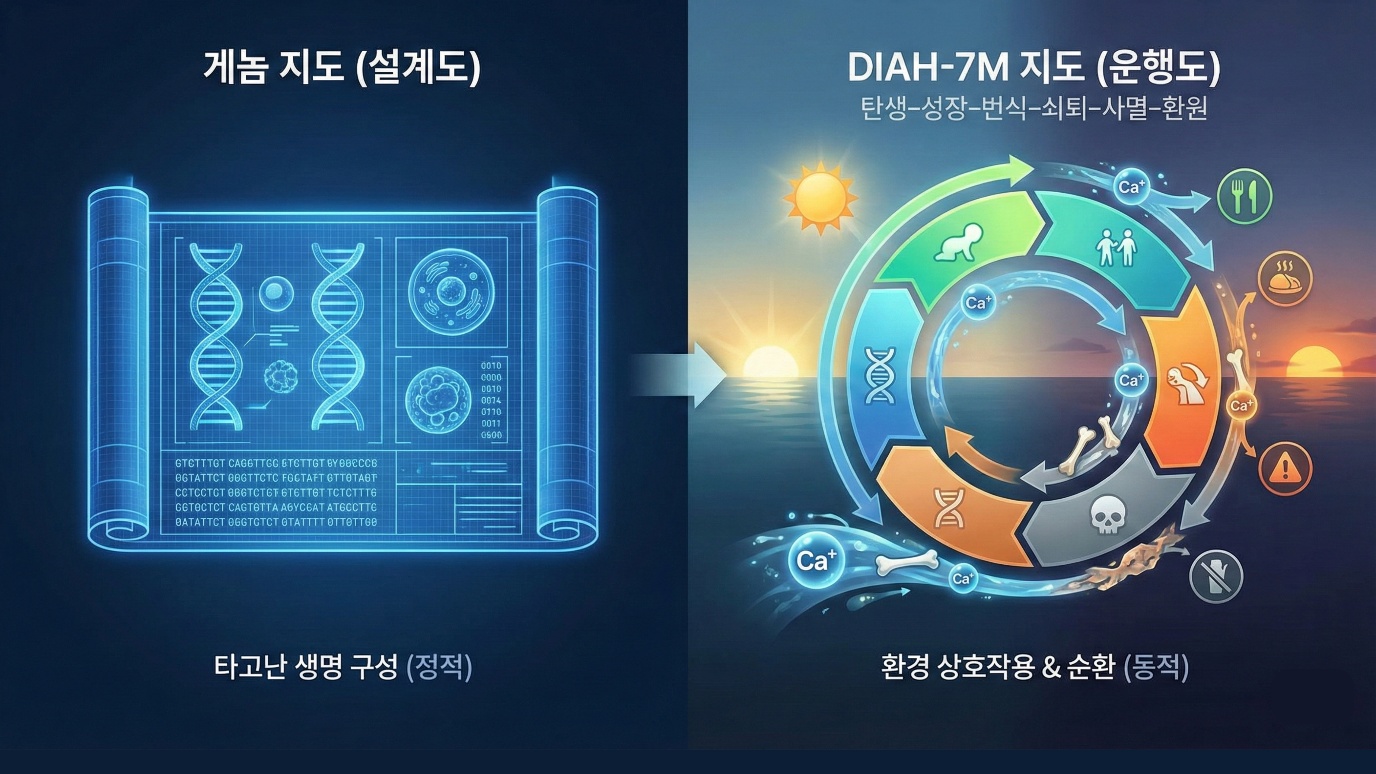
Along with the advance of genetics, DNA came to be regarded as the molecule that holds the essence of life, and the idea spread widely that if we understand DNA we can understand life. But nothing happens from a blueprint alone. No matter how precisely an architectural blueprint is drawn, someone must lay the bricks, weave the rebar, and pour the concrete for the building to rise. The blueprint tells us what must be made, but what actually makes it is not the blueprint. In life, what is that executor? Several molecules could be candidates. ATP, as the energy currency, supplies fuel to all activities of the cell. cAMP, as an intracellular signal messenger, transmits hormone signals into the interior of the cell. But the most universal and fundamental executor is calcium. At nearly every decisive moment of life, calcium pulls the trigger. If DNA is the design code, calcium is the execution code that turns that design into reality.
Let us think of the moment sperm meets egg. Fertilization is the beginning of life. Two half cells meet and become one complete cell, and this cell begins to divide, eventually becoming a complete individual. Yet at the moment the sperm enters the egg, a dramatic event occurs inside the egg. It is the calcium wave. In the mammalian egg, this calcium wave begins at the point where the sperm entered and sweeps across the whole egg in about 2 seconds. The heart beats about 2.5 to 3 billion times over a lifetime. At every beat the cardiac muscle cells contract and relax. At the heart of this process is calcium. The core of synaptic transmission is also calcium. 86 billion neurons, 100 trillion synapses. At every moment, hundreds of billions of calcium signals create our thoughts, emotions, and memories. In the process of blood coagulation that stops bleeding, calcium is also essential. Calcium is involved not only in the beginning of life but also in its end. When a cell receives a death signal, calcium is released from the endoplasmic reticulum, and this calcium flows into the mitochondria and executes apoptosis.
Why of all things did evolution choose calcium as the executor of life? First, calcium was already there. The primordial sea was rich in calcium, and for evolution, repurposing what already exists for a new use is more efficient than inventing something entirely new. Second, calcium was dangerous. A high cytosolic calcium concentration has a toxicity that precipitates ATP, aggregates proteins, and destroys the cell membrane. Because of this danger, every cell had to rigorously exclude calcium, and as a result a concentration difference of more than ten thousand-fold arose between the extracellular calcium concentration of about 1 to 2 millimolar and the intracellular calcium concentration of about 100 nanomolar. Thanks to this enormous concentration gradient, even if a calcium channel opens for only an instant, calcium rushes in quickly and creates a clear signal, and when the channel closes and pumps remove the calcium, the signal ends quickly. Third, calcium is versatile. It is a signaling molecule and at the same time a structural material. Fourth, calcium is recyclable. It is stored in the bones and drawn out and used when needed, and when the organism dies it returns to the environment and is used again by another life. If DNA is the program code, that is, the design code, then calcium is the interpreter that runs that code, that is, the execution code.
| Role | DNA (design code) | Calcium (execution code) |
|---|---|---|
| Function | Designs what to make and how | Executes when to activate |
| Analogy | Architectural blueprint, stored program | Builder, execute button |
| Property | Information storage, heredity | Signal transmission, trigger |
| Without it | No blueprint | The blueprint stays on paper |
The Six Stages of the Cycle of Life: At Every Stage, Calcium Executes
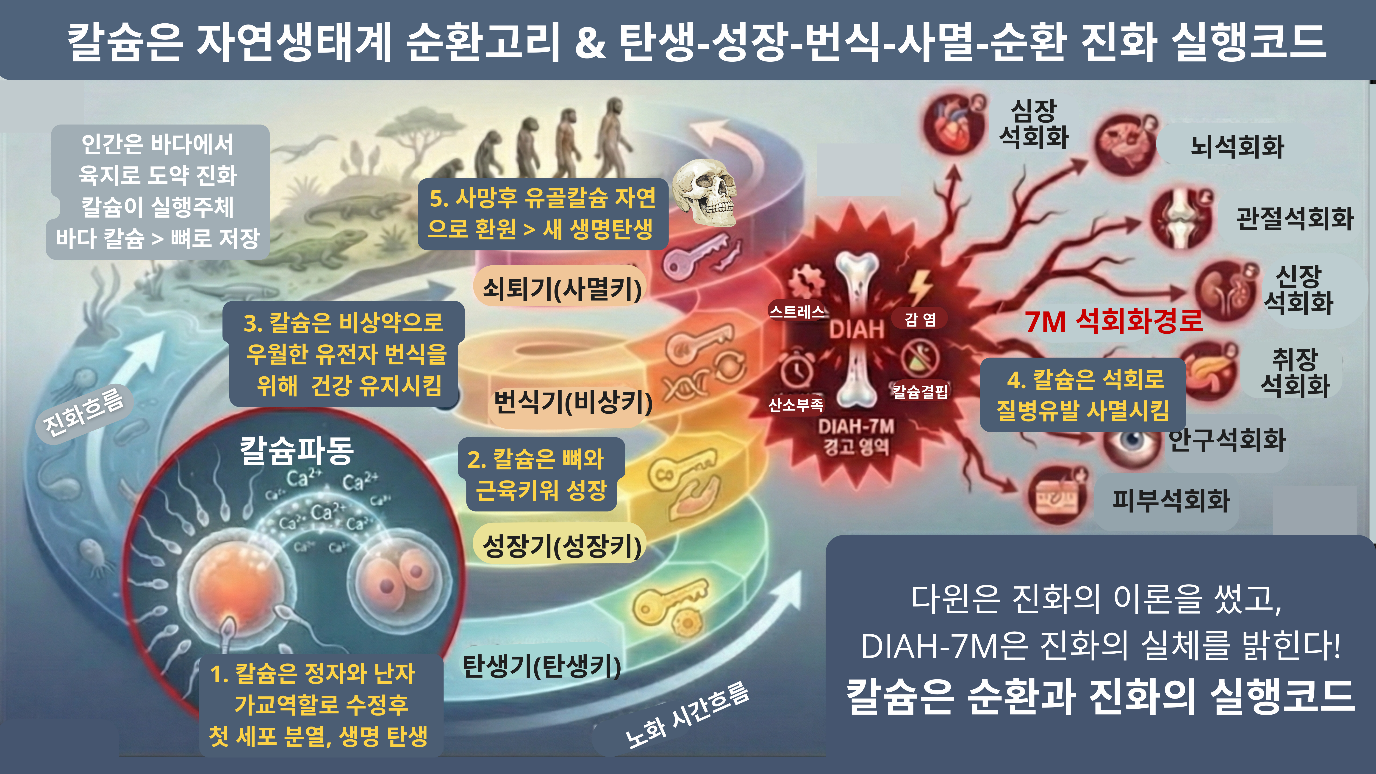
If DNA is the blueprint of life, calcium is the execution code that turns that design into reality. Earlier we looked at the role of calcium in fertilization, heartbeat, synaptic transmission, blood coagulation, and cell death. But this is only the tip of the iceberg. The range in which calcium operates as the execution code is far wider than this. Life cycles through six stages. Birth, growth, flourishing, decline, death, return. What is astonishing is that at every one of these stages, DNA designs and calcium executes. DNA designs "what to make and how," and calcium executes "when to activate." Just as a building does not rise from a blueprint alone, life does not operate from DNA alone. Let us look at how calcium operates as the execution code at each stage. Why of all things calcium? The cell normally keeps its cytosolic calcium concentration extremely low, at about 100 nanomolar. It creates a concentration difference of more than ten thousand-fold with the millimolar level outside the cell, opens a channel to let calcium in only when needed, and immediately pumps it out. By the amplitude, frequency, and rhythm of this sharp rise and fall, it distinguishes "what command it is." This is the physical condition that allows calcium to be the execution code.
1. The Stage of Birth: The Trigger That Awakens Life
To begin life, calcium acts as the trigger that awakens the egg. DNA prepares everything. It designs the egg activation system, arranges the cortical granules, and assembles the cell-division apparatus. It is like a performance hall where the stage machinery has been perfectly installed. The lighting, the sound, the actors, and the props are all in place. But if the curtain does not rise, the performance does not begin. At the moment the sperm enters, calcium raises the curtain. When the calcium wave sweeps across the egg, the performance called life begins. The cortical reaction occurs and blocks the entry of other sperm, and the first cell division begins. DNA designed the command "start life," but what executes that command is calcium. The fact that, in in vitro fertilization, when an egg does not activate its activation can be induced with a calcium ionophore shows that calcium is the key switch of the beginning of life. The sperm delivers genetic material, and at the same time it brings along a factor that triggers calcium oscillations inside the egg. If DNA is the script, calcium is the director who shouts "Action!" This is the execution code. The key to birth is calcium.
2. The Stage of Growth: The Builder That Completes the Body
To complete the body, calcium acts as the builder that stacks up bone and executes cell division. DNA provides the blueprint for making the body. It designs the structure of the growth plate, programs the osteoblasts and chondrocytes, and encodes the proteins that regulate the cell cycle. In an architectural analogy, DNA is the blueprint of a 100-story building. The steel-frame structure, the plumbing, and the electrical system are all drawn in the plans. But a building does not rise from a blueprint alone. Someone must issue commands at the site every day: "raise the rebar here," "pour the concrete there." Calcium is that site supervisor. At every moment a chondrocyte proliferates and enlarges in the growth plate, a calcium signal executes the transition of the cell cycle. Cell division is decided by the sum of several signals, but the representative signal that stamps the timing of "whether to execute now" is calcium. That hydroxyapatite is deposited between collagen to form hard bone is also something calcium executes. DNA provides the blueprint "make a skeleton 180 centimeters tall," but what stacks up the bone day by day is calcium. It is the same in neural development. The process by which synapses form in the brain and unnecessary connections are pruned can be likened to tending a garden. DNA has designed which trees and flowers to plant, but which branches to keep alive and which to cut away is decided by the pattern of the calcium signal. A frequently used circuit is learned toward reinforcement as the calcium signal pattern repeats, and a less-used circuit tilts toward pruning as the calcium signal weakens. If DNA is the blueprint of growth, calcium is the builder who makes decisions at the site every day. This is the execution code. The key to growth is calcium.
3. The Stage of Flourishing: The Trillions of Execute Buttons
When growth ends, the period of flourishing comes. In this period the organism runs all of its systems to survive, to reproduce, and to pass superior genes to the next generation. From an evolutionary standpoint, every physiological function of the flourishing period aims at one goal. The maximization of reproductive success. That the heart beats, that we breathe, that we think, that we react to threats, are all for survival, and survival is for reproduction. In the stage of flourishing, calcium is at its busiest. In the basic functions that maintain life, in nutrition and metabolism, in sensation and cognition, in movement and reaction, in protection and defense, in higher functions, and even in reproduction itself, in every domain calcium operates as the execution code. Let us look at them one by one.
Basic Functions That Maintain Life
Let us think of the heartbeat. DNA designs the heart. It makes the cardiac muscle cells, arranges the ryanodine receptors, installs the SERCA pumps, and assembles the contractile proteins. In an automobile analogy, it is a state in which the engine block, the pistons, and the fuel injection system are all assembled. But if you do not turn the ignition key, the engine does not run. At every beat, calcium turns the ignition key. When an electrical signal arrives, the calcium channels of the cell membrane open, a small amount of calcium enters, and this stimulates the ryanodine receptors of the sarcoplasmic reticulum so that a large amount of calcium is released. This is calcium-induced calcium release, CICR. This process repeats 60 to 100 times per minute, about 100,000 times a day, and 2.5 to 3 billion times over a lifetime. DNA designed the heart, but what makes the heart beat at every moment is calcium. This is the execution code.
Let us think of breathing. DNA designs the respiratory system. It makes the diaphragm, arranges the intercostal muscles, and programs the respiratory center in the brainstem. In a pump analogy, all the parts of the pump are assembled. But if you do not pump, air does not come in. At every breath, calcium does the pumping. A signal goes out from the respiratory center of the brainstem, an action potential is transmitted along the phrenic nerve, and calcium flows into the muscle cells of the diaphragm so that the muscle contracts. 12 to 20 times per minute, about 20,000 times a day, hundreds of millions of times over a lifetime. DNA designed the respiratory system, but what makes us breathe at every moment is calcium. This is the execution code.
Let us think of the autonomic nerves. DNA designs the sympathetic and parasympathetic nervous systems. In an automobile analogy, the accelerator and brake pedals are installed. But if you do not press the pedals, the car neither moves nor stops. In a crisis, calcium steps on the accelerator. When the sympathetic nerve is activated, calcium flows into the nerve terminals, norepinephrine is released, the heart rate rises, and blood pressure climbs. When the crisis passes, calcium steps on the brake. At the parasympathetic terminals, calcium influx triggers the release of acetylcholine, and the heart rate comes down. DNA designed the acceleration and deceleration systems, but what actually presses the pedals is calcium. This is the execution code.
Let us think of blood pressure regulation. DNA designs the vascular smooth muscle. In a plumbing analogy, the pipes and valves are installed. But if you do not operate the valves, the water pressure is not regulated. At every moment, calcium operates the valves. When calcium flows into the vascular smooth muscle cells, the muscle contracts, the vessel narrows, and blood pressure rises. When calcium is removed by the pumps, the muscle relaxes, the vessel widens, and blood pressure falls. DNA designed the blood pressure regulation system, but what actually raises and lowers blood pressure is calcium. This is the execution code.
Let us think of body temperature regulation. DNA designs the body temperature regulation system. In an air conditioning analogy, the cooler, the heater, the ventilator, and the temperature sensor are all installed. But if you do not run the system, the indoor temperature is not regulated. When it is hot, calcium runs the cooling system. When calcium flows into the sweat gland cells, sweat is secreted, and when calcium leaves the skin vascular smooth muscle, the vessels dilate and heat is released. When it is cold, calcium runs the heating system. When repetitive calcium signals are transmitted to the skeletal muscle, shivering occurs and heat is produced. DNA designed the body temperature regulation system, but what actually runs the system is calcium. This is the execution code.
| Function | What DNA designed | What calcium executes | Analogy |
|---|---|---|---|
| Heartbeat | Cardiac muscle cells, ryanodine receptors, SERCA | Contraction/relaxation repeated by CICR | The ignition key of the engine |
| Breathing | Diaphragm, intercostal muscles, respiratory center | Air intake/expulsion by muscle contraction | Pumping |
| Autonomic nerves | Sympathetic/parasympathetic nervous system | Norepinephrine /acetylcholine release | Accelerator and brake |
| Blood pressure | Vascular smooth muscle, calcium channels/pumps | Vascular contraction/relaxation | Valve operation |
| Body temperature | Sweat glands, skin vessels, shivering reflex | Sweat secretion, vascular dilation/contraction, shivering | Air conditioning system |
Nutrition and Metabolism
Let us think of digestion. DNA designs the digestive system. It makes the smooth muscle of the esophagus, stomach, and intestines, arranges the parietal cells that secrete gastric acid, and programs the pancreatic cells that secrete digestive enzymes. In a conveyor belt analogy, the belt, the rollers, and the sorting device are all installed. But if you do not turn the belt, the goods do not move. When food comes in, calcium turns the conveyor belt. When calcium flows in turn into the smooth muscle of the esophagus, stomach, small intestine, and large intestine, peristalsis occurs and the food moves downward. When calcium flows into the parietal cells of the stomach, gastric acid is secreted. When calcium flows into the acinar cells of the pancreas, digestive enzymes are secreted. DNA designed the digestive system, but what actually executes digestion is calcium. This is the execution code.
Let us think of the act of swallowing. DNA designs the swallowing system. In an elevator analogy, the elevator box, the cable, and the motor are installed. But if you do not press the button, the elevator does not move. When you swallow food, calcium presses the button. Calcium flows into the tongue muscles and pushes the food toward the pharynx, calcium flows into the pharyngeal muscles and passes the food to the esophagus, and calcium flows sequentially into the esophageal muscles and sends the food down to the stomach. This whole process occurs in the correct order within about 8 seconds. DNA designed the swallowing system, but what actually executes the act of swallowing is calcium. This is the execution code.
Let us think of saliva secretion. DNA designs the salivary glands. In a faucet analogy, the water pipe, the valve, and the tap are installed. But if you do not turn the tap, the water does not come out. When you smell food or see food, calcium turns the faucet. When an autonomic signal arrives at the salivary gland, calcium flows into the cells, and saliva is secreted. 1 to 1.5 liters of saliva a day is secreted this way. DNA designed the salivary glands, but what actually makes saliva secrete is calcium. This is the execution code.
Let us think of urination. DNA designs the urination system. In a drainage system analogy, the water tank, the drainpipe, and the valve are installed. But if you do not open the valve, the water does not drain. When the bladder fills, calcium opens the drainage valve. When the micturition reflex begins, calcium flows into the detrusor muscle so that the bladder contracts, and as calcium leaves the sphincter the sphincter relaxes and urine is expelled. DNA designed the urination system, but what actually executes urination is calcium. This is the execution code.
Let us think of hunger and satiety. DNA designs the appetite regulation system. In a car's fuel gauge analogy, the fuel sensor, the gauge screen, and the warning light are installed. But if it does not send a signal, the driver cannot know the fuel state. When the stomach empties, calcium sends the "low fuel" signal. In most hormones and secretory signals, calcium is used as the trigger at the moment of secretion, that is, exocytosis. DNA designed the appetite regulation system, but at the moment the "I'm hungry" or "I'm full" signal is actually sent, calcium is involved. This is the execution code.
Let us think of enzyme activation. DNA designs countless enzymes. Yet many enzymes are activated only when calcium binds. CaMK, PKC, calpain, amylase, lipase, and so on are like this. In a factory machine analogy, the machine is installed but it operates only when the power comes on. Calcium turns on the power. When a signal comes to the cell, the calcium concentration rises, calcium binds to the enzyme, and the enzyme is activated and performs its work. DNA designed the enzyme, but the switch that operates the enzyme is calcium. This is the execution code.
Let us think of hormone secretion. DNA designs the hormone secretion system. In a delivery service analogy, the goods are packed and stacked in the logistics warehouse. But if there is no delivery order, the goods stay in the warehouse. When blood sugar rises, calcium orders the delivery of insulin. When calcium flows into the beta cells, the insulin granules fuse with the cell membrane and insulin is secreted into the blood. DNA designed the hormone, but what sends the hormone out into the blood is calcium. This is the execution code.
| Function | What DNA designed | What calcium executes | Analogy |
|---|---|---|---|
| Digestion | Gastrointestinal smooth muscle, secretory cells | Peristalsis, gastric acid/enzyme secretion | Conveyor belt |
| Swallowing | Tongue/pharynx/esophagus muscles | Sequential muscle contraction | Elevator button |
| Saliva secretion | Salivary glands, secretory cells | Triggering saliva secretion | Faucet |
| Urination | Detrusor muscle, sphincter | Bladder contraction, sphincter relaxation | Drainage valve |
| Enzymes | CaMK, PKC, calpain, etc. | Enzyme activation | The power of the machine |
| Hormones | Insulin, sex hormones, etc. | Secretion by exocytosis | Delivery order |
Sensation and Cognition
Let us think of brain activity. DNA designs 86 billion neurons and 100 trillion synapses. In an internet analogy, fiber-optic cables, routers, and servers are installed all over the world. But if data packets are not transmitted, the internet does not work. At every moment, calcium transmits the data packets. When an action potential reaches a synaptic terminal, the calcium channels open, calcium flows in, synaptotagmin is activated, and neurotransmitters are released. This process occurs at every moment across 100 trillion synapses, and all of our thoughts, emotions, and memories are made. DNA designed the brain, but what makes the brain work is calcium. This is the execution code.
Let us think of vision. DNA designs the eye. It arranges 120 million rod cells and 6 million cone cells, makes the layered structure of the retina, and connects the optic nerve to the brain. In a camera analogy, the lens, the sensor, and the image processing chip are installed. But if the shutter is not pressed, the photo is not taken. When light reaches the retina, calcium presses the shutter. When the light signal is converted into an electrical signal in the photoreceptor, calcium acts as a feedback regulator that tunes sensitivity and adaptation. At the same time, at the photoreceptor synapse the calcium channels mediate neurotransmitter release so that visual information passes to the next stage. DNA designed the eye, but what executes seeing is calcium. This is the execution code.
Let us think of hearing. DNA designs the ear. It arranges the 16,000 hair cells of the cochlea and connects the auditory nerve to the brain. In a microphone analogy, the diaphragm, the circuit, and the amplifier are installed. But if the signal is not transmitted, the sound is not recorded. When sound comes in, calcium transmits the signal. When a sound wave shakes the cilia of the hair cells, the mechanically gated channels open and calcium flows in, and this calcium triggers neurotransmitter release so that the signal is transmitted to the auditory nerve. DNA designed the ear, but what executes hearing is calcium. This is the execution code.
Let us think of taste. DNA designs the taste buds of the tongue. It arranges taste receptor cells in about 10,000 taste buds. In a food taster analogy, the taster is ready to taste and evaluate. But if the evaluation result is not conveyed, the information is useless. When food touches the tongue, calcium conveys the evaluation result. When a taste substance binds to a receptor, the intracellular signaling pathway is activated, calcium flows into the cytosol, and neurotransmitters are released so that the signal is transmitted to the taste nerve. DNA designed the taste system, but what executes tasting is calcium. This is the execution code.
Let us think of smell. DNA designs the olfactory epithelium of the nose. It arranges millions of olfactory neurons that express about 400 kinds of different olfactory receptors. In a gas detector analogy, hundreds of kinds of sensors are installed. But if the detection result is not conveyed, the alarm does not sound. When odor molecules enter the nose, calcium conveys the detection result. When an odor molecule binds to an olfactory receptor, the signal transduction pathway is activated, calcium flows in, an action potential is generated, and olfactory information is transmitted to the brain. DNA designed the olfactory system, but what executes smelling is calcium. This is the execution code.
Let us think of touch. DNA designs the sensory receptors of the skin. It arranges Meissner corpuscles, Pacinian corpuscles, Merkel discs, and Ruffini endings. In a touchscreen analogy, sensors that detect pressure are laid across the whole screen. But if the touch information is not transmitted, the screen does not respond. When pressure is applied to the skin, calcium transmits the touch information. When a mechanical stimulus deforms a sensory receptor, the ion channels open and ions including calcium flow in so that a nerve signal is generated. DNA designed the touch system, but what makes us feel touch is calcium. This is the execution code.
Let us think of the sense of balance. DNA designs the vestibular organ of the inner ear. It makes three semicircular canals and two otolith organs, and arranges hair cells. In a gyroscope analogy, sensors that detect rotation and tilt are installed. But if the sensor information is not conveyed, posture is not corrected. When the body tilts or rotates, calcium conveys the sensor information. When the movement of the lymph fluid bends the cilia of the hair cells, the mechanically gated channels open and calcium flows in, and neurotransmitters are released so that the signal is transmitted to the vestibular nerve. DNA designed the balance system, but what makes us keep our balance is calcium. This is the execution code.
Let us think of pain. DNA designs the nociceptive system. It distributes nociceptors throughout the body and arranges the nerve fibers that transmit pain signals. In a fire alarm analogy, the heat detector, the smoke detector, and the alarm siren are installed. But if the alarm does not sound, we cannot evacuate even when a fire breaks out. When tissue is damaged, calcium sounds the fire alarm. When the substances released from the damaged site activate the nociceptors, the ion channels open, ions including calcium flow in and an action potential is generated, and the pain signal is transmitted to the brain. DNA designed the nociceptive system, but what sends the signal that it hurts is calcium. This is the execution code.
| Sense | What DNA designed | What calcium executes | Analogy |
|---|---|---|---|
| Brain/thought | 86 billion neurons, 100 trillion synapses | Neurotransmitter release | Internet data transmission |
| Vision | Rod/cone cells, retina, optic nerve | Phototransduction, signal transmission | Camera shutter |
| Hearing | Hair cells, auditory nerve | Neurotransmitter release | Microphone signal transmission |
| Taste | Taste buds, taste receptors | Neurotransmitter release | Taster evaluation conveyed |
| Smell | 400 kinds of olfactory receptors | Action potential generation | Gas detection alarm |
| Touch | Meissner/Pacinian corpuscles, etc. | Nerve signal generation | Touchscreen |
| Balance | Semicircular canals, otolith organs | Neurotransmitter release | Gyroscope |
| Pain | Nociceptors, pain nerves | Action potential generation | Fire alarm |