
This piece is the opening part of Chapter 12 of Stones in the Body: More Frightening Than Cancer (Yoon Jong-won). It is a narrative that carries the author's academic hypothesis, and the body, figures, and citations follow the manuscript as written.
Isaac Newton said, "If I have seen further, it is by standing on the shoulders of giants."
The DIAH-7M Chronic Disease Pathway System is the same. This discovery was not born out of nothing. Darwin's theory of evolution, the Human Genome Project, modern medicine, the traditional medicine of the East. It stands upon the tower of knowledge that these great predecessors built up over hundreds of years.
But standing on the shoulders of giants does not simply mean following the beaten path of existing knowledge. There is a new landscape that becomes visible only from that height. It means passing through the door the predecessors opened, and going forward onto the road they never managed to travel.
There is one thing that must be made clear. DIAH-7M is not a new hypothesis. It is an integrated system completed by rearranging countless already scientifically validated fragments around a single axis called calcium. That PTH draws calcium out of the bones, that inflammation activates osteoclasts, that acidosis dissolves bone, that hypoxia causes calcium overload in cells, that calcification deposits in blood vessels. Every one of these individual mechanisms has already been validated over several decades. DIAH-7M gathers these scattered puzzle pieces and shows one completed picture.
Of course calcium is not the only thing involved in life. Countless minerals such as magnesium, zinc, and iron each play their own role. But calcium holds a uniquely commanding position among them. It is calcium that has the largest amount among the minerals in the body (about 1kg in an adult), the most sophisticated homeostatic regulation system (a system centered on the parathyroid hormone and vitamin D axis and assisted by calcitonin), and the most wide-ranging physiological role (bone structure, nerve transmission, muscle contraction, cell signaling). DIAH-7M does not look only at calcium; it is a frame that takes calcium as the central axis to understand the entire mineral balance and metabolism.
In this chapter we look at how DIAH-7M meets the great existing discoveries, how it converses with them, and how together they complete a larger picture. And in that process we will confirm what the unique value that only DIAH-7M possesses is.
The Door Darwin Opened: The Question the Theory of Evolution Left and the Answer of DIAH-7M
In 1859, Charles Darwin, through "On the Origin of Species," fundamentally changed humanity's worldview. Darwin's theory of evolution is the foundation of modern biology and one of the greatest milestones in the intellectual history of humankind. Life is not fixed but changes. The species that adapts to its environment survives, and the species that does not disappears. This simple yet powerful principle of natural selection became the greatest framework for explaining the diversity of life.
After Darwin, science set out to find the material basis of evolution. Mendel's laws of heredity were discovered, and DNA was revealed as the carrier of genetic information. DNA is the repository of information passed from parent to child, and the medium in which variation accumulates across generations. With this, the "informational mediator" of evolution was elucidated.
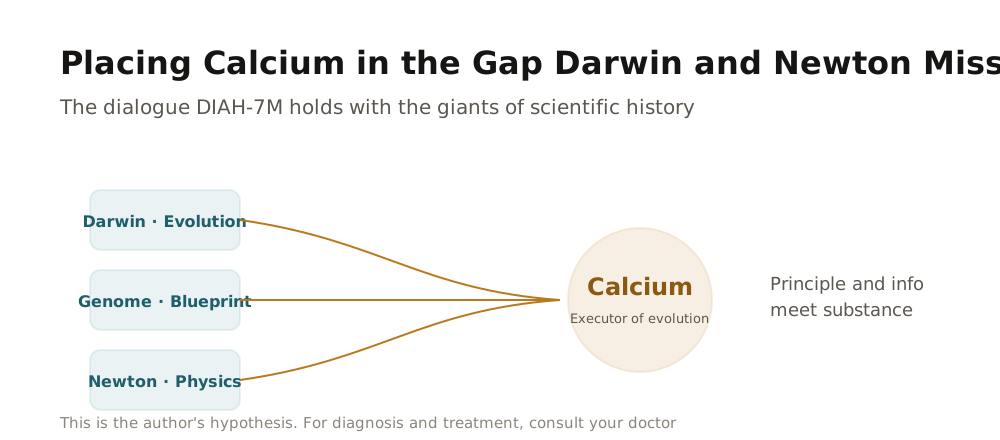
But here one question remains. DNA stores and transmits information. Then what takes charge of the physical operation that actually executes that information to build bone, to make the nerves work, to bring life into being and to close it? If DNA is the blueprint, who is the worker that reads and executes that blueprint?
DIAH-7M answers precisely this question. Calcium is the executor of evolution.
Giving hard shells to the mollusks in the Cambrian explosion, allowing vertebrates to leave the sea and climb onto land, giving birth to higher intelligence through the development of the nervous system and the brain. Calcium was present at the scene of every one of these evolutionary leaps.
Calcium is not a simple mineral but was the physical tool that nature used when it executed evolution. If DNA directs "what to make," calcium executes "how to make it and how to make it work." If Darwin discovered the principle of evolution, and DNA was revealed as the mediator of information, then DIAH-7M has discovered the executor that materially enforces that information.
This is not a denial of the theory of evolution. It is passing the great milestone that is the theory of evolution and taking one step further. It is principle and information meeting substance and thereby becoming, at last, a whole picture.
The Blueprint the Genome Drew: The Operating Chart Drawn Over It
In 2003, the Human Genome Project was completed. The base sequence of the 3 billion pairs of the human genes was all decoded. This was like reading out "the book of life." The Genome Project is a monumental achievement in the scientific history of humankind. This great feat achieved revolutionary results in cancer treatment, genetic disease diagnosis, personalized medicine, and more, and fundamentally broadened the horizon of modern medicine.
But before lifestyle-related chronic diseases such as hypertension, diabetes, and arthritis, it did not open the breakthrough that had been expected. Now, twenty years after the Genome Project was completed, these chronic diseases, far from decreasing, are increasing explosively. Why is that?
It is because in most lifestyle-related chronic diseases, environment and lifestyle take up a larger share than heredity. According to recent exposome research, in many chronic diseases the risk contribution that heredity explains is roughly at the 10 to 30% level, and the rest is taken up by environment, lifestyle, and exposure. The genome is a "blueprint." A blueprint shows what a building looks like, but it does not tell how that building is actually used, how it ages, and how it collapses. Even buildings built from the same blueprint have entirely different lifespans depending on how they are managed.
Even identical twins with the same genes draw entirely different health trajectories. One is healthy at 70, the other suffers from chronic disease at 50. If the blueprint is the same, why are the results different? Precisely because the "operating" is different. In what environment one lived, what food one ate, what stress one received. This is the DIAH condition.
If the genome map is the "innate blueprint," the DIAH-7M map is the "operating chart of living." With the blueprint alone the fate of a building cannot be known. Only with an operating chart can one know at last how a building is managed, how it ages, and when it is at risk of collapse.
DIAH-7M does not deny the Genome Project. It answers the question the genome left, "why do different results come from the same genes." By drawing an operating chart over the blueprint, it opens the road to recovering health sovereignty beyond the limits of the genes.
When the genome and DIAH-7M come together, we can at last see the complete picture of life. Innate condition and living environment, design and operation, heredity and the acquired. When these two meet and create synergy, true precision medicine becomes possible.
From Newton to Life: The Bridge Connecting the Inanimate and the Living
Modern science began with Newton's physics. The reason an apple falls, the reason planets revolve, the reason objects move. Newton clearly organized the laws of the inanimate world. His achievement is the foundation of the scientific revolution and a milestone that changed the whole of human civilization.
After that, science split into two branches. Physics and chemistry explored the world of the inanimate, and biology and medicine explored the world of life. The two worlds operated, as if they were separate kingdoms, by their own languages and laws.
But are the inanimate and the living really separate worlds?
DIAH-7M poses a question to this old boundary. Calcium begins in rock. It is inanimate. That calcium is weathered and becomes soil, is absorbed into plants, becomes the bones of animals, and flows through the blood of humans. It becomes living. And with death it returns once more to soil, to rock. It is reduced back to the inanimate.
Calcium endlessly crosses back and forth over the boundary of the inanimate and the living. No, for calcium that boundary never existed in the first place. Soil and life are a continuum connected by a single flow called calcium.
Of course other elements, such as the carbon cycle and the nitrogen cycle, also connect the inanimate and the living. But calcium has a decisive difference from these. Calcium does not simply cycle; it directly executes the structure of life (bone), the function (nerve transmission, muscle contraction), and even the transition between life and death (the calcium spark of birth, the calcium influx of death). Calcium is the mediator of the cycle and at the same time the executor of the operation of life.
This is the originality of DIAH-7M. Around a single substance called calcium, it has revealed the law of the cycle that runs through both the inanimate and the living. If Newton established the law of the inanimate, and Darwin established the law of the living, then DIAH-7M presents the law of the cycle that connects the two.
From Decomposition to Connection: Beyond Reductionism
The methodology of modern science was reductionism. It is understanding the complex by breaking it into the simple. The human body into organs, organs into tissues, tissues into cells, cells into molecules, molecules into atoms. It was believed that if one breaks it down and breaks it down again to understand the smallest unit, one can understand the whole.
This methodology achieved astonishing results. Antibiotics, vaccines, surgical techniques. The great achievements of modern medicine are all products of reductionism. Without reductionism there would be no modern medicine.
But before chronic disease, reductionism faced a new challenge. Hypertension, diabetes, arthritis, dementia. Why do these diseases come to one person at the same time? Why are they not solved with a single medication? Why does treating one produce another?
Reductionism revealed the parts but missed the whole. It saw the trees but failed to see the forest. It classified hundreds of chronic diseases each as a separate disease, but it could not explain why they come together.
DIAH-7M reconnects the parts that reductionism revealed. It reveals that the countless diseases with different names in fact follow one common pathway, DIAH → calcium efflux → the 7M pathological mechanisms.
This is not a denial of reductionism. It is the work of reconnecting those parts, upon the precise knowledge that reductionism built up, to restore the picture of the whole. It is answering the homework the age of decomposition left, "so how does the whole work."
Decomposition and connection are not opposed but complementary. If reductionism drew the precise map of the parts, DIAH-7M draws the map of the whole that connects those parts. When the two meet, only then is the complete map finished.
From the Laboratory to the Scene of Life: A Science Anyone Can Apply
Einstein's theory of relativity changed humanity's view of the universe. Quantum mechanics newly defined the essence of matter. The Genome Project decoded the secret of life. These discoveries are shining achievements in the intellectual history of humankind.
The theory of relativity is being applied indirectly to our daily life through GPS technology and the like. Quantum mechanics made semiconductors and smartphones possible. But an individual understanding the theory of relativity or quantum mechanics cannot thereby become healthy on their own or change their way of life. That is receiving a benefit indirectly through experts and technological systems.
DIAH-7M is different.
A person who has understood this principle can change starting from this evening's dinner table. They can choose an alkaline diet that prevents acidification. They can change starting from tonight's sleep. They can be wary of the sleep apnea that creates a state of hypoxia. They can change starting from tomorrow morning's breathing. They can increase the oxygen supply through deep breathing.
DIAH-7M is not a discovery confined to the laboratory. It is not a theory buried in a paper. It is a science that has come out onto the scene of life. It is not a tool only experts can use, but a compass that anyone can use starting today.
That the benefit of science is not monopolized by a few experts or by giant industries, but is delivered directly to every individual. That knowledge becomes not power but a tool. DIAH-7M opens that possibility.
From Disease Names to Pathways: A New Chapter to Open Together with Modern Medicine
Modern medicine is a great achievement that dramatically extended the average lifespan of humankind. Its paradigm is "disease-name-centered." When a symptom appears, an examination is done, a disease name is attached according to the examination results, and a medication matching that disease name is prescribed. For hypertension a blood pressure drug, for diabetes a blood sugar drug, for osteoporosis a calcium supplement, for hyperlipidemia a statin.
This system is very effective for acute diseases. For infection, antibiotics; for trauma, surgery. It is applying a clear solution to a clear cause.
But before chronic disease this paradigm faces a new challenge. Even taking medication, the disease does not heal. It is only managed. One medication gives rise to another side effect, and to prevent that side effect yet another medication is taken. The patient's medication bag grows thicker and thicker, and health hardly improves.
Why is that? Because a disease name is a result, not a cause. The disease name "hypertension" only describes the phenomenon of "blood pressure being high"; it does not tell "why it became high." Not knowing the cause, one cannot treat the cause, and it stops at management that only suppresses the result.
DIAH-7M looks not at the disease name but at the pathway. Hypertension, diabetes, arthritis, dementia. It reveals that these diseases with different names in fact arise along the same pathway, DIAH → calcium efflux → the 7M pathological mechanisms.
If one knows the pathway, one can block it before a disease name is attached. If the DIAH environment is improved, the door of the emergency warehouse does not open. If the door does not open, calcium does not flow out. If calcium does not flow out, the 7M mechanisms do not operate. If 7M does not operate, the occurrence of countless chronic diseases can be prevented at the source.
This is not a denial of modern medicine. The vast knowledge that modern medicine has accumulated, its sophisticated diagnostic technology, and its powerful treatment tools are still valid. DIAH-7M adds on top of that a new layer called the "pathway."
When disease-name-centered medicine and pathway-centered medicine meet, we can go beyond treatment to prevention, beyond management to fundamental resolution. This is the new chapter that modern medicine and DIAH-7M will open together.
The Handshake of East and West: The Meeting of the Theory of Circulation and Science
Eastern medicine has viewed the body from the perspective of circulation from thousands of years ago. If qi is blocked, disease arises; if qi flows, one becomes healthy. If the balance of yin and yang is broken, the body collapses; if the balance is restored, the body comes back to life. This viewpoint is deep wisdom that welled up from long observation and experience.
But the circulatory insight of Eastern medicine, differing in language system and empirical methodology from modern science, made dialogue with mainstream medicine difficult. What "qi is blocked" means materially, and what physiological state "the balance of yin and yang" is, were hard to explain in the same language.
DIAH-7M opens the possibility of translating the circulatory worldview of Eastern medicine into the language of science.
"Qi is blocked" can be understood as the DIAH environment being formed so that calcium flows out, and that calcium piling up in blood vessels and tissues and obstructing the flow. "The balance of yin and yang" can be interpreted as the balance between the state in which calcium works as an emergency medicine that saves life and the state in which it works as a poison that closes life.
What the East knew by intuition, DIAH-7M explains through the concrete substance called calcium and the concrete pathway called DIAH-7M. The abstract meets the substantial and becomes, at last, verifiable science.
This is neither a victory of Eastern medicine nor a victory of Western medicine. It is a handshake between the two. It is the holistic view of the East and the analytical methodology of the West meeting and filling in each other's empty places.
DIAH-7M is a bridge laid between East and West, tradition and modernity, philosophy and science. Upon this bridge, humanity can draw a more complete picture of health.
From a Discovery for Technology to a Discovery for Life
Over the past 300 years, the great discoveries of humankind led to the advancement of technology and industry.
Newton's mechanics gave birth to the Industrial Revolution. The steam engine, the train, the factory. Maxwell's electromagnetism opened the civilization of electricity. The light bulb, the telephone, the radio. Einstein's theory of relativity made nuclear energy and GPS possible. Quantum mechanics gave birth to the semiconductor and the computer.
These discoveries made human life convenient. Their value cannot be emphasized too much. But paradoxically, there is also an aspect in which that technology and industry now make us sick.
The chemicals that came out of factories cause inflammation in our bodies. The exhaust smoke that cars spew out pollutes the atmosphere. The additives in processed food acidify the body fluids. The sleep that smartphones have taken away creates a state of hypoxia. D, I, A, H. The by-products of modern civilization are forming the DIAH environment.
DIAH-7M runs against the grain of this flow.
This discovery is not for making a new machine. It is not for raising a new industry. It is solely a discovery for life.
The life of modern people suffering from chronic disease. The life of the earth groaning from environmental destruction. Saving these two at the same time is the sole goal that DIAH-7M aims for.
If the existing discoveries asked "how shall we use nature," DIAH-7M asks "how shall we coexist with nature." If the existing discoveries spoke in the language of technology, DIAH-7M speaks in the language of life.
This is the fundamental point of distinction that DIAH-7M possesses. From a discovery for technology to a discovery for life. From a science of use to a science of coexistence.
The Unique Position of DIAH-7M Alone: Scope, Relation, Method
In the history of science, great discoveries were sometimes connected to one another, sometimes complemented one another, and sometimes were integrated into one. But the manner differed for each discovery. To make clear how DIAH-7M differs from existing discoveries, let us examine the major cases in the history of science.
1. The Major Integration Attempts in the History of Science
In the 1930s and 1940s, the Modern Synthesis bound Darwin's theory of natural selection, Mendel's laws of heredity, and population genetics into one. This was a great achievement of fitting together scattered fragments within one academic field, evolutionary biology.
In the 1960s, Plate Tectonics explained continental drift, seafloor spreading, and earthquake and volcanic activity through a single mechanism. Taking the concrete physical process of mantle convection as the central axis, it connected the various phenomena that occur on the earth.
In the 1970s, James Lovelock's Gaia Hypothesis opened the pioneering perspective of viewing the entire earth as a single self-regulating system. It was the insight that life and the inanimate influence each other and maintain the earth's environment.
In 1977, George Engel's Biopsychosocial Model argued that disease must be understood as the interaction of biological, psychological, and social factors. It was an important critique of reductionist medicine and a presentation of a new direction.
In the 2000s, One Health presented the cooperative paradigm that human health, animal health, and environmental health are connected to one another. It opened the important direction that medicine, veterinary medicine, and environmental science must work together.
All of these attempts made great contributions in their own domains. DIAH-7M stands upon the shoulders of these predecessors.
2. The Unique Position of DIAH-7M
So how is DIAH-7M different from these predecessors? That difference can be organized along three axes. They are scope, relation, and method.
First, the expansion of scope: from a single discipline to the entire field
The Modern Synthesis connected the interior of evolutionary theory. Plate Tectonics connected the interior of earth science. All were the work of fitting together scattered fragments within one academic field.
DIAH-7M crosses the boundaries of disciplines. Evolutionary biology, genetics, physiology, pathology, environmental science, Eastern medicine, and even the critique of modern civilization: it connects things that had been in completely different domains into a single line.
The reason this connection is possible is that the substance called calcium actually runs through all of these domains. Calcium made shells in the Cambrian sea (evolution), forms bone according to the directions of DNA (heredity), operates the nerves and muscles (physiology), piles up as calcification and causes disease (pathology), cycles through the earth's ecosystem (environment), and materially embodies the "flow of qi" that Eastern medicine spoke of.
The expansion of scope was not achieved by force. It is possible because a single substance called calcium actually flows through all of these domains.