
This piece is the first part of Chapter 4 (1) of The Declaration of the Age of Physical Economics (Yoon Jong-won, Yoon So-ri, Yoon Jun). It is an academic exposition presenting the authors' physical economics hypothesis, and the body, figures, and citations follow the manuscript as written.
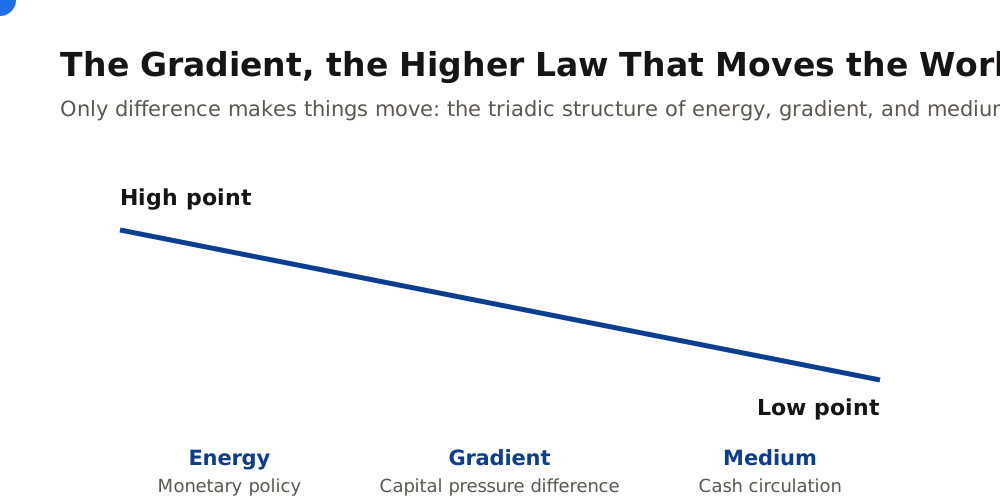
The thermometer that is the single indicator, the autopsy result sheet that is the after-the-fact report, the prescription that passes by way of the aorta. The three misalignments we have examined so far all share one assumption at the same place. It is the assumption of the invisible hand that has ruled economics for 250 years, namely that the market strikes its own balance. As long as this assumption is alive, the effort to catch a crisis in advance becomes an unnecessary task. That is where the reason lies that South Korea's self-employed took the shock head-on, without any advance warning, in the 1997 foreign exchange crisis, the 2003 card crisis, the 2008 global financial crisis, and the 2020 COVID crisis. The thirty years of a Korean restaurant owner who opened shop in 1996 are the span of time that passed through these four shocks one after another, and those thirty years become the guide for this chapter and the next.
A question follows. Why has the assumption of the invisible hand been sustained so powerfully? The reason economists could not shake this assumption for 250 years is that no universal law appeared that could replace the proposition that the market strikes its own balance. A law that works only within one nation's economy remains a hypothesis. But if the same law works beyond doubt everywhere in nature, in places that seem to have nothing to do with the economy, then that law is no longer a hypothesis. It takes its place as a universal cosmic law.
In this chapter, in search of that answer, we step one pace outside the economy. The reason a river flows, the reason a star shines, and the reason rain falls all happen under the same physical law, and what happens inside one nation's economy follows exactly the same law. The name of that law is the gradient.
The gradient is not a newly invented concept. It is a principle physics has treated for 150 years, only one that economics, meteorology, and environmental science have each locked away separately inside their own technical vocabularies. The aim of this chapter is to unpack this principle in everyday language and to show that natural systems and economic systems move upon the same law. Once the law of the gradient begins to become visible, it becomes clear why the 250-year-old assumption wavers, and it leads naturally into the story of flow within one nation's economy that the next chapter deals with. The fact that the same law works identically inside rivers and stars and economic systems is also the cosmic grounding of the conclusion that the root cause of a crisis is a physical event of flow and gradient before it is an anomaly in the statistical numbers. That is where the reason lies that the book is titled the age of physical economics.
The owner who opened a restaurant in 1996 was not conscious of the fact that his own shop was floating upon some universal law. The shop was a workplace and the ground of his livelihood. But the fact that this shop operated upon the universal law of flow was revealed at the moment the flow began to stop in 1997. At that time he did not even know the name of that law. In this chapter we examine that law together.
It Moves Only Where There Is a Difference
There is only one reason anything in nature moves. It is because there is a difference.
Water flows from a high place to a low place. Not because the water itself has a will to move, but because there is a difference in height between the two points. The moment that difference disappears, that is, once the water reaches the sea, it no longer flows. Not because the quantity of water has decreased. The Pacific Ocean holds an enormous amount of water, but because the surface height is uniform, not a single drop moves of its own accord. The premise of movement is not the amount of water but the difference in position.
Electricity is the same. An electric current flows from a place of high voltage to a place of low voltage. If you connect a small bulb to a 1.5 volt battery, it lights up, but the moment the voltage of the two poles becomes equal, the current disappears and the bulb goes out. Not because the chemical energy left inside the battery has become zero. It is because the difference in electric potential between the two poles has disappeared.
Heat is likewise. The reason heat is transferred from a hot coffee cup to the hand is not that the coffee has a temperature, but that there is a temperature difference between the coffee and the hand. The moment the coffee's temperature becomes equal to the hand's temperature, the flow of heat stops. The reason wind blows is also the pressure difference between a place of high pressure and a place of low pressure, and the reason water moves by osmosis when salt water and fresh water meet is also the difference in concentration between the two solutions.
In physics this simple principle is called the gradient. Mathematically it is the difference in a physical quantity between two points divided by the distance, but in everyday language one word is enough. The gradient is difference. Every spontaneous flow begins from this difference.
There is one point to note. The gradient is not energy itself. Even if there is energy, if there is no gradient, no flow occurs. A deep and wide lake holds an enormous amount of stored energy. But if the surface height is uniform, that energy does nothing at all. The gradient is the condition that puts energy in a state where it can do work. It is not the magnitude of the energy but the existence of a difference that determines the flow.
This principle applies without exception throughout the entire universe. The reason a star gives off light is also the temperature difference between its core and its surface, the reason the solar wind blows is also the pressure difference between the sun's thermosphere and interstellar space, and the reason the earth's ocean currents circulate is also the thermal difference between the equator and the polar regions. If there is a difference, it moves; if there is no difference, it stops. Nowhere in nature is there an exception.
Going one step further from here, we can see the fact that every flow system has a common structure. Any flow at all requires three elements simultaneously: energy, gradient, and medium.
Energy is the foundation for the system to exist. In a river it is the rain that the sun makes and gravity, in an electric circuit it is the chemical energy of the battery, and in a nation's economy it is the monetary policy energy that the central bank produces. Without energy the system itself cannot exist.
The gradient is the condition for that energy to be converted into flow. No matter how much energy there is, if it is distributed uniformly, it does nothing at all. Only when it holds a difference between two points does it become a state that can do work.
The medium is the actual substance that moves. In a river it is water, in an electric circuit it is electrons, in a nation's economy it is capital and logistics and credit, and between the lungs and the tissues it is oxygen that is the medium. Without a medium, a flow does not concretely come into being.
Only when the three elements of energy, gradient, and medium work together does flow come into being. Energy makes a gradient, the gradient moves the medium, and the movement of the medium sustains the system. In this book we call this relationship the triadic structure of flow.
The Triadic Structure of Flow: The Common Grammar of Nature, the Human Body, and the National Economy
| Domain | Energy | Gradient | Medium | Form of Flow |
|---|---|---|---|---|
| River | Sun, gravity | Difference in altitude | Water | River flow |
| Electric circuit | Battery, generator | Difference in voltage | Electrons | Electric current |
| Weather | Solar radiation | Difference in pressure and temperature | Air, water vapor | Wind, precipitation |
| Human blood vessels | Heart contraction | Difference in pressure | Blood | Blood circulation |
| National economy | Monetary policy | Difference in capital pressure | Cash | Capital circulation |
The core of this table is simple. Even if the medium differs, the principle is one. The principle by which a river flows, the principle by which a bulb lights up, the principle by which one person's blood circulates, and the principle by which a nation's capital circulates look different on the surface, but physically they are the same kind of system. In all of them energy makes a gradient, the gradient moves the medium, and the medium sustains the system. The moment the gradient disappears in any one of them, the movement of the medium stops, and the system converges to equilibrium. In nature, equilibrium is death.
The triadic structure of energy, gradient, and medium is the grammar of the whole book. The point at which a crisis begins within one nation's economy, the section that policy fails to reach, and the phase in which a shop collapses are all domains in which one axis of the triadic structure breaks down. But before we enter into the economic story in earnest, there is one more thing to note. These are five words for treating a simple law clearly.
The Grammar of Flow: Five Words to Learn
The law we have examined so far is simple. It is the fact that there must be a difference for there to be flow, and that there must be flow for a system to be alive. To treat a simple law clearly, five words are needed: flux, deposition, nonlinear sensitivity, dual blockade, and critical point. Because these five words appear repeatedly throughout the book, if you make each of them familiar to the eye just once, the flow you will meet in the next chapter becomes much clearer.
There is no need to memorize them. It is enough that when the five words appear again, the meaning naturally comes to mind as "ah, this was what it meant."
Flux: The Quantity of Flow
Flux is the amount of the medium that passes through a unit area during a unit time. Put simply, it is the size of the flow. If the gradient is difference, the flux is the flow itself that that difference actually produces.
If you liken it to river water, it becomes simple. The difference in altitude between the two end points of the river is the gradient, and the amount of water flowing every minute in that river is the flux. Even for a river of the same width, if the gradient doubles, the flux also grows twofold. This is one of the results of non-equilibrium thermodynamics that Onsager, the Norwegian-born American physical chemist, formalized in 1931. Flux is proportional to the gradient. If the gradient disappears, the flux also disappears.
The same relationship works in the Korean and U.S. economies as well. The interest rate difference between the central bank and the market is the capital pressure gradient, and the amount of capital released into the market each month along that difference is the capital flux. The income difference between one city and another is the consumption gradient, and the amount of logistics flowing between cities each year along that difference is the logistics flux. When the gradient falls, the flux falls with it. When the U.S. Federal Reserve pulled the policy rate down to effectively 0 percent right after the 2008 global financial crisis, the fact that the capital pressure gradient disappeared and the capital flux stopped along with it, failing to reach as far as the back alley, is the proof of this.
Deposition: The Trace That Does Not Return
Deposition refers to the accumulation that irreversibly builds up on the inner wall of a passage. The stale grime built up in a bathtub, the rust inside a water pipe, and the silt piled on a riverbed are examples of deposition. Once deposition has hardened and settled in place, it does not come loose again naturally. Neither boiling water, nor time, nor rest can remove deposition spontaneously.
The most representative medical case is vascular calcification. A review paper that a U.S. research team published in 2008 in Circulation, the journal of the American Heart Association, comprehensively laid out that the calcification of the blood vessel wall is not a simple accumulation of cholesterol but an active process resembling bone formation. Once deposition has entered its mature stage, it does not come loose spontaneously, and as time passes it expands its range.
What corresponds to deposition in a nation's economy is bad debt and once-contracted loan interest. The debt that has once hardened and stuck to a shop and the loan interest that drains out every month do not disappear automatically as time passes. The more debt piles up inside a shop, the harder it becomes to produce flow in that shop again. The core characteristic of deposition is irreversibility. Deposition is the way a system physically remembers its own past, and that memory works as the vulnerable path for the next crisis. A crisis appears to begin suddenly one day, but in fact it is the result of the accumulation of deposition over several years coming to the surface.
Nonlinear Sensitivity: A Slight Narrowing Makes a Large Difference
Nonlinear sensitivity refers to the phenomenon in which a minute change in the input produces an enormous change in the output. The most representative law in gradient systems is Poiseuille's Law.
Poiseuille, the nineteenth-century French physician, formalized in 1846 the fact that the flow volume of a liquid flowing inside a thin tube is proportional to the fourth power of the tube's radius. Not a simple proportion but a fourth-power proportion. If the radius of the passage narrows by half, the flow volume drops to one sixteenth. Even if the passage narrows by only 60 percent, the flow volume all but disappears, by nearly 99 percent. This is nonlinear sensitivity.
The same nonlinear sensitivity works in a nation's economy as well. When the capital passage into a shop narrows by half, the capital the shop receives does not decrease by half. It decreases to one sixteenth. That is the physical reason the sales of a back-alley shop do not recover even if the policy rate is pulled down to 0 percent. Even if the macro passage is open, if the micro passage is narrowed, by the time the large macro change reaches the micro level it has all but disappeared. This is also a fact that the present authors confirmed in 690 months of data from Korea and the United States.
Dual Blockade: Block One and It Holds, Block Two and It Collapses
Dual blockade refers to the event in which two passages in one system are blocked simultaneously. The case in which only one place is blocked and the case in which two places are blocked at the same time have opposite results.
If you call to mind the water supply and sewerage of a city, it becomes clear. In the case where only the water supply that brings in clean water is blocked, the city can hold out for a few days on its stored water. In the case where only the sewerage that drains out used water is blocked, the city temporarily reduces its water use and endures. But if the water supply and the sewerage are blocked at the same time, the city cannot hold out even a few days. Because there is neither water to come in nor water to go out.
Dual blockade is the word that most clearly explains how a crisis is made within a nation's economy. As a result of what the present authors verified with 690 months of data from Korea and the United States, in the 3 cases of single blockade in which only one passage was blocked and the system then recovered on its own, the economic system held out in every case. These are events in which either the passage bringing capital in was blocked or the passage draining it out was blocked, only one of the two occurring. But in the four Korea-U.S. cases of the 2008 global financial crisis and the 2020 COVID crisis, in which the two passages were blocked at the same time and a dual blockade formed, the system collapsed in every case. The 1997 foreign exchange crisis and the 2003 card crisis are, by the engine's measured verdict, cases in which a single-blockade advance warning of one blockade alone (the signal blockade) led into crisis (a measurement under the observational limit of the 25 gauges then in operation; the reading that the two passages were blocked at the same time remains a hypothesis of historical reconstruction).