
This piece is the complete Chapter 3 of The Declaration of the Age of Physical Economics (Yoon Jong-won, Yoon So-ri, Yoon Jun). It is an academic account presenting the authors' physical economics hypothesis, and the body, figures, and citations follow the manuscript as written.
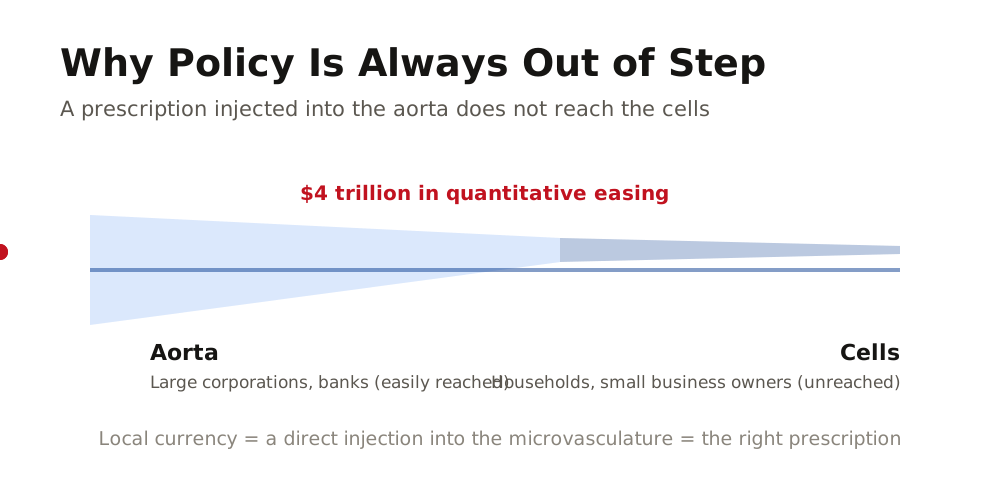
In the previous chapter, we confirmed the second limitation of existing economic reports. It was the failure of timing, the fact that the data a report shows is already a thing of the past. Yet even if we solve both the problem of what to look at (Chapter 1) and the problem of when to look at it (Chapter 2), there remains one more problem. What if the diagnosis is complete and the correct prescription is issued, but the medicine does not reach the patient?
This chapter examines the third structural limitation of existing economic policy. It is the failure of the pathway. We dissect why the shops in the back alley are still struggling and why small business owners are still crushed under loan interest, even when the government lowers interest rates, releases liquidity, and disburses subsidies. The answer can be found in the vascular structure of the human body, and this book calls the state in which funds fail to reach the microvasculature and become blocked within this structure monetary sclerosis.
The Transfusion Was Given, but the Patient Died: The Gap Between Policy Design and Policy Delivery
When an economic crisis strikes, the government releases money. It lowers interest rates, issues government bonds, and disburses subsidies. If we compare this to the human body, it is like giving a transfusion to a patient. Yet there are cases in which the patient does not recover even after receiving an ample transfusion. It is because the transfused blood failed to reach the affected area.
Let us follow, step by step, what happens when interest rates are lowered. The central bank lowers the base rate by 0.25 percentage point. The first place to receive the benefit of this rate cut is the commercial banks that deal directly with the central bank. The banks come to procure funds at this lowered cost. But to whom do the banks lend this money first? Naturally, they lend first to large corporations with large loan volumes, high credit ratings, and existing transaction relationships. Large corporations use these low-interest funds to buy back their own shares, to increase dividends, or to refinance existing debt at low rates.
Small and medium-sized enterprises come next. But the interest rate applied to small and medium-sized enterprises is higher than that for large corporations. This is because a credit risk premium is attached. Even if the base rate falls by 0.25 percentage point, the real loan rate for small and medium-sized enterprises falls by far less than that, or sometimes hardly falls at all. The self-employed and small business owners come even further behind. A considerable share of them rely not on commercial banks but on secondary financial institutions, card loans, and cash advances, and interest rates in this domain are almost never linked to changes in the base rate. Households come last of all. Mortgage rates reflect the base rate cut slowly, but credit loan and card loan rates often hardly change at all.
In the end, when the central bank cuts by 0.25 percentage point, large corporations receive almost the full 0.25 percentage point of benefit, while small and medium-sized enterprises receive only about 0.10 to 0.15 percentage point, and small business owners and households can scarcely feel even 0.05 percentage point. The medicine was clearly injected, but in the process of reaching the affected area it was diluted, absorbed, and evaporated. The state in which funds fill the aorta but fail to reach the microvasculature is precisely monetary sclerosis, and in Chapter 14 of this book it is formally named the H of the DIAH trigger (hypoxia, monetary sclerosis).
What the Body's Blood Vessels Tell Us: Why the Medicine Fails to Reach the Cells
This phenomenon can be understood clearly through the vascular structure of the human body. The blood that leaves the heart sets off along the aorta. The aorta is the thickest blood vessel in the human body, with a diameter reaching about 2.5 centimeters. Blood is delivered from the aorta to the arterioles, from the arterioles to the microvasculature, and from the microvasculature to the cells. In this process the diameter of the vessels grows progressively narrower, and by the time it reaches the microvasculature the diameter narrows to about 5 to 10 micrometers (μm), so narrow that a single red blood cell can barely pass through. Comparing the aorta's 2.5cm with the microvasculature's 5 to 10μm, there is a difference of about 2,500 to 5,000 times in diameter, and a difference of several million times in cross-sectional area. Because such vastly different scales coexist within the same vascular system, even if medicine is put in at one location, the proportion that reaches another location can become extremely small.
If all the blood vessels of the human body were joined together, their length would reach about 100,000 kilometers, and of these about 80% are microvasculature. Large vessels such as the aorta and the vena cava make up only a tiny fraction of the total vasculature. What this means is clear. Most of blood circulation takes place in the microvasculature, and the actual site where oxygen and nutrients are delivered to the cells is not the aorta but the microvasculature.
Here a crucial physical law is at work. According to Poiseuille's Law, the amount of fluid passing through a tube is proportional to the fourth power of the tube's radius. This means that even a slight narrowing of a blood vessel causes blood flow to decrease sharply. If the radius of the microvasculature decreases by just 10%, blood flow drops by about 35%. If it decreases by 20%, blood flow drops by about 60%. Once the microvasculature begins to become blocked, no matter how much blood is transfused into the aorta, the amount reaching the cells decreases sharply.
If we apply this structure directly to the economy, why policy fails becomes vividly apparent.
The Vascular Hierarchy and the Economic Mapping: A Transfusion into the Aorta Does Not Reach the Cells
| Vascular Layer | Economic Correspondence | Diameter | Policy Reach | Reality |
|---|---|---|---|---|
| Aorta / vena cava | Large corporations / financial institutions | About 2.5cm | Interest rate and tax support reach immediately | Base rate cut benefit absorbed immediately |
| Arterioles / venules | Small and medium-sized enterprises / the self-employed | About 0.3mm | Much of the policy effect is diluted | Real loan rate cut diluted |
| Microvasculature | Back-alley economy | About 5 to 10μm | Most policy fails to reach | Secondary financial and card loan rates unchanged |
| Cells | Households / small business owners | Terminal tissue | Direct reach is hardest | Interest burden felt, policy benefit not felt |
Large corporations and financial institutions, which correspond to the aorta, receive the benefit of policy first and in the greatest amount. Small and medium-sized enterprises and the self-employed, which correspond to the arterioles, receive policy in a diluted state. Policy barely reaches the back-alley economy, which corresponds to the microvasculature, and households and small business owners, which correspond to the cells, often fail to feel the very existence of the policy. And paradoxically, the ones that collapse first in a crisis are precisely these cells. Just as a patient's fingertips and toes are the first to develop frostbite in hypothermia, in an economic crisis the first to die are the shops and households of the back alley. Among the two blockade concepts this book introduces in earnest from Chapter 14, the state in which the very channel for funds is blocked corresponds to this microvascular blockade.
The 4 Trillion Dollars Injected into the Aorta: Tracing the Pathway of America's Quantitative Easing
The case in which this structure was revealed most dramatically is the quantitative easing (QE) of the U.S. Federal Reserve. After the 2008 global financial crisis, the Fed lowered the base rate to 0%, but when the economy did not recover, it embarked on an unprecedented measure. It purchased government bonds and mortgage-backed securities on a large scale from the market, injecting liquidity directly into the financial system. Through three rounds of quantitative easing from 2008 to 2014, the Fed's balance sheet swelled from about 891 billion dollars to about 4.5 trillion dollars. That is an increase in scale from 6% to 25% of GDP.
Where did this money go? When the Fed purchases government bonds and mortgage-backed securities, the payment enters the account of the financial institution that sold them. The excess reserves of depository institutions surged from about 2 billion dollars in 2008 to more than about 2 trillion dollars in 2014. The banks sought places to deploy this overflowing liquidity, and a considerable portion flowed into the asset markets rather than the real economy. The prices of assets such as stocks, bonds, and real estate rose, and the wealth of the people who held these assets increased.
The result was clear. The assets of America's wealthiest upper class increased substantially during the quantitative easing period, and the S&P 500 index rose about threefold, from a low of about 666 points in March 2009 to about 2,059 points at the end of 2014. During the same period, however, the growth in real income of the median American household was negligible, and Thomas Hoenig within the Fed continually warned at Federal Open Market Committee (FOMC) meetings that quantitative easing could bring about asset price distortion and long-term side effects.
If we compare it to the human body, it is as though the doctor gave the patient a transfusion worth 4 trillion dollars. The blood filled the aorta to the brim. But because the microvasculature was already narrowed with calcification and waste products, the amount of blood reaching the cells was negligible. Wall Street, which corresponds to the aorta, overflowed with blood, but the back-alley shops and households of Main Street, which correspond to the microvasculature, remained in a state of oxygen deprivation. The transfusion volume was the largest in history, but because the transfusion pathway was blocked, the patient's cells could not be revived. Japan repeated the same prescription for even longer, for thirty years. The Bank of Japan pursued zero interest rates in 1999, negative interest rates in 2016, and massive quantitative easing for close to thirty years, but real wages fell by about 13% from their 1997 peak. The result of the longest aortic prescription was chronic microvascular infarction.
Cases of Direct Injection into the Microvasculature: Korea's COVID Supplementary Budgets and America's PPP
If quantitative easing showed the limits of aortic transfusion, the 2020 COVID pandemic showed attempts at direct injection into the microvasculature in two countries at the same time. Korea and the United States chose different delivery pathways in the face of the same crisis, and the results diverged as well.
The Korean government drew up a first supplementary budget of 11.7 trillion won on March 17, 2020, and resolved a second supplementary budget of 12.2 trillion won on April 30 of the same year, and subsequently carried out supplementary budgets on four occasions in total, including the third and fourth. In the fourth supplementary budget, about 3.3 trillion won was separately allocated under the name of the New Hope Fund for small business owners, so that cash of 1 million won to 2 million won was deposited directly to the self-employed whose sales had declined. The nationwide emergency disaster relief fund also transferred 400,000 won to 1 million won per household directly into households in the form of local love gift certificates, prepaid cards, and credit card charge-ups. The key was that the funds entered households' accounts directly without passing through banks. As is verified in Chapter 19 of this book, Korea's blockade diagnosis was lifted just one month after the dual blockade was established in April 2020. This was the result of a direct injection reaching the microvasculature.
America's Paycheck Protection Program (PPP) had the same intent but a different pathway. This program, with a total scale of about 793 billion dollars, was designed as a structure that provided direct loans to small and medium-sized enterprises with 500 or fewer employees and forgave the loan if employment was maintained. But loan applications were made through the existing banking system. According to the U.S. Small Business Administration (SBA), the first round of loan funds, 349 billion dollars, was exhausted in a mere 13 days. Yet when research teams from the University of Chicago and Harvard University analyzed the SBA data, it was found that a considerable portion of the first-round funds was concentrated among a small number of all applicants. The banks processed first the large customers with whom they had existing transaction relationships, and large dining franchises such as Ruth's Chris Steak House and Shake Shack, which are listed companies, secured loans up to the maximum limit of 10 million dollars first.
The very tiny small business owners and businesses run by racial minorities, for whom the funds were most desperately needed, were pushed back. According to research by the Federal Reserve Bank of New York, the proportion of businesses that received PPP loans in the Bronx of New York, an area densely populated by Black business owners, was a mere 7% or so, and Wayne County in Michigan, where Detroit is located, was also only 11.6%. Compared with the national average of about 18%, this was a markedly low level. There was an attempt to inject directly into the microvasculature, but because the syringe went in through the aorta (the banking system), the large vessels near the aorta absorbed the medicine first.
The difference between Korea and the United States was clear. Korea bypassed the aorta called the bank because it transferred directly to household accounts, while the United States had a structure in which funds were sent to banks through the SBA and the banks then lent to businesses, so it passed through the aorta. As the delivery pathways diverged, so too did the results. No matter how good the medicine, if the delivery pathway is designed to run through the aorta, in the end the aorta absorbs it first. To reach the microvasculature directly, one must change the delivery pathway itself.
Direct Injection into the Microvasculature: A Comparison of 4 International Cases
| Program | Delivery Method | Reach to the Microvasculature | Result |
|---|---|---|---|
| Korea 2020 1st supplementary budget | 14.3 trillion won direct household support | Direct transfer to small business owners and households | Blockade lifted within 1 month, V-shaped rebound |
| Brazil Bolsa Família | Conditional cash transfer to low-income households | Direct reach to 60 million people's households | Extreme poverty rate reduced, domestic demand invigorated |
| U.S. PPP (2020) | Via SBA then banks | Partial reach to the microvasculature (limited) | Large corporations absorb first, tiny businesses subordinated |
| Japan QE (1999 onward) | Via BOJ then banking system | No reach to the microvasculature for 30 years | Chronic deflation |
Another international case with a design similar to Korea's supplementary budgets is Brazil's family allowance program (Bolsa Família). This program, introduced by the Lula government in 2003, is a structure in which the government transfers cash directly to low-income households that satisfy certain conditions, and at one time about 60 million people received its benefits, and it is evaluated as a policy that greatly lowered Brazil's extreme poverty rate. The fact that the funds entered the microvasculature called households directly, without passing through the aorta called banks, is a design shared in common with Korea's supplementary budgets.
The Prescription That Failed to Reach the Microvasculature of the Eurozone Periphery: The European Central Bank's Negative Interest Rates
The European Central Bank (ECB) introduced negative interest rates from 2014. It arranged things so that when banks deposited money with the ECB, they did not receive interest but instead had to pay a storage fee. It was a powerful signal not to pile up money but to release it as loans. If we compare this to the human body, it is like artificially raising the blood pressure so as to apply pressure that pushes the blood out to the microvasculature.
But the effect of this policy showed extreme disparity within Europe. Large corporations and sound small and medium-sized enterprises in the core eurozone countries such as Germany, France, and the Netherlands were able to procure funds at rates close to negative. But the rates at which small and medium-sized enterprises in the peripheral eurozone countries such as Greece, Italy, Spain, and Portugal actually borrowed from banks had a considerable gap with the core. The causes of this interest rate gap lay in differences in the soundness of each country's banking system, differences in the ratio of non-performing loans, and differences in the national credit risk premium.
If we compare it to the human body, it is a state in which the heart (the ECB) is pumping strongly, but the arterioles of the limbs called the peripheral countries have become calcified, so the blood fails to reach them sufficiently. The heart's stroke volume increased, but circulation at the extremities did not improve. In the aorta (core financial institutions), the ECB's negative interest rates took effect, but they were diluted at the arterioles (peripheral banks) and failed to reach as far as the microvasculature (peripheral small and medium-sized enterprises).
Tracing the Pathways of the 4 Major Global Policies: The 4 Prescriptions That Stopped at the Aorta
| Policy | Scale of Injection | Actual Pathway | Whether It Reached the Microvasculature |
|---|---|---|---|
| U.S. QE (2008 to 2014) | Balance sheet 891 billion to 4.5 trillion dollars | Fed then financial institutions then absorbed by asset markets | Did not reach Main Street |
| U.S. PPP (2020) | 793 billion dollars | SBA then banks then large customers processed first | Tiny small business owners subordinated |
| ECB negative rates (2014 onward) | Deposit rate -0.5% | ECB then core banks then diluted at the periphery | Did not reach peripheral small and medium-sized enterprises |
| Japan QE+ZIRP (1999 onward) | Sustained for 30 years | Aortic prescription repeated over the long term | Real wages -13% from 1997 peak |
Why Is the Aortic Prescription Repeated: The Structural Problem of the Delivery Pathway
A common structure is visible across the four cases. It is that all policy is delivered by way of the aorta. The central bank releases money to commercial banks, and government subsidies come down through the existing administrative apparatus and financial system. Along this delivery pathway, the closer an entity is to the aorta, the earlier and the more it absorbs. Rather than the policy design being wrong, it is a structural limitation of the delivery pathway itself.
The same principle is at work in the human body as well. If an IV drip is connected to the aorta, the organs close to the aorta receive blood first, and the fingertips and toes at the end of the microvasculature receive it last. This is exactly the reason the fingertips and toes of a patient with hypothermia grow cold first and develop frostbite. In the economy too, when a crisis strikes, the shops and households of the back alley collapse first. Yet the prescription comes down through the aorta. Only after the shops of the back alley have already closed their doors does the warmth of the policy faintly arrive.
It is not that the individual policies are wrong. Interest rate cuts, quantitative easing, and small and medium-sized enterprise loan support are all necessary. The problem lies in the fact that all of these policies operate only atop a delivery system that runs through the aorta. The medicine that enters through this pathway is absorbed first at the aorta, only the remainder flows to the arterioles, and what reaches the microvasculature is no more than a tiny fraction. And the blockade diagnosis this book establishes from Chapter 14 distinguishes the failure to reach the microvasculature into two kinds. They are the signal blockade, in which the policy signal fails to reach, and the channel blockade, in which the very channel for funds is physically blocked.
The Dilution Structure of Policy Reach: The Closer to the Cells, the Less Policy Reaches
| Vascular Layer | Economic Correspondence | Policy Reach Rate | Human Body Analogy |
|---|---|---|---|
| Aorta | Large corporations / financial institutions | Reaches immediately | Right next to the heart, received first |
| Arterioles | Small and medium-sized enterprises / the self-employed | Much is diluted | Limbs, reaches in diluted form |
| Microvasculature | Back-alley economy | Most fails to reach | Fingertips and toes, barely touched |
| Cells | Households / small business owners | Almost never reaches | Cells, policy benefit not felt |
As you look at this table, parts that overlap with your own experience will come to mind. The experience of seeing news that the government lowered interest rates but finding that your own loan interest hardly changed, the reality that an economic stimulus package was announced but the shops in the back alley still do not do business, and the situation in which stock prices rose but your salary stayed the same, all arise from this vascular hierarchy structure. It is not that the policy is wrong. It is because the pathway it reaches by is designed to run through the aorta that it fails to reach us, who correspond to the cells.
Conclusion
The core of what we examined in this chapter is the third structural limitation of existing economic policy, namely the failure of the pathway. The U.S. Fed increased its balance sheet from about 891 billion dollars to 4.5 trillion dollars from 2008 to 2014, but that money only raised the asset prices of Wall Street and failed to revive the back-alley economy of Main Street. America's PPP tried to inject directly into the microvasculature, but the moment it passed through the aorta called banks, large corporations absorbed it first. The European Central Bank's negative interest rates took effect in the core of the eurozone but failed to reach the small and medium-sized enterprises of the periphery. By contrast, Korea's 2020 supplementary budgets and Brazil's Bolsa Família succeeded in bypassing the aorta and reaching the microvasculature by the method of transferring funds directly into household accounts.
It is not that the medicine is wrong. The problem is that it does not reach the affected area. And the fundamental cause of this problem lies in the fact that the delivery pathway of policy is designed to run through the aorta (banks and financial institutions). The closer an entity is to the aorta, the earlier it absorbs the benefit of policy, and it almost never reaches the cells at the end of the microvasculature (households and small business owners). This failure to reach is the state in which funds are blocked, that is, monetary sclerosis, and the H of the DIAH trigger captures it quantitatively.
What to look at, when to look at it, whom it reaches: the three limitations we have examined so far are each independent and at the same time worsen one another. In a structure that looks only at the aorta with a single indicator, diagnoses with data from three months ago, and issues prescriptions through the aorta, the necrosis of the cells can neither be detected, nor prevented, nor treated.
Then a fundamental question remains. Why did 250 years of economics fail to see this structure? The three misalignments of the single indicator, the after-the-fact report, and the aortic prescription ultimately share one assumption at the same place. It is the assumption of the invisible hand, that the market finds equilibrium on its own. As long as this assumption is alive, the effort to catch a crisis in advance becomes something unnecessary. Then is there a larger law that can shake this assumption? If there is a universal law that rivers, stars, ecosystems, and the climate all follow, not only within one nation's economy, then that law would govern the flow of the economy in exactly the same way. In the next chapter, following that universal law, we step one pace outside the economy and encounter the same grammar that nature shows. The name of that law is gradient. And from Chapter 14 of this book, we unfold in earnest the 9-axis 59-gauge, the triple diagnostic system, and the DIAH-7M national economic diagnosis system that operate atop the law of gradient.
References
1. Congressional Budget Office (2022). How the Federal Reserve's Quantitative Easing Affects the Federal Budget. CBO Publication No. 58457.
2. Richmond Federal Reserve (2022). The Fed Is Shrinking Its Balance Sheet. What Does That Mean? Econ Focus, Third Quarter 2022.
3. Montecino, J. A., & Epstein, G. (2017). Did Quantitative Easing Increase Income Inequality? Institute for New Economic Thinking Working Paper Series, No. 28.
4. U.S. Small Business Administration (2021). Paycheck Protection Program Report: Program Data through May 31, 2021. SBA Office of Capital Access.
5. Granja, J., Makridis, C., Yannelis, C., & Zwick, E. (2022). Did the Paycheck Protection Program Hit the Target? Journal of Financial Economics, 145(3), 725-761. doi:10.1016/j.jfineco.2022.05.006
6. European Central Bank (2019). Negative Interest Rates and Bank Lending. ECB Working Paper Series, No. 2311.
7. Bowman, M. (2024). The Federal Reserve's Balance Sheet as a Monetary Policy Tool. Speech at Stanford Institute for Economic Policy Research, May 28, 2024.
8. Federal Reserve Bank of New York (2020). Double Jeopardy: COVID-19's Concentrated Health and Wealth Effects in Black Communities. Staff Reports, No. 936.
9. S&P Dow Jones Indices (2014). S&P 500 Index Historical Data. S&P Global.
10. Ministry of Economy and Finance (2020). The First Supplementary Budget Bill for Fiscal Year 2020. Ministry of Economy and Finance Press Release, March 17, 2020.
11. Soares, F. V., Ribas, R. P., & Osório, R. G. (2010). Evaluating the Impact of Brazil's Bolsa Família: Cash Transfer Programs in Comparative Perspective. Latin American Research Review, 45(2), 173-190.
12. Bank of Japan (2024). Japan's Economy and Prices over the Past 25 Years. BOJ Working Paper Series, No. 24-E-14.