
This piece is the opening part of Chapter 12 of Calcium: The Reality of Evolution That Darwin and the Genome Map Missed (Yoon Jong-won). The body, figures, and citations follow the manuscript as written.
Introduction: The World After the Discovery
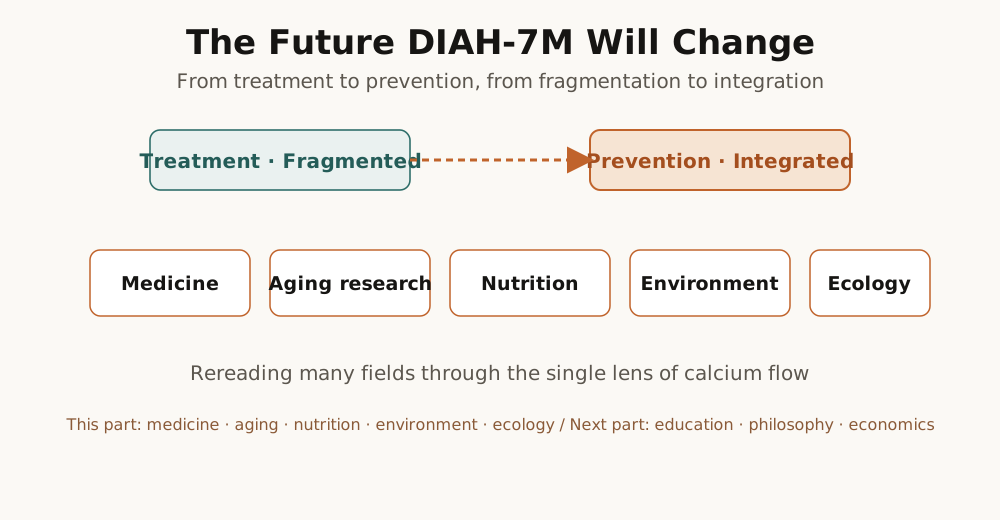
Earlier we saw that calcium is not a simple nutrient but a mediator of natural cycle and evolution and the execution code of life and death, and we laid out how it operates on the concrete map called the DIAH-7M Aging and Chronic Disease Pathway System, the Calcium Execution Code theory. Now the question shifts a little. It becomes the question, "So, if this discovery passes scientific verification and is widely accepted, how will the actual world change?" When we discuss the future, emotional imaginings and exaggerated promises are often mixed in, but the future we want to sketch here is not a world of such fantasy. It is a direction of change that is fully predictable when, on the foundation of already verified facts from physiology, aging science, and earth science, we string those pieces together with the common execution code called calcium. In this chapter we will follow, one by one, how the calcium execution code can change the language and standards of each field, reaching all the way from medicine, aging research, and nutrition to environment and ecology, education, philosophy, and economy and industry, and in the end we will gather it all into a single conclusion, "a society in which the cycle has been restored."
Medicine Changes
Right now medicine has a strong tendency to look at a person not as a whole but as a bundle of parts. When the chest feels tight one goes to cardiology, when short of breath to pulmonology, when blood sugar rises to endocrinology, when the lower back hurts to orthopedics, and when memory grows dim to neurology, and since each department prescribes medicine suited to its own organ and its own numbers, it is not rare for five or ten bags of medicine to be set on one person's table at the same time. According to the World Health Organization, chronic diseases account for an overwhelming share of deaths worldwide, but despite such polypharmacy the root of the disease is seldom weakened, and rather the new burden of interactions and side effects between drugs is being added onto the patient, a point that several health agencies have repeatedly noted.
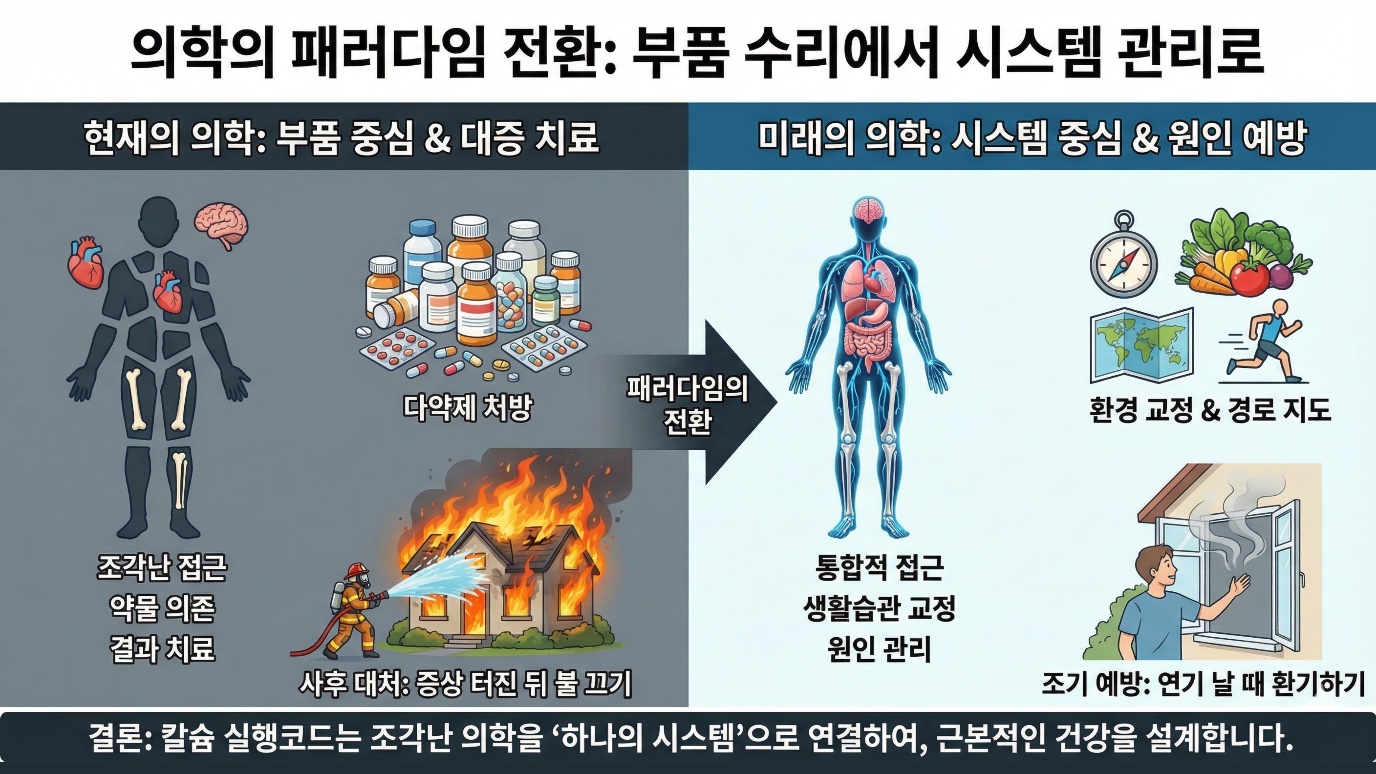
The value of the calcium execution code and the DIAH-7M chronic disease pathway system lies in revealing, over this fragmented landscape of medicine, a single hidden road called the "common pathway." When the DIAH conditions of deficiency, inflammation, acidosis, and hypoxia continue for a long time, our body, for the sake of survival, begins to draw out the calcium it stored in the bones, and when the calcium that has leaked out at this time sticks to the walls of blood vessels it leads to arteriosclerosis, when it sticks to the heart valves to valvular disease, when it sticks to joints and tendons to arthritis and calcific tendinitis, and when it affects the microvascular network and the nerves to an increased risk of stroke and dementia, a fact that many academic bodies report is becoming ever clearer through research related to cardiovascular, bone metabolism, and neurodegenerative diseases. What this book proposes is that we tie together the "calcium-calcification-7M pathway" that runs through these different diseases into a single execution code, and when we do, heart disease, diabetes, arthritis, dementia, and cancer begin to look like "the fruit of the same tree bearing different names."
Once this viewpoint is accepted, the timing and manner of diagnosis change from the start. Until now it has been common to visit the hospital only after the "result" appears, when the chest hurts, a joint swells, or memory grows hazy, and only then to look into the heart, joints, and brain, but from now on the pattern of examination can shift toward finding the "abnormal signals of the calcium execution code" long before symptoms appear. According to several research institutions, a drop in bone density, the vascular calcification score, and systemic inflammation markers are each independently important warning signals, but when seen together they can predict future risk of cardiovascular disease, osteoporosis, and dementia far more precisely. From the standpoint of the calcium execution code, a physician can look at the results of a regular checkup and say this. "Right now calcium has begun to leak little by little out of your bones, and its trace is showing very faintly on the walls of your blood vessels. It is not yet at the stage where we can attach the name of a disease, but if you change your lifestyle now, you can greatly reduce the risk of heart disease and cerebrovascular disease ten years from now." It is a move toward a medicine that ventilates when the smoke begins to rise, rather than putting out the fire after the symptom has burst.
The direction of treatment naturally changes as well. Today's standard treatment is designed around each number. If blood pressure is high, medicine to lower blood pressure, if blood sugar is high, medicine to bring it down, if cholesterol is high, medicine to drop it, and since the numbers return to their original place once the medicine is stopped, the number of people who live with medicine for life is increasing, as several health authorities warn. Once the calcium execution code is accepted, the focus shifts from "adjusting the numbers" to "correcting the environment." The goal becomes to reduce the lifestyle and eating habits that worsen DIAH, to align a diet and movement that lower inflammation and acidification, breathing and sleep that aid microcirculation and oxygen supply, and the balance of core minerals and vitamins such as calcium, magnesium, vitamin D, and K2, so that calcium does not leak excessively out of the bones in the first place and the pace of calcification that has already progressed is slowed. When this happens, the gaze that used to see the individual organs of heart, brain, joints, and kidneys separately looks instead at the common stage of "calcium circulation and the DIAH environment," and medicine can shift toward a more economical form that is faithful to physiology, seeking to reduce the burden of several chronic diseases at once with a single intervention.
In this process, in addition to the organ-based specialties, there is a strong possibility that new academic fields such as "calcium circulation medicine" or "calcification-bone metabolism integrative medicine" will emerge. Many universities and research institutions report that studies which bind together the calcification and bone metabolism abnormalities of bone, blood vessels, heart, and brain are already increasing, and when this current meets the system language called DIAH-7M, new medical services can rise as realistic blueprints, such as integrated care centers centered on calcium metabolism, calcification, and mineral balance, a "calcium pathway map" that visualizes risk based on the calcium execution code, and lifelong "calcium-based health design." It is medicine evolving one step, from a collection of fragments into a system medicine that understands and handles the execution code.
Aging Research Changes
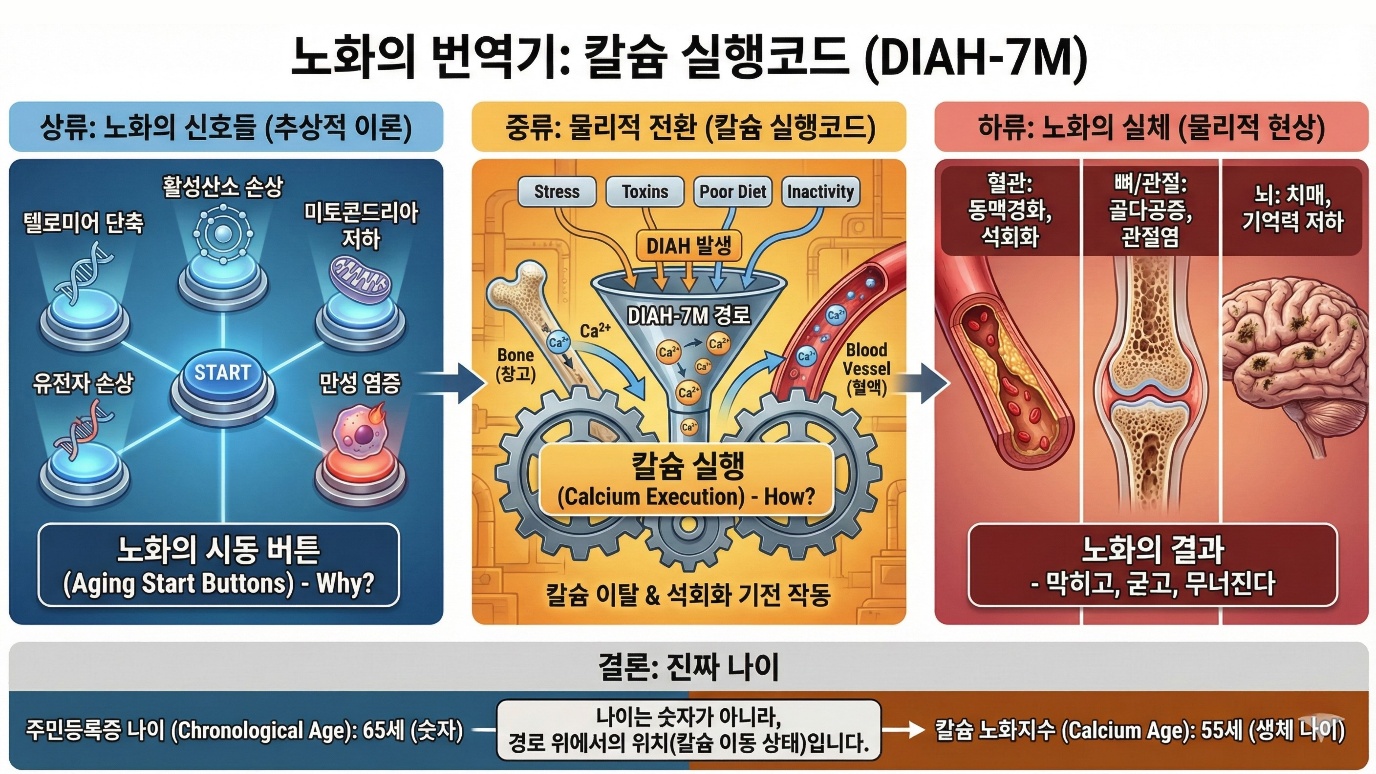
To the questions of why we age, why some people collapse far faster than their peers while others stay astonishingly young at the same age, aging research institutions in various countries have offered many hypotheses, such as telomere shortening theory, reactive oxygen damage theory, decline in mitochondrial function, NAD+ reduction, stem cell depletion, and chronic inflammation. It is hard to say that any one of them is entirely wrong, and experiments and clinical studies supporting each hypothesis continue to be published, but according to aging research institutes around the world, it is still assessed that an integrated explanation is lacking as to how these theories mesh with one another and lead to "the actual aging of the body," that is, through what pathway fragment and fragment become a single picture.
The calcium execution code is an attempt to draw a solid line called a "material pathway" over this fragmented puzzle. This book proposes the viewpoint that as one grows older recovery slows, and as stress, nutritional imbalance, lack of exercise, sleep disturbance, and environmental toxins pile up, deficiency, inflammation, acidosis, and hypoxia accumulate chronically, and then the body, for the sake of survival, begins to draw out the calcium it had stored in the bones and release it into the blood, and from precisely this point the DIAH-7M pathway, that is, the seven calcification-aging mechanisms that block, harden, coat, sever, and collapse, begins to operate all at once. Many cardiovascular-osteoporosis studies report that "the higher a person's vascular calcification score, the greater the increase in overall mortality and the risk of dementia and fracture," and according to several research institutions this is likely not a mere accompanying phenomenon but "the result of calcium piling up where it should not and leaking out from where it should be," and through this viewpoint it becomes possible to interpret the various aging hypotheses as arranged upstream and downstream of the DIAH-7M pathway.
In other words, genetic damage, telomere shortening, decline in mitochondrial function, and chronic inflammation are the "ignition buttons" of aging, and when these buttons strengthen DIAH and trigger the efflux of calcium from the bones, the material collapse that follows proceeds in a relatively regular pattern. The calcium execution code this book speaks of is not a single cause competing with existing theories, but the language of the execution stage that weaves those theories together, not in the direction of "why, from above?" but of "how, from below?" If each hypothesis explained the reason for aging, the calcium execution code is an interpretive frame that shows "how those reasons are actually translated into the phenomena of wrinkles and fractures, arteriosclerosis, and memory decline."
Once this viewpoint passes verification and is accepted, the tools for measuring aging also take on a more concrete and practical form. Right now the age written on the resident registration card, that is, chronological age alone, is often taken as the standard, but according to several research institutions bone density and the vascular calcification score, especially the coronary artery calcium score, are powerful indicators for predicting future cardiovascular events and the risk of death. When to this are added the inflammation markers that reflect the DIAH environment, the acid-base state, and the state of oxygen supply, a concept such as a "calcium aging index" can become reality, and a physician can offer a more concrete explanation, saying "your actual age is 65, but by the calcium and calcification indicators you are maintaining a body closer to 55," or "you are 50, but by the standard of the calcium execution code your body is already aging at the level of 65." It is an approach that sees age not as a number but as "a position on the pathway."
Anti-aging strategy becomes that much clearer as well. Right now new supplements, new procedures, and new anti-aging programs pour out, and since various media and advertisements speak of different prescriptions, an ordinary person finds it hard to judge which choice is truly a fundamental help. According to several public health agencies, it is repeatedly emphasized that in the end the ones most consistently proven effective are the basic lifestyle habits such as a balanced diet, regular physical activity, sufficient sleep, avoidance of smoking and excessive drinking, and stress management, but the more abstract the explanation of the "why," the weaker the motivation to practice is bound to be. From the standpoint of the calcium execution code, we can explain, together with a concrete pathway, that these basic lifestyle habits are the most realistic method with the fewest side effects for reducing DIAH, slowing the pace at which calcium leaks out of the bones, slowing the progression of the calcification that has already piled up, and thereby actually lowering our calcium aging index. Aging research will shift its center of gravity from "the secret to looking young" to "the technology of managing calcium circulation and DIAH to slow the pace of collapse."
Nutrition Changes
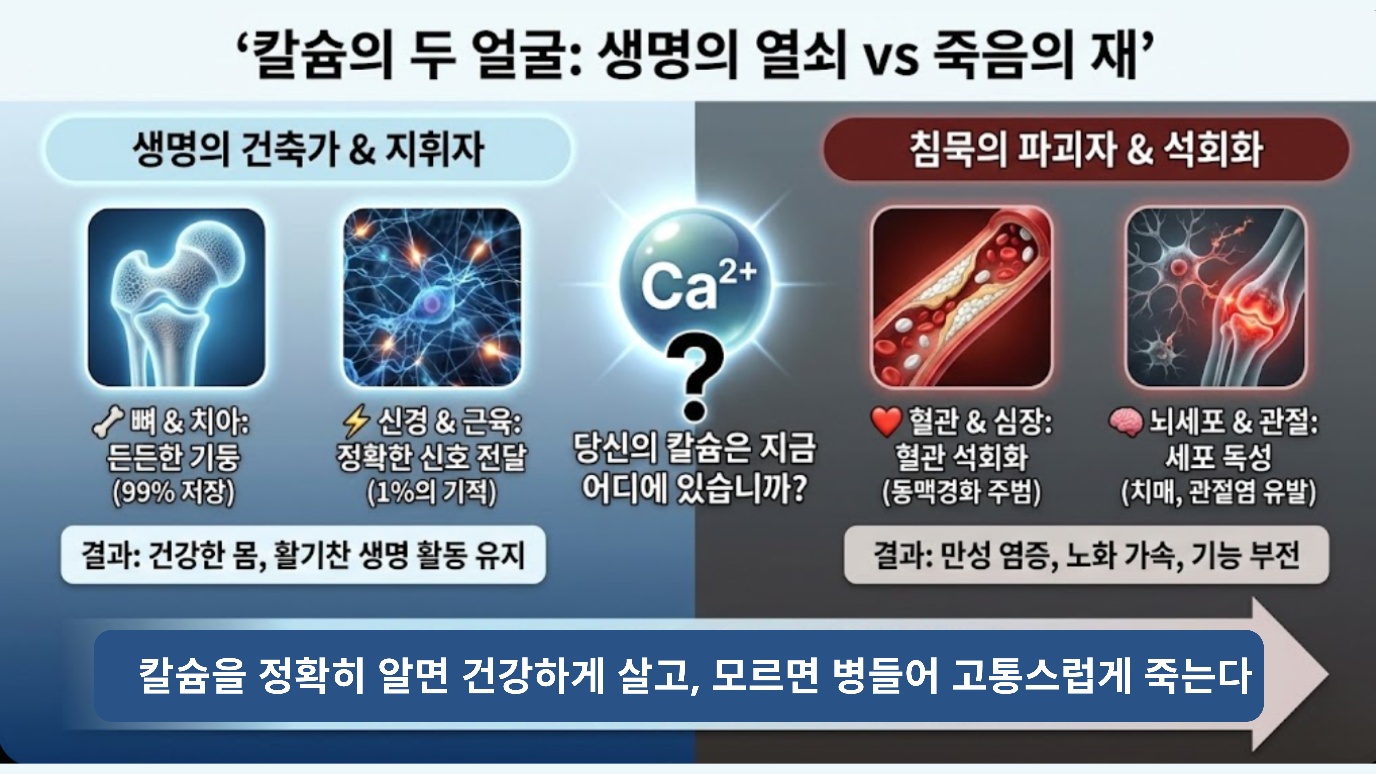
Until now, in nutrition, calcium has often been treated as "one of the several nutrients that make bones and teeth strong." When one thinks of anchovies, dried whitebait, and calcium supplements, most people also think only of something like "prevention of osteoporosis," and the reality is that they do not think deeply beyond that, and according to several health agencies, in many countries calcium intake still falls short of the recommended amount. Yet the fact that calcium operates as a common signal at almost every stage, from the very beginning of life to the heartbeat, nerve transmission, muscle contraction, hormone secretion, immune response, and apoptosis, is content already widely accepted in the fields of cell biology and biochemistry, as several academic bodies state.
The calcium execution code summarizes this fragmented knowledge into a single sentence. "Calcium is the execution code that turns life on, keeps it running, and shuts it down." From the calcium wave that occurs when sperm and egg meet at the moment of fertilization, to the calcium that builds bone in the growth period, the calcium that makes the heart beat one time after another, the calcium channels that open and close when a nerve cell transmits a signal, and even the calcium that leaks out of the bones in the final stage of aging and remains as calcification and stone, it is a picture in which a single substance runs through life from head to toe, from beginning to end. Once this viewpoint permeates nutrition, calcium is no longer "one line in the daily requirement," but settles in as a reference point for understanding other nutrients and as the axis of the entire nutritional design.
This naturally leads in the direction of a balance of vitamin D, K2, magnesium, protein, and trace minerals, a reduction of an excessively acidifying diet, and sufficient intake of fiber and antioxidant foods, and according to several nutrition societies, research results are already accumulating that such a pattern can simultaneously lower the risk of osteoporosis, cardiovascular disease, and diabetes. The calcium execution code will come to play the role of organizing such research into a single language.
The standards of the food industry change too. Right now there are many products where the phrase "calcium fortified" and its number catch the eye, but how much of that calcium is actually absorbed, in what form it is, and whether it is included alongside other ingredients that worsen the DIAH environment, are often not well revealed. According to several nutrition evaluation bodies, from now on not only "calcium content" but "calcium bioavailability," "the nutritional combination that aids calcium," and "a processing method that does not obstruct calcium circulation" may become the core indicators of food evaluation. Once the calcium execution code permeates industry, food will be designed and chosen from the standpoint not simply of an object to fill the stomach but of "a tool that increases the balance in my bone bank and keeps my blood vessels and organs clean."
The Perspective on Environmental Problems Changes
At the center of today's environmental and climate discussion stands "carbon." According to the Intergovernmental Panel on Climate Change (IPCC), the carbon dioxide humanity has emitted since industrialization is the main cause of the rise in the earth's average temperature, and countries are designing policy around carbon neutrality, carbon taxes, and greenhouse gas reduction targets. Reducing carbon is certainly absolutely important, but if in this process we come to see "only carbon," we may miss half of the enormous mechanism, that is, the way nature originally stored and cycled carbon.
The chemical formula of limestone, CaCO₃, shows symbolically the fact that carbon and calcium are an inseparable pair. According to several earth science research institutions, in the sea coral, shellfish, foraminifera, and calcareous plankton combine the calcium ions and carbon dioxide in seawater to make calcium carbonate shells, and after they die those shells sink to the bottom of the sea and form sedimentary layers, and as they are compressed over millions of years they form limestone strata, playing the role of locking an enormous amount of carbon "inside stone." This is an immense carbon storage system that the earth itself designed, and its core mediator is calcium. It means that without calcium, carbon has no proper place to be locked away and merely wanders between the atmosphere and the sea.
The problem is that as humanity emits an excessive amount of carbon dioxide in a short time, it has exceeded the limit this calcium-based carbon storage system can handle. According to the IPCC and several marine research institutes, a considerable portion of the carbon dioxide in the atmosphere is absorbed into the sea and lowers the sea's pH, and in this process it brings about an environment in which calcium carbonate shells dissolve ever more easily, that is, ocean acidification. An acidified sea is just like an acidified human body. Just as, when acidification progresses in the human body, calcium leaks out of the bones to neutralize the acid, and as a result the bones weaken and calcification progresses, so too in the sea, the more acidification worsens, the more the shells of coral, shellfish, and calcareous plankton dissolve, and the "skeleton" of the sea crumbles down. From the standpoint of this book, the earth too is falling ill along a pathway similar to DIAH-7M.
Therefore the climate problem can be redefined not as "a problem of carbon alone" but as "a problem in which the circulation of carbon and calcium has broken down together." It is necessary to reduce the water coming from the faucet, that is, carbon emissions, but at the same time we must reopen the drain, that is, the calcium-based carbon storage system. According to several research institutions, policies such as coral reef restoration, protection of shellfish and oyster farms, and the expansion of marine protected areas do not stop merely at protecting biodiversity but have the effect of restoring the sea's calcium carbonate ecosystem and reviving its natural carbon absorption capacity. In addition to this, various attempts to fix carbon using calcium are actually being researched and applied on a trial basis, as several climate technology related bodies report, such as ocean liming, which scatters lime powder into the sea to buffer acidification, enhanced mineral weathering, which scatters minerals rich in calcium and magnesium over farmland or coasts to absorb carbon dioxide, and technology that reacts captured carbon dioxide with calcium to harden it into the form of calcium carbonate for use as building material.
The common point of these methods is clear. They are all strategies that imitate or accelerate, with modern technology, the "sealing of carbon using calcium" that nature has done for billions of years. Once the calcium execution code enters the environmental and climate discussion, we can more clearly design a dual strategy that reduces carbon emissions and at the same time restores calcium circulation, and climate policy will come to strike a balance on the two axes of "reducing" and "restoring," "carbon" and "calcium."
Ecology and Earth Science Change
In the earth's crust calcium is one of the most abundant elements, and the limestone cliffs, marble quarries, chalk cliffs, coral reefs, and shell mounds across the continents are all "traces of the time in which calcium accumulated." According to several earth science research institutions, about 540 million years ago, in the period of the so-called Cambrian explosion, animals suddenly began to make shells and skeletons, and the material chosen at this time was precisely calcium-based minerals. The fact that the calcium shells and bones accumulated over the hundreds of millions of years since then make up a considerable part of the limestone strata we stand upon today tells us that the history of this planet is also "the history of calcium."
Once the viewpoint that calcium is a mediator of natural cycle and evolution is accepted, in ecology and earth science calcium circulation becomes a core concept standing shoulder to shoulder with the carbon, nitrogen, and water cycles. Just as in the human body calcium gathers in the storehouse of bone, comes out into the blood to be used in the cells, and returns again to the bone, so on the earth calcium is stored in rock, flows into rivers and seas through weathering, is stored again by marine organisms in their shells and bones, and then becomes rock once more through sedimentation and uplift, repeating this cycle. According to several earth system research institutions, this calcium-calcium carbonate cycle is an important axis that simultaneously governs the earth's climate stability, marine ecosystems, and soil fertility. What this book proposes is that we interpret concretely, through the substance called calcium, the metaphor that "the human body is a small earth, and the earth is an enormous human body."
Once this viewpoint spreads, in ecological research the calcium content of soil, the calcium carbonate saturation of the sea, and the flow of calcium moving along the food chain will be treated as important indicators. Phenomena such as acid rain and acid soil robbing trees and crops of calcium at the root, and as a result weakening forests and farmland, the influence of ocean acidification on calcareous organisms, and the mechanism by which the calcium accumulated in the bones and shells of mammals, birds, and fish becomes an indicator of ecosystem health, can be connected and studied more systematically. Just as in the human body we look at bone density and the calcification score together, so in the ecosystem research that looks at the "calcium storehouse" and the "calcium use-sedimentation pattern" together will grow active.