
This piece is the opening part of Chapter 10 (1) of The Declaration of the Age of Physical Economics (Yoon Jong-won, Yoon So-ri, Yoon Jun). It is an academic exposition presenting the authors' physical economics hypothesis, and the body, figures, and citations follow the manuscript as written.
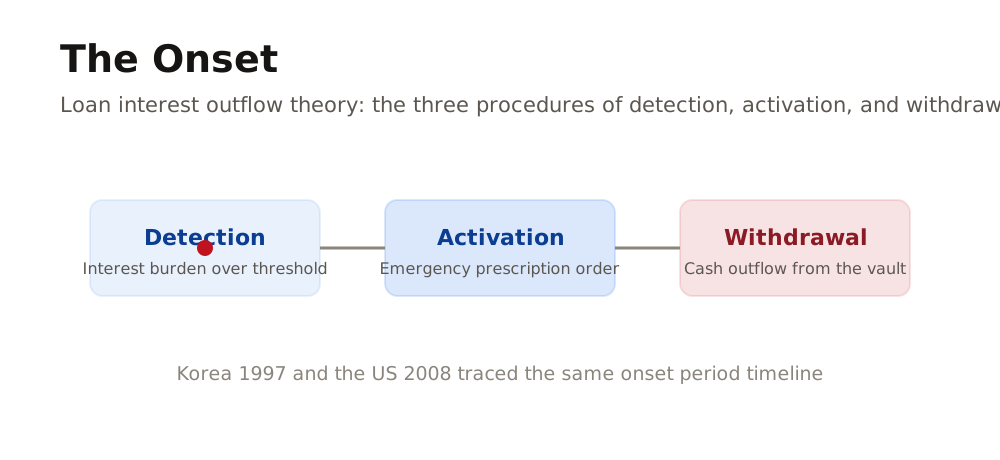
The previous chapter set in order the latency period of a crisis. It is the period during which, over five to ten years, surface indicators remain sound while pressure deepens inside the system. Then, when one or more of the four triggers at the funnel's outlet crosses its threshold, the system can no longer maintain the outward appearance of calm. The domain this chapter deals with is the time immediately after that.
In July 1997, something began to leak out in Korea. In August 2007, something began to leak out in the United States as well. The outward appearances of the two moments are quite different. In Korea, the external shock of the devaluation of the Thai baht was the fuse, and in the United States, the freezing of three asset-backed securities funds by France's BNP Paribas was the fuse. Yet what began inside the system immediately after the two events was the same. The emergency vault was opened.
In the DTDMC five-stage collapse pathway law that this author has established, the name of the second stage is onset (Trigger). It is the stage in which the factors accumulated in the previous chapter cross the threshold and set off one or more of the four DIAH triggers, and that activation switches on the pathway that draws out the system's emergency resources. The established doctrine that academically names this pathway is precisely the Loan Interest Outflow theory. Every flow in which households and firms draw out their emergency savings to get through hardship, in which the government and the central bank release their policy resources, and in which foreign exchange reserves are mobilized to repay short-term external debt falls within this doctrine.
The mere fact that the emergency vault is opened once is not itself a crisis. A crisis begins in earnest from the moment the emergency vault is opened repeatedly, and the funds that have flowed out cannot return to their original places but instead harden somewhere else and begin to narrow the passage. The core that this chapter seeks to unfold academically is as follows. How does the emergency vault open automatically, what leaks out and what hardens into a deposit, and why, once a deposit has formed, does it not dissolve on its own. The answers to these three questions lie within the results this author has verified with 351 months of Korean data and 339 months of U.S. data.
The Definition of the Loan Interest Outflow Theory
The Loan Interest Outflow theory is defined as follows. At the moment when the four DIAH triggers that converged at the funnel's outlet in the previous chapter cross the threshold, the system automatically detects the shortfall in available liquidity, and the pathway that draws out emergency resources to make up that shortfall is set off. The resources that have leaked out are partly recovered through the everyday transactions of households and firms, but the new loan interest that arises in the same period leaks out of disposable income each month and flows into marginal households and marginal firms, where it is deposited. The academic model in which this author has established the irreversible cumulative structure of this deposit is the Loan Interest Outflow theory.
The academic foundation of the Loan Interest Outflow theory stands upon the mediator equation. Here we formally unfold the mirror structure that this author already mentioned briefly in the previous chapter. If the substance that mediates flow in the human body is calcium, then the substance that plays the same role in the economy is cash. If the substance that hardens in the passage and narrows flow in the human body is microcalcification, then the substance that performs the same function in the economy is loan interest. If the signal that opens the emergency vault in the human body is parathyroid hormone, then the signal that occupies the same position in the economy is the policy signal and the market's autonomous borrowing signal. In this author's proof of isomorphism, this equation has been established not as a mere metaphor but as an academic fact that the two domains follow the same nonlinear deposit structure.
The first academic characteristic of the Loan Interest Outflow theory is automaticity. The moment the emergency vault opens is not controlled by anyone's will. During the few days in November 1997 when Korea's available foreign exchange within its reserves plunged to 9.2 billion dollars, the withdrawal of foreign exchange to repay short-term external debt proceeded not by anyone's will but by the time structure of maturities coming due. The same holds for the event in which, immediately after BNP Paribas froze three asset-backed securities funds in August 2007 in the United States, the LIBOR-OIS spread in the short-term funding market surged to 80 to 90 basis points. It was a compensatory response that the system automatically set off to protect itself, not anyone's decision.
The second academic characteristic is the asymmetry between principal and interest. Foreign exchange reserves can be replenished through IMF bailout financing or currency swaps. Korea recovered its foreign exchange through the IMF's 58 billion dollar agreement in December 1997, and the United States replenished the capital of financial institutions through the 700 billion dollar TARP in October 2008, and these are such cases. But the loan interest that households and firms took on during that onset period, that is, the deposited debt cost, is not dissolved by an injection of external funds. It is settled only through the coercive procedures of default processing, debt restructuring, and structural adjustment. Principal is reversible, interest is irreversible. This asymmetry constitutes the core proposition of the onset stage in this author's academic model.
The third characteristic is self-amplification. The loan interest deposit formed during the onset period narrows the funding passage at the next point in time, and the narrowed passage produces a larger blockade index for the same burden. In the deposit function that this author has established, the fact that the nonlinear exponent exceeds 1 is the academic formalization of this self-amplification. From the next section on, we unfold in turn the three procedures that run from crisis detection through command activation to withdrawal, the mathematical meaning of the deposit function, the accumulation across the three sectors of households, firms, and government, and the timelines of the onset periods of Korea 1997 and the United States 2008.
The Activation Signals and Deposit Pathways of the Four DIAH Triggers
| Trigger | Korean Name | Activation Signal | Deposit Pathway |
|---|---|---|---|
| D | Divergence | One-sided concentration of available liquidity | Accumulation of household borrowing, deposit in marginal households |
| I | Inflationary cost | Simultaneous rise in wages, raw materials, and interest rates | Weighting of the cost structure, deposit in marginal firms |
| A | Asset acidosis | Asset prices exceeding fundamentals | Asset bubbles, deposit in capital markets |
| H | Hypoxia of liquidity | Liquidity stagnation, shortage of transaction and credit oxygen | Deposit in regional credit |
The Three Procedures of Crisis Detection, Command Activation, and Withdrawal
Within the single event of the emergency vault opening, three small procedures are contained. Crisis detection, command activation, and the actual withdrawal. The three procedures proceed in temporal order, but each does not operate independently; rather, they exchange signals with one another. According to what this author confirmed in verifying the onset-period data of Korea and the United States, the shorter the time interval between the three procedures, the greater the shock the system received. The cases in which the sequence from detection to withdrawal was completed within a few days were the last week of November 1997 in Korea and mid-September 2008 in the United States.
The first procedure is detection. The interest rates of the short-term funding market, the remaining balance of foreign exchange reserves, and the turnover disruption of financial institutions' short-term funds operate as automatic signals. The flow in which Korea's call rate started in the 12 percent range from late September 1997 and entered the 30 percent range by late November was a detection signal at the market level. The event in which the LIBOR-OIS spread in the United States surged from its usual level of about 10 basis points to 80 to 90 basis points in August 2007 was also a signal of the same character. Before anyone's judgment intervenes, the price itself announces the crisis.
The second procedure is command activation. It is the stage in which the central bank and the government decide firmly to release policy resources, the foreign exchange authorities approve the release of foreign exchange, and the financial supervisory authorities order short-term liquidity support. In Korea, from October 1997 the Bank of Korea supplied short-term liquidity to the merchant banking sector, and in November the direct release of foreign exchange reserves began in earnest. In the United States, in December 2007 the Federal Reserve newly created an institution called the TAF (Term Auction Facility) and began to supply anonymous short-term funds to financial institutions. The time span of command activation differs from case to case. Korea took about 6 weeks, the United States about 4 months.
The third procedure is the actual withdrawal. It is the stage in which the command is translated into a flow of funds. In Korea in November 1997, the flow in which foreign exchange reserves rapidly leaked out to repay short-term external debt, the flow in which policy funds entered the merchant banking sector, and the flow in which households and firms broke into their emergency savings and increased short-term borrowing all proceeded at the same time. The withdrawal flow in the autumn of 2008 in the United States unfolded on a larger scale. The Federal Reserve's assets expanded by about 1.3 trillion dollars, from about 870 billion dollars in September 2007 to about 2.2 trillion dollars in December 2008. Over the same period, as the mortgage interest delinquency rate of households rose rapidly, the flow from households' emergency savings into interest repayment was also enormous.
The temporal compression of the three procedures is most conspicuous in the latter half of the onset period. In Korea, about 4 weeks ran from the IMF bailout request on November 21, 1997, to available foreign exchange of 9.2 billion dollars on November 26, to the low point of 3.9 billion dollars in available foreign exchange on December 18. In the United States, about 9 days ran from the government takeover of Fannie Mae and Freddie Mac on September 7, 2008, to the bankruptcy of Lehman Brothers on September 15, to the 85 billion dollar emergency support for AIG on September 16. Whereas in the early part of the onset period the gaps between the three procedures were on the order of a few days to a few weeks, in the latter part the same procedures compress to the order of hours. In the data this author verified, this compression was confirmed as an academic signal announcing entry into the next stage, blockade.
The same three procedures operate in the human-body domain as well. The stage in which the parathyroid's calcium-sensing receptor detects the concentration of ionized calcium in the blood in real time, the stage in which the parathyroid secretes parathyroid hormone and sends the command, and the stage in which that command reaches the osteoclasts of the bone so that the actual withdrawal of calcium release occurs, unfold in the same order. The fast response takes minutes to hours, the sustained response takes hours to days. The fact that the procedure itself is the same, with only the difference of whether the mediator is calcium or cash, has been established in this author's proof of isomorphism.
The Two Side Effects of the Compensatory Response: Shrinkage of the Emergency Vault and Formation of a Deposit
The compensatory response of the emergency vault opening is accompanied by two side effects. The first is the shrinkage of the emergency vault itself, and the second is the flow in which part of the funds that have leaked out cannot return to their original position and are deposited somewhere else. The two side effects share the academic characteristic that in the short term they are hardly visible, and then accelerate as the onset period progresses. In verifying the two cases of Korea and the United States, this author confirmed that the two side effects always proceeded as a pair.
Let us examine the first side effect. Korea's foreign exchange reserves started at about 33.2 billion dollars at the end of 1996. During the onset period of 1997 they were rapidly exhausted for the repayment of short-term external debt and for intervention in the foreign exchange market, and by late November available foreign exchange had fallen to about 9.2 billion dollars, and on December 18 it hit a low point of about 3.9 billion dollars. It was an ending in which the emergency vault was almost drained within about one year. In the case of the United States, the pattern was the opposite. Instead of shrinking, the emergency vault swelled up. The Federal Reserve's assets expanded from about 870 billion dollars in September 2007 to about 2.2 trillion dollars in December 2008, which was a flow in which newly created policy funds entered the emergency vault and its original function was degraded.
The second side effect is the formation of a deposit. The funds that have leaked out are partly recovered as households' everyday transactions and firms' working capital, but the new loan interest that arises in the same period hardens in the marginal-household, marginal-firm, and regional-credit sectors and narrows the passage. The flow in which many small and medium-sized enterprises that drew in short-term borrowing to stave off default during Korea's 1997 onset period then, under the higher interest burden immediately after the foreign exchange crisis, went into a chain of bankruptcies in 1998 is such a case. In the United States in 2008, as the mortgage interest delinquency rate rose steeply, the flow in which the share of households' disposable income leaking out into interest repayment grew ever larger proceeded.
The academic formalization of the deposit is expressed as follows. R(t) = ∫ η · T(τ)^k dτ. Here R(t) is the cumulative deposit up to time t, η is the deposit coefficient, T(τ) is the trigger intensity at time τ, and k is the nonlinear exponent. In this function that this author has established, the most important academic fact is that k exceeds 1. If k were exactly 1, the deposit would accumulate in simple proportion to the trigger intensity. But if k is greater than 1, the deposit accumulates as a power of the trigger intensity, and as time passes, more deposit forms even at the same trigger intensity. The mathematical identity of self-amplification lies precisely in this nonlinear exponent.
The same two side effects are observed in the human-body domain as well. When the compensatory response of calcium leaking out of the bone is repeated, the bone's own stored amount of calcium decreases and bone density declines. At the same time, part of the calcium that has leaked out is deposited as microcalcification in the endothelium of the microvasculature and narrows the passage. In the data of the medical domain that this author verified, these two side effects also always proceeded as a pair. With only the difference of whether the mediator is calcium or cash, the structure itself of the two side effects, shrinkage of the emergency vault and formation of a deposit, is the same.
The Asymmetry Between Principal and Interest
Principal is reversible, interest is irreversible. The most quantitative part among the core propositions of the Loan Interest Outflow theory that this author has established is precisely this asymmetry. Principal such as foreign exchange reserves and capital can be recovered through an injection of external funds. But the loan interest deposited in the same period, that is, the debt cost borne by marginal households and marginal firms, does not dissolve on its own even when external funds come in. It is settled only through the coercive procedures of default processing, debt restructuring, and structural adjustment.
Let us examine the pattern of principal recovery through the case of Korea. In the agreement with the IMF on December 3, 1997, a bailout financing package of about 58 billion dollars was confirmed, and on December 24 a first tranche of about 19.5 billion dollars was drawn down. Thereafter, follow-on funds including from the International Bank for Reconstruction and Development (IBRD) and the Asian Development Bank (ADB) were continuously injected over the course of 1998. As a result, foreign exchange reserves recovered to about 48.5 billion dollars by the end of 1998, and by the end of 1999 they surpassed the pre-crisis level at about 74 billion dollars. It is a quantitative case demonstrating reversibility at the principal level.
But the pathway of the loan interest deposited in the same period was different. The debt cost accumulated in 1997's onset period, when the debt ratio of the top 30 conglomerates averaged about 387 percent and some exceeded 700 percent, was not dissolved by the foreign exchange recovery. Between 1997 and 1998, 16 groups out of about the top 30 conglomerates went into default or workout, and in the single year of 1998 alone about 22,000 firms were processed into default. The proposition that deposited debt cost is settled only through coercive procedures was confirmed quantitatively in the Korean case.
The same asymmetry unfolded in the case of the United States as well. In October 2008 the capital of financial institutions was replenished through the 700 billion dollar TARP, the system's liquidity was expanded through the Federal Reserve's quantitative easing, and by the end of 2009 the capital levels of the major banks had recovered to before the crisis. But the mortgage interest that households took on during that onset period, that is, the deposited debt cost, was settled through a different pathway. Between 2007 and 2010, about 3.8 million home foreclosures proceeded in the United States, and about 9 million households changed their form of residence under the mortgage burden. The scale of the coercive procedures was larger and longer than in Korea.
The physical basis of the asymmetry is confirmed in Poiseuille's Law. According to the flow-rate law Q ∝ ΔP · r⁴ that Jean-Léonard Marie Poiseuille formalized in 1846, if the passage radius r narrows by half, then even at the same pressure difference the flow drops to one sixteenth. Even if the passage radius narrows by only 10 percent, the flow decreases by about 34 percent. When a deposit narrows the passage, even if the same policy stimulus (ΔP) is given, the flow of funds (Q) does not recover. The blockade index DLT that this author has established is the academic tool that quantifies passage stenosis, and the fact that the deposit function R(t) and the blockade index DLT are the result of describing the same nonlinear amplification structure with two variables is the foundation of academic coherence.