
In the previous part, we laid out the four gradients that turn the economy, the material equation between the human body and the economy, and a reconstruction of the 1997 IMF crisis through the five stages. Now we read the remaining two crises, the 2003 card crisis and the 2008 global financial crisis, in the same grammar, and close with the essential difference between the two types of crisis.
The 2003 Card Crisis: The Rupture of the Household Microvasculature
Korea, having barely gotten past the IMF crisis, began large-scale consumption-stimulus policies from 1999 to revive the economy. Tax benefits encouraging the use of credit cards were introduced, and as limits on cash advances were loosened, credit cards were transformed in effect into windows for short-term loans. By 2002, Korea's household debt had soared to 64% of disposable income, and by the end of 2003, about 4 million Koreans had been registered as credit delinquents. This was a scale equivalent to about 10% of Korea's population at the time, an event that left a direct scar on more households than the IMF crisis.
The direct fuse of this crisis was the liquidity crisis of LG Card in March 2003. LG Card, then Korea's largest card company, ran so short of funds that it had to temporarily suspend the cash-advance function of its ATMs, and this spread credit fear across the entire market. A follow-up study by the Bank for International Settlements (Kang & Ma, 2009, BIS Papers No. 46) described this crisis as the process by which the March 2003 LG Card panic spread into a funding failure across all the card companies, and it documented the fact that the ratio of nonperforming assets soared to 18%.
Reconstructing this crisis through the five stages yields the following. Stage 1, the accumulation of determinants, is the excessive issuance of cards and the surge in household debt from 1999 to 2002. Stage 2, the trigger, was the discovery of SK Global's accounting fraud in early 2003 and the ensuing credit crunch. Stage 3, dual blockade and the collapse of flow, was March 2003, when the interest burden on households and the funding failure of the card companies formed simultaneously (this simultaneity is a hypothesis of historical reconstruction; the engine's 690-month measured verdict for this period was CAM signal blockade alone, that is, a single-blockade leading alert). Households no longer had the cash to pay interest, and the card companies could no longer raise new funds. Stage 4, manifestation, appeared as 4 million credit delinquents, massive losses at the card companies, and a surge in personal bankruptcies, and Stage 5, collapse, led to LG Card's placement under creditor management and the mergers and reorganization of several card companies.
What makes this event special from the standpoint of the human body is that the site of collapse was not the center (foreign exchange reserves) but the periphery (households). If the IMF crisis was an event in which the heart's very pumping function nearly stopped, the card crisis was an event in which the microvasculature ruptured all at once. The interest burden of card debt accumulated across millions of households was depleting peripheral liquidity like microcalcification, and at a certain critical point it burst all at once. This event is a textbook case in Korean economic history showing how rapidly the peripheral gradient can collapse even when macro indicators (GDP growth rate, exchange rate, stock prices) are relatively stable.
GFC 2008: Calcification on a Global Scale
In the early hours of September 15, 2008, the investment bank Lehman Brothers, with 158 years of history, filed for Chapter 11 bankruptcy protection at the bankruptcy court in Manhattan, New York. Assets of 639 billion dollars, liabilities of 613 billion dollars, and 25,000 employees. This was the largest bankruptcy in U.S. history, and it soon became the trigger that set off a chain collapse in the global financial system. The Dow Jones Industrial Average plunged more than 500 points that day, and over the following six months major developed-country stock markets crashed by an average of 30 to 40%. The world economy entered the deepest recession since the Great Depression.
Reconstructing this collapse in the language of gradient yields the following. Stage 1, the accumulation of determinants, proceeded over seven years beginning in 2001. The U.S. Federal Reserve's ultra-low interest rate policy after 9/11 created a bubble in the housing market, and loans to low-credit borrowers, represented by subprime mortgages, were packaged into complex derivatives (mortgage-backed securities, MBS, and collateralized debt obligations, CDO) and sold to financial institutions around the world. The structure accumulated during this period is, in bodily terms, isomorphic to years of calcium deposition accumulated on the microvascular wall. Invisible, but it was slowly reducing the effective inner diameter of the entire system.
Stage 2, the trigger, was the surge in subprime delinquency rates in the summer of 2007 and the fund freeze at BNP Paribas. Stage 3, dual blockade and the collapse of flow, formed in the accelerating stretch that ran through the rescue of Bear Stearns in March 2008, the nationalization of Fannie Mae and Freddie Mac on September 7, and the fall of Lehman on September 15. As mutual trust among financial institutions collapsed, interbank lending rates soared (supply cut off), and at the same time investors fled all at once from short-term financial instruments, drying up the short-term funding market (outflow cut off). It was a textbook dual blockade in which supply and outflow were cut off at the same moment.
Stage 4, manifestation, appeared as a vast chain reaction that shook the world economy over the six months from September 2008 to March 2009: the stock market crash, the successive rescues of large financial institutions, the sharp contraction of the real economy, the plunge in exports and imports, and mass unemployment. What halted Stage 5, collapse, was the unprecedented quantitative easing of the U.S. Federal Reserve and major central banks, the U.S. Treasury's emergency rescue program (TARP), and China's 4 trillion yuan economic stimulus. That is, an external heart (international coordination) artificially drove the internal heart that was flickering out. Without this intervention, 2008 would have been recorded as a world depression on the scale of 1929, and testimonies that documented that possibility in real time are contained in memoirs published later.
The most important observation when reading this crisis structurally is the fact that the fall of Lehman was not the cause of the collapse but its result. The seven-year structure in which the interest burden of subprime mortgages had accumulated like microcalcification had already destabilized the entire system, and Lehman was merely the single event that collapsed first at that critical point. After-the-fact analyses that several early-warning indicators had been deteriorating in a chain reaction from the summer of 2007 came out belatedly, but at the time these signals were interpreted only as individual anomalies. In the 690-month empirical study of Chapter 11, this crisis is recorded as an event in which a dual blockade verdict was established as of March 2008 and a warning signal was caught six months before the fall of Lehman.
Endogenous and Exogenous: The Essential Difference Between Two Kinds of Collapse
The three crises examined so far (IMF 1997, the card crisis 2003, GFC 2008) all display a common structural feature. Determinants accumulated over several years, blockade formed at a particular moment (a single blockade of CAM alone in 1997 and 2003; a dual blockade in 2008), and several gradient indicators were already deteriorating simultaneously several months before the collapse. In the author's research, this type is classified as an endogenous flow collapse (Micro Flow Crisis). It is a crisis in which structural vulnerability that had long been under way within the economic system crossed a critical point and surfaced.
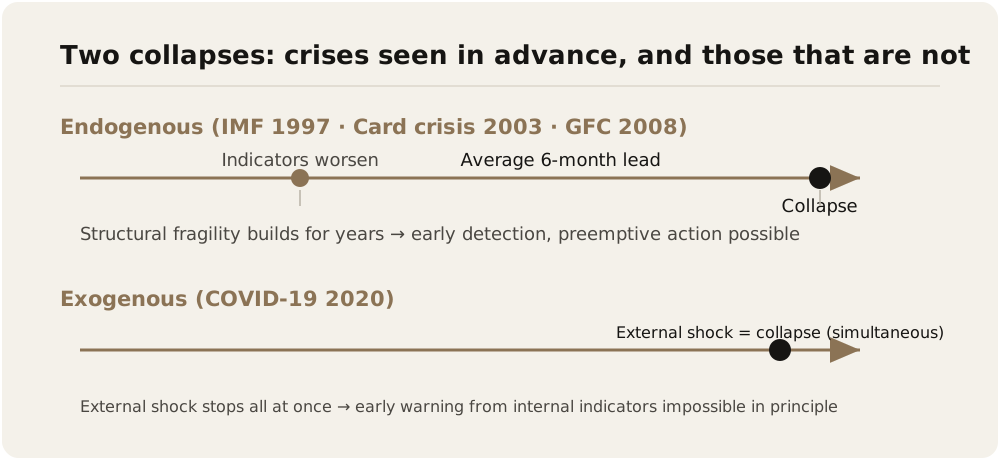
By contrast, the COVID-19 economic shock of early 2020 has an entirely different character. In March and April 2020, when the whole world entered shutdown almost simultaneously, the stock market crashed in a single month to a level similar to the decline of the five months in 2008. But this crisis was the result of major economic indicators being in the normal range until the end of 2019, and of a non-economic shock, an infectious disease, suddenly entering from outside and halting the entire system all at once. This type is classified as an exogenous flow collapse (Macro Flow Crisis).
The essential difference between the two types is this. In an endogenous flow collapse, the blockade condition forms gradually over several months, so the deterioration of gradient indicators precedes the collapse. It is for this reason that in the author's 690-month empirical study, all three events, IMF 1997, the card crisis 2003, and GFC 2008, had their blockade signal (a single-blockade leading alert of CAM alone for 1997 and 2003; a dual blockade for 2008) caught an average of six months ahead of the point of collapse. By contrast, in an exogenous flow collapse, the dual blockade forms almost simultaneously with the external shock, so a leading warning based on internal indicators is impossible in principle. That the dual-blockade signal in the COVID-19 crisis was caught in the same month as the collapse is not the model being wrong, but the result of accurately reflecting the model's design scope.
This distinction has large policy implications. An endogenous crisis is a preventable crisis, and is therefore an object of early detection and preemptive intervention. An exogenous crisis is an unpreventable crisis, and therefore the key is the prior accumulation of response capacity (fiscal room, foreign exchange reserves, social safety nets) and a rapid response protocol. That modern economic policy has treated these two types with the same early-warning indicators and the same response manual, without distinguishing them, is one structural cause of the repeated failure of crisis management. This book argues that this distinction holds identically in human medicine as well. If myocardial infarction is an endogenous crisis (years of accumulated vascular calcification), then multiple-trauma from a traffic accident is an exogenous crisis (an external mechanical shock), and that the medical approach to the two types is fundamentally different derives from the essential difference in gradient dynamics.
Conclusion
In this chapter, we reread the economy as a system of gradients. The four gradients of income-consumption, saving-investment, center-periphery, and domestic-foreign make up the engine of economic circulation, and when any one of these collapses, the economy enters crisis. The material equation between the human body and the economy (cash ↔ calcium, loan interest ↔ microcalcification, bone ↔ emergency vault, neighborhood economy ↔ microvasculature, central bank ↔ heart) is not a mere metaphor but a formalization of the way the same physical grammar is realized in the two systems.
The three major crises (IMF 1997, the card crisis 2003, GFC 2008) all proceeded in accordance with this grammar. Determinants accumulate over several years, blockade forms at a particular moment (a single blockade of CAM alone in 1997 and 2003; a dual blockade in 2008), and collapse propagates from periphery to center or from center to periphery. And this endogenous type of crisis, unlike an exogenous shock-type crisis, is detectable in advance in principle. In Chapter 11, we will verify this detectability quantitatively with 690 months of empirical data.
In the next chapter, we widen the field of view further, reinterpreting historical events from the standpoint of gradient collapse. We will confirm that events from vastly different eras and scales, such as the fall of the Roman Empire, the Great Depression, the Soviet dissolution, and the Amazon crisis, all proceeded in accordance with the same grammar we confirmed in nature, the human body, and the economy. History does not repeat itself, but the grammar of collapse repeats.
참고문헌
- Minsky, H. P. (1986). Stabilizing an Unstable Economy. New Haven: Yale University Press.
- Reinhart, C. M., & Rogoff, K. S. (2009). This Time Is Different: Eight Centuries of Financial Folly. Princeton: Princeton University Press.
- Kang, T., & Ma, G. (2009). Credit card lending distress in Korea in 2003. BIS Papers, No. 46, 95-106. Bank for International Settlements.
- Kim, K. (2006). The 1997-98 Korean financial crisis: Causes, policy response, and lessons. IMF Seminar on Crisis Prevention in Emerging Markets. International Monetary Fund.
- Drehmann, M., Borio, C., & Tsatsaronis, K. (2012). Characterising the financial cycle: don't lose sight of the medium term! BIS Working Papers, No. 380. Bank for International Settlements.
- Haldane, A. G., & May, R. M. (2011). Systemic risk in banking ecosystems. Nature, 469(7330), 351-355. https://doi.org/10.1038/nature09659
- Scheffer, M., Bascompte, J., Brock, W. A., Brovkin, V., Carpenter, S. R., Dakos, V., Held, H., van Nes, E. H., Rietkerk, M., & Sugihara, G. (2009). Early-warning signals for critical transitions. Nature, 461(7260), 53-59. https://doi.org/10.1038/nature08227
- Acemoglu, D., Ozdaglar, A., & Tahbaz-Salehi, A. (2015). Systemic risk and stability in financial networks. American Economic Review, 105(2), 564-608. https://doi.org/10.1257/aer.20130456
- Mishkin, F. S. (2011). Over the cliff: From the subprime to the global financial crisis. Journal of Economic Perspectives, 25(1), 49-70. https://doi.org/10.1257/jep.25.1.49
- Prigogine, I., & Stengers, I. (1984). Order Out of Chaos: Man's New Dialogue with Nature. New York: Bantam Books.
Source: The Universal Law: Gradient, Chapter 7, "The Economy's Gradient" (2/2). The body text follows the original manuscript verbatim and is provided for informational purposes.