
In the previous chapter we reread the human body as a landscape of gradients. Now we carry the same grammar into the national economy. The economy, too, is a circulatory system. Money flows, goods move, labor and capital are exchanged, and a great circulation continues: from the central bank to commercial banks, from commercial banks to firms and households, and from firms and households back again to the central bank. While this circulation holds, the economy is alive; the moment the circulation stops, the economy enters crisis.
The circulation of the economy, like the circulation of the body, turns on gradients. The gap between high and low income, the gap between the central bank's policy rate and market rates, the gap between saving and investment, the gap in interest rates and exchange rates between the domestic economy and abroad: these gradients generate the flow of money, and that flow sustains the metabolism of the whole economy. From this book's point of view, an economic crisis is redefined not as "the economy turning bad" but as "a state in which a gradient can no longer be sustained."
This chapter has three goals. The first is to map the basic gradients that drive the economy. The second is to formalize the material equations between the body and the economy: cash is calcium, loan interest is microcalcification, and the neighborhood economy is the microvasculature. The third, and the most empirical, is to reconstruct the three major crises that Korea and the world experienced over the past thirty years, the 1997 IMF foreign-exchange crisis, the 2003 credit-card crisis, and the 2008 global financial crisis, in the language of gradient collapse.
At the end of the chapter we explain a distinction that emerged from the author's empirical research: the essential difference between an endogenous flow crisis (Micro Flow Crisis) and an exogenous flow crisis (Macro Flow Crisis). This distinction provides a physical answer to the question of why some crises give warning signals six months in advance while others are only detected on the day they strike, and it is also the central concept of the 690-month empirical study of Korea and the United States covered in Chapter 11.
The Four Gradients That Drive the Economy
The gradients that drive the economy span several layers, but for practical purposes they can be organized into four principal gradients: the income-consumption gradient, the saving-investment gradient, the center-periphery gradient, and the domestic-foreign gradient. These four gradients interlock to sustain a nation's economy, and the collapse of any one of them shakes the other three in a chain reaction.
The income-consumption gradient is the most basic engine of economic circulation. Households earn income in exchange for labor and spend part of that income; firms take that spending as revenue and disburse it again as wages and purchases of parts and materials. Each time this flow completes one turn, it registers as a measure of the economy's total activity. The observation that low-income households have a much higher marginal propensity to consume than high-income households (the central insight of the consumption function that Keynes established in The General Theory) shows that this gradient is the decisive variable determining the speed and depth of economic circulation. As long as a healthy gradient is maintained between income and consumption, the economy turns.
The saving-investment gradient mediates the time-shift between present consumption and future consumption. Household savings pass through banks and are converted into corporate investment, and corporate investment becomes the foundation for productivity growth and future income. This gradient collapses in two ways. When savings are excessive and investment is absent, the economy falls into a liquidity trap; when savings are insufficient while investment is excessive, a bubble forms. The Korean economy in the mid-1990s followed the latter pattern, while Japan in the early 2000s became trapped in the former; both are representative cases.
The center-periphery gradient operates along the hierarchy of interest rates and liquidity. When the central bank sets its policy rate, the funding rates of commercial banks move; when commercial banks' funding rates move, the rates on corporate and household loans move; and this gradient is transmitted all the way to the periphery. This transmission structure is structurally identical to the hierarchy of heart to aorta to arteries to arterioles to capillaries in the human body. As long as the gradient from center to periphery is transmitted smoothly, the economy's circulation is fluid, but when the gradient becomes occluded at a particular segment, flow at the periphery drops sharply. The situation in which small and mid-sized firms and self-employed workers cannot obtain loans even after the U.S. Federal Reserve cuts rates repeatedly is a textbook case of blockage in the intermediate segment, and this is also the core mechanism of the 2008 global financial crisis, which we take up later in this chapter.
The domestic-foreign gradient mediates trade and capital flows. Price competitiveness between exports and imports, the gap between domestic and foreign interest rates, and the difference in value between the home currency and foreign currencies act together to generate cross-border flows. When a nation's economy fails to adapt to a sudden change in this gradient, it leads to a currency crisis, which is the experience Korea and several other East Asian nations went through in 1997. These four gradients interlock to determine the health of an economy, and the way a disturbance in one gradient transmits to another shapes the specific pathway of a crisis.
The Material Equation: Cash Is Calcium
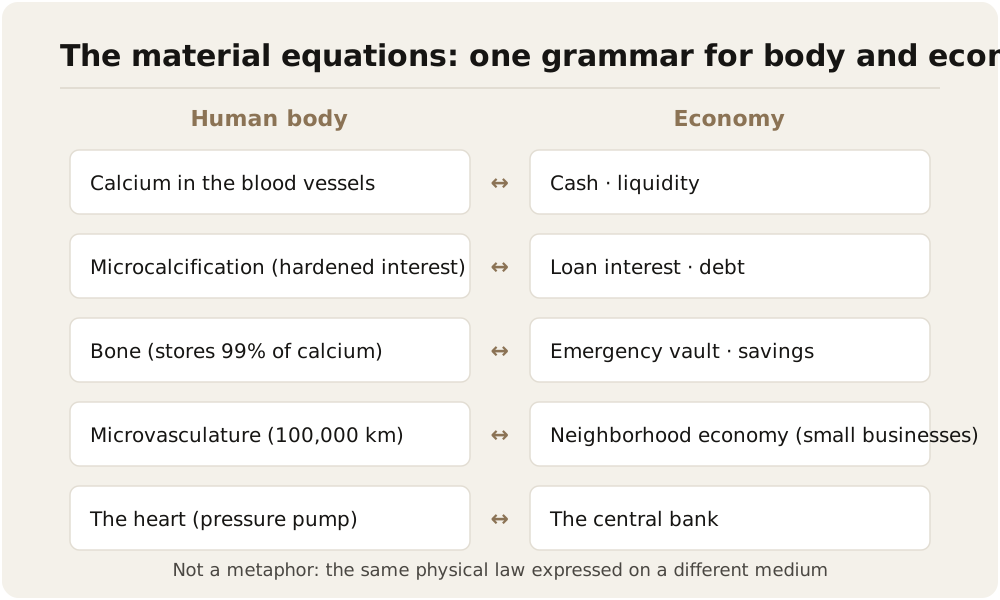
If the human body and the economy operate on the same physical grammar, then there should be a quantitative correspondence between the two systems that goes beyond mere metaphor. The author calls this correspondence the material equation and formalizes it as five one-to-one pairings. This equation is not rhetorical figuration but a claim of structural isomorphism between variables that share identical function, identical dynamic behavior, and even the same r⁴ sensitivity and irreversible-deposition characteristics.
First, cash is calcium. In the body, calcium is the mediator that circulates inside and outside cells to transmit signals; in the economy, cash is the mediator that circulates among households, firms, and government to complete transactions. Both mediators function only "while flowing," and the moment the flow stops, the system's function also stops. Just as a cell that loses its calcium gradient meets death, an economy that loses its liquidity gradient sees transactions halt and function cease.
Second, loan interest is microcalcification. Principal can be repaid and returned, but interest does not return. Interest that leaves the periphery (households, small merchants) every month and moves to the center (financial institutions, creditors) shows exactly the same dynamic behavior, in that it is never recovered, as microcalcification deposited on vessel walls. As interest accumulates, disposable liquidity at the periphery decreases, and as loan interest persists, the same nonlinear r⁴ effect observed when a vessel's effective bore narrows is also observed in the economy. For this reason, households whose interest burden has crossed a critical threshold collapse sharply under even a very small additional shock.
Third, bone is the emergency vault. Human bone is a vast reservoir storing ninety-nine percent of the body's total calcium, and what corresponds to it in household and national economies is emergency savings and loan availability. Under normal conditions this reservoir is rarely used, but in a crisis it is withdrawn from rapidly. When withdrawals repeat, the reservoir itself weakens, and in the next crisis its protective function is further diminished. The paradoxical simultaneous progression of osteoporosis and vascular calcification, in which bone weakens while vessels harden at the same time, is structurally the same phenomenon as the simultaneous progression, in the economy, of savings depletion and debt-interest accumulation.
Fourth, the neighborhood economy is the microvasculature. The site where a nation's economic circulation actually takes place is not the large conglomerates or the financial districts of major cities but the peripheral network formed by millions of small merchants and small and mid-sized enterprises. The total scale of this peripheral network is comparable to the roughly one hundred thousand kilometers of the body's microvasculature, and most of the economy's total activity occurs there. And it is precisely there that the signs of gradient collapse appear first and recover last. Even when macro indicators look normal, if the neighborhood commercial districts stand empty, the economy is already sick.
Fifth, the central bank is the heart. It is the pump that generates the circulatory pressure gradient at the very center of both systems. Just as the heart regulates the pressure with which it pumps blood, the central bank regulates the intensity of circulation across the whole economy by adjusting two variables: the supply of liquidity and the interest rate. Just as hypoxia begins at the extremities when the heart weakens, the neighborhood economy begins to collapse first when the central bank's ability to sustain the gradient weakens. The claim that these five correspondences are not metaphor but structural isomorphism is verified concretely in the three crisis cases that follow.
IMF 1997: Korea's First Flow Collapse
On December 3, 1997, the Korean government and the International Monetary Fund agreed on a bailout package worth 58 billion dollars. Korea had formally requested an IMF bailout on November 21, so the agreement came just twelve days later. At the time, Korea's foreign-exchange reserves had fallen to roughly 3.9 billion dollars, leaving the country effectively on the brink of sovereign default, unable even to repay short-term foreign debt. The won-dollar exchange rate spiked to 1,995 won on December 24, nearly double what it had been the month before, and the public greeted the end of the year amid fears that "the country is going under." Few episodes in Korea's economic history are as clear a case of gradient collapse as this one.
Reconstructing the pathway of this collapse through the five stages of the gradient framework runs as follows. Stage 1, the accumulation of determinants, built up over several years in the mid-1990s. Under a strong-won policy, large conglomerates borrowed heavily from low-interest foreign sources, causing short-term foreign debt to snowball; the chaebols' excessive investment piled up as redundant, overcapacity facilities that eroded profitability; and the current-account deficit became chronic. These factors were outwardly masked by strong growth rates through 1996. Stage 2, the trigger, came with the bankruptcies of the Hanbo Group in January 1997 and Kia Motors in July. As the implicit trust that large conglomerates "cannot fail" was shaken, foreign creditors' outlook cooled sharply, and the Hong Kong stock market crash of October 23 became the decisive trigger.
Stage 3, the dual blockade or flow collapse, proceeded through November. Foreign creditors stopped rolling over short-term loans and began withdrawing them en masse, drying up foreign-currency liquidity, while at the same time domestic financial institutions stopped lending to one another as mutual trust collapsed. Reading this as external inflows and internal circulation being cut off at the same moment is, however, a hypothesis of historical reconstruction. The engine's 690-month measured verdict across this entire span was CAM (signal blockade) alone, that is, a single-blockade leading alert (a measurement made under the observational limit of the 25 gauges in operation at the time). Stage 4, manifestation, appeared in December as a chain of events: a surge in the exchange rate, a stock-market crash, a sharp rise in corporate bankruptcies, mass unemployment, and a spike in interest rates. Stage 5, total collapse, was averted thanks to the IMF's emergency bailout, but the Korean economy went on to carry the structural aftereffects of low growth, high unemployment, and polarization for more than twenty years afterward.
The most important observation when reading this crisis from a gradient perspective is that the gradient indicators were already sending warning signals long before foreign-exchange reserves bottomed out in November. Indicators such as the ratio of short-term foreign debt to foreign-exchange reserves, the trend in the current-account deficit, and the chaebols' debt ratios had already begun deteriorating simultaneously from the second half of 1996, and when analyzed retrospectively using the author's DIAH-7M framework, a blockade signal of CAM (signal blockade) alone, that is, a single-blockade leading alert, was already detected as of May 1997. In the 690-month empirical study covered in Chapter 11, this crisis is recorded as an event for which a single-blockade leading alert was established a full six months before the actual collapse.
The next installment reconstructs the remaining two crises, the 2003 credit-card crisis and the 2008 global financial crisis, through the same five stages, and examines the essential difference between endogenous and exogenous flow collapse, the distinction that separates crises that can be foreseen from those that cannot.
Source: The Universal Law: Gradient, Chapter 7, "The Economy's Gradient" (1/2). The body text follows the original manuscript and is provided for informational purposes.