
This piece is the opening part of Chapter 9 of Stones in the Body: More Frightening Than Cancer (Yoon Jong-won). It is a narrative that contains the author's academic hypotheses, and the body, figures, and citations follow the manuscript as written.
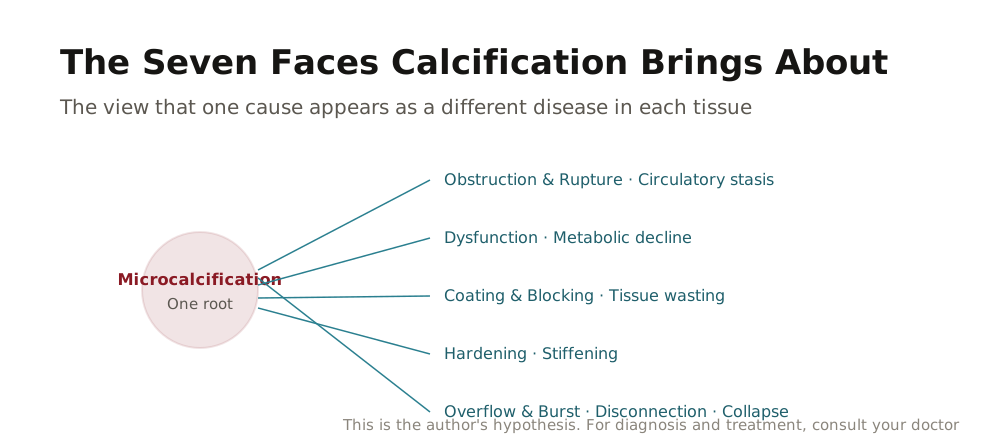
In the previous chapter we examined the 'Calcium Absorption-Microcalcification Double Lockdown Theory (CAM-DLT).' Calcium that has flowed out of the bone blocks the passages of the microvessels and the lymphatic vessels, disturbs the calcium signal inside the cell, and lowers the energy production of the mitochondria, causing a 'three-axis lockdown.'
We were the first in the world to reveal that this mechanism is the fundamental cause of aging and chronic disease. At the same time that the cell signal becomes unstable because calcium absorption is insufficient, the calcium that has flowed out of the bone turns into microcalcification and blocks the passages; the state in which these two combine and lock the cell away is precisely the 'Double Lockdown (CAM-DLT).'
Now the question deepens by one more step. In exactly what way does a cell trapped in the double lockdown break down? When the lockdown persists, what pathological changes appear in the cells and tissues?
The answer lies in seven pathological mechanisms, that is, the '7M (Mechanisms).' When calcium that has escaped from the bone reaches the soft tissue, it causes damage in different ways depending on its location, its concentration, and the characteristics of the tissue.
In some places it blocks the tubes (Obstruction & Rupture), in some places it makes movement dull (Dysfunction), and it can also coat the receptors and block the signal (Coating & Blocking). It also hardens the vessel walls (Hardening), makes cells proliferate excessively (Overflow & Burst), cuts off nerves and blood vessels (Disconnection), and finally brings down even the bones and teeth (Collapse).
In fact, 7M is not a new concept. We are already speaking of 7M in everyday life. "They say the blood vessel got blocked," "They say the brain blood vessel burst," "My knee is stiff," "They say the blood vessels have hardened," "A lump has grown," "The foot has rotted," "The bone has worn away." These are expressions we commonly use when we speak of a disease state or a cause of death, at the hospital, at the funeral hall, or at a family gathering.
DIAH-7M is the common pathway by which hundreds of chronic diseases arise, and at the same time it is a concept that scientifically systematizes the outcomes of diseases we already know. In this chapter we disclose its substance for the first time.
[Table] The Five Stages of the DIAH-7M Aging and Chronic Disease Pathway System
| Stage | English | Theory Name | Abbreviation |
|---|---|---|---|
| ① Factor | Factor | DIAH Four-Gate Funnel Theory | DIAH-FG |
| ② Start | Start | DIAH Trigger Bone Calcium Efflux Theory | DIAH-BCO |
| ③ Lockdown | Lockdown | Calcium Absorption and Microcalcification Double Lockdown Theory | CAM-DLT |
| ④ Manifestation | Manifestation | Calcification 7M Pathological Manifestation Theory | Ca-7M |
| ⑤ Result | Result | 7M Life System Devastation | 7M-A |

This is the fourth stage of the DIAH-7M Aging and Chronic Disease Pathway System, the domain of ④ Manifestation and ⑤ Result. In this chapter we examine in detail how the seven pathological mechanisms manifest as concrete diseases in the locked-down cell.
What You Will Learn in This Chapter
After reading this chapter you will be able to answer the following questions.
First, 1M Obstruction & Rupture - why do blood vessels get blocked and burst? Second, 2M Dysfunction - why do joints and valves stiffen? Third, 3M Coating & Blocking - why do receptors lose their function? Fourth, 4M Hardening - why do blood vessels and organs become hard? Fifth, 5M Overflow & Burst - why do cells proliferate excessively? Sixth, 6M Disconnection - why do nerves and blood vessels get cut off? Seventh, 7M Collapse - why do bones and teeth fall apart?
We examine the process by which the calcium that has flowed out breaks down our body in seven different ways. In particular, you will come to understand which disease each mechanism is connected to, and why a single cause appears as hundreds of different diseases. Let us look at this in detail.
The Position of DIAH-7M: An Integrated Framework from the Perspective of Calcium Metabolism
Chronic disease arises from the combined action of various factors such as genetics, lifestyle, environment, and aging. DIAH-7M is a framework that seeks to understand chronic disease in an integrated way by taking 'calcium metabolism abnormality' among these as its core axis. It is not a single cause of chronic disease; rather, it acts as a core pathway that interacts with several risk factors and contributes to the onset of disease and the progression of aging.
The Full Composition of 7M (Mechanisms)
| Mechanism | Korean Name | English Name | Action | Scope |
|---|---|---|---|---|
| 1M | Pyeyeol | Obstruction & Rupture | it blocks and bursts | calcification deposit→lumen occlusion, stenosis, infarction, rupture, hemorrhage |
| 2M | Dunhwa | Dysfunction | it grows dull | calcification deposit→dulling of joint/muscle/valve movement, decline in contraction/relaxation function |
| 3M | Pipye | Coating & Blocking | it is coated and blocked | calcification deposit→receptor blockage, signal blockage, secretion blockage, insulin resistance |
| 4M | Gyeonghwa | Hardening | it hardens | calcification deposit→fibrosis, calcification, rigidity, loss of elasticity |
| 5M | Beompa | Overflow & Burst | it overflows and bursts | excessive calcium influx→cell overproliferation, hypertrophy, tumor, expansion, apoptosis |
| 6M | Danjeol | Disconnection | it is cut off and severed | calcification deposit→nerve severance, vascular occlusion, tissue necrosis, apoptosis |
| 7M | Bunggoe | Collapse | it falls apart | calcium deficiency→structural collapse of hard tissue (bone, teeth) |
[ 7M Mechanism Scientific Evidence References / 7M Mechanism References]
1. Pyeyeol / Obstruction & Rupture (1M)
1-1. StatPearls (NCBI Bookshelf: Coronary Artery Calcification, NBK519037): Coronary artery calcification is mainly associated with atherosclerosis, and together with risk factors such as hypertension and diabetes it explains the burden of lesions within the blood vessel (risk of stenosis/occlusion) / CAC is most commonly due to atherosclerosis and is associated with major risk factors, reflecting atherosclerotic burden 1-2. Current Opinion in Lipidology (PMCID: PMC4166045; PMID: 25188916): A summary of the view that microcalcifications can raise the instability of atherosclerotic plaque and the risk of rupture (vulnerability) / Microcalcifications can contribute to plaque instability and rupture vulnerability
2. Dunhwa / Dysfunction (2M)
2-1. Circulation (PMCID: PMC4199903): A summary of the pathophysiology and research consensus in which calcific aortic valve disease (CAVD) leads to structural deformation of the valve and functional decline (stenosis/reduced mobility) / CAVD links calcification to valve structural and functional impairment 2-2. Clinics in Shoulder and Elbow (PMCID: PMC7726362): A review of the clinical presentation, treatment, and course in which, in calcific tendinitis of the shoulder rotator cuff, calcium deposition creates functional impairment such as pain and restriction of range of motion / Calcific tendinitis causes pain and reduced range of motion, reflecting functional limitation
3. Pipye / Coating & Blocking (3M)
3-1. Frontiers in Endocrinology (PMCID: PMC10711676): A meta-analysis of observational studies showing that insulin resistance (HOMA-IR) is associated with the prevalence and progression of coronary artery calcification (CAC) / Higher HOMA-IR is linked with increased prevalence and progression of CAC 3-2. Arteriosclerosis, Thrombosis, and Vascular Biology (ATVB) (PMID: 36727521; PMCID: PMC9944758): An experimental/mechanistic report that calciprotein particles (CPP) in the blood lower endothelial function and impair NO metabolism (the nitric oxide pathway) / CPPs induce endothelial dysfunction by impairing nitric oxide metabolism
4. Gyeonghwa / Hardening (4M)
4-1. Arterial Stiffness (PMCID: PMC7199843): A review of vascular calcification being closely connected to arterial stiffness (reduced elasticity), organizing the related signals and regulators / Vascular calcification is strongly associated with arterial stiffening and loss of compliance 4-2. Arterial stiffness and hypertension (PMCID: PMC10691097): A review article that arterial stiffness and systolic hypertension are strongly interlocked pathophysiologically / Arterial stiffness and systolic hypertension are closely interrelated pathophysiologically
5. Beompa / Overflow & Burst (5M)
5-1. Cancers (PMCID: PMC7600741): A summary showing that in hepatocellular carcinoma the calcium signal is a core axis governing tumor biology such as cell growth, migration (metastasis), and death / Ca²⁺ signaling is essential for regulating cancer cell growth, migration, and death in liver cancer 5-2. Cell (PMCID: PMC4459646; PMID: 9568714): A proposal that calcium-dependent phosphatase (calcineurin) can induce the gene program of cardiac muscle hypertrophy / Calcium-dependent calcineurin signaling can drive a transcriptional pathway for cardiac hypertrophy
6. Danjeol / Disconnection (6M)
6-1. StatPearls (NCBI Bookshelf: Calciphylaxis, NBK519020): A review of the 'vascular disconnection model' in which cutaneous arteriolar calcification causes ischemia and infarction, leading to painful necrotic lesions / Cutaneous arteriolar calcification leads to tissue ischemia and infarction in calciphylaxis 6-2. Frontiers in Aging Neuroscience (PMCID: PMC8674839): A mechanistic review in which Ca²⁺ imbalance is connected, in Alzheimer's pathology, to neuroinflammation, neuronal injury, autophagy, and apoptosis / Ca²⁺ dysregulation is linked to neuroinflammation, neuronal injury, autophagy, and apoptosis in AD-related pathways
7. Bunggoe / Collapse (7M)
7-1. StatPearls (NCBI Bookshelf: Physiology, Parathyroid Hormone, NBK499940): An endocrine physiology summary that when blood calcium falls, PTH is secreted and operates in the direction of maintaining calcium homeostasis / PTH is secreted in response to low serum calcium to maintain calcium homeostasis 7-2. International Journal of Nanomedicine (PMCID: PMC5034904; PMID: 27695330): By organizing the dynamics of demineralization/remineralization (mineral movement in and out) in teeth and bone, it explains the physicochemical basis of 'weakening/collapse of hard tissue under calcium deficiency' / Demineralization-remineralization dynamics underpin hard-tissue weakening when mineral balance is negative ※ Explanation of the 7M term: Pyeyeol (閉裂) is a term different from the pyeyeol (肺熱, heat of the lung) in traditional Korean medicine; it is a coined word meaning 'blockage (閉)' and 'bursting (裂).' It encompasses lumen occlusion (blockage of blood vessels/airways/intestines), rupture (aneurysm/organ bursting), and hemorrhage (internal bleeding/external bleeding).
※ M5 core mechanism: When, in an environment where transmission has broken down (ischemia caused by microvascular calcification), the Ca²⁺ signal becomes excessive, the cell rushes toward hypertrophy, overproliferation, and death. This is the connecting link that joins 'blood vessel (the road), tissue (the land), cell (the house).'
8. Microcalcification / Microcalcification & Calcifying Vesicles
8-1. Front Cardiovasc Med (PMCID: PMC5732140; PMID: 29322046): A review article that extracellular vesicles (EVs) act as mediators of cardiovascular calcification and that calcifying vesicles induce the nucleation of microcalcification / Extracellular vesicles serve as mediators of cardiovascular calcification, with calcifying vesicles initiating microcalcification nucleation (Bakhshian Nik, Hutcheson, Aikawa 2017)
8-2. Circ Res (PMID: 25711438; PMCID: PMC4409143): A mechanistic study that vascular smooth muscle cells (VSMC) mediate calcification through exosomes and that calcium imbalance promotes the secretion of calcifying vesicles / VSMC calcification is mediated by regulated exosome secretion; calcium imbalance induces calcifying vesicle release (Kapustin, Shanahan et al. 2015)
8-3. J Physiol (PMCID: PMC4887700): A review article that VSMC-derived exosomes are involved in calcification and thrombosis and that exosome secretion increases in synthetic smooth muscle cells / VSMC exosomes contribute to calcification and coagulation; synthetic VSMCs show increased exosome release (Kapustin, Shanahan 2016)
8-4. Nat Rev Cardiol: A review article integrating the inflammatory, osteoblastic, and mineralization pathways of vascular calcification / Inflammatory, osteogenic, and mineralization pathways in vascular calcification are interconnected (Demer, Tintut)
8-5. Circulation: A study of the mechanism and clinical significance of calcification in atherosclerosis, and that microcalcification contributes to plaque instability / Calcification in atherosclerosis: mechanisms and clinical implications; microcalcifications contribute to plaque instability (Doherty et al.)
8-6. Eur Heart J (PMID: 24740885): A reexamination of the pathophysiology and clinical relevance of medial vascular calcification / Medial vascular calcification revisited: pathophysiology and clinical relevance (Lanzer, Boehm, Sorribas et al.)
8-7. Nat Rev Cardiol: A review article on the regulatory mechanisms of vascular calcification, the balance between calcification inhibitors and promoters / Regulatory mechanisms of vascular calcification: balance between inhibitors and promoters (Sage, Tintut, Demer)
8-8. Circulation (PMID: 18040026): A molecular imaging study that in the early stage of atherosclerosis osteoblast differentiation and inflammation proceed simultaneously and microcalcification forms / In vivo molecular imaging shows osteogenesis associates with inflammation in early-stage atherosclerosis; microcalcification concept (Aikawa, Nahrendorf, Figueiredo et al. 2007)
8-9. Nat Rev Rheumatol: The mechanism by which calcium crystals induce inflammation and tissue damage, activation of the NLRP3 inflammasome / Calcium crystal-induced inflammation and tissue damage via NLRP3 inflammasome activation (McCarthy, Dunne)
8-10. Kidney Int: A review article that phosphate plays a core role in vascular calcification and that the collapse of the calcium-phosphate balance promotes calcification / The emerging role of phosphate in vascular calcification; calcium-phosphate imbalance promotes calcification (Giachelli)
8-11. Kidney Int: The key mediators and therapeutic targets of arterial calcification in chronic kidney disease / Arterial calcification in chronic kidney disease: key mediators and therapeutic targets (Shanahan, Crouthamel, Kapustin, Giachelli)
8-12. Mayo Clin Proc: An explanation that calcific uremic arteriolopathy (Calciphylaxis) is a cutaneous manifestation of systemic vascular calcification and thrombosis / Calciphylaxis: a cutaneous manifestation of systemic vascular calcification and thrombosis (Weenig)
8-13. Am J Med Sci: A review article on the pathophysiology and clinical features of calcific uremic arteriolopathy / Calciphylaxis (calcific uremic arteriolopathy): pathogenesis and clinical features (Brandenburg, Kramann, Rothe et al.)
8-14. J Am Coll Cardiol / Circ Res: The mechanism and clinical importance of vascular calcification in diabetes and chronic kidney disease / Vascular calcification in diabetes and chronic kidney disease: mechanisms and clinical significance (Raggi, Bellasi, Gamboa et al.)
8-15. Robbins & Cotran Pathologic Basis of Disease (textbook): Establishing the concepts of dystrophic calcification (dystrophic) and metastatic calcification (metastatic), a standard reference for the classification of calcification / Standard textbook reference for dystrophic vs metastatic calcification classification
※ Explanation of the 7M Term
Pyeyeol (閉裂) is a term different from the pyeyeol (肺熱, heat of the lung) in traditional Korean medicine; it is a coined word meaning 'blockage (閉)' and 'bursting (裂).' It encompasses lumen occlusion (blockage of blood vessels/airways/intestines), rupture (aneurysm/organ bursting), and hemorrhage (internal bleeding/external bleeding).
The DIAH-7M Formula: DIAH Four-Gate Funnel (1st, 2nd, 3rd factors) → DIAH (four triggers) → Bone Calcium Efflux → Double Lockdown (CAM-DLT) → 7M (seven pathological manifestations) → Onset of Chronic Disease
Here we will examine one by one the concept of each mechanism, its connecting link to the DIAH trigger, and how the role of immune cells and inflammation contributes to a particular disease.
To aid understanding we will make active use of analogy, but we will clearly distinguish and explain the parts that differ from the actual molecular-level mechanism.
1M Obstruction & Rupture (it blocks and bursts)