
In the previous part 1, we laid two foundations: that the twelve hallmarks of aging are not cause but result, and that the four DIAH factors (deficiency, inflammation, acidosis, hypoxia) draw the calcium of bone out in one direction and deposit it in the microvasculature. Now we examine the third foundation, that is, how the dual blockade that is the turning point these four factors create forms, and why it surfaces as seven damage patterns. And with that grammar we reread the first disease, hypertension.
The Two Faces of Dual Blockade: Signal Blockade and Channel Blockade
When the four DIAH factors operate over the long term, at some point the system crosses an unrecoverable turning point. This book calls this turning point dual blockade and the collapse of flow. The name "dual" is no coincidence. It is because at this turning point the pathway that is the microvasculature loses two functions simultaneously. One is the function of supplying to the cell what it needs, and the other is the function of discharging what the cell has made. Only when these two worsen simultaneously at the same time does the system cross from a "managed state" to a "progressing disease."
If one understands the microvasculature simply as a tube through which blood flows, this structure is not easy to see. The microvasculature is a bidirectional exchange system. In the supply direction, oxygen, glucose, amino acids, hormones, immune cells, and drugs flow from the artery into the cell, and in the discharge direction, carbon dioxide, lactate, uric acid, metabolic waste, toxins, and inflammatory substances flow from the cell into the vein. That a cell is alive means that these two directions of flow are being maintained simultaneously. Even if only supply is maintained, the cell is poisoned and dies; even if only discharge is maintained, the cell starves and dies. If even one of the two directions worsens, the cell's function declines, and if the two directions worsen simultaneously, the cell begins to spend its energy on survival rather than recovery.
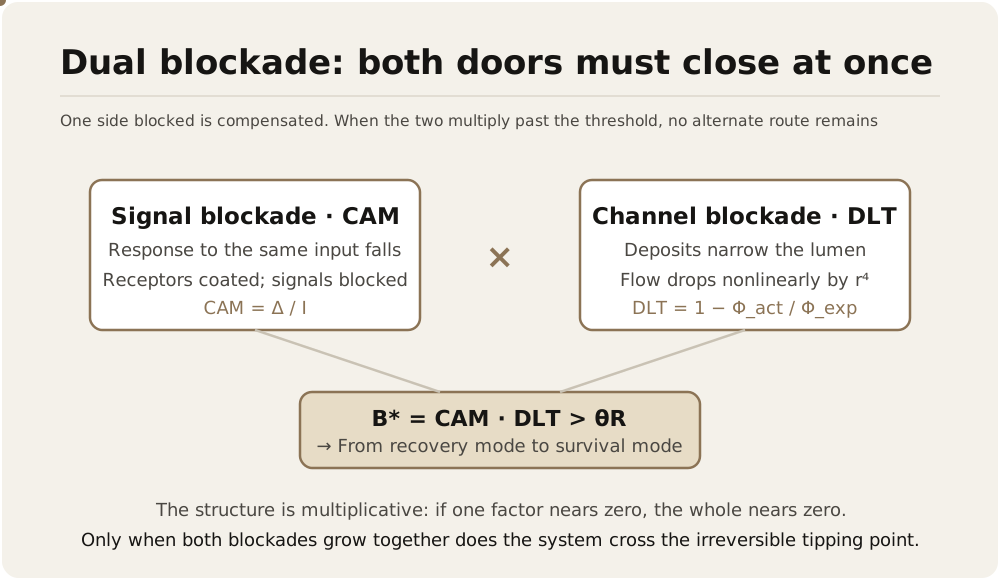
In this book, this dual blockade is formalized along two axes, CAM and DLT. CAM is the abbreviation for Conductance Attenuation Metric, which in plain language means functional signal blockade. Expressed as a formula it is CAM = Δ/I (it is defined only when the input is at or above a certain threshold, I ≥ I_min), where I is the input signal entering the system and Δ is the deficit by which the response to that signal has decreased relative to the normal value. In a healthy system this value is maintained close to 0, and the more the signal conduction function attenuates, the larger the value grows. That CAM approaches 1 means a state in which the system can hardly respond at all to the same input, that is, a state in which the signal is not delivered. When the calcium channels and pumps of the cell membrane lose function through long suffering from hypoxia, inflammation, acidosis, and deficiency, the response the cell puts out to the same amount of hormonal and metabolic signal decreases. On the surface it is called by different names such as insulin resistance, hypothyroidism, and immune decline, but the physical essence is one. It is a state in which the system puts out a weaker response to the same input, that is, a state in which conductance has attenuated.
DLT is the abbreviation for Deposition-induced Luminal Throttling, meaning the physical narrowing of the lumen due to deposition. Expressed as a formula it is DLT = 1 − Φ_act/Φ_exp(Δ), where Φ_act is the actual flux observed under a given driving force Δ (a pressure difference, concentration difference, or voltage difference), and Φ_exp(Δ) is the flux that would be expected at that driving force had there been no deposition. In a healthy tube this value converges to 0, and the more deposition builds up on the inner wall of the tube and the effective inner diameter narrows, the larger the value grows. The speed of the increase follows exactly the r⁴ proportionality of Poiseuille's law. Merely by microcalcification building up in the lumen of the microvasculature and the surrounding tissue and reducing the radius by 10%, DLT rises to about 0.34, and if it is reduced by 20%, it rises to about 0.59. When the lumen narrows, supply decreases, and when the surrounding tissue hardens, diffusion slows and discharge decreases; the blockade of these two directions is contained within this single indicator.
The point to note in the definitions of these two indicators is that neither contains a medium-specific word such as "calcium" or "microcalcification." CAM is merely the ratio of signal to response, and DLT is merely the ratio of actual flux to expected flux. This medium-independence is the fundamental reason the same indicators can be applied as they are to the economy, ecosystems, and information systems in the remaining chapters of this book. In the human body, I becomes a hormone, Δ becomes the cell response, and Φ becomes microvascular flow rate. In the economy, I becomes a policy signal, Δ becomes the real-economy response, and Φ becomes the flux of funds. Only the names of the variables in the formula change; the formula itself is the same. This identity is confirmed with economic data in Chapter 11.
The verdict indicator of dual blockade is defined as the product of the two indicators, B* = CAM · DLT. This simple multiplicative structure automatically guarantees, mathematically, the necessary-condition nature of dual blockade. If one side is close to 0 (normal operation), the entire product is also close to 0 and cannot cross the threshold, and only when both sides grow sufficiently large does the product cross the threshold θR and dual blockade form. If the signal dimension is alive, compensation is possible even if the channel narrows, and if the channel is alive, compensation is possible even for a signal deficit. But when the two sides grow simultaneously, there is no alternative pathway in either direction, and in this state the system abandons recovery mode and switches to survival mode. Put plainly, it is a strategy of "postpone fixing and just hold on for now." While it holds on, all repair work is delayed, delayed repair gives rise to new damage, and new damage leads once again to holding on. The longer this cycle continues, the more the system stiffens, and from a certain point it does not return to recovery mode without external intervention.
There is another reason dual blockade is fearsome. It is because inflammation and calcification become each other's fuel. Inflammation converts the smooth muscle cells of the vessel wall into a phenotype resembling osteoblasts and promotes calcification, and calcification creates hypoxia and waste stagnation in the microenvironment and fixes inflammation in place. This bidirectional feedback, expressed in the language of circulatory-system science, is a positive feedback loop, and expressed in clinical language, a "loop that is hard to break." An organ in which this loop has begun to turn is diagnosed on the surface with various disease names, but beneath it one and the same process progresses. The five diseases to be addressed from now on are all merely the organ-specific names of this loop.
Calcification itself must also be seen divided into two levels. One is microvascular calcification, in which microcalcification is studded point by point on the inside of the lumen and the intima, and the other is tissue calcification, deposited in the interstitium of tissue and between cells. Microvascular calcification reduces the supply (IN) function, and tissue calcification reduces the discharge (OUT) function by which waste products leave the cell by diffusion. It is because the two calcifications progress simultaneously in one person's body that the name dual blockade holds, and had there not been this simultaneous progression, a compensatory pathway would have operated and the system could have held on longer. That the coronary artery calcification score (CAC) and albuminuria move in the same direction in clinical tests, and that brain small-vessel disease imaging findings coexist with lower-limb arteriolar calcification, are all indicators showing that this dual structure has spread throughout the whole body.
Let us recall in numbers the r⁴ nonlinearity that Poiseuille's law speaks of. If the radius of a healthy arteriole is taken as 100, when microcalcification builds up and the radius decreases to 90, the flow rate decreases to about 66%, proportional to the fourth power of 90. When the radius becomes 80, the flow rate drops to about 41%; when it becomes 70, to about 24%; and when it becomes 50, to about 6%. A change described as "slightly narrowed" on a coarse image such as an angiogram means, from the standpoint of the amount of supply the cell actually receives, a loss of half or more. Conversely, if the body raises systemic pressure even slightly to compensate for the supply shortage, that impact strikes the microvascular wall again and accelerates calcification. The nonlinearity is harsh in both directions. That the grammar of gradient is written on top of this nonlinearity explains physically why chronic disease is difficult to notice early and progresses sharply in the late stage.
The Seven Damage Patterns: Different Faces of the Same Loop
The way dual blockade surfaces organ by organ is astonishingly regular. Even though the anatomical structures of tissues and organs differ, the same seven damage patterns are observed repeatedly. The author's framework calls these patterns the 7M. They are Blockage-Rupture (閉裂), in which something blocks and bursts; Dulling (鈍化), in which movement slows; Masking (被蔽), in which receptors are covered and signals are cut off; Hardening (硬化), in which tissue stiffens; Overgrowth (氾破), in which cells overproliferate or swell; Severance (斷絶), in which nerves and vessels are cut off and tissue necrotizes; and Collapse (崩壞), in which the structure itself gives way. These seven do not occur in a set order. In one organ one or two stand out, and in another organ a different combination stands out. But viewing the human body as a whole, almost no new patterns other than these seven are observed.
Blockage-Rupture is a name bundling blockage and bursting into a single word. When a tube narrows and at some point becomes completely blocked, it becomes myocardial infarction or cerebral infarction, and conversely, when a weakened wall cannot withstand the inner pressure and bursts, it becomes aortic dissection or cerebral hemorrhage. The microcalcification review by Harvard Medical School's Hutcheson team (Hutcheson, Maldonado, & Aikawa, 2014, Curr Opin Lipidol 25:327-332) showed that these two events are the two extremes of the same axis, the stability and instability of plaque. There is the added finding from finite-element analysis that when microcalcifications 10 to 50 micrometers in size are locally concentrated in the fibrous cap inside a plaque, the mechanical stress of the cap is amplified more than fivefold, dramatically raising the risk of rupture. Blockage and bursting seem like opposite phenomena, but they are in fact different expressions of the same physical process (the calcium built up on the tube wall and the resulting mechanical weakening of the wall).
Dulling is the common name for the phenomenon in which the heart valve does not open and close well, the joint does not move smoothly, and the vessel cannot smoothly perform contraction and relaxation. The review of calcific aortic valve disease (CAVD) in Circulation (Lerman et al., 2015) established that the calcium building up on the valve is a structural cause that lowers both the speed and the amplitude of opening and closing, and the calcific tendinitis study in the Clinics in Shoulder and Elbow journal (Oh et al., 2020, Clin Shoulder Elb) clinically showed the pathway by which calcium deposition in the shoulder rotator cuff simultaneously creates pain and restriction of range of motion. Dulling is an easily noticed precursor before function stops completely.
Masking is a state in which the cell's receptors and signaling apparatus are "covered" by clumps of calcium and protein and cannot work properly. A recent meta-analysis in Frontiers in Endocrinology (Xu et al., 2023, Front Endocrinol) established that HOMA-IR, an indicator of insulin resistance, shows a significant correlation with the prevalence and progression of coronary artery calcification, and a 2023 study in the ATVB journal (Bosteen et al., 2023) presented experimental evidence that blood calciprotein particles directly damage the nitric oxide metabolism of the vascular endothelium. A cell that is covered and cannot receive signals looks fine on the surface but begins to be functionally cut off from the world.
Hardening is tissue stiffening. An artery that has lost elasticity transmits systolic blood pressure straight to the periphery and applies repeated impact to the microvasculature, a hardened valve increases the afterload on the heart and induces ventricular hypertrophy, and a fibrotic liver and lung lose functional units. The Arterial Stiffness journal (Boutouyrie et al., 2020) and a recent review (Cecelja & Chowienczyk, 2023, Heart) established that arterial stiffness is strongly coupled pathophysiologically with systolic hypertension. Hardening is the long-term accumulated form of dulling, and in itself becomes the source of new damage.
Overgrowth is the phenomenon in which the calcium signal is abnormally amplified and cells overproliferate or become enlarged. The hepatocellular carcinoma study in the journal Cancers (Cui et al., 2020, Cancers) established that the calcium signal is a key axis governing the growth, metastasis, and death of liver cancer cells, and a Cell paper (Molkentin et al., 1998, Cell) showed that calcineurin, a calcium-dependent phosphatase, can directly induce the genetic program of myocardial hypertrophy. Overgrowth is the cell-level common pathway of cancer, to be addressed in the next Chapter 10, and the seed of cardiac hypertrophy and tissue fibrosis.
Severance appears in two forms: local tissue being cut off by ischemia and necrosis when a vessel is blocked, and a nerve losing function from the periphery inward due to a shortage of flow. The calcific uremic arteriolopathy (NBK519020) material in StatPearls established as the clinical standard the pathway by which arteriolar calcification of the skin causes ischemia and infarction and leads to painful necrotic lesions, and a review in Trends in Neurosciences (Calvo-Rodriguez & Bacskai, 2021, Trends Neurosci 44:136-151) established at the molecular level the pathway by which mitochondrial and calcium imbalance leads to neuronal death and synapse loss in Alzheimer's. Severance is the result of all the preceding stages accumulated, and is the point at which the most dramatic scene clinically appears.
Collapse is the structure itself giving way. When the density of bone drops below a certain threshold, a fracture occurs even from a minor impact, teeth are demineralized and lose function, and cartilage disappears so that the joint surface converts to direct bone-on-bone friction. A 2016 review in the International Journal of Nanomedicine (Abou Neel et al., 2016, Int J Nanomedicine) established the dynamics of demineralization and remineralization of hard tissue and explained the physicochemical basis on which the structure gives way when the mineral balance is maintained in the negative direction for a long time. Collapse is a stage in which recovery is virtually impossible, and it is the threshold this book calls the "point of no return."
The 7M is not a set of diagnostic names. The 7M is merely the name for the seven damage patterns that recur behind diagnostic names. In the body of a hypertension patient, hardening and blockage-rupture stand out; in the body of a diabetes patient, masking occurs first; in the brain of an Alzheimer's patient, severance is the central event; in the joint of an arthritis patient, dulling and hardening accumulate; and in the kidney of a chronic kidney disease patient, collapse is the terminus. From now on we look at five scenes in turn. The scenes differ, but the grammar is one.
Hypertension: The Process by Which the Pressure Gradient Wears Down
To measure blood pressure is not to measure a number but to measure a gradient. The value of 120 mmHg systolic blood pressure is the pressure that the blood the heart pumps out from the left ventricle creates at the starting point of the aorta, and the entire process by which this value falls to a pressure near 0 at the peripheral microvasculature is the pressure gradient that sustains a person's circulation. In the body of a healthy person, this gradient flows smoothly, and the elastic arteries absorb the momentary pressure shock the heart creates with each contraction and transmit it smoothly to the periphery. Hypertension is not a state in which the number has risen from 120 to 140, but a state in which this smooth gradient has stiffened over the long term.
According to the clinical reference resource of the U.S. National Library of Medicine, about 90 to 95% of hypertension patients worldwide are classified as having essential hypertension, for which no specific single cause can be found (StatPearls, Essential Hypertension, NBK539859). The name "essential" itself is a euphemism meaning "cause unknown." Cases with a clear single cause, such as secondary hypertension due to narrowing of the renal vessels or a specific endocrine tumor, account for only 5 to 10%, and for almost all of the rest there is no decisive molecular- or cellular-level explanation for why blood pressure rises. This book seeks to fill this blank space in the language of gradient.
The fundamental cause that wears down the pressure gradient is the r⁴ resistance increase of the microvasculature. When microcalcification is deposited on the peripheral microvascular wall, the effective radius decreases, and in accordance with Poiseuille's law, even a mere 10% reduction in radius decreases the flow rate by about 34%. For tissue to make up this decrease, the entire system must create a higher driving pressure, and this demand returns to the heart and raises the mean systolic pressure. In other words, the rise in blood pressure that appears on the surface as a number is not the cause but the system's compensatory response to a gradient decline already under way at the periphery. From this perspective, "essential" can be redefined not as cause unknown but as another name for "an already-advanced physical condition, namely the accumulation of microvascular calcification."
This interpretation naturally explains a long-standing paradox of antihypertensive drugs. Major drugs such as diuretics, calcium channel blockers, angiotensin-converting enzyme inhibitors, angiotensin receptor blockers, and beta blockers all lower the numbers excellently. But when the drug is stopped, blood pressure rises again immediately in most patients. In the language of gradient, the reason is clear. It is because the drug corrects the numbers but does not correct the physical condition of peripheral calcification. So long as the condition remains as it is, the system repeats the same compensation in the same way. This is the reason "lifelong medication" has become the structural default.
Reconstructed through the five stages, it is as follows. Stage 1, the accumulation of determinants, is the long-term low-intensity activation of the DIAH square. Factors such as a diet centered on processed foods, sedentary living, chronic stress, lack of sleep, and smoking keep deficiency, inflammation, acidosis, and hypoxia turned on simultaneously at low intensity. Stage 2, the trigger, is the functional abnormality of the vascular endothelium and the initial nucleation of microcalcification, and at this stage there are still no symptoms whatsoever. Stage 3, dual blockade and the collapse of flow, forms after decades of accumulation. The lumen narrows sufficiently (DLT), and the signal-receiving function of the endothelium weakens sufficiently (CAM). Stage 4, manifestation, is hypertension and the indicators of arterial stiffness that can be captured as numbers. Stage 5, collapse, is the appearance of target-organ damage such as myocardial infarction, cerebral infarction, heart failure, and chronic kidney disease.
What does this reconstruction mean in practical terms? First, chasing only the blood pressure number is chasing the result, not chasing the cause. Second, the everyday choices that reduce the accumulation of determinants in Stages 1 and 2 (diet, exercise, sleep, stress management) are the least costly intervention and, in the language of gradient, the intervention most at the root. Third, drugs must be combined, even while managing the numbers, with other interventions that restore the gradient, and without that combination the drug becomes a lifelong companion. These three practical implications are the conclusions that naturally follow when hypertension is reread in the language of gradient.
Let me add one three-second analogy. Hypertension is a state in which the attendant at the front gate of a parking lot, trying to reduce the internal parking congestion, pushes incoming vehicles in more forcefully. Seen from the outside, it looks as if only the pressure of the front-gate barrier has risen, but in reality the inner alleys of the parking lot have already narrowed, and greater force has become necessary at the entrance to break through them. An intervention that lowers only the front-gate pressure may briefly relieve the attendant's labor, but it cannot change the fact that the inner alleys have narrowed. The true intervention that restores the gradient is the work of widening the inner alleys again, that is, the work of changing the upstream environment of the microvasculature. Blood pressure is the result, and the alleys are the main body.
If what collapses in hypertension was the pressure gradient, in the following part 3 we read in turn the signal-transduction gradient (diabetes), the brain microvascular perfusion gradient (Alzheimer's), the subchondral bone blood-flow gradient (degenerative arthritis), and the glomerular filtration gradient (chronic kidney disease), and synthesize how the five scenes converge into a single grammar.
This article is part (2/3) of the three-part series covering Chapter 9 of The Universal Law: Gradient. The references are consolidated in part (3/3). The body text follows the original manuscript and is provided for informational purposes.