
In the previous part 1, we formalized the economy as a flow system, established the five pairs of body and economy, transplanted dual blockade onto the economy as the product of CAM and DLT, and on top of that designed the DIAH-7M economic diagnostic engine. The engine was made first from the medical framework, and the economic data was substituted in after the fact. Now we look at the measured results of applying that engine to the 690 months of Korea and the United States, divided into four crises.
The Measured Results of the Four Crises: Overview
The following table organizes the relationship between the point at which the engine judged blockade to have formed and the point at which the official crisis occurred in the 690-month verification. For the four major crises, the gradient warning point, the crisis manifestation point, the lead time, and the type of crisis are shown together. The type of blockade in the engine's measurement differs from crisis to crisis. The leading signals of 1997 and 2003 were single-blockade leading alerts of CAM (signal blockade) alone, and the formation of dual blockade applies to the four Korea-U.S. cases of 2008 and 2020.
| Crisis | Gradient warning | Crisis manifestation | Lead time | Type |
|---|---|---|---|---|
| 1997 Asian (Korea) | May 1997 | November 1997 | 6 months | Endogenous |
| 1998 LTCM (U.S.) | March 1998 | September 1998 | 6 months | Endogenous |
| 2003 credit unwind (Korea, U.S.) | May 2003 | November 2003 | 6 months | Endogenous |
| 2008 global financial crisis (Korea, U.S.) | March 2008 | September 2008 | 6 months | Endogenous |
| 2020 COVID shock (Korea, U.S.) | Simultaneous | Simultaneous | 0 months | Exogenous |
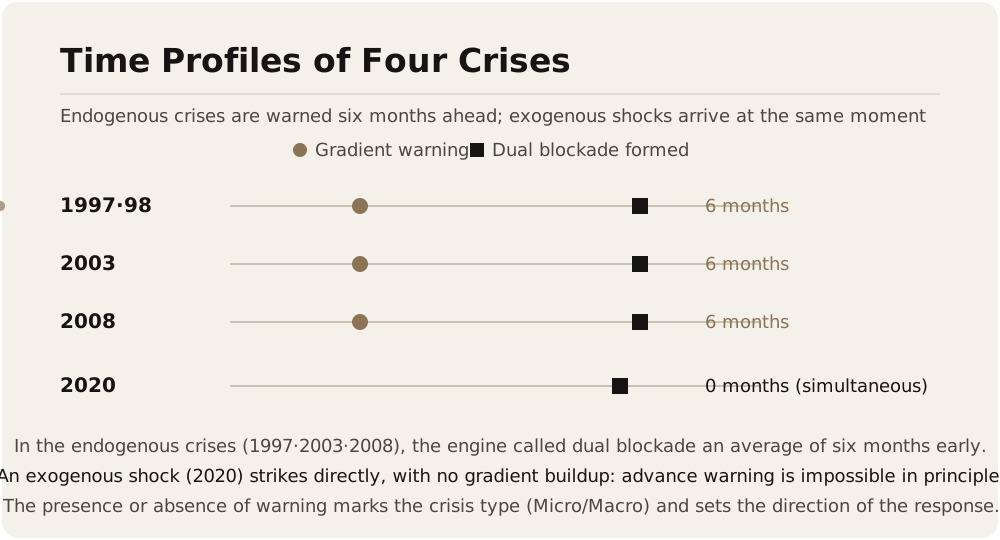
Summarized in a single sentence, the content of the table is this. In all three endogenously progressing crises (the 1997 Asian financial crisis, the 2003 credit unwind, the 2008 global financial crisis), the engine judged blockade to have formed an average of six months ahead of the official crisis point (a single-blockade leading alert of CAM alone for 1997 and 2003; a dual blockade for 2008). And in the fourth crisis, which occurred by an exogenous shock (the 2020 COVID economic shock), the shock and the dual blockade formed simultaneously, without a leading warning. These four patterns coincide exactly with the theory this chapter established earlier (an endogenous crisis allows a leading warning through the accumulation of gradient, and an exogenous shock paralyzes the system momentarily without the accumulation of gradient).
In the following four subheadings, we reconstruct these crises one by one in the language of gradient. For each crisis, we place the time series of both Korea and the United States side by side and show concretely on which axis, and through which gauge, the engine captured the blockade. It is a narration not of historical events but of the process of gradient collapse, and that narration is the place that most directly proves the domain-independence of the grammar of gradient.
Asian Crisis 1997 & LTCM 1998: The Collapse of the Liquidity Gradient
Korea's 1997 is a year in which the gradient had worn down over a long time on the foreign exchange and external transaction axis. Together with the progress of financial liberalization after 1994, domestic financial institutions' dependence on short-term foreign debt rose rapidly, and as of the end of 1996 the proportion of short-term foreign debt in total foreign debt exceeded 50%. Among the engine's foreign exchange axis gauges, the short-term to long-term foreign debt maturity ratio gauge began to move in the warning direction from the latter half of 1995, and in May 1997 the volume, gradient, and resistance gauges of this axis all turned in the worsening direction, and the blockade formation of that axis was judged. What the engine captured in May 1997 was the blockade of this one axis, but that blockade was not yet a system-level dual blockade.
In July of the same year, the collapse of the Thai baht operated as an exogenous trigger. After this trigger, capital flight across Asia accelerated, and on November 21, 1997, the Korean government officially requested a bailout from the IMF. The engine's measured verdict across this entire span is CAM (signal blockade) alone, that is, a single-blockade leading alert. A system-level dual blockade was not judged to have formed (the possibility that the financial axis was in fact blocked as well remains a hypothesis under the observational limit of the 25 gauges in operation at the time). Calculating from May 1997, when the blockade signal came first, a six-month lead time to the manifestation of the crisis is confirmed.
The United States' 1998 is the same crisis with a different face. As the ripple of the Asian crisis accelerated global risk aversion, the hedge fund Long-Term Capital Management (LTCM), which had earned arbitrage from narrow interest rate spreads with high leverage, collapsed in the face of spreads widening in the opposite direction from what was expected. LTCM held about 125 billion dollars in assets and notional derivative positions exceeding 1 trillion dollars by the summer of 1998, and if these positions were exposed to a chain of margin calls, they could spread into counterparty risk for the entire U.S. financial system. September 1998, when William McDonough of the Federal Reserve Bank of New York convened 14 major investment banks and organized an LTCM rescue consortium, is the climax of this crisis (Edwards, 1999, Journal of Economic Perspectives). In the engine's U.S. time series, this event was captured as the simultaneous blockade of the financial credit axis and the interest rate and term structure axis, and the verdict point is March 1998, ahead of the September Fed intervention. Here too the lead time is six months.
The two events were geographically far apart but are the two ends of the same wave. Korea experienced the collapse of the liquidity gradient through the foreign exchange channel, and the United States through the interest rate spread channel, and the common mechanism of the two pathways is the event in which capital flowed in one direction for a long time and the accumulated gradient unwound nonlinearly in the opposite direction after a particular trigger. Just as Poiseuille's r⁴ law operates in blood vessels, a small change in the interest rate and exchange rate spreads created a nonlinear counter-reaction in the financial system. This common physics binds the two events into one gradient event.
Credit Unwind 2003: The Threshold Release of Credit Deposition
In 2003, Korea experienced an extreme accumulation of gradient on the household credit axis. In the process of overcoming the 1999 foreign exchange crisis, the government loosened the regulation of credit card issuance to stimulate domestic demand, and the number of credit cards issued, about 39 million at the end of 1999, increased to 104.8 million by the end of 2002. Over the same period, the household credit balance increased rapidly from about 50% of GDP to 65%, and the debt-repayment burden relative to household disposable income entered a danger zone. In the engine's household consumption circulation axis, this change moved all three gauges in the worsening direction from May 2003, and a blockade verdict was handed down for that axis (Kang & Ma, 2009, BIS Papers No. 46).
In November 2003, as the delinquency rate of the card companies crossed the threshold and major card companies fell into a liquidity crisis, the crisis became full-blown, and about 4 million credit delinquents arose that year. The reading that the household axis and the financial axis were blocked together is a hypothesis of historical reconstruction; here too, the engine's measured verdict is CAM (signal blockade) alone, that is, a single-blockade leading alert. A system-level dual blockade was not judged to have formed. From the blockade signal in May to the manifestation of the crisis in November, a six-month lead time is again confirmed. The core of this crisis is the process in which the interest burden that looked manageable at the level of an individual household accumulated to the level of the entire population, crossed a particular threshold, and converted all at once into delinquency. This is a textbook case of the microcalcification-loan interest correspondence.
The United States' 2003 is a year in which the same grammar operated in a different form. The dot-com bubble collapse that began at the peak of the Nasdaq index in March 2000 led to a recession in 2001, and the National Bureau of Economic Research (NBER) judged March to November 2001 to be the official recession period. But this recession did not end quickly, and as the December 2001 Enron scandal and the June 2002 bankruptcy of WorldCom followed, the residual deposition of corporate credit extended into 2003. The unemployment rate maintained its upward trend until June 2003, and the recovery of capital investment accelerated only in the second half of 2003 (FCIC Final Report, 2011).
In the engine's U.S. time series, this period is a time in which the long-term blockade of the business investment circulation axis and the financial credit axis persisted simultaneously. In May 2003 the blockade of the two axes clearly formed, and in November, as risk signs additionally appeared on the housing and asset market axis, a system-level dual blockade was judged. This crisis did not surface as a dramatic occurrence of credit delinquents like Korea's card crisis, but it was a quiet dual blockade that occurred in the process of the long-term deposition of corporate credit being released, and the seeds of the next crisis were sown in the place where this quiet dual blockade ended. That the low interest rates and loose credit conditions of 2003 led to the expansion of subprime mortgages over the following five years is the result.
The 2003 of the two countries differed in medium. Korea's was household credit, the United States' was corporate credit. But the basic physics of the gradient wearing down, the deposition building up, and being released all at once at the threshold was the same. This is evidence that the dual blockade framework is not subordinate to the medium. The reason the body's framework operates in the economy is the same context. Even if the media differ, if the physics is the same, the grammar is the same.
GFC 2008: The Textbook of Simultaneous Dual Blockade in Both Countries
The global financial crisis of 2008 is the most typical case of dual blockade among the four crises this chapter addresses. The physical mechanism of the crisis is the most vivid, it is the only endogenous event in which Korea and the United States experienced the same crisis simultaneously, and it is a case in which the analysis of existing economics and the gradient language of this book overlap almost perfectly. The 2011 official report of the U.S. Financial Crisis Inquiry Commission diagnosed the fundamental cause of this crisis as the accumulation of the housing bubble and the simultaneous realization of risk dispersed throughout the financial system (FCIC Final Report, 2011), and the analysis Gary Gorton and Andrew Metrick organized in the Journal of Economic Literature in 2012 formalized this crisis as a repo run in shadow banking (Gorton & Metrick, 2012, Journal of Economic Literature).
Reread in the language of gradient, this crisis is as follows. In the mid-2000s, the United States accumulated over several years, on the housing and asset market axis, a gradient reversal in which price increases exceeded income increases by an annual average of 5 to 6 percentage points. This accumulation led to the increase of the debt gradient on the household credit axis, and it was dispersedly deposited throughout the financial credit axis through structured securities such as MBS and CDO based on subprime mortgages as underlying assets. On the surface it looked as if the risk had been dispersed, but in reality it was a state in which the deposition had been laid homogeneously across the entire system. When the subprime delinquency rate crossed the threshold in the summer of 2007, MBS prices collapsed at a speed close to r⁴, and as it led to the emergency sale of Bear Stearns in March 2008, the nationalization of Fannie Mae and Freddie Mac in September, and the bankruptcy of Lehman Brothers in the same month, the simultaneous blockade of the financial credit axis and the housing and asset market axis formed.
In the engine's U.S. time series, the gradient warning is captured in March 2008. This point is the month in which the collapse of Bear Stearns surfaced and the Fed urgently introduced the Primary Dealer Credit Facility. The engine judged the blockade formation of the financial credit axis at this point, and at the September Lehman bankruptcy point, as the housing and asset market axis and the business investment circulation axis additionally entered blockade, a system-level dual blockade verdict was handed down. A six-month lead time from March to September is confirmed here as well. These six months were the time in which the Fed tried to slow the spread of the crisis by successively introducing emergency liquidity supply facilities, and viewed after the fact, it is a case in which the leading warning acted as breathing room for the policy response (Bernanke, 2015, The Courage to Act).
Korea's 2008 is a case in which the United States' dual blockade was directly transmitted through the foreign exchange channel. Korea itself had a relatively small housing and credit bubble, but in the face of the fact that the global financial system is a single circulatory system, its size was not decisive. Within a month after September 2008, the won-dollar exchange rate surged by about 20%, and major banks began to have difficulty raising short-term foreign currency liquidity. In the engine's Korea time series, the simultaneous blockade of the foreign exchange axis and the financial credit axis was judged in September 2008, and prior to this, in March, a gradient warning had come first on the foreign exchange axis. Korea's lead time is also six months, coinciding with the United States.
On October 30, 2008, Korea and the United States concluded a currency swap agreement of 30 billion dollars, and this agreement played a decisive role in the immediate stabilization of Korea's foreign exchange market. It was a measure in which the two countries' central banks directly connected each other's circulatory systems, and this structurally resembles the body's collateral circulation, which compensates for the microvascular blockade of one organ with the circulation of another organ. After this event, the currency swap network among major central banks established itself as a standard component of the global financial safety net, and it operated immediately again at the time of the 2020 COVID shock.
The two countries in 2008 differed in the starting point of the crisis but had the same destination. In the place where the gradient wore down, the deposition built up, and supply and discharge collapsed simultaneously, the system collapsed nonlinearly. The engine issued a six-month leading warning in each of the two countries, and this warning meshed exactly with the actual crisis. This is the single most powerful case this chapter presents, and this single case occupies that much weight in the empirical verification of the grammar of gradient.
COVID 2020: The Different Time Profile of an Exogenous Shock
The 2020 COVID economic shock is a fundamentally different type from the previous three crises. If the previous three crises were endogenous events that exploded after a particular trigger on top of the long-term accumulation of gradient, the 2020 crisis is an exogenous event in which a biological event outside the economy (the global spread of a novel virus and the resulting social distancing policies) paralyzed the economic system momentarily. This typological difference is reflected as it is in the engine's time profile.
The engine's U.S. time series shows a distinctive pattern in which blockade verdicts occur simultaneously on all axes between March and April 2020. The business investment circulation axis, the household consumption circulation axis, the labor market axis, and the financial credit axis entered blockade together in almost the same week, and the system-level dual blockade verdict was also handed down at the same point. There was virtually no leading warning. The gradient warning point and the dual-blockade formation point judged by the engine were within the same month, and the lead time is recorded as 0 months. Korea's time series is also in the same form. In mid-March 2020, the KOSPI fell about 35% within a month, and around March 16, when the Bank of Korea urgently cut the base rate by 50bp, all axes moved in the worsening direction simultaneously.
This time profile coincides exactly with the theory of this chapter. The reason the engine can issue a leading warning in an endogenous crisis is that the gradient wears down gradually over several months to several years. Because an exogenous shock strikes the system directly without this process of wearing down, a leading warning is impossible in principle through the observation of gradient. That the engine could not issue a leading warning in the COVID shock is not a failure of the engine but evidence that the engine's theory accurately reflected the characteristics of an exogenous shock. If the engine had issued a six-month leading warning in the COVID shock as well, that would rather have been a result casting doubt on the theoretical consistency of the engine.
This distinction between the two types does not merely confirm the coherence of the theory. The policy implication is clear. An endogenous crisis allows a leading warning, so preemptive intervention has meaning. An exogenous shock allows no leading warning in principle, so the speed and scale of the ex-post response determine everything. This is the reason the responses of 2008 and 2020 were structurally different. In 2008, staged responses accumulated over several months, and in 2020, the fastest-scale monetary and fiscal response in history was carried out within weeks. The type of crisis determined the time structure of the response, and that typological distinction appears as it is in the engine's time profile.
Measured Results: The Dual-Blockade Identification and Six-Month Lead of the Four Crises
The result of synthesizing the measurement of the four crises is consistent in two directions. Within the 690-month observation period, the engine captured all four officially identified system-level crises with a blockade verdict, and all four coincided with or preceded the crisis points confirmed after the fact by the Bank of Korea, the IMF, the NBER, and the Fed. In the three endogenous crises (the 1997 Korean foreign exchange crisis, the Korea-U.S. transmission of the 2008 global financial crisis, and the 2003 card crisis), the point of blockade formation (a single-blockade leading alert of CAM alone for 1997 and 2003; a dual blockade for 2008) came an average of six months before the crisis manifestation point, and in the 2020 COVID economic shock, an exogenous shock, dual blockade was judged simultaneously with the shock, without a lead. This difference in time structure is the most important observation in the measurement of this chapter.
This result is powerful but must also be precisely delimited. The six-month leading warning of dual blockade confirmed in the four crises is a measurement within the observed data range of the 690 months of Korea and the United States, not a universal generalization for all possible economic systems and points in time. The discussion of this chapter maintains this limitation as it is. The result confirmed in the four crises of the two countries is a proof of concept for the framework of this book, and expansion verification to 43 countries, re-verification in a longer time series, and advance-prediction verification in new crisis types are the work that must be accumulated going forward.
Nevertheless, the meaning this result holds is not small. First, in that the theory is not a result adjusted after the fact but a result that emerged from applying a structure designed in a medical framework to economic data, this performance is strong evidence of domain-independence. Second, there were three cases within the observation period in which only a single blockade formed, and in all three of these a system-level crisis did not occur. This is a result that confirms the necessary-condition nature of dual blockade from the opposite direction. If a case had been observed in which a system crisis occurred from a single blockade alone, the theory of this chapter would have been dealt a blow. That there was no such case is evidence that the falsification condition of the theory was not met, and this is the force a scientific claim holds in the Popperian sense.
Third, that the engine maintained a binary structure in which the basis of the verdict is transparently revealed axis by axis raises the strength of the interpretation. A complex machine learning model can produce similar accuracy on the same data, but it is difficult to reconstruct the basis of the verdict after the fact. This engine recorded, on a monthly basis, which gauge of which axis entered blockade in which month, and that record is preserved as the author's internal material. That, once a formal research registration is made, it becomes a structure in which an independent researcher can directly check this record and re-verify it, is the design direction of this engine. This transparency is a device that substantively guarantees the falsifiability of the scientific claim.
In the following part 3, we examine what this measured result means, how it complements the existing early-warning systems, why it is six months of all things, and the possibility of a preventive economics that this grammar opens.
This article is part (2/3) of the three-part series covering Chapter 11 of The Universal Law: Gradient. The references are consolidated in part (3/3). The body text follows the original manuscript and is provided for informational purposes.