
This piece is the opening part of Chapter 19 (1) of The Declaration of the Age of Physical Economics (Yoon Jong-won, Yoon So-ri, Yoon Jun). It is an academic exposition presenting the authors' physical economics hypothesis, and the body, figures, and citations follow the manuscript as written.
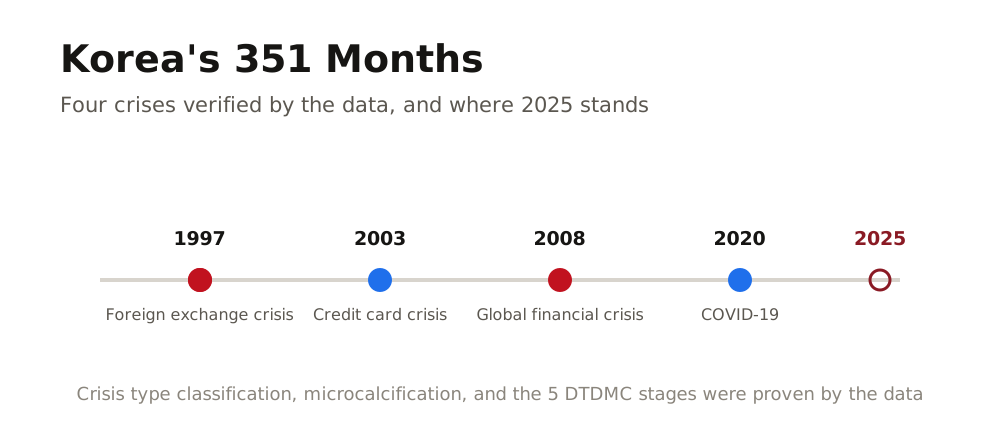
The Question That 351 Months Posed to the Theory
There is a day, November 21, 1997, on which the Korean government applied to the International Monetary Fund for a bailout. It was the point at which foreign exchange reserves had fallen to 3.9 billion dollars. From that day until March 2026, nearly thirty years have passed, and over that span the Korean economy passed through four major crises. The 1997 foreign exchange crisis, the 2003 credit card crisis, the 2008 global financial crisis, and the 2020 COVID shock are all contained on a single time series. The macro data measuring these four crises on a monthly basis accumulated over 351 months, and this data becomes the material for verifying physical economics theory.
Physical economics theory was established earlier as the Five-Stage Collapse Pathway Law (DTDMC). It begins at a funnel, an outflow occurs, when two channels are blocked simultaneously seven forms of manifestation appear, and it finally reaches annihilation, in five stages. The four-element equation stating the isomorphism between the human body and the economy, namely the four pairings in which calcium is cash, bone is the emergency safe, microcalcification is the interest on debt, and CO₂ is inflationary pressure, was also established together. The mathematical formulation that dual blockade is composed of the multiplication of signal blockade (CAM) and channel blockade (DLT), and even the prescription principle that the point of arrival of policy must be the microvasculature, are all propositions established earlier.
These propositions were established by logic, but they must be verified by data. The material of verification is Korea's 351 months. The four crises the Korean economy passed through in this time differ in their era backgrounds, their direct causes, their operating mechanisms, and their shock magnitudes, all of them. The 1997 crisis arose from an external debt structure, the 2003 crisis ignited spontaneously from household credit excess, 2008 was a shock transmitted from a fracture in the global structure, and 2020 was an event that began from a natural disaster called a pandemic. The fact that the four crises differ in their surface appearance and in the kind of their causes creates the qualification for verification.
For the same tool to catch four crises that arose by the same mechanism is weak in meaning. But if four different kinds of crisis all pass through the same five stages that the theory predicted, then that theory is not a tool overfitted to a particular point in time or a particular crisis type. This is the passage where the proposition that the surfaces of the crises are all different yet the physical structure operating within them is one gets proven by data, and this becomes the heaviest implication of the 351-month verification.
What this chapter unfolds is the points of that verification. The proposition that crisis type is automatically classified in the data is verified by the contrast between 1997 and 2020. The core of the four-element equation, that microcalcification (interest) is a variable independent of CO₂ (inflation), is confirmed in its purest form in the 2003 credit card crisis. The pathway law that the five-stage collapse pathway proceeds in the same order is the place traced in the 14-month time series of the 2008 global financial crisis, and the dual-blockade thesis that CAM and DLT combine by multiplication is verified in the cases of single-blockade self-recovery. The effect of the microvascular direct-injection prescription was proven in the 1-month recovery from COVID in 2020, and the proposition that the duration of blockade measures structural depth is the conclusion derived from the sixfold difference between the 6 months of the global financial crisis and the 1 month of COVID.
The 344 months of normal periods are also material for verification. The fact that the time in which no crisis ignited was long constitutes one aspect of the system's precision, and the point that this silence is not mere silence but another verification case of the multiplication structure is unfolded in section 5. Three Korean cases in which single blockade was partially activated and then self-recovered are contained within the 344 months, and that recovery itself is also direct evidence of the mathematical proposition that CAM and DLT are multiplied rather than added. The contrast between the 7 months in which dual blockade ignited and the 3 periods in which single blockade self-recovered shows most clearly the agreement between the multiplication structure the theory predicted and the actual data.
Overview of Korea's 351-Month Verification
| Item | Korea 351 months (1997.1 to 2026.3) |
|---|---|
| Verification period | January 1997 to March 2026 |
| Dual blockade occurrences | 7 months / 351 months (2.0%) |
| Crisis detection | 4 cases (IMF, credit card, GFC, COVID) |
| DTDMC pathway match | 4/4 (100%) |
| False positives | 0 cases |
| False negatives | 0 cases |
| Lead detection | Micro crises 3 cases about 6 months / macro crisis 1 case same month |
| Recovery detection | 2/2 (100%) |
| Single-blockade self-recovery | 3 cases (2001, 2011, 2022) |
The 1997 Foreign Exchange Crisis, the Proposition That Crisis Type Is Classified
Let us suppose there are two patients who have come to the hospital with the same flu symptoms. Both have a fever, both cough, and both feel heavy in the body. The doctor does not prescribe the same medicine to the two. When one is an office worker whose immunity has dropped from a few days of overtime, and the other is an elderly person who has ordinarily suffered from an underlying lung condition, the same medicine may be sufficient for one and insufficient for the other. The reason the doctor issues different prescriptions to the two patients is that the doctor knows that behind the same symptoms a different mechanism is operating.
The same principle operates in economic crises too. The event on November 21, 1997, in which the Korean government applied to the IMF for a bailout, and the event in April 2020 in which the Korean economy took the shock of the COVID lockdown, are both similar in their surface appearance that the flow was blocked. But the causes of the two crises were the exact opposite. The cause in 1997 was that calcium (foreign currency) had drained out from the outside, and the cause in 2020 was that all flows were temporarily halted by an external shock. The prescription had to be different, and the recovery speed had to be different. Had one tried to prescribe the same medicine for the two crises, there is a high probability that neither would have survived.
The tool that discriminates crisis type is the V-Series. The V-Series is a set of 9 gauges that measure structural vulnerability, and as explained earlier, it is a tool that asks "when the same shock strikes, how deeply will it collapse?" The same tool output "low" for the 1997 foreign exchange crisis and output "not detected" for COVID in 2020. Both outputs were accurate. What that accuracy proves is the point that crises are not all of the same kind, and the point that the system automatically classifies crisis type.
The reason the V-Series output "low" for the 1997 foreign exchange crisis is that Korea's domestic structure was relatively healthy. The growth rate of the working-age population was +0.72%, and the Gini coefficient was 0.298, a level below the OECD average. Household debt had not reached the danger threshold, and the domestic demand base had not collapsed either. And yet the crisis came. If so, the conclusion follows that the cause of the crisis lay not in a domestic underlying condition but elsewhere. The V-Series "low" output did not mean there was no crisis but was the accurate classification "this crisis did not come from an underlying condition."
The real cause of the crisis lay in the external debt structure. The short-term external debt ratio had soared from 40% in 1994 to 45% in 1995 and 58% in 1996. This means that more than half of the external debt was short-term, to be repaid within a year, and it was a structure that would immediately transmit into a liquidity crisis once the inflow of funds from outside stopped even once. The current account deficit grew fivefold in just two years, from 4.5 billion dollars in 1994 to 8.5 billion dollars in 1995 and 23.1 billion dollars in 1996. The average corporate debt ratio was 387% in 1996 and exceeded 500% in 1997. A mismatch structure, in which Korea's large corporations borrowed foreign currency short-term and tied it up in long-term investments, had accumulated, and this structure collapsed under the external shock of the Thai baht's crash in July 1997.
IMF 1997, the Four-Year Accumulation of the External Debt Structure (Structural Diagnosis)
| Indicator | 1994 | 1995 | 1996 | 1997 | 1998 (crisis) |
|---|---|---|---|---|---|
| GDP growth rate | 8.5% | 9.2% | 7.0% | 5.9% | -5.5% |
| Current account | $-4.5bn | $-8.5bn | $-23.1bn | $-8.2bn | $+40.4bn |
| Short-term external debt ratio | 40% | 45% | 58% | reserves depleted | restructuring |
| Average corporate debt ratio | 250% | 290% | 387% | over 500% | chain bankruptcies of large firms |
On the surface the GDP growth rate looked sound, at around 8%. But behind that growth the external debt structure was rapidly weakening. This is where the reason structural diagnosis must operate on a longer time scale than blockade diagnosis lies. The accumulation of the external debt structure cannot be seen through the change of a single quarter or a single year. Only when a time series spanning four years is spread out in one place does it finally become apparent where the fracture is growing.
The point at which blockade diagnosis sent its first signal was May 1997. With most of the 9 axes sending abnormal signals simultaneously, the CAM blockade ignited. A state in which policy signals do not reach households and small business owners had begun. In the same period, the Korean government's official position was "Korea is different from Thailand," the IMF did not classify Korea as a crisis-affected country either, and nowhere in the domestic press was there the word crisis. In June, the D (income polarization) trigger was added, and all four of the D, I, A, H triggers were activated. This is the judgment that income polarization and cost explosion and price surge and monetary sclerosis were proceeding simultaneously.
In August, the figure of the blockade diagnosis rose to the highest place in the entire 351 months. Kia Motors was processed into bankruptcy, and the insolvency of the merchant banks began to surface. On October 23, Hong Kong's Hang Seng index crashed 10.4% in a single day, and fear spread across all of Asia, and in early November the Korean government announced that "foreign exchange reserves are sufficient," but the actual usable foreign exchange reserves did not even reach half of the announced figure. When the Korean government applied to the IMF for a bailout on November 21, the diagnostic engine had already been maintaining the CAM blockade for six months. This means that when the market and the official institutions were all saying "Korea is fine," the engine alone was detecting the blockage of the flow.
IMF 1997, the Six-Month Leading Trajectory of the Blockade Diagnosis
| Month | Score grade | Simultaneous warning axes | Active triggers | Official position and events at the time |
|---|---|---|---|---|
| 1997-05 | alert threshold breached | most axes warning simultaneously | I+A+H | CAM blockade triggered. Government "Korea is different from Thailand" (6 months prior) |
| 1997-06 | alert maintained | many axes warning simultaneously | D+I+A+H | Quadruple trigger activated (5 months prior) |
| 1997-07 | alert maintained | many axes warning simultaneously | D+I+A+H | 7.2 Thai baht crash. Government "fundamentals are solid" (4 months prior) |
| 1997-08 | peak (crisis) | most axes warning simultaneously | D+I+A+H | Highest figure in the entire 351 months. Kia Motors bankruptcy (3 months prior) |
| 1997-09 | alert maintained | most axes warning simultaneously | D+I+A+H | Merchant bank insolvency spreading (2 months prior) |
| 1997-11 | alert maintained | many axes warning simultaneously | D+I+A+H | 11.21 IMF bailout application (trigger event) |
The landscape that the satellites saw independently corroborated this diagnosis. In the nighttime light data of the U.S. Defense Meteorological Satellite Program (DMSP/OLS), Korea's nighttime activity index hit its peak of 8.84 in 1996, then fell 8.1% to 8.12 in 1997, and fell further to 7.91 in 1998, recording a cumulative decline of 10.5%. The satellites caught the point of recovery too. In 1999, the nighttime light recovered to 8.52, a rise of 7.7% over the previous year. Entry into the crisis and exit from the crisis were both measured with the same tool, and the fact that satellites can catch the physical evidence not only of the crisis but of the recovery was confirmed in the 1997 data. In the same period, in the surface temperature satellite (Landsat), the urban heat island of Seoul weakened from 24.48 degrees in 1997 to 23.22 degrees in 1998. When the factories stopped, the lights at night decreased, and when industrial activity contracted, the heat of the city cooled. Because two mutually independent physical quantities, nighttime light and surface temperature, pointed in the same direction, this was not a measurement error but an actual contraction of economic activity.
Structural diagnosis captured the deterioration of the external debt structure across 1994 to 1996, blockade diagnosis triggered a six-month leading alert in May 1997, and the satellites independently confirmed the simultaneous decline and recovery of nighttime light and surface temperature across 1996 to 1999. It is a record in which three layers converged on the same conclusion through different time scales and different data sources. The proposition that this convergence proved gathers into the conclusion of this section. Crisis type is automatically classified in the data, an external-debt-type crisis is screened out as V-Series low, and that screening itself is a diagnosis that makes the prescription different. It is also the same principle as the reason a doctor can issue different prescriptions even when patients complain of the same symptoms.
If the 1997 foreign exchange crisis was an external-debt-type crisis in which calcium drained out from the outside, the next crisis the Korean economy passed through followed a different path of ignition. A case in which households collapsed in a state with no external shock, no inflation, and no exchange rate crisis occurred six years later. The channel blockade (DLT) that ignited without inflation becomes a case that verifies the core proposition of the four-element equation.
The 2003 Credit Card Crisis, the Proposition That Microcalcification Is Not Inflation
The variable most frequently cited as a reason households collapse is inflation. The explanation is that when prices rise rapidly, what one can buy on the same salary decreases, and in the end households cannot endure. This explanation is intuitive, but there is one missing part. It is the possibility that households can collapse even in a state with no inflation. If households collapse even without inflation, that means there is another variable, besides inflation, that brings households down. A natural experiment that discriminated that variable occurred in Korea in 2003.
In 2002, Korea's consumer price inflation rate was 2.7%, and in 2003 it was 3.5%. These were stable figures within the Bank of Korea's price stability target range (2.5% to 3.5%). The exchange rate was also stable. Foreign exchange reserves exceeded 150 billion dollars, a level incomparable with the crisis situation at the time of the 1997 foreign exchange crisis, when they had fallen to 3.9 billion dollars. There was no external shock either. The aftermath of the collapse of the U.S. information technology bubble in 2001 was already winding down by mid-2002, and the global economy was in a recovery phase. There was no inflation, no external shock, and no exchange rate crisis.
And yet households began to collapse. The cause was household credit excess, or more precisely, the accumulation of the interest burden households shouldered. At the end of 2002, the number of credit cards issued in Korea reached 104.8 million, and it was a period in which each person held an average of 4.6 cards. The credit card companies competed in issuance through street recruitment and indiscriminate limit grants, and households rapidly increased their short-term debt through credit card cash advances and card loans. In 2002, the household credit balance was 444 trillion won, an increase of 28% over the previous year. A structure took hold in which a considerable portion of household disposable income drained out each month as credit card interest and fees.
This is the purest verification material for the four-element equation. The four-element equation defines microcalcification (interest) and CO₂ (inflationary pressure) as separate variables. Microcalcification is what builds up directly on the blood vessel wall and narrows the channel, and CO₂ is what accumulates inside the cell and rots the cell. Just as the locations at which the two substances operate in the human body are different, the domains in which interest and inflation operate in the economy are also different. The fact that the household microvasculature was blocked in Korea in 2003, where there was no inflation, directly proves the proposition that channel blockade can ignite through interest alone, even without inflation. Had interest and inflation been the same variable, then when one is absent the other should not be able to operate either. The 2003 data rejects that assumption.
The output of the diagnostic engine also agreed with this proposition. In May 2003, DIAH-7M ignited the CAM blockade. At that same point, there were six months remaining until the LG Card default moratorium (November), and it was the same six-month leading detection as in the 1997 foreign exchange crisis. The interesting fact was the composition of the activated triggers. Cost explosion (I) and monetary sclerosis (H) were activated, but the CAM blockade ignited in a state where the price surge (A) trigger was not activated. The fact that the channel-blockade condition is met through the interest burden alone, even without inflation, appeared exactly in the trigger pattern. The trigger composition itself differed from that of the 1997 foreign exchange crisis, in which all four of the D, I, A, H triggers were activated, and this difference shows at the classification stage the fact that the essences of the two crises are different.
The landscape the satellites saw also pointed in the same direction. The DMSP/OLS nighttime light index fell 4.4% from a baseline of 8.50 in 2001 to 8.13 in 2002, and fell to 7.46 in 2003, recording a cumulative decline of 12.2%. That nighttime light decreased 12.2% in just two years is direct evidence that the business activity of the back-alley economy and small business owners physically contracted. The credit card crisis was a typical case of channel blockade in which the consumption channel of households was blocked, and the satellites confirmed that this blockade led to a physical decrease in actual economic activity. In the same period, in the surface temperature satellite, the appearance of the heat of the city center weakening emerged. The urban surface temperature, which had been 24.84 degrees in 2002, fell to 18.74 degrees in 2003, and recovered to 25.03 degrees in 2004. The recovery in 2004 is interpreted as a signal that, as the government's credit recovery support and relief measures for credit delinquents took effect, urban vitality began to revive.
Credit Card Crisis 2003, Satellite Field Measurement: Microvascular Contraction That Occurred Without Inflation
| Year | Nighttime light intensity | Year on year | Surface temperature (°C) | Economic situation at the time |
|---|---|---|---|---|
| 2001 | 8.50 (baseline) | · | 15.97 (suspected outlier) | Recovery period after the IT bubble. Surge in credit card issuance begins |
| 2002 | 8.13 | -4.4% | 24.84 | 104.8 million credit cards, 4.6 per person. Household credit up 28% |
| 2003 | 7.46 (lowest) | -12.2% | 18.74 | May CAM blockade ignites. November LG Card default. Channel blockade manifests |
| 2004 | (collection ended) | · | 25.03 | Signal of urban vitality recovery. Effect of credit recovery support |
The proposition that the 2003 credit card crisis verified is the core principle of the four-element equation. Microcalcification and CO₂ are independent variables, and even when only one of the two variables operates, microvascular blockade can ignite. Had this proposition not been proven, it would be possible to suspect that some two of the four variables of the four-element equation are different expressions of the same variable. But the data of Korea in 2003 shows the fact that a crisis ignited through interest accumulation alone in a state where inflation was stable, and this directly proves the independence of the two variables. The point that the "prohibition on conflating microcalcification (interest) and CO₂ (inflation)" stated earlier is not a mere classificatory distinction but a physical fact that actually exists in the data was confirmed in the credit card crisis.