
This book has so far confirmed the grammar of gradient in two domains. In the human body, we saw that the gradient collapse of the microvasculature is the common upstream source of chronic disease and cancer, and in the economy we saw that the same grammar is reproduced as predictive power for four crises in the 690-month time series of Korea and the United States. The two domains are completely different in outward form, but they were read through the same five stages (accumulation of determinants, trigger, dual blockade, manifestation, collapse), and the same nonlinear collapse and the same Gradient Precedence Principle were observed. The possibility these two confirmations point to is simple. The grammar of gradient may be not the exclusive property of medicine or the economy but a domain-independent language that sits above them.
This chapter is an attempt to extend that possibility to six domains. We look in turn at what form the grammar of gradient already operates in within physics, chemistry, engineering, information systems, ecosystems, and social systems. In each domain, we will confirm the fact that that field's classic discoveries (Prigogine's non-equilibrium thermodynamics, Turing's morphogenesis, Poiseuille's laminar flow equation, Shannon's information theory, Holling's ecological resilience, the scale-free networks of modern complex-systems science) are already translatable into the language of gradient. This translation is not something this book has newly discovered. It is closer to the work of binding into a single grammar observations that were already in place.
Before beginning this chapter, let me make one thing clear. This chapter is not a chapter that presents empirical verification of the same level as Chapter 9 on medicine or Chapter 11 on the economy in each domain. It is because a quantitative verification tool corresponding to the body's DIAH-7M framework or the economy's 59-gauge engine has not been built in the same manner in each field of physics, chemistry, engineering, information, ecology, and society. What this chapter does is to show how the grammar of gradient connects with the core discoveries already accumulated in each domain, and it goes only as far as that connection conferring conceptual coherence on the hypothesis of this book. Quantitative verification is separate work that must be accumulated going forward, and let me state first that this book does not claim the completion of that work.
The Boundary of the Extension: What Can Be Shown and What Cannot
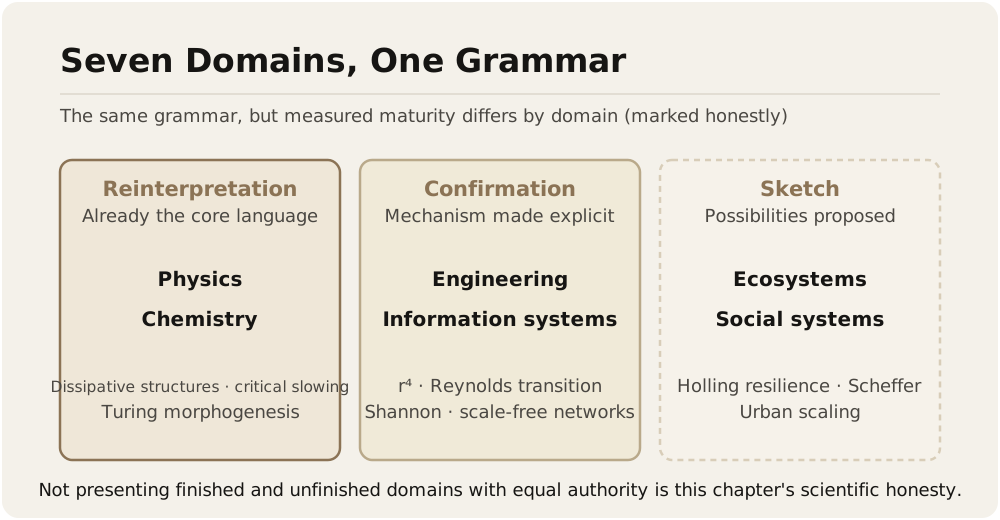
The six domains this chapter addresses have different levels of maturity. The non-equilibrium thermodynamics tradition of physics and chemistry has developed for decades with the concept of gradient already at its center, and the fluid mechanics and structural mechanics of engineering have taken this concept as a design principle. Information theory formalizes the capacity and loss of information flow almost directly in the language of gradient. In these four fields, the framework of this book is closer to adding one layer of interpretation on top of the existing formalized language.
By contrast, in ecosystems and social systems the formalization of gradient is relatively loose. Ecology has already approached a gradient perspective through Holling's resilience theory and Scheffer's critical transition research, but it is not at the level of showing a single medium and the clear pathway of five stages like the body and the economy. In social systems it is even more so. The analysis of the flows of population, cities, and organizations is dispersed across various fields, and a formalization integrated in the language of gradient is still at the stage of accumulation. This chapter shows the current state of that accumulation as it is, but does not exaggerate it as if it were a completed theory.
Accordingly, the tone of this chapter changes slightly from domain to domain. In physics and chemistry the main thing is reinterpretation, rereading existing discoveries in the language of gradient; in engineering and information the main thing is the explicit confirmation of already-operating principles; and in ecology and society the main thing is a sketch that proposes future possibilities. This difference is not to be hidden but to be revealed. The extension of science always proceeds along a gradation of maturity, and honestly marking that gradation is the way to maintain the credibility of this chapter.
Physics: Non-equilibrium Thermodynamics and Gradient
In physics, gradient is one of the oldest concepts. Since the establishment of thermodynamics in the 19th century, the flow of heat was described as driven by a temperature gradient, the diffusion of particles by a concentration gradient, and electric current by a voltage gradient. The relationship each of these three flows has with its respective gradient was formalized into three linear transport laws, Fourier's law, Fick's law, and Ohm's law, and these laws have remained the cornerstone of physics and engineering for nearly 200 years. Within this tradition, gradient is not a mere metaphor but a physical entity. It can be measured, it can be calculated, and flow can be predicted.
What extended this tradition a step further in the mid-20th century was the reciprocal relations of Lars Onsager. Onsager proved in 1931 the fact that when several flows and several gradients are coupled with one another within a system, those coupling coefficients are symmetric, and for this achievement he received the Nobel Prize in Chemistry in 1968. What Onsager's reciprocal relations mean is profound. One kind of gradient can drive another kind of flow, and that coupling is constrained by physical symmetry. The complex transport phenomena in the body, in which the blood pressure gradient drives oxygen flow and the osmotic gradient drives water flow, are all within this Onsager framework. The physical root of the E-∇-M formalization this book addresses also lies here.
But linear transport laws alone cannot explain the critical collapse this book focuses on. Critical collapse is by definition a nonlinear phenomenon, and to understand nonlinear phenomena, the physics of the region far from equilibrium is needed. The person who pioneered this region is Ilya Prigogine, and the name of the achievement for which he received the Nobel Prize in Chemistry in 1977 is dissipative structures. What Prigogine showed is this. An open system to which energy or matter is continuously supplied from outside can maintain a stable order that is not an equilibrium state, and this order collapses immediately when the external supply is cut off. Living organisms, the economy, cities, and ecosystems all correspond to this dissipative structure.
From the standpoint of dissipative structures, this book's dual blockade is not a new story. For an open system to maintain order, both supply (inflow) and discharge (outflow) must operate, and if either side is cut off, the system returns to an equilibrium state and the order collapses. If the two sides are cut off simultaneously, the collapse is faster and deeper. That the structure Prigogine saw in the steam engine and in chemical reactions repeats in the same form in the body's microvasculature, and again in the same form in the economy's circulatory system, is no coincidence. It is because all three fields are the same kind of dissipative structure.
Prigogine's work also connects directly with the phenomenon of critical slowing down. The closer a system far from equilibrium comes to a critical transition point, the longer the recovery time from a small perturbation becomes, and the variance of the state variable increases. This phenomenon is commonly observed in ecosystems, climate, financial markets, and biological systems, as the Scheffer team organized in Nature in 2009 (Scheffer et al., 2009, Nature). This observation meshes with this book's Gradient Precedence Principle. Before the state value Φ crosses the threshold, the rate of change S moves first, and the change of S is revealed as the observable sign of critical slowing down. Viewed from the physics side, the six-month lead this book speaks of corresponds to a particular time scale of critical slowing down.
The most classic experimental case of a dissipative structure is Rayleigh-Bénard convection. When a thin layer of liquid is heated uniformly from below, as long as the temperature difference is below a certain threshold, heat is transmitted by conduction alone and the liquid maintains a stationary state. But the moment the temperature difference crosses the threshold, the liquid suddenly forms regular hexagonal-pattern convection cells and switches to an entirely different dynamical regime. When the energy supplied from outside exceeds the threshold, the system creates a new order on its own, and this order disappears immediately when the energy supply is cut off. The principle this simple experiment shows applies in the same form to complex dissipative structures such as biological tissue, economic circulation, ecosystems, and cities. The maintenance of order requires a continuous flow of energy, and the moment that flow is cut off, the order collapses.
The concrete insights this convection experiment contributes to the framework of this book are two. First, the fact that the nonlinearity of the critical transition is a physical essence. Up until just before the transition, the system shows no outward change, and then a sudden structural change occurs at the threshold, and this suddenness is not a defect of the system but the manifestation of a basic physical law. Second, a dissipative structure collapses qualitatively faster when supply and discharge worsen simultaneously than when supply alone weakens. In Rayleigh-Bénard convection, when the heat exchange of the upper and lower parts weakens simultaneously, the convection cells become irregular and eventually disappear. This mechanism is the physical origin of the nonlinear collapse that the body's dual blockade and the economy's dual blockade show, and it is revealed here that it is not an individual phenomenon of medicine and the economy but a law of dissipative structures in general.
In summary, in physics the grammar of gradient has been at the center from 200 years ago, and since the mid-20th century non-equilibrium thermodynamics has extended that grammar to systems far from equilibrium. What this book confirmed in medicine and the economy is another expression of this extension, and it does not conflict with the existing framework of physics but rather complements it. If I may add one thing, the contribution of this book lies not in presenting a new law to physics, but in concretely showing that the language of non-equilibrium thermodynamics can be converted into a diagnostic tool for living systems.
Chemistry: Reaction, Diffusion, Self-Organization
Chemistry is another field in which the language of gradient is most naturally dissolved. Every chemical reaction takes a concentration gradient as its energy source, and the reaction rate is described as a function of the concentration gradient of the reactants and of temperature and pressure. The reaction rate equation proposed by Svante Arrhenius at the end of the 19th century formalized this relationship as a function of temperature, and it has been used throughout the 20th century as the foundational formula of the world chemical industry. Within this tradition, gradient is both the cause of the reaction and the measure of the flow.
The point at which chemistry is especially interesting from the standpoint of the grammar of gradient is the region where reaction and diffusion are coupled. The paper on morphogenesis published by Alan Turing in 1952 mathematically formalized the spatial patterns this coupling creates (Turing, 1952, Philosophical Transactions of the Royal Society B), and this theory subsequently had a profound influence on chemistry, biology, and ecology. What Turing showed is this. When two kinds of chemical substances react with each other and diffuse at different rates, the initially uniform space differentiates into a spatial pattern on its own. The stripes of a zebra, the spots of a cheetah, and the patterns of fish skin are all explained as manifestations of this Turing mechanism.
The reason the Turing pattern is important in the grammar of gradient is that this pattern shows most vividly the fact that the spatially uneven distribution of a gradient directly determines the structure of a system. That the body's organs form into particular shapes at the developmental stage, that the vegetation of an ecosystem is distributed in a certain spatial pattern, and that the physical structure of a city develops along a center-periphery gradient are all the same kind of gradient-based self-organization phenomenon. Turing's formalization was completed in the 1950s, but it took half a century for its implications to be fully extended beyond chemistry.
This pattern, which Turing predicted mathematically in 1952, remained only a theoretical possibility for nearly half a century. It was only in the 1990s that the Turing pattern was first reproduced in an actual chemical experiment, and it was subsequently confirmed in several species as the actual mechanism of animal skin patterning. According to what the team of Shigeru Kondo of Osaka University in Japan reported in Science in 2010, the fact that the stripe formation of the zebrafish operates by the actual Turing mechanism was directly confirmed by cellular-level imaging (Kondo & Miura, 2010, Science). A pattern predicted mathematically was reproduced in the skin of an organism 60 years later, and this discovery confirmed once more that the grammar of gradient is a common language crossing chemistry, biology, and medicine.
Another important stream of chemistry is the oscillating reaction (BZ reaction) discovered by Boris Belousov and Anatol Zhabotinsky. Whereas a general chemical reaction proceeds monotonically toward equilibrium, the BZ reaction shows oscillations in which the concentration periodically rises and falls. This phenomenon was long thought to violate the second law of thermodynamics, but as Prigogine's non-equilibrium thermodynamics was established, it was understood that a system can maintain a periodic order when there is an external energy supply. This oscillating structure provides a chemical prototype for various periodic biological and social phenomena such as the heartbeat, the circadian rhythm, and the economy's business cycle.
Another powerful example chemistry provides is the collapse of the enzyme chain reaction. Within the body, a metabolic pathway is a structure in which several enzymes operate in a chain, and if even one step of this chain is severely inhibited, the accumulation of the upstream substrate and the deficiency of the downstream product occur simultaneously. It is a case in which this book's dual blockade concept, the simultaneous collapse of supply and discharge, is realized in its simplest form in a biochemical chain. Many of the metabolic diseases that molecular biology revealed in the latter half of the 20th century are the biochemical expression of this enzyme chain blockade, and familiar diseases such as diabetes, hyperlipidemia, and gout are in that list. The language of chemistry and the language of medicine are speaking of the same structure at this point.
In the framework of this book, the most central insight chemistry provides is the fact that a dissipative structure is basically a chemical engine in which reaction and diffusion are coupled. On the supply side reactants enter, on the discharge side products leave, and only while these two directions of flow are maintained does the system maintain its own order. If either of the two directions is blocked, the system collapses toward equilibrium, and if the two directions are blocked simultaneously, the collapse accelerates nonlinearly. The two blockade axes we called CAM and DLT in the human body are in fact merely a case of the supply and discharge blockade of a chemical dissipative structure concretized in a biological system. The process by which the language chemistry already possesses extends to medicine, and again to the economy, is the essence of the landscape this book has drawn.
This article is part (1/3) of the three-part series covering Chapter 12 of The Universal Law: Gradient. The references are consolidated in part (3/3). The body text follows the original manuscript and is provided for informational purposes.