
This piece is the complete Chapter 9 of The Declaration of the Age of Physical Economics (Yoon Jong-won, Yoon So-ri, Yoon Jun). It is an academic exposition presenting the authors' physical economics hypothesis, and the body, figures, and citations follow the manuscript as written.
The DTDMC we examined earlier, that is, the Five-Stage Collapse Pathway Law, is a law that organizes the five stages of collapse: factor, onset, blockade, manifestation, and annihilation. It has been confirmed that these five stages operate in the same order in stars, in rivers, in the human body, and in a nation's economy, and that this order has never once been violated in thirty years of data from Korea and the United States. Now we look in earnest at the very first of those five stages, the factor stage. This is because the first stage is the longest, the quietest, and the most decisive stage.
Everyday life is full of stories that begin with the word "suddenly." A salaried worker whose chest suddenly tightens on the way to work one day and who is rushed to the emergency room, a self-employed person whose sales suddenly drop by half in some quarter, are such cases. Yet if you look into that person's health checkup record from five years earlier, if you spread open that shop's three years of sales ledgers, almost without exception the same fact is revealed. That "suddenly" was in fact the result of an accumulation that had built up in one direction over five to ten years. Something had been piling up bit by bit on the inside; it simply was not visible from the outside.
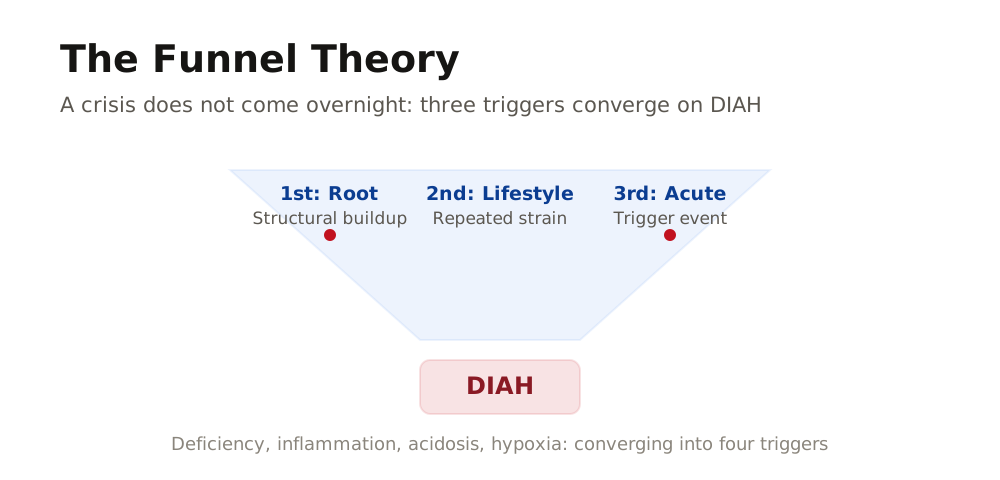
The judgment errors of management accumulate over the long term, and on top of that accumulation wrong spending habits grow, and at the end of it a sudden disaster passes through as the fuse. On ground where the first-order accumulation has deepened, the second grows, and at the end of the second having grown sufficiently, the third passes through acutely. The three orders are not separate branches proceeding independently; they are an accumulation that is pushed inward in temporal order. The place where the pressure gathers at the end of this accumulation is fixed. It is the four states of income polarization, cost explosion, price surge, and monetary sclerosis. The entrance begins at the first order, narrows into the second, and finally passes through at the third, in the shape of a funnel, and the exit gathers into the four states. This book calls this accumulation structure the funnel theory.
Below, we will unpack the funnel theory in order. First we lay out what exactly the funnel theory is, and then we explain the three triggers of the first-order judgment error, the second-order wrong spending habits, and the third-order sudden disaster in temporal order. Next we explain in earnest the four DIAH triggers at the funnel's exit, and we pin down why the time the accumulation takes is five to ten years. Finally, we close the piece with what becomes visible in everyday life once you know the funnel.
What Is the Funnel Theory
You have probably used a funnel in the kitchen at least once. You use a funnel when transferring cooking oil into a PET bottle, or when pouring powder into a bottle with a small opening. The shape of a funnel is simple. The top is wide and the bottom is narrow. No matter in what varied forms you pour things in, in the end they flow out through the narrow exit in a single fixed direction. The shape in which the diversity of the entrance gathers into singularity at the exit, this is the essence of the funnel.
The shape in which a crisis is made in a nation's economy resembles a funnel exactly. The pressure that comes in through the entrance is pushed inward following temporal order. What goes in first is the judgment error of management. The large-direction judgments made by government policymakers, corporate management, and the head of a household harden in a wrong form and accumulate on the inside of the system for five to ten years. Once that accumulation has proceeded to a certain degree, the second trigger grows on top of it. It is wrong spending habits. The small spending decisions that a household, a company, and a nation make every day harden in the wrong direction. At the end of this second accumulation having deepened, the third trigger finally passes through as the fuse. It is a sudden disaster or loss. The three orders are not separate branches proceeding independently; they are a funnel structure that is pushed inward following temporal order.
At the end of it, the pressure gathers into four states. Income polarization, cost explosion, price surge, and monetary sclerosis. Bundling the first letters of the English words, they are called DIAH, and they correspond one-to-one with deficiency, inflammation, acidosis, and hypoxia in the medical domain. Only the medium has changed from calcium to cash; the structure of the exit itself is preserved as is. The table below gathers the entire structure of the funnel in one place. It organizes at a glance how the first-, second-, and third-order triggers connect to the DIAH exit.
The First-, Second-, and Third-Order Triggers of the Funnel Theory and the DIAH Exit
| Order | Name | Essence |
|---|---|---|
| First-order trigger | Root trigger, judgment error of management | Accumulation that amplifies over the long term. Grows on the inside of the system in units of 5 to 10 years |
| Second-order trigger | Lifestyle trigger, wrong spending habits | Behavioral habit that grows on top of the first-order accumulation. Widens the funnel a little each day |
| Third-order trigger | Acute event trigger, sudden disaster and loss | Acts as the fuse at the end of the second-order accumulation. Passes through suddenly |
| Exit | The four DIAH triggers | The four states that gather into income polarization, cost explosion, price surge, and monetary sclerosis |
The First-Order Root Trigger, the Judgment Error of Management
What goes into the funnel first is the first-order root trigger. In the human body it is the state of the mind, and in a nation's economy it is the judgment error of management. The word management, in a narrow sense, refers to corporate management, but here it includes more broadly government policymakers, corporate executives, and even the head of a household. It is the accumulation in which people who occupy the position of deciding the large direction of a system make wrong judgments and those judgments harden. The doctrine organizes the role of this trigger as "accumulation that amplifies over the long term." It does not operate every day, but each time it operates it tilts the large direction of the system to one side, and over five to ten years its influence grows steadily larger.
It is clear when you call it to mind in everyday life. Suppose the management of a company made the judgment ten years ago, in a time when the market was good, that "our business model will work forever." With that judgment hardened, they cling to the same model even as the market changes. Employees, even if they want to say "this model no longer works," cannot open their mouths before management's decision. As five years pass and ten years pass, an "unchangeable model" hardens on the inside of the company. The same thing happens in a household. If parents firmly believe that the parenting method of thirty years ago is right and apply the same method to their children, then even as the times change, that judgment accumulates cracks on the inside of the family.
The same thing happens in a nation's economy. In the 1980s, Korea achieved high-speed growth with a model of the government leading the raising of industry. It was a flow in which the government designated industries, banks supplied funds, and companies built factories and exported. The very fact that this model worked well up to the 1980s hardened the judgment of the 1990s policymakers. Even though in the 1990s the world financial market was rapidly liberalized so that companies could directly borrow short-term foreign currency, the judgment of the policymakers still remained in the 1980s model. While the judgment "our model works" accumulated for seven years, the danger of short-term foreign-currency borrowing grew on the inside of the system. The financial liberalization model of the United States from 2001 to 2007 and the land-collateral lending model of Japan from 1985 to 1991 hardened in the same shape.
The three cases appear at first glance to be different crises. Korea's was a foreign-exchange crisis, the United States' was a housing bubble and financial crisis, and Japan's was the collapse of an asset bubble. Yet from the perspective of the first-order root trigger they are of exactly the same shape. A model that had worked well in one era was carried over as is by the next era's policymakers in the posture that "our judgment is right." That judgment accumulated on the inside of the system for five to ten years, and that accumulation created the soil in which the next order's trigger would grow.
The First-Order Root Trigger, Cases of Judgment Error in Korea, the United States, and Japan
| Country/Period | Hardened old judgment | New danger it failed to follow |
|---|---|---|
| Korea 1990-1996 | Government-led, bank-mediated supply of industrial funds works | Companies' direct short-term foreign-currency borrowing and foreign-exchange risk |
| United States 2001-2007 | The 1980s financial liberalization is right | The risk of complex mortgage products |
| Japan 1985-1991 | The land-collateral lending model is safe | The risk of an asset-price bubble and credit expansion |
The Second-Order Lifestyle Trigger, Wrong Spending Habits
On the foundation where the first-order judgment error has sufficiently accumulated, the second-order lifestyle trigger grows. In the human body it is the habit of behavior, and in a nation's economy it is wrong spending habits. The doctrine organizes the role of this trigger as "widening every day." If the first order is a large judgment that hardens once over the long term, the second order is the accumulation of spending that is decided in small amounts day by day. Because it operates every day, the speed of accumulation is fast, and on top of the first-order accumulation it widens the funnel in earnest within one to two years at the shortest, five years at the longest.
The person who first pointed to the core of this order is the American economist Hyman Minsky. In his 1986 book Stabilizing an Unstable Economy, Minsky pointed out that a stable period itself becomes the seed of a crisis. It is that even a person who usually feared risk gradually grows accustomed to that risk as time passes without incident. Having tried it once and found it fine, they try it a second time too, and since the second time is also fine, they try it on a larger scale the third time. The risk that was small at first grows a little each day, and in the end, the moment it crosses some line, the entire system begins to collapse.
Let us call it to mind in everyday life. A salaried worker opened an overdraft account for the first time. The initial limit is 5 million won, and at first they are afraid and do not use it much. Then one month they use it once, and since they pay it back right away with the next month's salary, nothing happens. In the second month they use it again. Again nothing happens. In the meantime the overdraft account grows familiar, from "a tool used only in emergencies" to "a tool used briefly every month." A year later they raise the limit to 10 million won, and another year later to 20 million won. The person themselves says "everyone uses this much." Yet over five years the accumulation of debt is proceeding within the household every day.
The same thing happens at the unit of a nation's economy. The United States from 2001 to 2007 was precisely such a period. On top of the first-order judgment accumulation that the 1980s financial liberalization model is right, when the Federal Reserve rapidly lowered the benchmark interest rate after 2001, the spending habits of households and banks tilted steadily toward risk. At first, only people with good credit received mortgages. Then, since nothing happened, loans went out to people with ordinary credit too, and again since nothing happened, to people with poor credit as well. A loan that went out to a person with poor credit is called subprime. In the meantime, American household debt accumulated every day over six years, and Japan too, after 1985, accumulated the wrong spending habits of land-collateral lending in the same shape for seven years. Both cases are the result of the second-order wrong spending habits widening the funnel every day on the soil that the first-order judgment error had hardened.
The Accumulation Pattern of the Second-Order Lifestyle Trigger
| Stage | Spending habit | Result |
|---|---|---|
| Early (on top of first-order accumulation) | At first, fearing risk, cautiously trying | If nothing happens, familiarity forms |
| Middle (1 to 3 years) | Repeating the familiarized risk on a larger scale every day | One person's spending habit spreads to another |
| Late (3 to 5 years) | Spending on the basis of "nothing has happened, so it is fine" spreads to the whole market | On top of the first-order accumulation, the funnel widens in earnest |
The Third-Order Acute Event Trigger, Sudden Disaster and Loss
At the point where the first-order judgment error has hardened for five to ten years and on top of it the second-order wrong spending habits have widened the funnel every day, the third-order acute event trigger finally passes through. In the human body it is a sudden injury or infection, that is, an event of the body, and in a nation's economy it is a sudden disaster or loss. The doctrine organizes the role of this trigger as "passing through suddenly." Unlike the first and second orders, the third order has almost no accumulation time. It is added to the system suddenly one day, and immediately plays the role of the fuse that pushes things through the funnel's exit.
It is clear when you call it to mind in everyday life. Suppose a household is getting along well without great difficulty as usual. Then one day a parent is suddenly hospitalized with a serious illness. This event is no one in the family's fault and is not directly related to the usual spending habits. Yet when that event enters a household in which the first- and second-order accumulation has deepened, it becomes the fuse that pushes the whole household through to the next stage. The same thing happens in a nation's economy. Third-order events are broadly divided into three kinds. Geopolitical events such as the first oil shock of 1973 or the U.S.-China trade dispute of the late 2010s, technological changes such as the internet of the late 1990s or the artificial intelligence of the late 2010s, and natural disasters and epidemics such as COVID in 2020. None of them is any citizen's fault, nor are they of a kind that can be prevented.
The most decisive aspect of the third-order event trigger is that on its own it hardly ever produces a crisis. During the 1973 oil shock every nation's economy was shaken, but not a single nation collapsed immediately, and the 2020 COVID shock too struck all nations simultaneously, but hardly any nation went as far as system shutdown. For a third-order event to progress into a crisis, the first- and second-order accumulation must already have deepened inside that system. In the 1997 Korean foreign-exchange crisis, precisely that happened. At the stage where the first-order judgment error that the 1980s government-led model is right had hardened for seven years, the second-order wrong spending habits of short-term foreign-currency borrowing had accumulated every day, and on top of it the third-order event of the 1997 Southeast Asian foreign-exchange crisis finally passed through. The size of a third-order event's shock is determined by how much the first and second orders had already accumulated inside the system. Here lies the reason why the first, second, and third orders of the funnel seem to operate separately but in reality operate together in temporal order.
The Funnel's Exit, Convergence into the Four DIAH Triggers
Having pinned down the first-, second-, and third-order triggers in turn, we now shift our gaze to the funnel's exit. Where does the accumulation that has been pushed inward in temporal order finally gather. The shape of the exit that makes a nation's economy move to the next stage, that is, the onset stage, is fixed. In the medical domain, when a person's body collapses, the funnel's exit is the four triggers of deficiency (D, Deficiency), inflammation (I, Inflammation), acidosis (A, Acidosis), and hypoxia (H, Hypoxia), and bundling the first letters of the English words, they are called DIAH. When moved to a nation's economy, the English code is still D, I, A, H, and the Korean names are income polarization, cost explosion, price surge, and monetary sclerosis. Only the medium has changed from calcium to cash; the structure of the exit itself is preserved as is.
The most decisive aspect the four DIAH have is that they are the condition that makes interest (microcalcification). Deficiency (D) makes a state in which, because resources do not reach the periphery, one lives by borrowing; cost explosion (I) makes a state in which, because costs grow larger than income, one draws out emergency resources; price surge (A) makes a state in which, because the value of money falls, one must borrow more to buy the same thing; and monetary sclerosis (H) makes a state in which, because circulation is blocked, one borrows at short-term high interest. When the four states operate together, households and companies and the government alike cannot but take out loans. From those loans interest arises, and that interest hardens at the narrowed passage and becomes microcalcification. Here lies the actual meaning of the definition that DIAH is the funnel's exit.
The first exit is income polarization (D). It is a state in which assets and income are concentrated on one side so that the other side starves. It suffices to call to mind the sight, within a household, of one person's credit-card bill tying up the living expenses of all the other family members. Even though there clearly are resources within the family, they are concentrated on one side so that the other side starves. At the unit of a nation, it is a state in which the top 10 percent hold more than half of all assets and the bottom 50 percent have almost no assets. The doctrine organizes the funnel structure of this exit as "the three-stage convergence of structural factor to spreading factor to deepening factor." Asset concentration brings on the stagnation of real income, that leads to the polarization of consumption, and in turn hardens into the loss of opportunity and the weakening of jobs.
The second exit is cost explosion (I). It is a state in which costs such as interest, taxes, medical expenses, education expenses, and housing expenses rise all at once, simultaneously and on multiple fronts. It is clear when you call it to mind through the situation of a shop. In some year, if the rent, employees' salaries, material costs, and card fees rise at the same time, there is almost nothing the shop operator can do. This is because even if they try to cut one cost, another cost rises again. The doctrine organizes the funnel structure of this exit as "parallel triggers." Because interest, taxes, medical care, and education and housing operate simultaneously and on multiple fronts, even if you block any one branch, another branch immediately continues the accumulation. The third exit is price surge (A). It is a state in which the value of money has fallen so that more money is needed to buy the same thing. Even if one earns the same salary for the same amount of labor, the things one can buy decrease, and the shortfall must be filled by borrowing. The doctrine organizes the funnel structure of this exit as "cyclical triggers." A feedback loop operates in which raw-material prices shake the supply chain, the supply chain shakes wages, and in turn shakes the exchange rate.
The fourth exit is monetary sclerosis (H). It is a state in which money clearly exists in the market but does not actually reach the place where it is needed. It is the same shape as the state in the human body in which oxygen has reached the lungs but does not go all the way to the cells beyond the microvasculature. It is the situation in which the government announces that "enough money has been released into the market," yet the passbook of the neighborhood shop actually shows sales decreasing further. On the large fund paths money is abundant, but it does not reach the small fund paths. The doctrine organizes the funnel structure of this exit as "a causal chain." The first-order credit crunch brings on the second-order chain of defaults, that brings on the third-order scramble for cash, and as a result the disappearance of employment follows. When the four exits operate together, the strongest pressure in the funnel is formed, and that point is the point of moving to the onset stage, the second of the five stages.
The One-to-One Correspondence of the Four DIAH Triggers Between Medicine and Economy, and the Funnel Structure of Each Trigger
| Code | Medical domain (a person's body) | Economic domain (a nation) | Funnel structure |
|---|---|---|---|
| D Income polarization | Deficiency of vitamin D, calcium, minerals | State in which assets and income are concentrated on one side so that the other side starves | Structural factor to spreading factor to deepening factor (three-stage convergence) |
| I Cost explosion | Chronic low-grade inflammation | Simultaneous rise of interest, taxes, medical, education, and housing costs | Parallel triggers (simultaneous, multi-front) |
| A Price surge | Increase in acidity within tissue | State in which the value of money has fallen so that more money is needed for the same thing | Cyclical triggers (feedback loop) |
| H Monetary sclerosis | Insufficient supply of oxygen to tissue | State in which money exists in the market but does not reach the place where it is needed | First-order credit crunch to second-order chain of defaults to third-order scramble for cash (causal chain) |
The Time of Accumulation, Why Five to Ten Years
Having pinned down both the entrance and the exit of the funnel, we must now pin down one more interesting fact. It is that the time it takes for the first-, second-, and third-order triggers to accumulate in turn and reach the exit is almost the same. Korea from 1990 to 1996, seven years; the United States from 2001 to 2007, six years; Japan from 1985 to 1991, about seven years. In all three cases, the accumulation reached the funnel's exit within a time of five to ten years. They were crises of different eras, different nations, and different kinds, but the time of accumulation alone was almost the same. The time of five to ten years is the limit time that a nation's economic system can hold out with its own compensation. Just after the accumulation begins, the system absorbs the pressure through the government's new policy, the company's cost reduction, and the household's adjustment of consumption, but once it exceeds five years, the reserve of self-compensation steadily decreases, and between seven and ten years it is almost entirely exhausted.
This accumulation time of five to ten years must be understood together with the six-month advance detection that was confirmed alongside it in the verification of the five stages. After the accumulation of five to ten years has proceeded, in the six months just before the crisis in earnest appears at the surface, a tremor is caught first in the macro indicators. In the 1997 Korean foreign-exchange crisis, the signal reached the critical threshold in May 1997 and the IMF bailout application was made on November 21. There were about six months of advance time. In the 2008 U.S. global financial crisis too, the signal reached the critical threshold in March 2008 and Lehman Brothers went bankrupt on September 15. Again six months. The five-to-ten-year funnel accumulation appears compressed into a tremor in the macro indicators during the last six months. The point of surfacing that people commonly call "the crisis came suddenly" is in fact merely the moment when the pressure gathered in the funnel pours out through the final exit, and the true beginning had already begun five to ten years before that.
This flow of time produces the greatest usefulness of the funnel theory. It is that there is a relatively long time of five to ten years before the crisis appears at the surface in earnest. Within this time there is ample time to pin down the order of the accumulation, to check to what order and to what degree it has proceeded, and, if possible, to slow the speed of the accumulation. Completely preventing a crisis is difficult, but lengthening the time until the crisis or reducing the intensity of the crisis is fully possible. Noticing in advance what is accumulating at the entrance of the funnel is the first step in that.
Comparison of the Seven-Year Accumulation in the Three Cases of Korea, the United States, and Japan
| Case | Accumulation begins | Crisis surfaces | Accumulation period |
|---|---|---|---|
| Korean foreign-exchange crisis | 1990 (market liberalization) | November 1997 (IMF bailout) | About 7 years |
| U.S. financial crisis | 2001 (entry into low interest rates) | September 2008 (Lehman bankruptcy) | About 6 years |
| Japanese asset bubble | 1985 (Plaza Accord) | 1991 (collapse of the asset bubble) | About 7 years |
What Becomes Visible Once You Know the Funnel
The reason we have unpacked the funnel theory in turn is one thing. It is that once you know the shape of the funnel, you become able to pin down where a nation's economy stands right now. A nation's economy is too large and complex for an ordinary citizen to look into as a whole. Yet if you have the tools of the first-, second-, and third-order triggers and the four DIAH triggers of the exit, then within the news articles you receive every day, you can pin down at which order and to what degree the accumulation is proceeding. You can check what judgment error of the policymakers or management has hardened, what spending habits of households and companies are accumulating every day, what sudden event is being added, and which of the four triggers of the exit is steadily deepening.
The same funnel structure operates not only at the unit of a nation but at the unit of a household and a company, and in a person's health as well. In a household, on the spot where the head of the household's judgment error has hardened as the first order, the wrong spending habits of family members grow as the second order, and a parent's sudden illness or a sudden dismissal at work passes through as the third-order event. In a company, management's judgment error passes through as the first order, the wrong spending decisions of employees and management as the second, and a sudden change in the market or the departure of a key business partner as the third. In a person's health, the state of the mind passes through as the first order, wrong eating habits and lack of exercise as the second, and a sudden injury or infection as the third. The four triggers of the exit are of the same shape too. Income polarization in which resources are concentrated on one side, cost explosion in which costs rise all at once, price surge in which the value of money or the price standard is shaken, and monetary sclerosis in which resources exist but do not actually go where they are needed. The shapes of the first-, second-, and third-order triggers and the DIAH exit are preserved as is, differing only in the medium and the field.
The conclusion gathers into one thing. It is that the funnel structure is a universal structure. Whether it is a person's body, a household, a company, or a nation's economy, they all follow the same funnel. The temporal order of the first-, second-, and third-order triggers is the same, the four triggers of the exit are the same, and the time of five to ten years that the accumulation takes is similar too. Only what the medium is and where the field is differs; the shape of the funnel itself is preserved as is. This universality is the greatest basis for being able to use the funnel theory as a tool.
When the pressure accumulated in this way crosses the critical threshold at some moment, it moves to the second of the five stages, that is, the onset stage. Once the pressure gathered in the funnel begins to pour out in earnest through the exit, a nation's economy begins to mobilize emergency resources. Households break their savings and increase their overdrafts, companies draw out their internal reserves, and the government releases its foreign-exchange reserves or injects emergency finances. It is an emergency action that pulls future resources forward in advance to block the present crisis. In the human body, calcium leaks out of the bones, and in a nation's economy, households and companies and the government take out loans so that interest arises. Only the medium has changed from calcium to cash; the action is the same. This book calls the formal name of this stage the leakage theory.
References
1. Kindleberger, C. P., & Aliber, R. Z. (2011). Manias, Panics, and Crashes: A History of Financial Crises (6th ed.). New York: Palgrave Macmillan.
2. Minsky, H. P. (1986). Stabilizing an Unstable Economy. New Haven: Yale University Press.
3. Reinhart, C. M., & Rogoff, K. S. (2009). This Time is Different: Eight Centuries of Financial Folly. Princeton: Princeton University Press.
4. Scheffer, M., Bascompte, J., Brock, W. A., Brovkin, V., Carpenter, S. R., Dakos, V., Held, H., van Nes, E. H., Rietkerk, M., & Sugihara, G. (2009). Early-warning signals for critical transitions. Nature, 461(7260), 53-59.