
This piece is the complete Chapter 13 of The Declaration of the Age of Physical Economics (Yoon Jong-won, Yoon So-ri, Yoon Jun). It is an academic exposition presenting the authors' physical economics hypothesis, and the body, figures, and citations follow the manuscript as written.
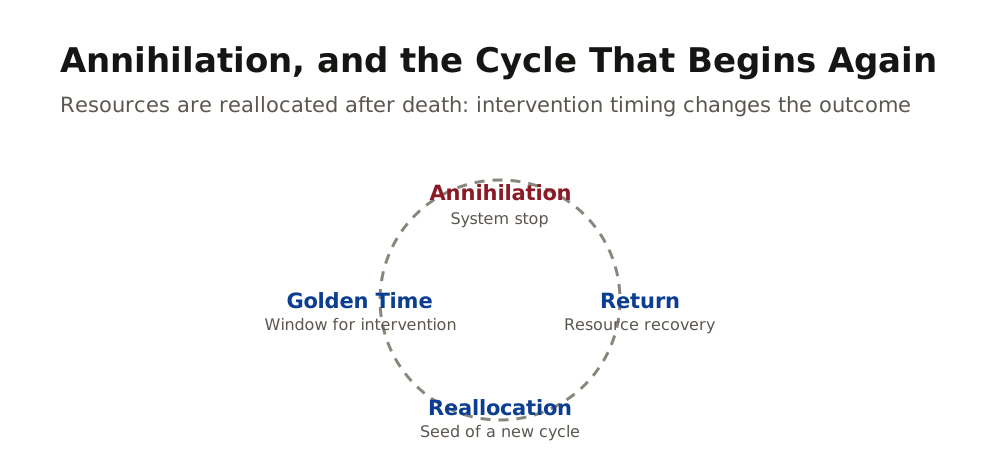
We have now come as far as the fourth stage of DTDMC, that is, the Five-Stage Collapse Pathway Law. We have examined the process by which, in the funnel theory, cost factors converge into the DIAH trigger; in the outflow theory, interest arises; in the dual blockade theory, channel blockade (DLT) and signal blockade (CAM) are engaged simultaneously; and in the 7M theory, the dual blockade manifests in seven different forms. When only one 7M manifests, the system still operates partially. Even if the capital market is obstructed (1M), the real economy remains alive, and even if the supply chain is severed (6M), the central flow of funds still circulates. But when several 7Ms accumulate in combination, no place remains to compensate. This moment, in which the entire system stops, is the fifth stage, annihilation.
Annihilation: When 7Ms Accumulate in Combination, the System Stops
In the human body, annihilation appears under the name of multi-organ failure. Following the annihilation pathway of a diabetic patient makes the process clear. It begins with insulin resistance (3M Coating & Blocking). The cells fail to receive the insulin signal, and blood sugar regulation collapses. As time passes, microcalcification accumulates in the kidneys and the kidneys harden (4M Hardening). When kidney function declines, the ability to filter the blood decreases, and the unfiltered waste that remains in the blood places a load on other organs. The microvasculature of the retina becomes obstructed and vision begins to be lost (1M Obstruction & Rupture), the peripheral nerves of the feet are severed and sensation disappears (6M Disconnection), and calcium leaches out of the bones so that bone mass decreases (7M Collapse). When the positive feedback in which the failure of one organ places a load on another organ, and that load in turn worsens the first organ, crosses a critical threshold, it reaches a multi-organ failure that cannot be reversed even by external intervention.
In the economy, annihilation appears under the name of national default. Following the pathway of Korea in 1997 reveals the same structure as multi-organ failure in the human body. The chaebol's structure of excessive borrowing had hardened over thirty years (4M Hardening), and on top of it, as the short-term external debt of merchant banks was refused rollover, the capital market suffered an acute obstruction (1M Obstruction & Rupture). The obstruction soon spread to subcontractors and suppliers, and the supply chain was severed in a chain reaction (6M Disconnection), and foreign exchange reserves drained from 33.2 billion dollars down to 3.9 billion dollars, so that the national structure itself collapsed (7M Collapse). After four 7Ms accumulated in combination within six months, an external intervention of 58 billion dollars in IMF bailout funds came in.
The same structure repeated in Argentina in 2001. The peso-dollar fixed exchange rate system had hardened for more than ten years (4M Hardening), the economy did not respond even when the government loosened fiscal policy (3M Coating & Blocking), and in December 2001 a default on 132 billion dollars of external debt was declared, so that the national structure collapsed (7M Collapse). GDP plunged by 11 percent, and within two months the presidency changed five times. In Greece in 2010 as well, with public sector rigidity (4M) and fiscal policy non-response (3M) lying underneath, a sovereign bond default (7M) erupted, GDP plunged by 25 percent, and the country had to receive a Troika bailout.
There is one fact common to the annihilation of all three countries. It is that the system did not stop when only one 7M manifested, but only after three or more accumulated in combination. Korea was 4M+1M+6M+7M, Argentina was 4M+3M+7M, and Greece was 4M+3M+7M. Just as the system endured under a single blockade, so under a single 7M the system still operates partially. Only after several 7Ms accumulate in combination and all compensation pathways are exhausted does it reach annihilation.
The Annihilation Pathways of Three Countries: 7M Combined Accumulation to National Default
| Country | Time of Annihilation | 7M Combined Accumulation | External Intervention |
|---|---|---|---|
| Korea 1997 | 1997.11 | 4M (chaebol rigidity) + 1M (capital market obstruction) + 6M (supply chain severance) + 7M (foreign reserve depletion) | IMF 58 billion dollar bailout |
| Argentina 2001 | 2001.12 | 4M (exchange rate rigidity) + 3M (policy non-response) + 7M (external debt default of 132 billion dollars) | IMF support + peso devaluation |
| Greece 2010 | 2010.5 | 4M (public sector rigidity) + 3M (fiscal non-response) + 7M (sovereign bond default) | Troika 110 billion euros |
Return: After Death, Resources Are Reallocated
In the human body, death is not the end. A dead organism decomposes and returns to its constituent elements such as carbon, nitrogen, calcium, and phosphorus. Those elements scatter into the soil, the water, and the atmosphere and become the material for new life. It is a cycle in which carbon becomes glucose again and calcium becomes bone again. The reason the doctrine calls this stage return is that death is not extinction but a process of going back to the original state.
In the economy too, the same return occurs after a national default. The restructuring process from 1998 to 2003, following the 1997 foreign exchange crisis in Korea, is the economic version of this return. Half of the top thirty chaebol were dismantled or merged, and the assets, personnel, and technology of the dismantled chaebol were reallocated into a new ownership structure. On the soil of that reallocation, Samsung Electronics' semiconductor business rose to number one in the world, LG Display grew, and a digital economy such as Naver and Kakao sprouted. Industries that either had not existed or had remained on the periphery before the crisis grew after the crisis on top of the reallocated resources.
In Argentina too, after the 2001 default, export competitiveness recovered through the peso devaluation, and agriculture-based growth resumed. In the United States as well, after the 2008 financial crisis, TARP funds were recovered, fintech and the sharing economy filled the empty spaces left by the financial structure that had been broken down in the course of the crisis, and the shale revolution changed the landscape of the energy industry. A national default is not an end but a reallocation of resources. It is a process in which the existing structure is broken down, and the broken-down assets, personnel, and technology flow into new industries and enterprises.
Life Cycle Theory and Disease Theory: Providence or Choice?
After examining the five stages of DTDMC, one question remains. Are decline and annihilation inevitable, or are they something that can be prevented? The doctrine presents two frames to this question simultaneously.
The Six-Stage Life Cycle: The Same Order from the Universe to the Cell
| Stage | Human Body | Nation | Economy | Star | Cell |
|---|---|---|---|---|---|
| 1. Birth | Fertilized egg | Founding of a nation | Startup founding | Stellar ignition | Cell division |
| 2. Growth | Infant → adult | Territorial expansion | Revenue growth | Main sequence | Differentiation |
| 3. Reproduction | Childbirth | Alliance | Business expansion | Supernova elements | Division |
| 4. Decline | Aging | Weakening of national power | Deficit / debt | Red giant | Senescence |
| 5. Death | Death | Destruction | Bankruptcy | White dwarf | Cell death |
| 6. Return | Decomposition → soil | New nation | Resource reallocation | Nebula → new star | Recycling |
The first frame is the life cycle theory, and its core proposition is that the cycle is inevitable. Every system, from the universe to the cell, passes through the six stages of birth, growth, reproduction, decline, death, and return. When a star exhausts its nuclear fusion fuel, it becomes a red giant and then a white dwarf, and it is a cycle in which the elements scattered by a supernova explosion become the material for a new star. The human body, the nation, and the enterprise all follow the same order. No system grows forever, and decline and death are part of the cycle.
The second frame is the disease theory, and its core proposition is that decline can be managed. That decline is inevitable does not mean that its speed too is predetermined. In the human body, aging cannot be stopped, but by maintaining calcium absorption and suppressing the DIAH trigger, healthy lifespan can be extended by ten or twenty years. In the economy too, if debt (microcalcification) is managed, decline slows, and if it is not managed, it accelerates. The reason Japan has been undergoing thirty years of chronic slowdown since the collapse of its asset bubble is not the inevitability of decline but the fact that it spent thirty years without releasing the dual blockade.
The two frames do not conflict but coexist. The life cycle theory tells the direction, and the disease theory adjusts the speed. The direction of decline cannot be changed, but the speed of decline can be changed, and the key to changing the speed depends on which stage of DTDMC one intervenes at.
The Golden Time: Which Stage You Intervene at Changes the Result
If one intervenes at stage one (factor), the DIAH trigger itself does not accumulate. Policy design that structurally suppresses income polarization, institutionally manages cost explosion, and blocks monetary sclerosis in advance is the intervention at this stage. The cost is lowest and the effect is greatest. If one intervenes at stage two (onset), the generation of interest can be limited. Policy that redesigns the loan structure, disperses the interest burden, and maintains a thick emergency vault (savings) is the intervention at this stage. It is still a section that can be reversed.
If one intervenes at stage three (blockade), the B* value of the already activated dual blockade must be pulled down below the critical point θR. Adjusting interest rates alone is insufficient, and debt restructuring and direct support must be injected simultaneously. To release the DLT (channel blockade), the interest burden must be reduced, and to release the CAM (signal blockade), a pathway must be created along which capital is broken down and delivered all the way to households. It is a section where the cost is large but it is still possible. After stage four (manifestation), as the 7Ms accumulate in combination, the intervention cost increases exponentially. Once stage five (annihilation) is reached, it cannot be reversed without external intervention, that is, without a large-scale injection of funds such as an IMF bailout or TARP.
The Golden Time: Intervention Cost and Reversibility by Stage
| Stage | Intervention | Cost | Reversibility |
|---|---|---|---|
| Stage 1 Factor | Suppress the DIAH trigger (structural policy design) | Lowest | Fully possible |
| Stage 2 Onset | Limit the generation of interest (redesign of loan structure) | Low | Possible |
| Stage 3 Blockade | Release the dual blockade (interest rates + debt restructuring + direct support simultaneously) | High | Still possible (golden time) |
| Stage 4 Manifestation | Manage the 7Ms (restructuring, industrial reorganization) | Very high | Partial |
| Stage 5 Annihilation | External intervention (IMF, TARP, etc.) | Maximal | Impossible (only external injection is possible) |
The golden time lasts until stage three (blockade). Suppressing the accumulation of interest and restoring circulation before the dual blockade becomes entrenched can produce the greatest effect at the lowest cost. The reason the sustained-circulation local currency the doctrine proposes is a design that seeks to resolve both DLT (blocking backflow) and CAM (direct reach to the cell) simultaneously is precisely to release the dual blockade within the golden time.
The Five Stages of DTDMC, Traversed as a Single Pathway
Let us follow Korea in 1997 through the entire five stages of DTDMC. At stage one, factor, the chaebol's management of excessive borrowing tilted the direction of the system through a judgment error (the first trigger), the high-cost structure widened the funnel each day through bad spending habits (the second trigger), and the Southeast Asian foreign exchange crisis passed the fuse through an acute disaster (the third trigger). The DIAH trigger crossed the critical threshold. The four states of income polarization (D), cost explosion (I), price surge (A), and monetary sclerosis (H) worsened simultaneously.
At stage two, onset, to prevent the cash flow from being cut off, the merchant banks borrowed short-term external debt and opened the emergency vault, and interest arose from that borrowing. Once interest arises, it permanently drains out of disposable income and hardens onto the consumption channel. At stage three, blockade, as interest drained out of disposable income and narrowed the consumption channel, channel blockade (DLT) was engaged, and as capital failed to be broken down and delivered from large enterprises to households, signal blockade (CAM) was engaged simultaneously. The reading that B* crossed the critical point θR and became entrenched as a dual blockade is a hypothesis of historical reconstruction. The engine's actual measurement over 690 months rendered, for the 1997 section, a single CAM (signal blockade), that is, a single-blockade leading alert (this is an actual measurement under the observational limit of 25 gauges in operation at the time).
At stage four, manifestation, the dual blockade manifested simultaneously in four forms. The rigidity of the chaebol structure (4M Hardening), the acute obstruction of the capital market (1M Obstruction & Rupture), the chain severance of the supply chain (6M Disconnection), and the depletion of foreign exchange reserves (7M Collapse). At stage five, annihilation, after the four 7Ms accumulated in combination and all compensation pathways were exhausted, the system stopped, and an external intervention of 58 billion dollars in IMF bailout funds was injected. And at the return stage, the assets, personnel, and technology of the dismantled chaebol were reallocated into new industries and became the soil of Korea's digital economy.
Overview of the Five Stages of DTDMC: The Full Pathway Correspondence between the Human Body (Diabetic Patient) and the Economy (Korea 1997)
| Stage | Theory | Human Body (Diabetic Patient) | Economy (Korea 1997) |
|---|---|---|---|
| Stage 1 Factor | Funnel theory | Primary (stress) + secondary (diet) + tertiary (infection) → DIAH trigger | Primary (excessive borrowing) + secondary (high cost) + tertiary (Southeast Asian crisis) → DIAH |
| Stage 2 Onset | Outflow theory | PTH activation → calcium outflow from bone → generation of interest (microcalcification) | Short-term external borrowing → generation of interest → drained from disposable income |
| Stage 3 Blockade | Dual blockade theory | DLT (narrowing of the microvascular channel) + CAM (failure of calcium breakdown and delivery) | DLT (blockage of the consumption channel) + CAM (failure of capital breakdown and delivery) |
| Stage 4 Manifestation | 7M theory | 3M (insulin resistance) → 4M (kidney hardening) → 1M (retinal obstruction) → 6M (nerve severance) → 7M (bone mass loss) | 4M (chaebol rigidity) → 1M (capital market obstruction) → 6M (supply chain severance) → 7M (foreign reserve depletion) |
| Stage 5 Annihilation | Annihilation | Multi-organ failure → death → return (decomposition into constituent elements) | National default → IMF 58 billion dollars → return (asset reallocation → new industries) |
690 Months: Flow-Structure Diagnosis Surpasses Numerical Diagnosis
In the diagnosis of the national economies over a combined 690 months, 351 months of Korea and 339 months of the United States, the DTDMC law and the 7M code system confirmed the following three facts. First, under a single blockade, the system in all cases maintained a suppression mode and endured. This was because even when one blockade was activated, the compensation pathway operated as long as the other remained alive. Second, under a dual blockade, the system in all cases collapsed. This was because channel blockade (DLT) and signal blockade (CAM) were engaged simultaneously and the compensation pathway itself was extinguished. Third, countries with the same 7M code combination proceeded along the same pathway.
Over the 690 months, this flow-structure diagnosis never once missed a crisis, nor did it ever mistakenly judge as a crisis something that was not a crisis. This is a fundamentally different approach from that of existing economics, which diagnoses crises on the basis of figures such as the GDP growth rate, the unemployment rate, the debt ratio, and the price index. Figures show the result that has already occurred. Recession is confirmed only after GDP turns negative, an employment crisis is confirmed only after the unemployment rate soars, and a foreign exchange crisis is confirmed only after the foreign exchange reserves run dry. By the time the result is confirmed, the golden time has already passed.
Existing Economics and Physical Economics: The Decisive Difference in Method of Diagnosis
| Category | Existing Economics | Physical Economics |
|---|---|---|
| Object of diagnosis | Numerical figures (GDP, unemployment rate, debt ratio, price index) | The structure of flow (channel width, signal reach, gradient) |
| Timing of diagnosis | After the figures cross the threshold (after the fact) | When the flow begins to be blocked (in advance) |
| Classification of crisis | By type (financial crisis, currency crisis, fiscal crisis) | By manifestation (7M code combination) |
| Explanation of cause | A different cause for each type | A single cause (dual blockade = simultaneous blockage of income and consumption by interest) |
| Prescription | A different prescription for each type | Release of the dual blockade = simultaneous resolution of DLT and CAM |
| Verification | Centered on after-the-fact explanation | 690 months of advance diagnosis, 0 detection errors |
Physical economics diagnoses crises not by figures but by the structure of flow. It looks at how much the channel has narrowed (DLT), whether the signal is reaching the cell (CAM), whether the product of the two axes has crossed the threshold (B* > θR), and which 7M is manifesting. What was not visible in figures is visible in flow. Even in a section where GDP is still sound, if the sales of a back-alley shop are already dropping by 30 percent, numerical diagnosis cannot catch that change, but flow-structure diagnosis detects the narrowing of the microvasculature (the back-alley economy).
The Declaration of Physical Economics
The theoretical establishment of the five stages of DTDMC concludes here. From factor to onset, from onset to blockade, from blockade to manifestation, from manifestation to annihilation, and to the return beyond annihilation. The law that there is a fixed order along the path by which an economy collapses, the fact that each stage of that order operates with a physically identical structure in the human body and in the economy, and the verification result that this law had 0 detection errors in the actual data of 690 months are the academic foundation of physical economics.
Existing economics sees the economy as a system of numbers. Physical economics sees the economy as a system of flow. Numbers record the result that has already occurred, but flow shows where things are being blocked right now. While the economy is alive, funds flow along the gradient, consumption circulates along the channel, and policy signals reach all the way to the back alley. The moment that flow is blocked, the economy stops. If it is blocked, it dies. This single sentence is both the starting point and the conclusion of physical economics.
How this law operated in the actual data of 690 months, what was seen in Korea's 351 months and what was seen in the United States' 339 months, and how the monthly report that repeats this diagnosis every month is produced, is what follows.
References
1. Reinhart, C. M., & Rogoff, K. S. (2009). This Time is Different: Eight Centuries of Financial Folly. Princeton University Press.
2. Minsky, H. P. (1986). Stabilizing an Unstable Economy. New Haven: Yale University Press.
3. Kindleberger, C. P., & Aliber, R. Z. (2005). Manias, Panics, and Crashes: A History of Financial Crises (5th ed.). Hoboken: Wiley.
4. Stiglitz, J. E. (2002). Globalization and Its Discontents. New York: W. W. Norton.
5. Blustein, P. (2001). The Chastening: Inside the Crisis That Rocked the Global Financial System. New York: PublicAffairs.
6. International Monetary Fund. (1998). The IMF's Response to the Asian Crisis. IMF External Relations Department.
7. Brunnermeier, M. K. (2009). Deciphering the Liquidity and Credit Crunch 2007-2008. Journal of Economic Perspectives, 23(1), 77-100.
8. Demer, L. L., & Tintut, Y. (2008). Vascular calcification: Pathobiology of a multifaceted disease. Circulation, 117(22), 2938-2948.
9. Hofbauer, L. C., et al. (2007). Vascular calcification and osteoporosis. Osteoporosis International, 18(3), 251-259.
10. Khan, M., Jose, A., & Sharma, S. (2022). Physiology, Parathyroid Hormone. StatPearls Publishing.