
This piece is the front part of Chapter 8 of Stones in the Body: More Frightening Than Cancer (Yoon Jong-won). It is a narrative containing the author's academic hypothesis, and the body, figures, and citations follow the manuscript as written.
The World's First: Identifying the Root Cause of Aging and Chronic Disease
In the previous chapter, through the DIAH (Deficiency, Inflammation, Acidosis, Hypoxia) trigger bone calcium efflux theory, we examined in detail "how" calcium escapes from the bones.
We confirmed that when the blood calcium concentration falls and D (Deficiency) arises, PTH (parathyroid hormone) is secreted as an emergency measure, breaking down calcium in the bones and sending it into the blood vessels; that when I (Inflammation) arises, calcium is dissolved from the bones to replenish it for the activation of immune cells; that when A (Acidosis) accumulates, calcium is mobilized as the bone is sacrificed like a "buffer that neutralizes acid"; and that when H (Hypoxia) comes, ATP runs short and the pump function wavers, and in its aftermath the calcium balance inside the cell can collapse.

Now the question deepens one step further. Where does the calcium that has escaped from the bones go? Under normal conditions it should return to the bones to restore balance, or be properly excreted through the kidneys.
But calcium that has chronically been over-released from the bones fails to find its place. In the end it clings to the walls of the roughly 10 km of microvessels connected to the roughly 37 trillion cells, stagnates in the interstitial fluid, and even blocks the flow of the lymph, turning the circulation of the whole body toward the 'direction of blockade'.
This mechanism is a concept first established at the DIAH-7M Laboratory, and it is disclosed here for the first time in this chapter.

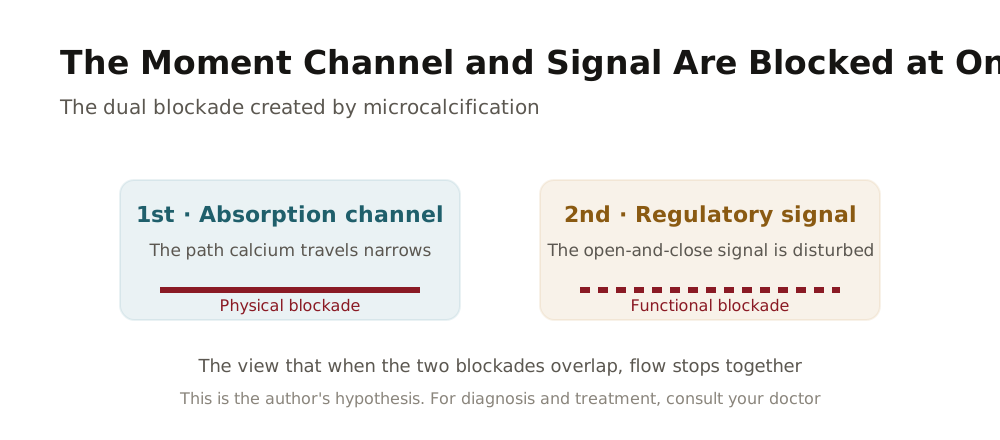
But here there is an important discovery. The point is that the problem is not only 'channel blockade'. When calcium absorption becomes unstable, the blood calcium concentration wavers, and in its aftermath the calcium signal inside the cell also becomes unstable, so that the cell function itself begins to grow dull.
And a cell whose function has grown dull, unable to use calcium in its proper place, more easily attaches and piles it up in the wrong place, and as a result the fine deposits increase and the channel narrows further.
In other words, when the channel is blocked the cellular environment worsens, when the environment worsens the calcium regulation breaks down further, and the broken regulation in turn increases deposits and blocks the channel further, in a way that the two problems push each other up, forming a loop of vicious cycle.
This is the third stage of the DIAH-7M Aging and Chronic Disease Pathway System, the domain of ③ Lockdown.
And at this stage, for the first time in the world, we now clearly identify that the root cause of aging and chronic disease lies in the 'calcium absorption and microcalcification dual blockade (CAM-DLT)' state, in which the instability of the signal that lowers cell function (insufficient calcium absorption) and the blockage of the channel (microcalcification) caused by bone calcium efflux combine to imprison the cell.

[Table] The Five Stages of the DIAH-7M Aging and Chronic Disease Pathway System
| Stage | English | Theory Name | Abbreviation |
|---|---|---|---|
| ① Factor | Factor | DIAH Four-Gate Funnel Theory | DIAH-FG |
| ② Start | Start | DIAH Trigger Bone Calcium Efflux Theory | DIAH-BCO |
| ③ Lockdown | Lockdown | Calcium Absorption and Microcalcification Dual Blockade Theory | CAM-DLT |
| ④ Manifestation | Manifestation | Calcification 7M Pathological Manifestation Theory | Ca-7M |
| ⑤ Result | Result | 7M Life System Collapse | 7M-A |
This chapter deals with the third of these, ③ Lockdown.
What You Will Learn in This Chapter
After reading this chapter you will be able to answer the following questions.
After reading this chapter you will be able to answer the following core questions.
First, where does the calcium released from the bones pile up, and why is that a problem? (Channel blockade)
Second, when calcium absorption is unstable, what happens inside the cell? (Signal blockade)
Third, how does the dual blockade reinforce each other and form a vicious cycle? (The twin engines of death)
Fourth, why is obesity not a simple weight problem but a 'blockade disease'? (A representative case)
Fifth, why does fixing only one side fail to cure the disease? (Conclusion)
We will look at where the calcium that escapes from the bones piles up, how the instability of calcium absorption breaks down the cell signal, and how these blockades reinforce each other and entrench chronic disease.
In particular, the 'Calcium Absorption and Microcalcification Dual Blockade Theory (CAM-DLT)' proposed in this chapter will explain, within a single frame, why diets fail again and again, why the disease does not heal even when medicine is taken, why aging accelerates, and why this is the root cause of chronic disease.
Let us look at it in detail.
The Cell, the Smallest Unit of Life, and the Microcirculatory System
In the previous chapter, through the bone calcium efflux theory driven by the DIAH (Deficiency, Inflammation, Acidosis, Hypoxia) trigger, we confirmed the mechanism by which the bone dissolves in order to maintain the blood calcium concentration. Now the discussion moves to the next stage. It is the question of how the excess calcium eluted from the bones acts within the body.
In a normal metabolic process, blood calcium should be reabsorbed into the bones or excreted through the kidneys. But calcium released in a state of chronic imbalance fails to find its place. It is adsorbed onto the inner walls of the microvessels connected to the roughly 37 trillion cells, stagnates in the cellular interstitial fluid, and impedes the flow of the lymphatic vessels.

What exactly is disease? We commonly regard disease as a breakdown of bodily function or an enemy to be removed. But seen from the cell's point of view, disease is not the passive result of a cell losing its function. Rather, it is closer to an active emergency survival regime that minimizes metabolic activity in order to survive in a worsened internal environment.
This state, which halts normal activity and cuts off exchange with the outside, is named blockade (Blockade) in this theory.
To understand the inevitable mechanism of why the cell has no choice but to be blockaded, we must first look at the basic knowledge of what structure the cell, the basic unit of life activity, is made of, and how the cell is connected to its surrounding environment and survives.
Why We Must First Look at the Cell, the Smallest Unit of Life, and the Microcirculatory System
The fastest road to understanding health begins not by seizing on the 'five viscera and six bowels' such as the heart, liver, and kidneys, but by first looking at a smaller stage, namely the cell and the microcirculatory system. This is because the five viscera and six bowels are the 'stage of results' where symptoms appear, whereas the cell and microcirculation are the 'scene of causes' where those results are made.

To survive, a cell absolutely requires three things: first, the supply of fuel such as oxygen and glucose; second, the metabolism that burns that fuel to produce the energy called ATP; and third, the excretion that empties out the carbon dioxide and waste products that come from the metabolic process; and if even one of these three goes wrong even once, the cell loses its function and in the end enters the survival mode called 'blockade'.
Inside the cell, facilities such as the cell membrane, mitochondria, nucleus, endoplasmic reticulum, and lysosomes run like a factory, but no matter how sophisticated the facilities are, if raw materials do not come in and garbage cannot go out, the factory has no choice but to stop.
So the survival of a cell is not explained by the 'internal structure of the cell' alone; it is completed only when the microcirculatory system connected to that cell, namely the supply road that runs from artery to arteriole to capillary to interstitial fluid, and the excretion road that divides into vein and lymph and escapes outward, are open together.

In the end, health is not about knowing many names of organs, but about understanding and managing the state in which the "flow of coming in and being emptied out" is maintained at the cellular level, and the starting point for slowing aging and escaping chronic disease also lies in properly seeing this single unit called 'cell and microcirculation'.
Basic Knowledge of the Cell and the Microcirculatory System
In order to clearly understand the full theory, the Dual Blockade Theory (CAM-DLT), we first define the structure of the cell and the circulatory system connected to the cell.
The internal structure and function of the cell. The cell, the smallest unit that makes up the human body, is not a simple substance but is itself equipped with one complete system of life.
1. The Components of the Cell: The Core Facilities of the Factory of Life
The cell, the smallest unit of our body, looks simple on the outside, but inside it, like a huge factory, sophisticated facilities each taking their own role are running without rest.

Cell membrane: It is the boundary membrane that separates the inside and outside of the cell. Through the receptors and channels present in the membrane, it performs a selective permeability function, taking in the necessary nutrients and blocking the unnecessary substances.
The main gate and security system of the factory of life. The cell membrane is the fence of the factory and the main gate that controls entry and exit.
While preventing just anyone from entering carelessly, through the doors in the membrane (receptors and channels) it performs a selective permeability function, surely taking in the nutrients the factory needs and thoroughly blocking the unnecessary substances.
Cytoplasm: The workshop floor of the factory of life. The cytoplasm is a jelly-like fluid that fills the inside of the cell, like the broad workshop floor of the factory. All the machines (endoplasmic reticulum, mitochondria, and so on) are placed here, and it is the actual scene where the nutrients and calcium that come in from outside first arrive and spread.
Mitochondria: They are the core organelle responsible for the cell's respiration and energy metabolism. Using the supplied oxygen and nutrients, they produce ATP, the energy source essential for maintaining life.
The main power plant of the factory of life. The mitochondria are the core power plant that runs the factory machines.
Burning as fuel the oxygen and nutrients that come in along the external roads (blood vessels), they produce, 24 hours a day, ATP, the essential energy source without which the cell cannot maintain life and stay active.

Nucleus: It is the control center that stores DNA, the genetic information. It contains the information that governs all life activities, such as the cell's division, growth, and protein synthesis.
The central control room. The nucleus is the central control room that commands the entire factory. It keeps the genetic information (DNA), which is the blueprint of the factory and the work order, in the safest place, and all the commands that decide when the cell will divide and grow and what protein products to make are issued from here.

Endoplasmic reticulum: It serves as a channel that synthesizes and moves proteins, and in particular it performs the important storehouse function of storing intracellular calcium ions and regulating their concentration. The logistics line and materials warehouse of the factory of life. The endoplasmic reticulum is the conveyor belt and warehouse that makes and moves goods inside the factory.
It also synthesizes and carries proteins, but in particular it serves as the core materials warehouse that separately stores the calcium ions most important in this theory, sends them out when needed, and regulates their concentration.

Lysosome: The waste treatment plant of the factory of life. The lysosome is the waste treatment plant that breaks down and recycles the garbage and defective products that come from the factory and the invading bacteria. If this treatment plant breaks down, garbage (toxins) piles up like a mountain inside the factory and the cell falls ill.
2. The Microcirculatory System Connected to the Cell: The Sophisticated Road Network That Keeps the Cell Alive
The microcirculatory system connected to the cell. A cell cannot survive independently; it must ceaselessly exchange substances through the blood vessels and body fluids. This is called microcirculation (Microcirculation), and it consists of two flows: supply and excretion.
No matter how excellent the facilities the factory called the cell is equipped with, if raw materials do not come in or waste products cannot be cleared away, it has no choice but to halt operation.
In our body there exists a flow of blood vessels and body fluids that handles this logistics, namely the microcirculatory system. This is not a simple pipe, but an intelligent road network that widens and narrows the road according to the situation and controls the goods.
Supply System: Supplying Oxygen and Glucose to the Cell
First let us look at the supply route of nutrients such as oxygen and glucose. From the artery to the front of the cell, the process by which the blood pumped out from the heart reaches the entrance of the cell follows a sophisticated step-by-step system, entering from a huge highway into a narrow alley.
Heart → ① Artery (highway) → ② Arteriole (valve) → ③ Capillary (oxygen raw material and
carbon dioxide waste exchange market) → ④ Interstitial fluid (warehouse) → ⑤ Cell (factory)

① Artery (highway): The artery is the broad highway along which the blood just pumped from the heart runs at the strongest pressure. Loaded full with oxygen and glucose, it spreads rapidly from the center of the body to each organ and tissue, and it serves as the starting point that brings even distant tissues into the supply zone without any delay in time.
② Arteriole (a back road fitted with a regulating valve): When you exit the highway you meet a small, dense road called the arteriole. This place is not a simple channel. There is muscle (smooth muscle) in the vessel wall, so it is fitted with a regulating valve that can contract or relax on its own.
Our body regulates this valve to perform an efficient distribution, sending more blood to tissues that are highly active at the moment and less blood to tissues that are resting. If this valve breaks down, an imbalance arises in the blood flow supply.
③ Capillary (exchange market): Past the arteriole, capillaries 10 times thinner than a hair are tangled like a net. This place is so thin that its wall is made of only a single layer of cells. Thanks to this thin wall, the oxygen and glucose that were in the blood can escape out of the vessel, and conversely the waste products that were in the tissue can come in.
In other words, it is the exchange market where the actual trading of substances is concluded.
④ Interstitial fluid (buffering delivery zone): The oxygen and nutrients that have escaped the vessel do not enter the cell right away. They must pass through the interstitial fluid, the liquid that fills the space between the capillary and the cell without a gap.
The interstitial fluid is a buffer zone that delivers the goods unloaded from the vessel right up to the cell's front door, and a middle logistics warehouse that briefly stores the garbage the cell puts out. Only when this water is clear and flows well is the cell healthy.

Excretion System: Excreting the Carbon Dioxide and Toxins Generated in the Cell
The excretion system is the road that sends out the carbon dioxide, waste products, and toxins generated in the cell, and only when excretion necessarily follows once supply has come in is the rhythm of life called 'circulation' completed.
When the small factory called the cell operates, carbon dioxide like exhaust smoke inevitably arises, and toxins, dregs, and various waste products pile up like industrial waste left on the workshop floor, and to clear away this garbage the body divides into two branches according to size and nature.

If we sum up the roles of the vein and the lymph in one line, it is most accurate to understand that the 'vein recovery system' takes charge of carbon dioxide and small waste products that dissolve well in water, while the 'lymph excretion system' takes charge of the large, heavy dregs such as protein and fat components, cell fragments, and pathogens, and in the end both of them join the vein at the last and connect all the way to the stage of excretion outside the body.
1. Vein recovery system (handling the cell's ordinary garbage)
Vein recovery system (handling the cell's 'ordinary garbage'): The carbon dioxide and small metabolic waste products that dissolve well in water, put out by the cell, first escape out of the cell and mix into the interstitial fluid, then seep back into the vessel through the nearest capillary wall and are recovered.
The substances recovered in this way ride along the venules (small veins) and gather and move into ever larger veins, and in the lungs the carbon dioxide is discharged through the breath, in the kidneys the small waste products are filtered out into the urine, and some substances are sorted out through a process of breakdown and detoxification in the liver, and you may see this flow as resembling the process by which the household garbage that comes out every day at home moves along a set collection route to the treatment plant and is sorted out.
[Small waste products: carbon dioxide, small metabolic waste products] Cell → Interstitial fluid → Capillary → Venule → Vein → Lung/Kidney

2. Lymph excretion system (handling the cell's 'large waste')
As the cell does its work, it is not only lightly recovered things like carbon dioxide that come out; 'large garbage' such as big lumps of toxins, fat dregs, fragments of dead cells, and invading bacteria also arises together, and because these things are large in size, it is hard for them to return into the vessel again through the capillary wall.
So the body made one more separate drainage channel, and that is the lymphatic capillary and the lymphatic vessel, and the lymphatic capillary, which begins like a straw with a blocked end, sucks in the polluted interstitial fluid and the large particles and gathers and sends them to the lymphatic vessel, and after filtering and monitoring them while they pass through the lymph nodes, at the last it joins them into a large vein and sends them back to the circulatory system.

[Large waste route: large toxins, fat] Cell → Interstitial fluid → ① Lymphatic capillary → ② Lymphatic vessel → ③ Lymph node → Large vein (subclavian vein) → Vein
① Lymphatic capillary (a straw with a blocked end, the 'first collection zone'): When large garbage and polluted interstitial fluid begin to pile up around the cell, it is hard to recover them again with the vessel alone. At this point the lymphatic capillaries hidden here and there in the tissue operate, and, shaped just like a straw with a blocked end, closed on one side and with a very thin wall, they quietly suck in the 'large loads' such as protein dregs, fat components, and cell fragments that cannot get into the vessel.

To put it simply, it is the 'first collection bin' that first gathers and holds the large waste scattered in the factory of life called the cell, and when this stage is blocked, the interstitial fluid grows turbid, edema arises, and the tissue begins to feel heavy and stifled.
② Lymphatic vessel (a 'dedicated drainage channel' on which collection trucks run): The contents gathered by the lymphatic capillary lead right into the thicker lymphatic vessel, and this road is not a simple tube but is designed to flow in only one direction because there is a 'valve that prevents backflow' on the inside, and each time the surrounding muscles move it is pressed like a pump and the lymph is pushed forward.
In other words, the lymphatic vessel is a dedicated road on which the collection trucks loaded with large garbage pass, and when the flow slows or is blocked, the dregs stay long in the tissue so that inflammation and stiffness worsen, and the feeling of the skin or joints swelling can grow.
③ Lymph node (a checkpoint and water purification plant, a 'sorting and purification center'): The lymph that has risen along the lymphatic vessel necessarily passes through lymph nodes here and there, and here it filters out the substances that have come in, and if invaders such as bacteria or viruses are mixed in, immune cells respond immediately.
By analogy, it is a 'checkpoint' and a 'purification site' that stops the garbage trucks carried up from the factory of life called the cell in front of the lymph node, inspects them one by one, catches and handles dangerous substances or invaders on the spot, and sends on to the next road only what is allowed to pass, and the reason the lymph nodes swell and hurt when there is an infection is precisely because the battle and the purification work of the immune cells are concentrated all at once in this place.

The Cell Too Undergoes Birth, Aging, Illness, and Death (生老病死)
As we examined earlier in the 'Calcium Code theory' and the 'Calcium Cosmic Integration theory', everything in the cosmos passes through the cycle of birth, growth, reproduction, decline, death, and return. It is so for the stars, so for life, and the same for the cell.
Calcium is not a simple nutrient. We commonly know calcium as merely a nutrient that strengthens the bones. But from the perspective of cell biology, calcium is the execution code (Execution Code) that signals the beginning and the end of life activity. Taking the change in calcium concentration as its signal, the cell carries out the following cycle of birth, aging, illness, and death.

When cell division begins, the calcium signal pulls the trigger, and when the cell grows and makes proteins, calcium plays the role of a switch. In the maturity when the cell fulfills its function, calcium operates as the execution code of every signal. And when the cell grows old and its function declines, the calcium regulation begins to waver, and finally when the cell dies, calcium flows in en masse and sends the signal "now finish it".
Birth (Cell Division): Even at the moment when sperm meets egg and fertilization takes place, calcium quietly plays a core role. Like a key that opens a door, the calcium signal coordinates the membrane and internal reactions of the egg to help the sperm enter and the fertilization be concluded, and then, inside the egg, the calcium concentration changes sharply like a wave and turns on the switch of "now begin division", pulling the trigger of the first cell division. In the end, you may see calcium as something like a traffic light that connects the whole scene where a new life sets out, from the establishment of fertilization to the beginning of division.
Growth (Protein Synthesis): When the cell makes proteins in order to grow, calcium also plays the role of an important switch. Just as a work order "now run the machines and begin production" comes down to a factory, when the calcium signal turns on the protein synthesis process is set in motion, and when it turns off the process slows or stops, and the flow called growth takes on a rhythm.
Death (Apoptosis): When the moment comes at which the cell has reached the end of its lifespan or its damage is so great that it must no longer hold out, calcium becomes the signal that turns on the last switch. Just as an emergency light turns on in a factory and a final order "now close the doors and wrap up" comes down, as calcium greatly increases inside the cell the self-digestion program operates, and the cell quietly folds and closes itself so as not to harm its surroundings, then is broken down and disposed of according to a set procedure.
