
This piece is the complete Chapter 7 of The Declaration of the Age of Physical Economics (Yoon Jong-won, Yoon So-ri, Yoon Jun). It is an academic exposition presenting the authors' physical economics hypothesis, and the body, figures, and citations follow the manuscript as written.
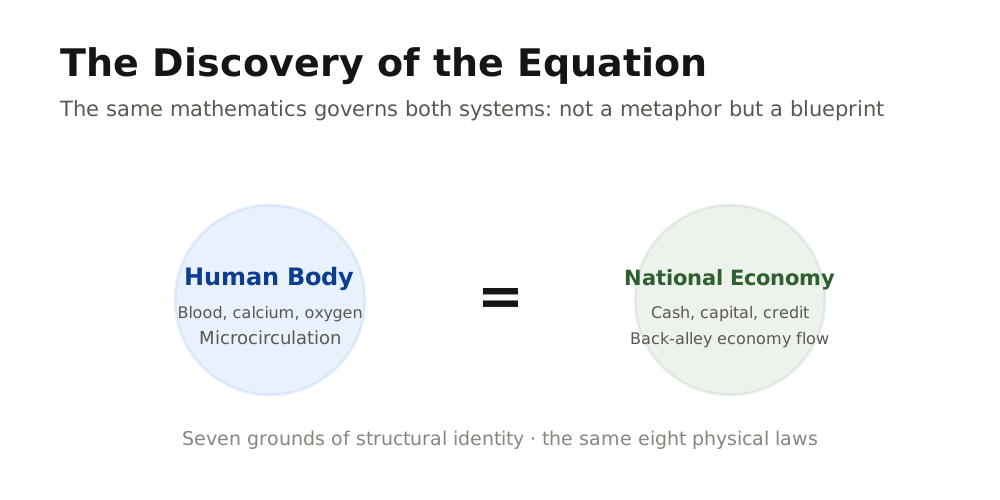
Earlier we examined the blind spot that the five schools of Keynesianism, monetarism, MMT, the Austrian school, and supply-side economics had held for 250 years. It is the fact that all five schools looked only at quantity, and that no school saw the simultaneous blockade of flow. And so a single proposition holds up every chapter of this book. A nation's economy is not a total quantity but a flow, and collapse is the simultaneous blockade of flow.
A question remains. How can we verify that the proposition is correct? If the proposition works only inside a national economy, then the proposition remains one more hypothesis. But if the same proposition is at work in yet another system that appears to have nothing to do with the economic system, then the hypothesis becomes fact. That is the academic conclusion that the two systems stand upon the same blueprint.
That other system is the human body. It is a field with a vast body of knowledge accumulated over thousands of years to diagnose and treat the blockages and collapses of a system, a gigantic complex system made up of about 37 trillion cells, a system with a circulatory pathway reaching about 100,000 kilometers. The fact that the human body and a nation's economy are not merely in a relationship of analogy but are two complex systems that follow the same blueprint, this fact is the substance of this chapter.
One Discovery: They Follow the Same Blueprint
The fact that the cash flowing into a Korean back-alley eatery that opened its doors in 1996 and the blood flowing inside the body of a Korean self-employed person operate upon the same physical law was not visible on its own. Nor was the fact that the event in which the Korean back-alley eatery was blocked during the 1997 foreign exchange crisis and the event in which the body of the Korean self-employed person was weakened by stress were events of the same kind visible on its own. Yet the two events were things that happened upon the same blueprint. Let us examine step by step how the blueprint is the same.
The diagnostic system that the present author established was originally a framework developed for the human body. It is a system designed to explain along what pathway aging and chronic disease arise and worsen. It is a system that analyzes the structure of the flow by which about 37 trillion cells are maintained, and that integrates more than 200 diseases into the four triggers of deficiency, inflammation, acidosis, and hypoxia and the seven forms of damage of obstruction and rupture, dysfunction, coating and blocking, hardening, overflow and burst, disconnection, and collapse.
But when the present author applied this framework to the national economy, there was an unexpected discovery. The structure by which, inside the human body, blood is supplied to the whole body through the aorta and reaches the cells through the microvasculature overlapped in agreement with the structure by which, inside the national economy, funds are supplied to the whole economy through financial institutions and reach households through the back-alley economy. The event in which, in the human body, cells die when the microvasculature is blocked was following the same principle as the event in which, in the national economy, small business owners die when the back-alley economy is blocked. The event in which, in the human body, a patient dies when the two channels of the signal channel CAM and the mediator channel DLT are blocked simultaneously was walking the same path as the event in which, in the Korean and American economies too, the system collapses when those same two channels are blocked simultaneously.
In 1687, the English physicist Newton discovered that the phenomenon of an apple falling and the phenomenon of the moon orbiting the earth are governed by the same law, namely universal gravitation. The apple and the moon differ entirely in size and in material, yet the same physical law governs the two events. The human body and a nation's economy are likewise. The human body operates on cells and blood and oxygen, and the economic system operates on households and cash and resources. The materials differ, but the structure of circulation, the physics of blockage, and the pathway of collapse are the same. The equation this book speaks of is that conclusion.
The Basic Equation: The Human Body and a Nation's Economy Follow the Same Blueprint
| Human body | A nation's economy | Common principle |
|---|---|---|
| About 37 trillion cells | Tens of millions of economic agents | The constituent units need resources in order to survive |
| About 100,000 km of blood vessels | Road, communication, and financial networks | The pathway along which resources flow |
| Aorta and vena cava | Large corporations and financial institutions | The center that policy easily reaches |
| Microvasculature (more than 80% of the whole) | The back-alley economy (the majority of economic agents) | The endpoint where actual exchange occurs |
| Cells | Households and small business owners | The first to die and the last to survive |
| Circulation of blood stops = death | Cash flow stops = collapse | If it is blocked, it dies |
Structural Identity: Seven Grounds
The claim that the human body and the national economy are of the same structure is not a mere analogy. In academic terms it is called structural isomorphism. It means that the two systems actually possess the same structural characteristics. Seven grounds support the fact: resource circulation, hierarchical structure, homeostasis maintenance, pathological pattern, causal chain, prescriptability, and prognostic prediction.
First, resource circulation. In the human body, the heart pumps blood and sends it to the whole body through the aorta, delivers oxygen and nutrients at the cells, and then returns to the heart through the veins. In the national economy, the central bank supplies liquidity and sends it to firms and households through financial institutions, and it returns again to national finances through consumption and taxes. In both systems resources circulate, and if the circulation stops, the system dies.
Second, hierarchical structure. The human body is stratified into organ systems, organs, tissues, and cells. The national economy too is stratified into industries, large corporations, small and medium enterprises, small business owners, and households. In both systems the upper tier is a structure that supports the lower tier, and even if an individual unit of the lower tier dies the upper tier is not immediately affected, but a large-scale die-off of the lower tier leads to a decline in the function of the upper tier.
Third, the homeostasis maintenance mechanism. The human body has a regulatory function that seeks to keep body temperature around 36.5 degrees, blood pressure within the normal range, and blood sugar at an appropriate level. The Korean and American economies too have a policy-regulatory function that seeks to keep interest rates, prices, and exchange rates within a stable range. In both systems, when an external shock occurs the internal regulatory function operates and tries to restore equilibrium, and when the regulatory function exceeds its limit the system becomes unstable.
Fourth, pathological pattern. The human body has acute diseases and chronic diseases. An acute myocardial infarction arises suddenly and requires immediate treatment, whereas type 2 diabetes progresses slowly over several years. In the national economy too there are acute crises that erupt within a few days, like the 2023 collapse of Silicon Valley Bank in the United States, and chronic crises that progress over several decades, like Japan's 30-year prolonged stagnation. The principle of onset, the speed of progression, and the treatment method for the acute and the chronic operate with the same structure in the human body and in the economic system.
Fifth, causal chain. In the human body, if high blood pressure is left untreated it leads to arteriosclerosis, and if arteriosclerosis worsens it leads to myocardial infarction. There is a causal chain in which a cause creates a symptom and a symptom creates a complication. In the national economy too, if household debt rises consumption shrinks, if consumption shrinks corporate revenue declines, if corporate revenue declines employment declines, and if employment declines household income declines again, and this causal chain operates. The chain structure appears the same in the two systems.
Sixth, prescriptability. A disease that arises in the human body can be treated by administering drugs, by surgery, by correcting lifestyle habits, and so on. A crisis that arises in the national economy too can be responded to by adjusting interest rates, by fiscal spending, by structural reform, and so on. In both systems prescription is possible, and the effect of the prescription differs according to timing and pathway. The fact that even the same drug produces different results depending on whether it is injected into the aorta or injected directly into the microvasculature is also the same.
Seventh, the possibility of prognostic prediction. If we grasp the current state of health through a comprehensive checkup, we can predict the risk of diseases that may arise in the future. A patient whose blood pressure is high, whose cholesterol is high, and whose blood sugar is at the borderline has a high risk of cardiovascular disease. The economic system is likewise, and if we synthesize several indicators we can predict along what pathway a crisis is likely to progress. This is why the diagnostic system that the present author established examines the whole body of a nation's economy with 59 gauges across 9 organ systems.
The Seven Grounds of Structural Identity: Not an Analogy but the Same Structure
| Ground | Human body | A nation's economy | Common structure |
|---|---|---|---|
| 1. Resource circulation | Blood: heart to arteries to cells to veins | Funds: central bank to banks to firms to households | If circulation stops, it dies |
| 2. Hierarchical structure | Organ systems to organs to tissues to cells | Industries to large firms to SMEs to households | Death below leads to functional decline above |
| 3. Homeostasis | Regulation of temperature, blood pressure, blood sugar | Regulation of interest rates, prices, exchange rates | Possesses an equilibrium-restoring function |
| 4. Pathological pattern | Acute myocardial infarction vs chronic diabetes | Acute bank run vs chronic stagnation | Acute and chronic have the same structure |
| 5. Causal chain | High blood pressure to arteriosclerosis to myocardial infarction | Household debt to shrinking consumption to corporate bankruptcy | Cause to symptom to complication |
| 6. Prescriptable | Drugs, surgery, lifestyle correction | Interest rates, fiscal policy, structural reform | Timing and pathway determine the effect |
| 7. Prognostic prediction | Predicting disease risk by comprehensive checkup | Predicting crisis by whole-body examination | The grounds of the 59 gauges |
The Same Mathematics Governs Two Systems: Eight Physical Laws
In addition to the seven structural grounds, the fact that the human body and the Korean and American economies are actually governed by the same physical laws can be shown through the eight principles of Poiseuille, the continuity equation, entropy, diffusion, Ohm, inertia, positive feedback, and the critical point.
First, Poiseuille's Law. The volume of liquid passing through a tube is proportional to the fourth power of the tube's radius. It is the law we examined earlier. If the radius of a blood vessel shrinks by 10 percent, blood flow decreases by about 35 percent, and if it shrinks by 20 percent, it decreases by about 60 percent. In the national economy too, when the lending pathway narrows, access to funds decreases more than proportionally. When interest rates rise, the small business owner's access to funds decreases by a margin far larger than the rate hike, and this is the economic application of Poiseuille's Law.
Second, the continuity equation. In fluid dynamics, the amount coming in and the amount going out must necessarily balance. If the amount going out exceeds the amount coming in, the system is depleted, and if the amount coming in exceeds the amount going out, pressure builds up. In the human body, if water intake and excretion fail to balance, edema or dehydration occurs. In the national economy, if tax revenue has fallen but fiscal spending is maintained, a fiscal deficit accumulates, and if the deficit persists it leads to national default. The fiscal crisis of Greece was a case of violating this law.
Third, the law of entropy. According to the second law of thermodynamics, unless energy is supplied from outside, every system progresses toward a state of disorder. In the human body, if nutritional intake and exercise stop, the muscles weaken and immunity declines. In the national economy, if investment stops, infrastructure grows old, and if investment in people declines, productivity declines. The principle that maintenance requires ceaseless input applies the same to the two systems.
Fourth, the law of diffusion. Matter moves from a place of high concentration to a place of low concentration. In the human body, the case in which oxygen diffuses from the blood (high concentration) to the tissues (low concentration) is the representative case. In the economic system, capital flows to where the rate of return is high. If there is no interest-rate difference, capital movement stops, and the larger the gap in the rate of return, the more active the capital movement. The principle that a difference in concentration creates flow is the same in the two systems.
Fifth, Ohm's Law. Electric current is proportional to voltage and inversely proportional to resistance. In the human body, if a blood vessel narrows (resistance increases), blood flow decreases. In the national economy, if regulation and fixed costs increase (resistance increases), the flow of funds decreases. The various administrative costs, taxes, fees, and rents applied to small business owners are the resistance of the national economy, and the higher the resistance rises, the more the flow of funds in the back-alley economy decreases.
Sixth, the law of inertia. An object at rest remains at rest unless an external force is applied. Once a chronic disease has settled into the human body, it is very difficult to recover on one's own without drugs or changes in lifestyle. In the economic system too, a system that has fallen into recession is difficult to recover on its own without external intervention. The fact that the result of waiting for market self-correction in the Great Depression of 1929 was a GDP decline of about 30 percent and an unemployment rate of 25 percent supports the principle.
Seventh, the positive feedback loop. It is a chain structure in which worsening summons worsening. In the human body, if a blood vessel narrows blood pressure rises, and if blood pressure rises more damage occurs to the vessel wall, and more calcium is deposited on the damaged vessel wall so that the vessel narrows further. In the national economy, if non-performing loans increase banks reduce lending, and if lending is reduced firms go bankrupt, and if firms go bankrupt non-performing loans increase further. The positive feedback loop operates with the same structure in the two systems.
Eighth, the critical point. Every system has an irreversible turning point. In the human body, if the two channels are blocked simultaneously, it enters an irreversible state in which self-recovery is impossible. In the national economy too, if the consumption channel and the investment pathway are blocked simultaneously, the system stops all at once. The 1997 Korean foreign exchange crisis and the 2008 global financial crisis are cases that crossed the critical point. The principle that it must be caught before it crosses the critical point coincides with the concept of the golden time in emergency medicine for patients. As a result of the present author's verification with 690 months of Korean and American data, in the 2 cases of single-channel blockade the system survived in all of them, and only in the 4 cases of simultaneous blockade of both channels did it cross the critical point and the system collapse.
The Application of the Eight Physical Laws to the Human Body and the Economy: The Same Mathematics Governs Two Systems
| Physical law | Application to the human body | Application to a nation's economy | Core principle |
|---|---|---|---|
| Poiseuille | Vessel shrinks 10% leads to blood flow down 35% | Lending pathway shrinks leads to funds plunging | If it narrows, it plunges |
| Continuity equation | In does not equal out leads to edema or dehydration | Revenue does not equal spending leads to fiscal crisis | If balance breaks, it collapses |
| Entropy | Without input, it weakens | Without investment, it grows old | Maintenance requires input |
| Law of diffusion | Oxygen diffuses by concentration difference | Capital moves by return difference | Difference creates flow |
| Ohm's Law | Resistance up leads to blood flow down | Regulation and cost up leads to fund flow down | Resistance reduces flow |
| Law of inertia | Chronic disease does not recover without external force | Recession does not recover without intervention | Stagnation does not resolve itself |
| Positive feedback | Vessel damage to calcium to further narrowing | Bad debt to lending down to bankruptcy to more bad debt | Worsening summons worsening |
| Critical point | Two channels blocked leads to self-recovery impossible | Two channels blocked leads to system stopping | Once crossed, it cannot be reversed |
Not a Metaphor but a Blueprint: The Meaning of Structural Isomorphism
Let us make a point here. The work of applying the human body to the national economy is not a mere metaphor. A metaphor is merely a tool for the convenience of explanation. If it is at the level of saying that likening the national economy to the human body makes it easy to understand, it may be a useful metaphor but it cannot become a tool of diagnosis.
The conclusion this book speaks of is structural isomorphism. It is the fact that the two systems, though made of different materials, operate by the same mathematics and the same physical principles. The event in which, in the human body, when a blood vessel narrows blood flow decreases in proportion to the fourth power of the radius is a law of fluid dynamics, and the event in which, in the economic system, when the lending pathway narrows access to funds decreases more than proportionally is also the same law of fluid dynamics. The event in which, in the human body, the simultaneous blockade of the signal channel and the mediator channel summons death, and the event in which, in the Korean and American economies, the simultaneous blockade of those same two channels summons system collapse, are the same physics of channel blockade.
There is a reason the distinction is important. It is because, if structural isomorphism holds, the principle discovered in one system can be applied to the other system. The diagnostic system, the pathological classification, the treatment pathway, and the prognostic prediction method that the medicine which diagnoses the human body has accumulated over thousands of years can be applied to the national economy. Just as in the human body more than 200 diseases were integrated into the four triggers of deficiency, inflammation, acidosis, and hypoxia and the seven forms of obstruction and rupture, dysfunction, coating and blocking, hardening, overflow and burst, disconnection, and collapse, in the national economy too every crisis can be integrated into the same four triggers and the same seven forms. If it were a metaphor, integration would be impossible. It is possible because it is structural isomorphism.
We return to the proposition we saw earlier. A nation's economy is not a total quantity but a flow, and collapse is the simultaneous blockade of flow. The human body is the same. A patient's health is not the total quantity of blood but the flow of blood, and a patient's death is the simultaneous blockade of the flow of blood. The fact that the two systems stand upon the same proposition, this fact is the shortest proof of structural isomorphism.
If It Is Blocked, It Dies: The Universal Principle of Every Flow System
The proposition that cuts across the whole book is the fact that if it is blocked, it dies. The proposition was declared at the beginning of the book, and it was confirmed repeatedly earlier. Here we make the point that the proposition applies not only to the human body and a nation's economy but has a universality that applies to every flow system.
The proposition that if it is blocked, it dies operates without regard to scale and material. In the universe, a star dies when the flow of its nuclear fusion fuel runs out. In the human body, a cell undergoes necrosis within a few minutes when blood flow is cut off. In a river, when the flow of water is blocked, the ecosystem at the endpoint dies. In the atmosphere, when the airway is blocked, oxygen cannot reach the lungs and the patient cannot breathe. In the national economy, when cash flow stops, households and firms go bankrupt.
The Universality of Flow Collapse: One Principle Regardless of Scale and Material
| System | What flows | Where it is blocked | Result |
|---|---|---|---|
| Universe (a star) | Nuclear fusion fuel | Nuclear reaction pathway | Death of the star |
| Human body | Blood, calcium, oxygen | Microvasculature, arterioles | Cell necrosis, organ failure |
| Inside a cell | Metabolic products | Cell membrane transport pathway | Cell death |
| River | Flow of water | Tributaries, channels | Downstream drought, ecosystem collapse |
| Atmosphere | Oxygen, air | Airway, alveoli | Inability to breathe |
| National economy | Cash, capital, credit | Back-alley economy, households | Small business closures, economic crisis |
The fact this table conveys is clear. The proposition that if it is blocked, it dies applies not only to a particular system but to every flow system. This is why the equation that links the human body and a nation's economy is not an arbitrary metaphor but stands upon a universal law that cuts across every complex system. Just as Newton linked the apple and the moon into one proposition with the universal law of gravitation, the universal law of flow links the human body and a nation's economy into one proposition.
The Academic Position on Which This Equation Stands
The equation linking the human body and a nation's economy is not a result made by chance in empty space. Within the history of scholarship there were similar attempts first, and the model the present author established stands upon those attempts. The work of pointing out where it stands helps toward clearly understanding the academic position of the equation.
The Austrian-born American biologist Bertalanffy published in 1968 a book called General System Theory. It is the book that first systematized the concept that biological, physical, and social systems possess common structural principles. Bertalanffy's insight laid the academic grounds that a principle discovered in one system can be applied to another system. The complex systems science that developed thereafter has studied systems in which new phenomena are created from the interactions among constituent elements, and network science has analyzed the connection structure and the vulnerability of systems made up of points and lines.
The model the present author established, while standing upon this academic tradition, has two points of distinction. First, it established the structural isomorphism between the human body and a nation's economy not as a mere analogy but as an equation grounded in physical law. The seven structural grounds and the eight physical laws support the equation, and they show that the equation is not a rhetorical tool but a diagnosable academic framework. Second, it did not remain in theory but was implemented as a practical diagnostic system. As long as the equation holds, the conclusion follows that the tools of the medicine which diagnoses the human body are applicable to the national economy as well. The model the present author established is a system that confirmed that conclusion through actual measurement in the economic data of Korea and the United States, and it stands at the academic point where theory and actual measurement meet in the same place.
What This Equation Creates
If structural isomorphism holds, the diagnostic tools accumulated in one system can be applied to the other system. In the human body there is the diagnostic system of medicine accumulated over thousands of years, and that system has developed to the point of precisely monitoring the flow and blockage of blood. The reason it is possible, in a comprehensive checkup, to look simultaneously at dozens of figures such as blood pressure, blood sugar, and cholesterol and to predict a patient's future risk is that medicine acknowledged the fact that the structure of the human body operates upon physical laws and built its tools upon that.
The same approach is possible for the national economy. Just as, in the human body, blood flow is diagnosed by dividing it by organ system, the flow of funds in the national economy can be diagnosed by dividing it into axes corresponding to the organ systems. Just as, in the human body, the degree of vascular stenosis is measured in figures, the degree to which the funding channels of the national economy narrow can be measured in figures. Just as, in the human body, when the two channels are blocked simultaneously it enters an irreversible state, in the national economy too, when the two channels are blocked simultaneously, it enters the threshold at which the crisis takes full form. As long as the equation stands, the conclusion follows that the diagnostic precision of medicine can be transferred as it is into the precision of national economic diagnosis.
The reason the small business owners of Korea's back-alley shops were struck by shocks without prior warning in 1997, in 2008, and in 2020 alike is that there was no diagnostic tool that reaches all the way to the back-alley economy. If we build a diagnostic tool upon the equation, the possibility opens that the tool can reach not only the aorta but the back-alley economy that corresponds to the microvasculature. Whether the possibility actually works is the place that Korea's and America's long-term data answer, and that answer lies in the flow that unfolds later upon this equation.
The One Truth That the Equation Holds Up
The human body and a nation's economy are two complex systems that follow the same blueprint. This fact is held up by the seven structural grounds of resource circulation, hierarchical structure, homeostasis, pathological pattern, causal chain, prescriptability, and prognostic prediction, and by the eight physical laws of Poiseuille, the continuity equation, entropy, diffusion, Ohm, inertia, positive feedback, and the critical point. It is not a metaphor but structural isomorphism, and because the isomorphism holds, the diagnostic principle of one system is applicable to the other system as well.
A nation's economy is not a total quantity but a flow, and collapse is the simultaneous blockade of flow. The fact that this proposition applies identically to the two systems of the human body and the national economy as a universal proposition, that fact is the truth the equation holds up.
References
1. Bar-Yam, Y. (1997). Dynamics of Complex Systems. Addison-Wesley.
2. Barabási, A.-L. (2003). Linked: How Everything Is Connected to Everything Else and What It Means for Business, Science, and Everyday Life. Plume.
3. Holland, J. H. (1995). Hidden Order: How Adaptation Builds Complexity. Addison-Wesley.
4. HuBMAP Consortium (2023). Anatomical Structures, Cell Types, and Biomarkers of the Healthy Human Blood Vasculature. Scientific Data, 10, 452.
5. Newton, I. (1687). Philosophiæ Naturalis Principia Mathematica. Royal Society.
6. Poiseuille, J. L. M. (1846). Recherches expérimentales sur le mouvement des liquides dans les tubes de très petits diamètres. Mémoires des Savants Étrangers, 9, 433-544.
7. Poole, D. C., et al. (2021). Muscle Microvascular Oxygen Pressures During Exercise. Journal of Physiology, 599(1), 3-27.
8. Von Bertalanffy, L. (1968). General System Theory: Foundations, Development, Applications. George Braziller.