
This piece is the complete Chapter 9 of Calcium: The Reality of Evolution That Darwin and the Genome Map Missed (Yoon Jong-won). The essay that opens Part Three is included together with it. The body, figures, and citations follow the manuscript as written.
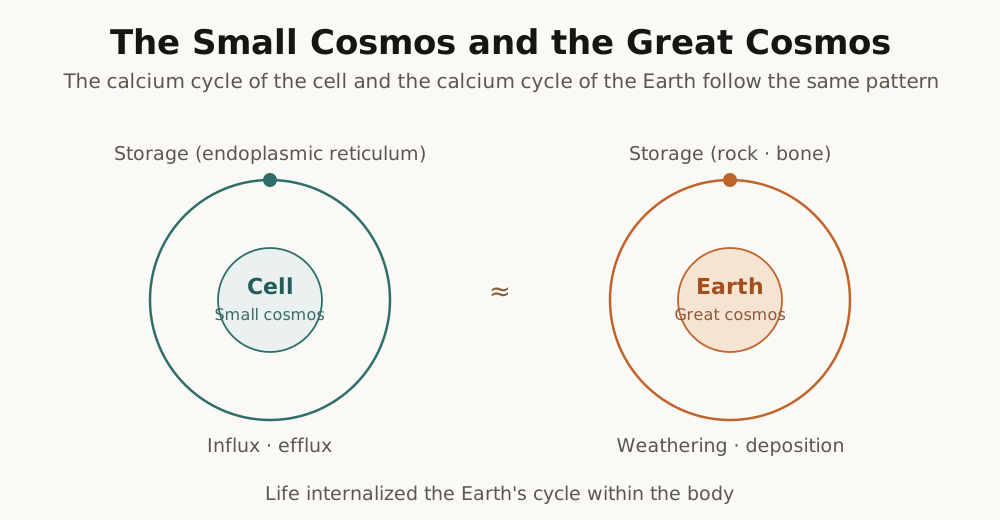
The essay that opens Part Three: The Expansion of the Cycle (from the cell to the Earth, the same principle)
Introduction: The Pattern Repeats
Earlier we confirmed a single material pathway running through the six stages of life, from birth to growth, reproduction, decline, and death, and on to return. That pathway is the DIAH-7M Aging and Chronic Disease Pathway System. This framework, in which the four triggers of Deficiency, Inflammation, Acidosis, and Hypoxia cause calcium to leak out of the bones, and the leaked calcium brings about aging and disease through seven pathological pathways, showed us that if DNA is the design code of life, calcium is the execution code that carries out that design.
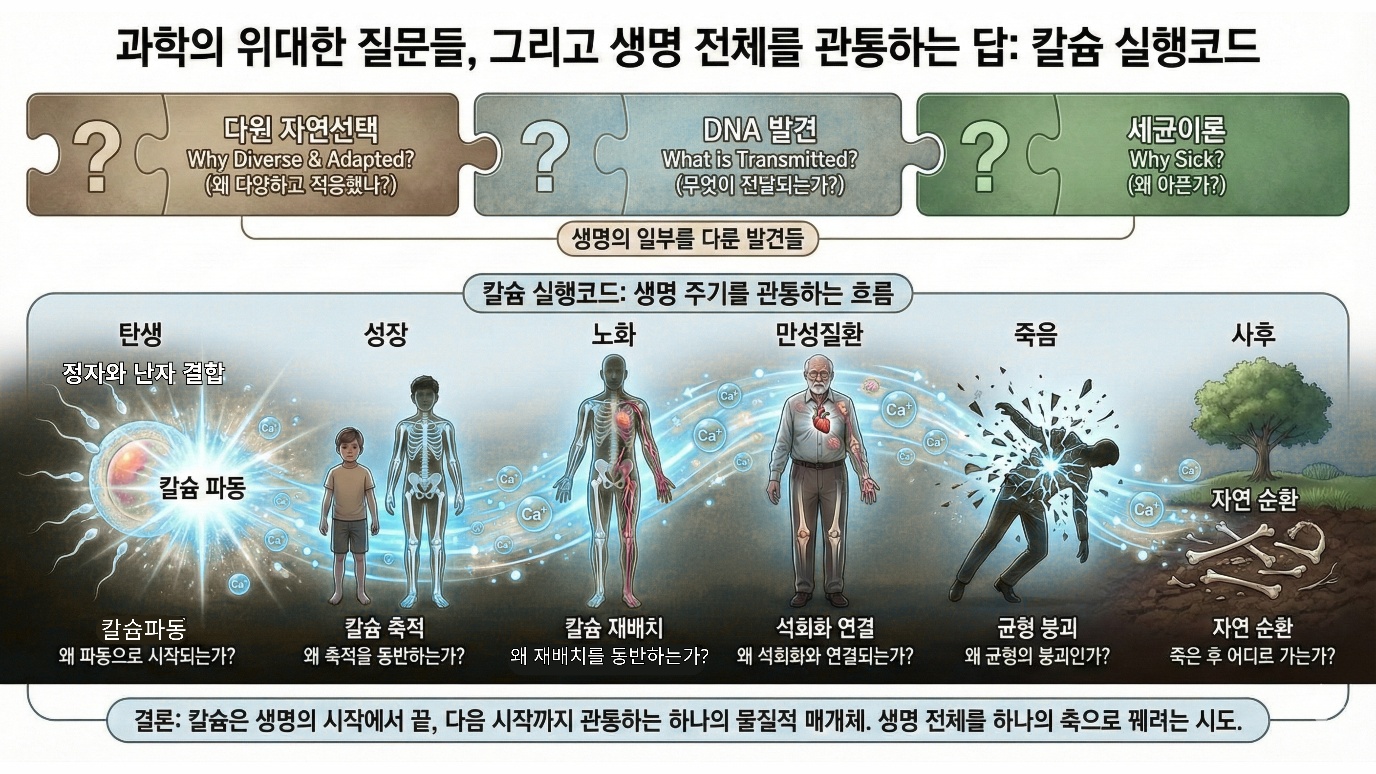
The first cell, 3.8 billion years ago, turned the toxicity of calcium to its own advantage and built a signaling system. In the Cambrian period, 540 million years ago, organisms pushed calcium out of the cell to make shells and skeletons, and 400 million years ago vertebrates, as they came up onto land, developed a whole-body homeostasis system that made use of bone as a calcium storehouse. At last the human brain uses calcium signals in its 86 billion neurons and 100 trillion synapses to produce consciousness, memory, and thought. The ability to regulate calcium was itself the ability to survive, and the ability to survive was the core of evolutionary fitness.
But after reproduction the protective systems weaken. The DIAH triggers cause calcium to leak out of the bones, and the leaked calcium carries out the exit through the 7M pathways. Blood vessels become blocked, joints stiffen, signals are cut off, elasticity disappears, cells overflow, connections are severed, and structure collapses. When the individual dies, the calcium returns to the environment. The next life borrows and uses it. Death was not an end but a giving back.
Now let us widen our view. This calcium cycle observed at the level of the individual appears in the same pattern at the level of the Earth as well. The small cosmos of the human body and the great cosmos of the Earth share a remarkably similar structure. Both store, circulate, and regulate calcium. Both maintain a balance of input and output, and when that balance breaks, problems arise.
If in the human body bone is the calcium storehouse, on Earth it is limestone; if in the human body blood carries calcium, on Earth it is rivers and seas; if in the human body hormones regulate the flow of calcium, on Earth living things and geological processes take on that role.
This similarity is no coincidence. Life was born on Earth, is made of the material of the Earth, and takes part in the cycles of the Earth. The calcium cycle of the human body is a miniature of the Earth's calcium cycle. The small cosmos reflects the pattern of the great cosmos.
Introduction: The Same Pattern, a Different Scale
We have seen that calcium is the execution code running through life from beginning to end, from birth to return, and through the DIAH-7M Aging and Chronic Disease Pathway System we have tried to clarify along which material pathway aging and disease proceed.
Now, widening our gaze a little further, we will look at how closely the calcium cycle that takes place inside our bodies resembles the calcium cycle that takes place on the vast planet called Earth. This is not a mere metaphor or literary imagining.
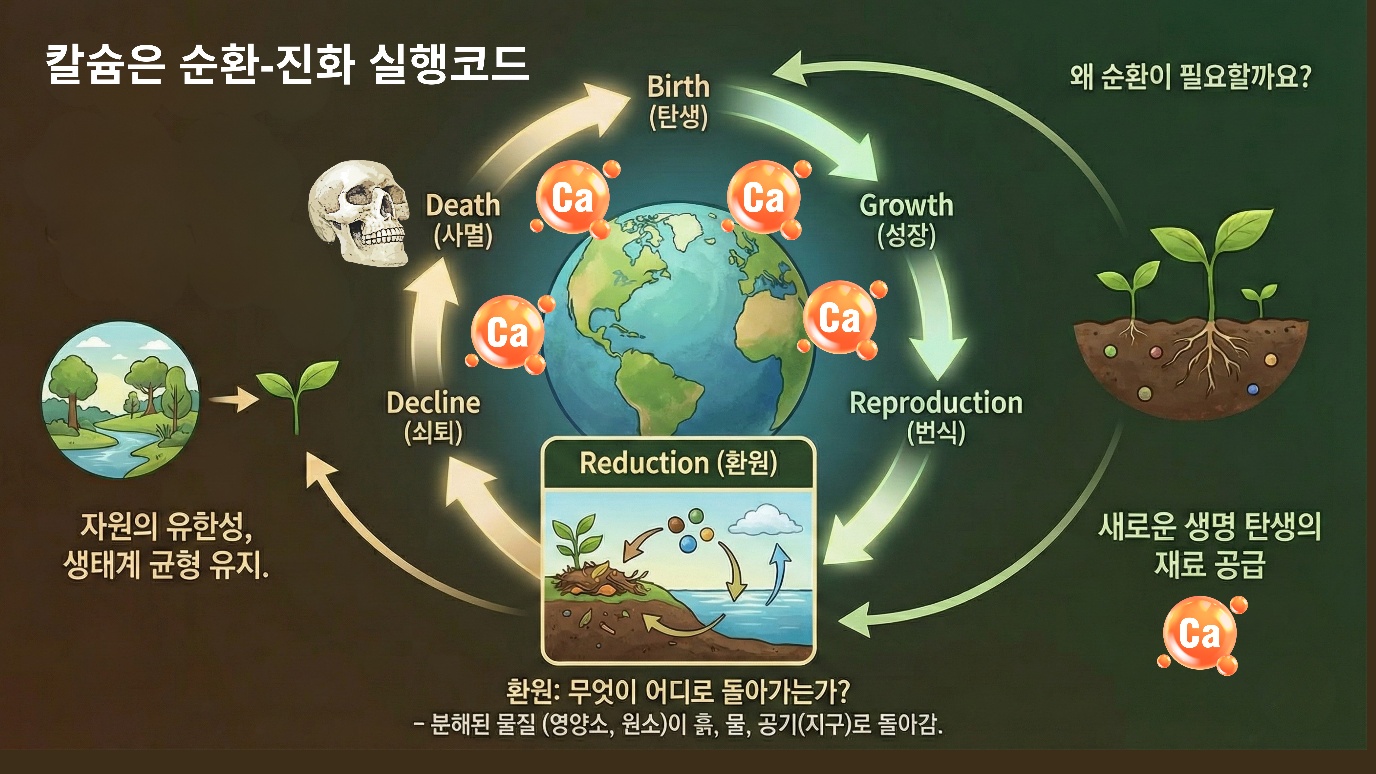
In fact, when we set the calcium cycle structure of the human body and the calcium cycle structure of the Earth side by side and compare them, we come to discover that the five stages of storage and efflux, circulation and use, and return follow a remarkably identical pattern.
The scale is so different that comparison seems pointless, one side being a human body of 2 meters and the other a planet 12,700 kilometers in diameter, but the way calcium flows within them, the principle of being stored, leaking out, being used, and returning again, is essentially the same. In this chapter we will look at these two circulatory systems side by side, and think about why such a match is no coincidence, and what meaning this fact throws into our understanding of evolution and life.
The Calcium Cycle of the Human Body
Our bodies contain about 1 kilogram of calcium, of which 99 percent is stored in the bones and teeth, as reported by various physiological research institutions. This bone does not merely play the role of a pillar supporting the body; it plays the role of a kind of calcium bank. When the body needs calcium it withdraws it from this bank, and when calcium is plentiful it deposits it again, so that deposits and withdrawals are constantly taking place. The concentration of calcium in the blood must be maintained within a very narrow range, between 8.5 and 10.5 milligrams per deciliter, and because even a slight deviation from this concentration causes serious problems for the heartbeat, muscle contraction, and nerve transmission, the body operates an elaborate hormone system to maintain this balance.
When the blood calcium concentration falls, the parathyroid glands secrete parathyroid hormone, that is, PTH, and this hormone sends a signal to the bones instructing them to release the stored calcium into the blood. Conversely, when calcium is sufficient, the thyroid gland secretes calcitonin, which sends a signal to store calcium back into the bones. The calcium released in this way rides the river of the blood and travels throughout the whole body, being used in cells everywhere. When a nerve cell transmits a signal, when a muscle contracts, when a hormone is secreted, when a cell divides and dies, in all these moments calcium ions act as signals. And the used calcium either returns to the bones again or is excreted in the urine through the kidneys, about 100 to 200 milligrams per day.
The problem arises when the DIAH conditions examined earlier, that is, deficiency and inflammation, acidosis and hypoxia, persist chronically. In such an environment the body, for the sake of survival, keeps drawing calcium out of the bones, and the calcium drawn out, failing to return properly to the bones, begins to pile up on the walls of blood vessels, in the joints, and in soft tissue. Just as a bank balance runs dry when withdrawals exceed deposits, the calcium storehouse of the bones empties out and osteoporosis progresses, while at the same time calcium piles up in the wrong places and arteriosclerosis and calcification progress. This is the process by which the calcium cycle breaks down at the level of the human body, and it is the material basis of the 7M pathways examined in the previous chapters.
The Calcium Cycle of the Earth
Now let us shift our gaze from our bodies to the Earth. Calcium circulates on the Earth as well. Only, its scale and its time are incomparably larger than those of the human body. According to various earth-science research institutions, calcium is the fifth most abundant element in the Earth's crust.
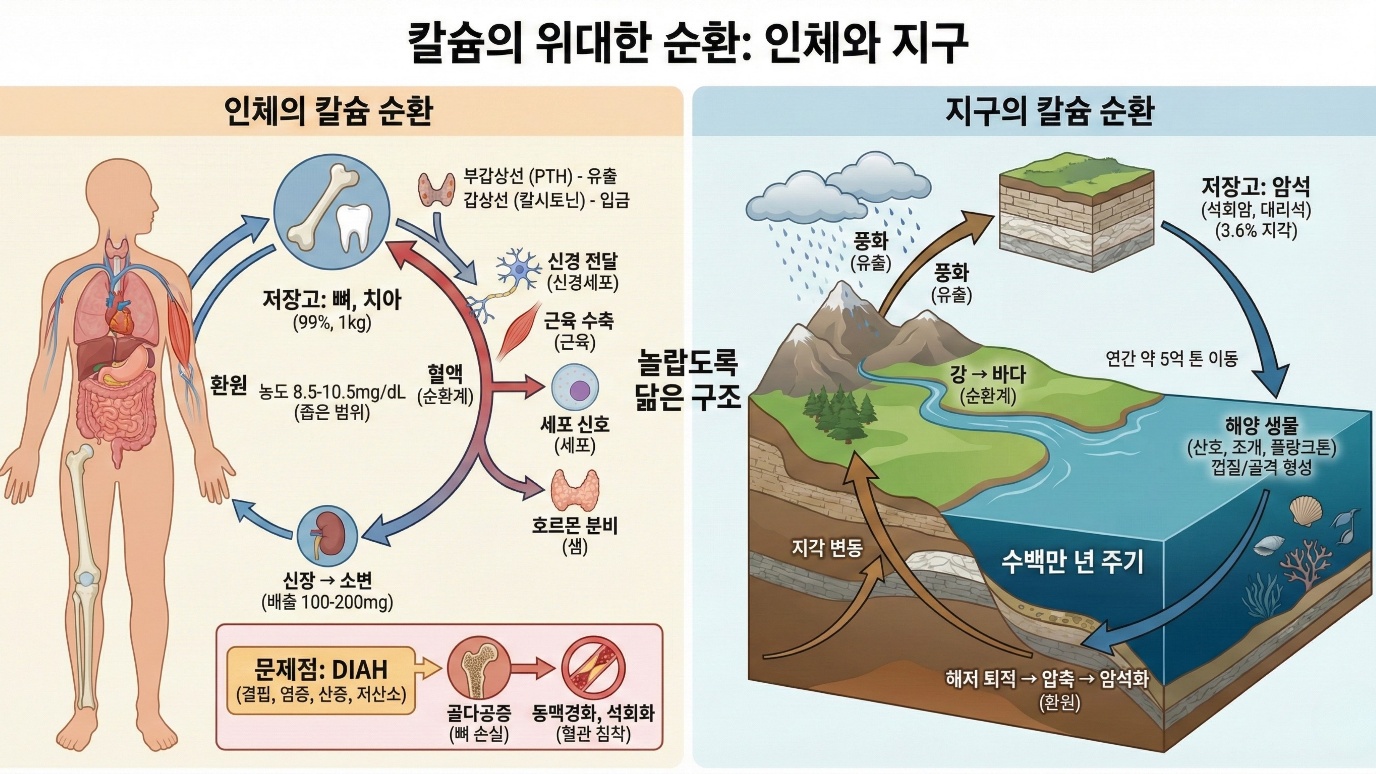
This calcium is stored mainly in the form of rock such as limestone, marble, and dolomite, and these rocks were in fact made when the shells and bones of creatures that lived in the sea hundreds of millions of years ago piled up and were pressed together. The limestone strata of the Earth are, so to speak, a vast storehouse of calcium accumulated over hundreds of millions of years.
The calcium within this rock is not trapped forever; it leaks out little by little through a process called weathering. When rain falls, the rainwater absorbs carbon dioxide from the atmosphere and becomes weak carbonic acid, and this acidic rain dissolves the limestone so that calcium ions dissolve out into the water. According to various geological studies, the calcium that leaks out through weathering in this way flows along the rivers to the sea, and the amount of calcium that the world's rivers carry to the sea reaches about 500 million tons per year. The calcium that flows into the sea remains dissolved in the seawater until marine creatures such as coral, shellfish, foraminifera, and calcareous plankton use it to make shells and skeletons. When these creatures die, their shells and bones sink to the bottom of the sea and form a sedimentary layer, and as they are compressed over millions of years they become limestone again. And when crustal movement raises this limestone back up to the surface, it is once again subjected to weathering and the calcium leaks out, so the cycle continues.
To summarize, the Earth's calcium cycle follows five stages: it leaks out of the storehouse called rock through the process called weathering, flows along the circulatory system called rivers and seas, is used by marine creatures, and is returned to the storehouse again through sedimentation and lithification. One turn of this cycle takes millions of years, and the amount of calcium involved is incomparably vaster than in the human body, but the structure itself is remarkably similar to the cycle that takes place in our bodies.
A Comparison of the Two Cycles
When we place the calcium cycle of the human body and the calcium cycle of the Earth side by side, the five stages correspond exactly. Just as bone plays the role of calcium storehouse in the human body, rock such as limestone plays the role of storehouse on the Earth. Just as the hormone PTH is responsible for the efflux process that draws calcium out of the bones in the human body, weathering by acidic rain is responsible for the efflux process that dissolves calcium out of the rock on the Earth. Just as blood plays the role of a circulatory system carrying calcium throughout the body in the human body, rivers and seas play the role of a circulatory system carrying calcium on the Earth. Just as cells use calcium for signal transmission, contraction, and secretion in the human body, marine creatures such as coral, shellfish, and plankton use calcium to make shells and skeletons on the Earth. And just as used calcium returns to the bones again in the human body, on the Earth the remains of creatures are deposited and become rock again, so that return takes place.
The difference in scale is of course enormous. Spatially, the human body is a little over 2 meters in size and the Earth is more than 12,700 kilometers in diameter, so there is a difference of several million times. Temporally, the calcium cycle of the human body takes place on the order of minutes to days, and bone remodeling proceeds on the order of months to years, but one turn of the Earth's calcium cycle takes millions of years.
Quantitatively, the calcium contained in the human body is about 1 kilogram, while the calcium of the whole Earth amounts to tens of trillions of times that. Yet in spite of all these differences, the pattern of the five stages of storage-efflux-circulation-use-return is itself identical.
This match is no coincidence. Life was born within the geological and chemical environment of the planet Earth, and it has evolved by using the materials and conditions that environment provides. The Earth's calcium cycle existed long before life appeared, and the first cells had to learn how to handle calcium within this cycle. And as life grew steadily more complex, it came to reproduce, in miniature, inside the body the calcium cycle that had taken place in the external environment.
It made an internal storehouse called bone, an internal sea called blood, and an internal regulatory system called hormones, so that it could keep its calcium concentration constant without being shaken by changes in the external environment. According to various evolutionary-biology research institutions, internalizing the chemical conditions of the external environment within the body in this way was one of the core strategies of the evolution of life, and the internalization of the calcium cycle can be called a representative example of it.
Life Internalized the Cycle of the Earth
Seen from this perspective, the human body is a small Earth. Just as the Earth stores calcium in rock, we store calcium in bone; just as the Earth circulates calcium through rivers and seas, we circulate calcium through blood; just as the Earth uses calcium through marine creatures, we use calcium through cells. This is not a poetic metaphor but a reflection of the actual history through which life has evolved.
Going down to a smaller scale, this pattern repeats at the level of the cell as well. Within an individual cell, calcium is confined in an internal storehouse called the endoplasmic reticulum, and when a signal comes it is released into the cytoplasm, causes various reactions, and is recovered into the endoplasmic reticulum again. The concentration of calcium inside the cell is normally kept very low, on the order of nanomoles, but when a signal comes it momentarily surges up to the order of micromoles and then falls again. These microscopic cycles gather to become the cycle at the level of tissues and organs, and that gathers to become the cycle at the level of the individual, and as individuals die and are born they connect to the cycle at the level of the ecosystem and the Earth. From the cell to the Earth, the scale differs but the same pattern repeats like a fractal.
According to various ecology and Earth-system research institutions, the recognition that life and the Earth are closely connected through material cycles in this way is already treated as important in Gaia theory and Earth-system science, and calcium, together with carbon, nitrogen, and water, is one of the key elements that mediate this connection. Only, compared to the cycles of carbon, nitrogen, and water, the calcium cycle has received relatively less attention, which, considering the decisive role calcium plays in the signal transmission and structure formation of life, can be called an imbalance. This is precisely why this book pays attention to the calcium cycle.
Evolution Takes Place upon the Cycle
In Chapter 8 we saw that death is not an end but a return, and that a cycle is essential if infinite life is to be carried on with finite resources. The match of the human-Earth calcium cycle examined in this chapter extends that discussion one step further. Life evolved upon the cycle. Upon the stage on which the Earth circulates calcium, life has used that cycle, internalized it, and refined it, growing steadily more complex.
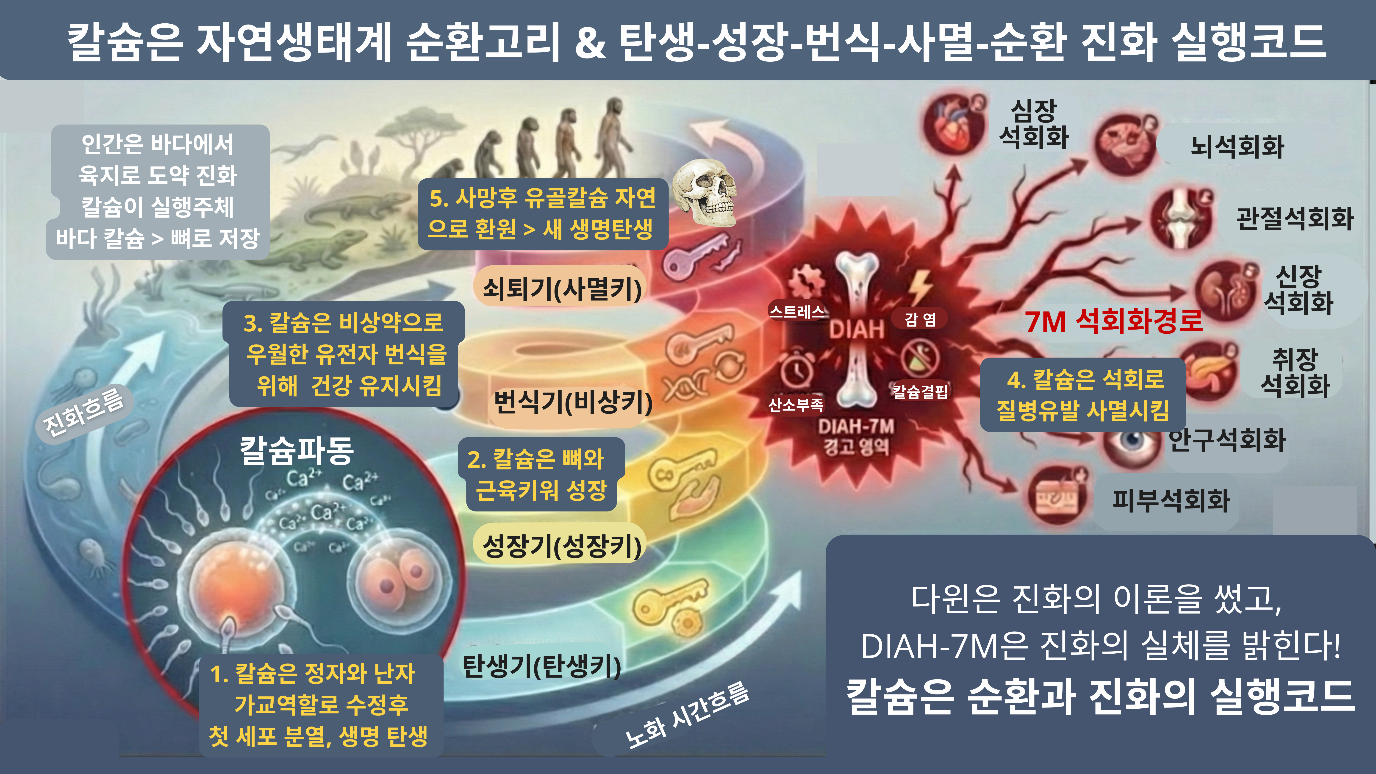
Darwin discovered natural selection. It is the principle that the individual well adapted to its environment survives and leaves descendants, and that in that process the species changes. Yet for this natural selection actually to work, there must be a cycle in which life is born, grows, reproduces, dies, and is born again. Without a cycle there are no generations, and without generations selection cannot accumulate. The natural selection Darwin discovered is a play performed upon the stage of this cycle, and the calcium cycle is the material foundation that supports that stage.
By way of analogy, DNA is the script of the play, natural selection is the audition that decides which actors will appear in the next season, and the calcium cycle is the theater building and the stage machinery. No matter how excellent the script, there can be no performance without a theater, and no matter how strict the audition, there is no place for the actors to stand without a stage. Darwin discovered the principle of the audition, and molecular biology decoded the language of the script, but the theater and the stage, that is, the material foundation of the cycle, have received relatively less attention. The calcium execution code is an attempt to fill in this missing piece.
Why Calcium of All Things
So why did calcium of all things come to take on this role? Why calcium rather than magnesium or iron, sodium or potassium? To answer this question we need to think about the conditions that a mediator of the cycle must meet.
First, it must be sufficiently abundant on Earth. No matter how good an element's properties are, if it is rare it cannot become the mediator of a cycle that sustains all of life. According to various geochemistry research institutions, calcium is the fifth most abundant element in the Earth's crust, and a considerable amount is dissolved in seawater as well, so life could easily gain access to it.
Second, it must be essential to life. If the mediator of the cycle were a substance unrelated to life, it could not mediate the cycle of life. Calcium is deeply involved in the core processes of life such as cell signal transmission, muscle contraction, nerve transmission, hormone secretion, and the formation of bone and shell, so it is in a relationship with life that cannot be severed.
Third, it must be capable of both storage and movement. For a cycle to take place, something must be stored somewhere and then be able to leak out, move, and be stored again when needed. Calcium can be stored stably in bone or rock in the form of a solid mineral such as hydroxyapatite, while at the same time it can dissolve in water in ionic form and move through blood or seawater. There are not many elements that possess this dual nature.
Fourth, it must be recyclable. The calcium atom itself does not disappear even after passing through chemical reactions; only its form changes, and it can keep circulating. An infinite cycle is possible in which calcium that was in bone leaks out, circulates in the blood, and returns to bone again; the bone of a dead creature decomposes and goes into the soil; and the calcium of the soil passes into plants, into animals, and into the bones of new life again.
Magnesium has many properties similar to calcium, but it is not as suited to making bone as calcium is. Iron is excellent at carrying oxygen, but it is not as versatile as calcium in structure formation and signal transmission. Sodium and potassium are important for nerve transmission, but they have no ability to make solid structures. Calcium is the only element that meets all four conditions, and this, various biochemistry research institutions explain, is why calcium was chosen as the mediator of the natural cycle and of evolution.
Conclusion: The Meeting of the Small Cosmos and the Great Cosmos
In this chapter we have seen that the calcium cycle of the human body and the calcium cycle of the Earth follow the same pattern, though their scales differ. The storehouses of bone and rock, the efflux mechanisms of PTH and weathering, the circulatory systems of blood and rivers/seas, the users that are cells and marine creatures, and the return processes of redeposition and sedimentation correspond exactly. This match is not a coincidence but a reflection of the evolutionary history in which life was born within the Earth's calcium cycle and internalized it.
The human body is a small Earth, and the Earth is a vast human body. From the cell to the Earth, the same cyclical pattern repeats like a fractal. Evolution took place upon the stage of this cycle, and calcium is the key material that supports that stage. In the next chapter we will look again at Darwin's theory of evolution from this perspective, examining what Darwin discovered and what he did not, and how the calcium execution code fills that empty place.
References
1. Peacock, M. (2010). Calcium metabolism in health and disease. Clinical Journal of the American Society of Nephrology, 5(Supplement 1), S23-S30. doi:10.2215/CJN.05910809
2. Berridge, M. J., Bootman, M. D., & Roderick, H. L. (2003). Calcium signalling: dynamics, homeostasis and remodelling. Nature Reviews Molecular Cell Biology, 4(7), 517-529. doi:10.1038/nrm1155
3. Berner, R. A. (2004). The Phanerozoic Carbon Cycle: CO₂ and O₂. Oxford University Press. doi:10.1093/oso/9780195173338.001.0001
4. Ridgwell, A., & Zeebe, R. E. (2005). The role of the global carbonate cycle in the regulation and evolution of the Earth system. Earth and Planetary Science Letters, 234(3-4), 299-315. doi:10.1016/j.epsl.2005.03.006
5. Milliman, J. D., & Droxler, A. W. (1996). Neritic and pelagic carbonate sedimentation in the marine environment: ignorance is not bliss. Geologische Rundschau, 85(3), 496-504. doi:10.1007/BF02369004
6. Lenton, T. M., & Watson, A. J. (2011). Revolutions that Made the Earth. Oxford University Press. doi:10.1093/acprof:oso/9780199587049.001.0001
7. Carafoli, E., & Krebs, J. (2016). Why Calcium? How Calcium Became the Best Communicator. Journal of Biological Chemistry, 291(40), 20849-20857. doi:10.1074/jbc.R116.735894
8. Case, R. M., et al. (2007). Evolution of calcium homeostasis: from birth of the first cell to an omnipresent signalling system. Cell Calcium, 42(4-5), 319-330. doi:10.1016/j.ceca.2007.02.001
9. Schlesinger, W. H., & Bernhardt, E. S. (2013). Biogeochemistry: An Analysis of Global Change (3rd ed.). Academic Press. doi:10.1016/C2010-0-66291-2
10. Falkowski, P. G., et al. (2008). The microbial engines that drive Earth's biogeochemical cycles. Science, 320(5879), 1034-1039. doi:10.1126/science.1153213